Page 368 of 457

NFront & Rear Suspension Ball Joints........385
NSteering Shaft Seal....................385
NSteering Linkage......................386
NDrive Shaft Universal Joints..............386
NBody Lubrication.....................386
NWindshield Wiper Blades................387
NWindshield And Rear Window Washers.....387
NExhaust System......................388
NCooling System.......................389
NHoses And Vacuum/Vapor Harnesses.......394
NBrakes.............................394
NMaster Cylinder Ð Brake Fluid Level Check . . 396
NFuel System Hoses....................397NAutomatic Transmission................398
NAll Wheel Drive (AWD) Ð If Equipped.....400
NFront And Rear Wheel Bearings...........401
NAppearance Care And Protection From
Corrosion...........................401
NCleaning The Center Console Cup Holders . . . 406
mFuses (Integrated Power Module)...........407
mVehicle Storage........................410
mReplacement Light Bulbs.................411
mBulb Replacement......................412
NHeadlights..........................412
NHigh Intensity Discharge Headlights (HID) Ð
If Equipped.........................413
368 MAINTAINING YOUR VEHICLE
Page 372 of 457

ONBOARD DIAGNOSTIC SYSTEM Ð OBD II
Your vehicle is equipped with a sophisticated onboard
diagnostic system called OBD II. This system monitors
the performance of the emissions, engine, and automatic
transmission control systems. When these systems are
operating properly, your vehicle will provide excellent
performance and fuel economy, as well as engine emis-
sions well within current government regulations.
If any of these systems require service, the OBD II system
will turn on the ªMalfunction Indicator Light.º It will
also store diagnostic codes and other information to
assist your service technician in making repairs. Al-
though your vehicle will usually be drivable and not
need towing, see your dealer for service as soon as
possible.CAUTION!
²Prolonged driving with the ªMalfunction Indica-
tor Lightº on could cause further damage to the
emission control system. It could also affect fuel
economy and driveability. The vehicle must be
serviced before any emissions tests can be per-
formed.
²If the ªMalfunction Indicator Lightº is flashing
while the engine is running, severe catalytic con-
verter damage and power loss will soon occur.
Immediate service is required.
372 MAINTAINING YOUR VEHICLE
Page 373 of 457

Loose Fuel Filler Cap Message
Should the ªLoose Fuel Filler Capº or ªgASCAPº mes-
sage appear, there may be a problem in the evaporative
system. Before taking the vehicle into a qualified Dealer-
ship Service center, check first to see if the fuel filler cap
is possibly loose, improperly installed, or damaged. A
loose fuel filler cap message will be displayed in the
instrument cluster. Tighten the gas cap until a9clicking9
sound is heard. This is an indication that the gas cap is
properly tightened. Press the odometer reset button to
turn the message off. If the problem persists, the message
will appear the next time the vehicle is started. If the
problem is detected twice in a row, the system will turn
on the Malfunction Indicator Light (MIL). Resolving the
problem will turn the MIL light off. Take your vehicle in
to a qualified Dealership Service center.
EMISSIONS INSPECTION AND MAINTENANCE
PROGRAMS
In some localities, it may be a legal requirement to pass
an inspection of your vehicle's emissions control system.
Failure to pass could prevent vehicle registration.
For states, which have an I/M (Inspection and
Maintenance) requirement, this check verifies the
following: the MIL (Malfunction Indicator Light)
is functioning and is not on when the engine is running,
and that the OBD (On Board Diagnostic) system is ready
for testing.
Normally, the OBD system will be ready. The OBD
system maynotbe ready if your vehicle was recently
serviced, if you recently had a dead battery, or a battery
replacement. If the OBD system should be determined
not ready for the I/M test, your vehicle may fail the test.
MAINTAINING YOUR VEHICLE 373
7
Page 376 of 457

MAINTENANCE PROCEDURES
The pages that follow contain therequiredmaintenance
services determined by the engineers who designed your
vehicle.
Besides the maintenance items for which there are fixed
maintenance intervals, there are other items that should
operate satisfactorily without periodic maintenance.
However, if a malfunction of these items does occur, it
could adversely affect the engine or vehicle performance.
These items should be inspected if a malfunction is
observed or suspected.
Engine Oil
Checking Oil Level
To assure proper engine lubrication, the engine oil must
be maintained at the correct level. Check the oil level at
regular intervals, such as every fuel stop.The best time to check the engine oil level is about 5
minutes after a fully warmed engine is shut off. Do not
check oil level before starting the engine after it has sat
overnight. Checking engine oil level when the engine is
cold will give you an incorrect reading.
Checking the oil while the vehicle is on level ground will
improve the accuracy of the oil level readings. Maintain
the oil level between the MIN and MAX markings on the
dipstick. Adding one quart of oil when the reading is at
the MIN mark will result in a MAX reading on these
engines.
376 MAINTAINING YOUR VEHICLE
Page 378 of 457

American Petroleum Institute (API) Engine Oil
Identification Symbol
This symbol means that the oil has
been certified by the American
Petroleum Institute (API). The
manufacturer only recommends
API Certified engine oils.
Engine Oil Viscosity (SAE Grade) Ð 4.0 Liter
Engines
SAE 10W-30engine oil is preferred for all operating
temperatures. The engine oil filler cap also shows the
recommended engine oil viscosity for your vehicle.
Lubricants which do not have both, the engine oil certi-
fication mark and the correct SAE viscosity grade num-
ber should not be used.
Engine Oil Viscosity (SAE Grade) Ð 3.8 Liter
Engines
SAE 5W-20 engine oil is recommended for all operating
temperatures. This engine oil improves low temperature
starting and vehicle fuel economy. Your engine oil filler
cap also shows the recommended engine oil viscosity for
your vehicle.
For information on engine oil filler cap location, refer to
the Engine Compartment illustration in this section.
Lubricants which do not have both, the engine oil certi-
fication mark and the correct SAE viscosity grade num-
ber should not be used.
Synthetic Engine Oils
You may use synthetic engine oils provided the recom-
mended oil quality requirements are met, and the recom-
mended maintenance intervals for oil and filter changes
are followed.
378 MAINTAINING YOUR VEHICLE
Page 380 of 457

plug. Malfunctioning spark plugs can damage the cata-
lytic converter. For proper type of replacement spark
plugs, refer to the ªVehicle Emission Control Informa-
tionº label in the engine compartment.
Engine Air Cleaner Filter
Refer to the ªMaintenance Scheduleº in Section 8 of this
manual for engine air cleaner filter maintenance inter-
vals.
NOTE:Be sure to follow the ªdusty or off-road condi-
tionsº maintenance interval if applicable.
WARNING!
The air induction system (air cleaner, hoses, etc.) can
provide a measure of protection in the case of engine
backfire. Do not remove the air induction system (air
cleaner, hoses, etc.) unless such removal is necessary
for repair or maintenance. Make sure that no one is
near the engine compartment before starting the
vehicle with the air induction system (air cleaner,
hoses, etc.) removed. Failure to do so can result in
serious personal injury.
Catalytic Converter
The catalytic converter requires the use of unleaded fuel
only. Leaded gasoline will destroy the effectiveness of the
catalyst as an emission control device.
380 MAINTAINING YOUR VEHICLE
Page 397 of 457

WARNING!
²Overfilling the brake fluid reservoir can result in
spilling brake fluid on hot engine parts and the
brake fluid catching fire.
²Use of brake fluid that may have a lower initial
boiling point or unidentified as to specification,
may result in sudden brake failure during hard
prolonged braking. You could have an accident.
Use only brake fluid that has been in a tightly closed
container to avoid contamination from foreign matter or
moisture.
CAUTION!
Do not allow petroleum base fluid to contaminate the
brake fluid, all brake seal components could be
damaged causing partial or complete brake failure.
Fuel System Hoses
Electronic Fuel Injection high pressure fuel systems are
designed with hoses and quick connect fittings which
have unique material characteristics to provide adequate
sealing and resist attack by deteriorated gasoline.
You are urged to use only the manufacture specified
hoses with quick connect fittings, or their equivalent in
material and specification, in any fuel system servicing. It
is mandatory to replace any damaged hoses or quick
connect fittings that have been removed during service.
MAINTAINING YOUR VEHICLE 397
7
Page 409 of 457
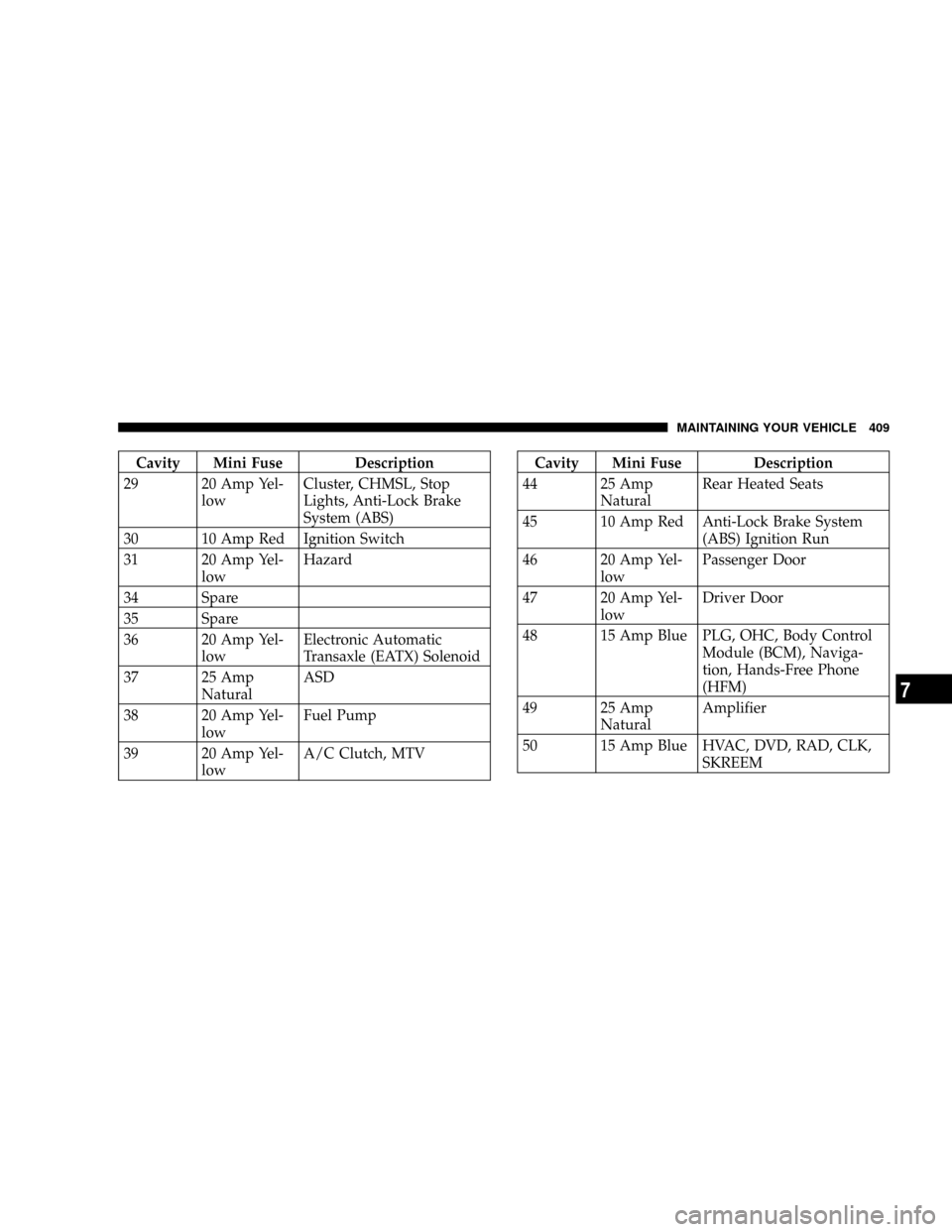
Cavity Mini Fuse Description
29 20 Amp Yel-
lowCluster, CHMSL, Stop
Lights, Anti-Lock Brake
System (ABS)
30 10 Amp Red Ignition Switch
31 20 Amp Yel-
lowHazard
34 Spare
35 Spare
36 20 Amp Yel-
lowElectronic Automatic
Transaxle (EATX) Solenoid
37 25 Amp
NaturalASD
38 20 Amp Yel-
lowFuel Pump
39 20 Amp Yel-
lowA/C Clutch, MTVCavity Mini Fuse Description
44 25 Amp
NaturalRear Heated Seats
45 10 Amp Red Anti-Lock Brake System
(ABS) Ignition Run
46 20 Amp Yel-
lowPassenger Door
47 20 Amp Yel-
lowDriver Door
48 15 Amp Blue PLG, OHC, Body Control
Module (BCM), Naviga-
tion, Hands-Free Phone
(HFM)
49 25 Amp
NaturalAmplifier
50 15 Amp Blue HVAC, DVD, RAD, CLK,
SKREEM
MAINTAINING YOUR VEHICLE 409
7