Page 251 of 358

vehicle is immediately lowered. To cancel the alarm,
insert the key in the ignition switch or press the TRANS-
MIT button on the key fob.
To prevent triggering the tow-away alarm feature, press
the tow-away alarm switch to turn off the tow-away
alarm before towing the vehicle, or when parking on a
surface subject to movement, such as a ferry or auto train.To do so, turn the key in the ignition switch to the
OFF/LOCK or ACC positions, or remove key from the
ignition switch. Press the upper half of the tow-away
alarm switch. The indicator light will illuminate briefly.
Then, exit the vehicle and lock with a key or the remote
control. The tow-away alarm remains switched off until
the vehicle is locked again with a key or the remote
control, at which time it is automatically reactivated.
CONVERTIBLE TOP EMERGENCY OPERATION
If the convertible top cannot be closed using the convert-
ible top switch, check the following:
²Is the decklid closed properly?
²Is there sufficient battery voltage? Start the engine if
necessary.
²Is the rear cargo compartment divider secured in the
vertical position?
WHAT TO DO IN EMERGENCIES 249
6
Page 259 of 358
MAINTAINING YOUR VEHICLE
CONTENTS
m3.2L Engine...........................260
mOnboard Diagnostic System (OBD II).........261
mEmissions Inspection And Maintenance
Programs............................262
mReplacement Parts......................263
mAuthorized Dealer Service................263
mMaintenance Procedures..................264
NEngine Oil..........................264
NIgnition Wiring System.................271NCrankcase Emission Control System........271
NMaintenance-Free Battery................271
NAir Conditioner......................273
NPower Steering Fluid...................274
NChassis Lubrication....................275
NBody Lubrication.....................276
NWindshield Wiper Blades................276
NWindshield Wiper Blade Replacement.......277
NWindshield Washer Reservoir.............278
7
Page 264 of 358

EMISSIONS INSPECTION AND MAINTENANCE
PROGRAMS
In some localities, it may be a legal requirement to pass
an inspection of your vehicle's emissions control system.
Failure to pass could prevent vehicle registration.
For states which have an I/M (Inspection and
Maintenance) requirement, this check verifies
the following: the CHECK ENGINE Light is functioning
and is not on when the engine is running, and that the
Onboard Diagnostic system (OBD II) is ready for testing.
Normally, the OBD II system will be ready. The OBD II
system maynotbe ready if your vehicle was recently
serviced, if you recently had a dead battery, or a battery
replacement. If the OBD II system should be determined
not ready for the I/M test, your vehicle may fail the test.Your vehicle has a simple ignition key actuated test
which you can use prior to going to the test station. To
check if your vehicle's OBD II system is ready, you must
do the following:
1. Insert your ignition key into the ignition switch.
2. Turn the ignition to the ON/RUN position, but do not
crank or start the engine.
3. If you crank or start the engine, you will have to start
this test over.
4. As soon as you turn your key to the ON/RUN
position, you will see your CHECK ENGINE light come
on as part of a normal bulb check.
5. Approximately 15 seconds later, one of two things will
happen:
a. The CHECK ENGINE light will flash for about 10
seconds and then return to being fully illuminated
262 MAINTAINING YOUR VEHICLE
Page 265 of 358

until you turn OFF the ignition key or start the engine.
This means that your vehicle's OBD II system isnot
readyand you shouldnotproceed to the I/M station.
b. The CHECK ENGINE light will not flash at all and
will remain fully illuminated until you turn off the
ignition key or start the engine. This means that your
vehicle's OBD II system isreadyand you can proceed
to the I/M station.
If your OBD II system isnot ready,you should see your
authorized dealer or repair facility. If your vehicle was
recently serviced or had a battery failure or replacement,
you may need to do nothing more than drive your
vehicle as you normally would in order for your OBD II
system to update. A recheck with the above test routine
may then indicate that the system is now ready.
Regardless of whether your vehicle's OBD II system is
ready or not ready, if the CHECK ENGINE light is
illuminated during normal vehicle operation, you shouldhave your vehicle serviced before going to the I/M
station. The I/M station can fail your vehicle because the
CHECK ENGINE light is on with the engine running.
REPLACEMENT PARTS
Use of genuine Mopartparts for normal/scheduled
maintenance and repairs is highly recommended to en-
sure the designed performance. Damage or failures
caused by the use of non-Mopartparts for maintenance
and repairs will not be covered by the warranty offered
by DaimlerChrysler Corporation.
AUTHORIZED DEALER SERVICE
Your authorized dealer has the qualified service person-
nel, special tools and equipment to perform all service
operations in an expert manner. Service Manuals are
available which include detailed service information for
your vehicle. Refer to these manuals before attempting
any procedure yourself.
MAINTAINING YOUR VEHICLE 263
7
Page 273 of 358
To minimize the possibility of catalyst damage:
²Do not shut off the engine or interrupt the ignition
when the transmission is in gear and the vehicle is in
motion.
²Do not try to start the engine by pushing or towing the
vehicle.
²Do not idle the engine with any spark plug wires
disconnected for a prolonged period.
Ignition Wiring System
The ignition cables should be kept clean and properly
connected. Terminals should be fully seated. Cracked,
damaged, or faulty cables should be replaced.
Crankcase Emission Control System
Proper operation of this system depends on freedom
from sticking or plugging due to deposits.
Check the ventilation hose for indication of damage or
plugging deposits. Replace if necessary.
Maintenance-Free Battery
The top of the maintenance-free battery is permanently
sealed. You will never have to add water, nor is periodic
maintenance required.
MAINTAINING YOUR VEHICLE 271
7
Page 274 of 358
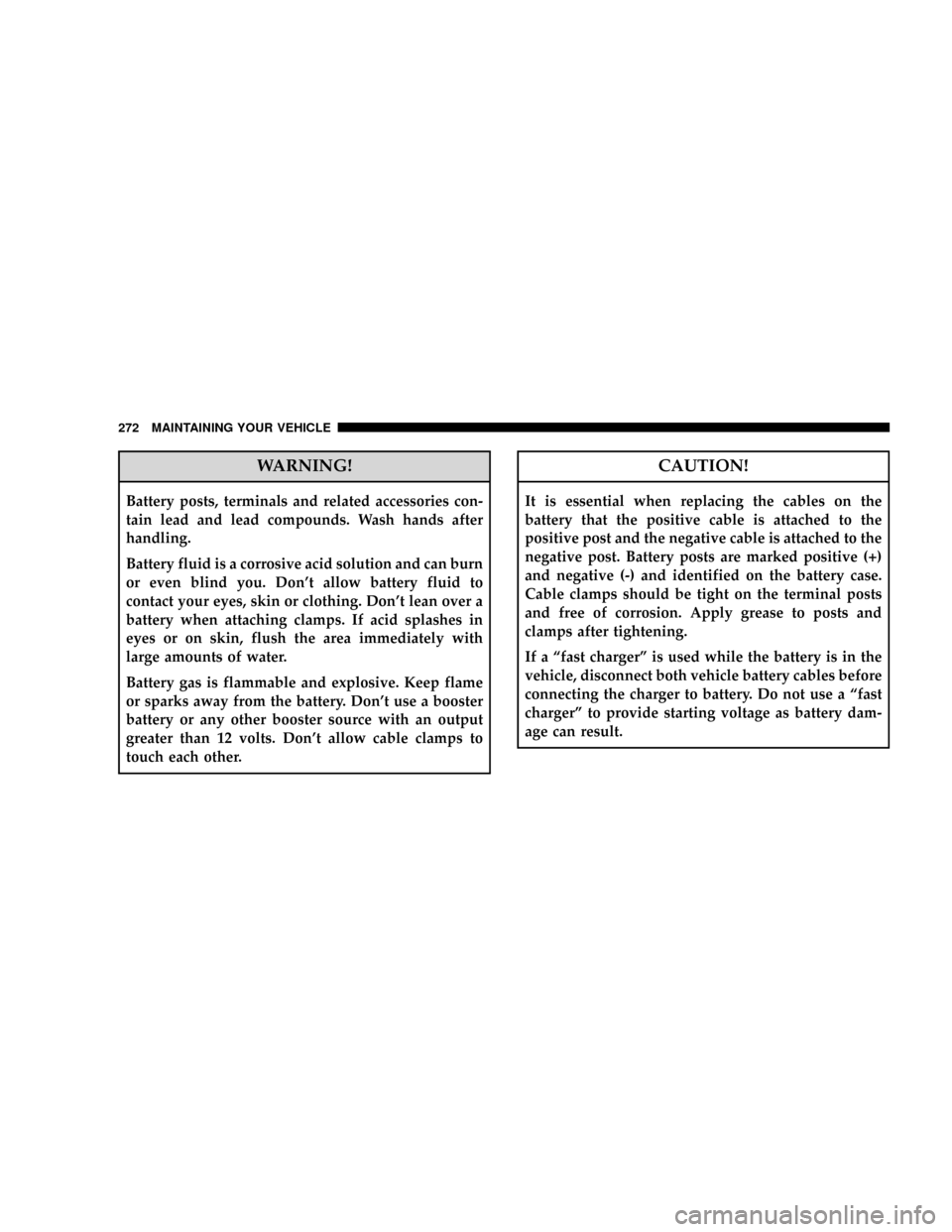
WARNING!
Battery posts, terminals and related accessories con-
tain lead and lead compounds. Wash hands after
handling.
Battery fluid is a corrosive acid solution and can burn
or even blind you. Don't allow battery fluid to
contact your eyes, skin or clothing. Don't lean over a
battery when attaching clamps. If acid splashes in
eyes or on skin, flush the area immediately with
large amounts of water.
Battery gas is flammable and explosive. Keep flame
or sparks away from the battery. Don't use a booster
battery or any other booster source with an output
greater than 12 volts. Don't allow cable clamps to
touch each other.
CAUTION!
It is essential when replacing the cables on the
battery that the positive cable is attached to the
positive post and the negative cable is attached to the
negative post. Battery posts are marked positive (+)
and negative (-) and identified on the battery case.
Cable clamps should be tight on the terminal posts
and free of corrosion. Apply grease to posts and
clamps after tightening.
If a ªfast chargerº is used while the battery is in the
vehicle, disconnect both vehicle battery cables before
connecting the charger to battery. Do not use a ªfast
chargerº to provide starting voltage as battery dam-
age can result.
272 MAINTAINING YOUR VEHICLE
Page 304 of 358
Relay Control Module FusesThe relay control module fuses are located in the Control
Module Box next to the battery in the engine compart-
ment. Slide the control module box cover retaining clips
forward and lift the cover from the control module box to
gain access to the relay control module fuses.
302 MAINTAINING YOUR VEHICLE
Page 313 of 358

VEHICLE STORAGE
We recommend that you follow these guidelines before
storing your vehicle for extended periods.
²Fill the gas tank. This will prevent water condensation
inside the tank. If you plan on storing your vehicle
more than two months, add an anti-oxidant fuel
stabilizer to the gas tank.
²Change the oil to remove any corrosive combustion-
related acids in the crankcase.
²Wash and wax the vehicle to protect the finish.
²Cover the vehicle whenever possible to prevent acci-
dental damage to the finish.
²Store the vehicle in a dry, well-ventilated location.
²If the vehicle will be subjected to freezing tempera-
tures, remove the battery and store it in a dry, well-
ventilated place. If the vehicle is not going to be driven
in the next three weeks, follow the battery recharge
procedure in the Service Manual, then disconnect the
battery at the negative terminal.
CAUTION!
Use care when disconnecting the remote positive
cable. It is connected to the battery and can short out
to any metal on the vehicle. Always tape or wrap the
exposed cable end to prevent electrical shorts.
Disconnecting the battery causes the engine control sys-
tem to lose memory of some ªlearnedº functions. The
engine may run rough when first started after a battery
disconnect until the control module ªrelearnsº these
functions.
MAINTAINING YOUR VEHICLE 311
7


