Page 171 of 358
NOTE:Due to the starter non-repeat feature, the key
must be turned completely to the left before attempting
to start the engine again.Extremely Cold Weather (below -20ÉF or -29ÉC)
For reliable starting in areas where temperatures fre-
quently drop below -20ÉF (-29ÉC), we recommend the use
of an externally powered battery and an electric engine
block heater. Advice on these items and installation is
available at your authorized dealer.
If Engine Fails to Start
CAUTION!
Do not try to push or tow your vehicle to get it
started. Your vehicle cannot be started this way.
Pushing with another vehicle may damage the trans-
mission or the rear of your vehicle. See Section 6 of
this manual for proper jump-starting procedures.
STARTING AND OPERATING 169
5
Page 193 of 358

Synchronizing ESP
If the power supply was interrupted (battery discon-
nected or discharged), the BAS/ESP malfunction indica-
tor light may be illuminated with the engine running. To
re-synchronize the ESP, and cancel the malfunction indi-
cator light, the steering angle sensor will need to be
recalibrated.
1. Turn the ignition switch to the ON/RUN position.
2. Rotate the steering wheel to the center position.
3. Rotate the steering wheel completely to the left, and
then rotate the steering wheel completely to the right.
4. Bring the steering wheel back to the center position.
5. The BAS/ESP malfunction indicator light will go out.
If the BAS/ESP malfunction indicator light is still illumi-
nated, the vehicle should be serviced at an authorized
dealer.
ESP Control switch
The ESP control switch is located in the center console.
When the ESP is switched off, the warning light in the
instrument cluster comes on. When the ESP is switched
on, the warning light goes out.
STARTING AND OPERATING 191
5
Page 233 of 358
WHAT TO DO IN EMERGENCIES
CONTENTS
mHazard Warning Flasher..................232
mIf Your Engine Overheats.................232
mTIREFIT Tire Repair And Jacking............234
NTIREFIT............................234
NPreparations For Jacking................237
NJack Location And Instructions............239
mJump-Starting The Battery.................241mFreeing A Stuck Vehicle..................244
mTowing A Disabled Vehicle................245
NTowing Eyes.........................247
NTow-Away Alarm.....................248
mConvertible Top Emergency Operation........249
NRelieving Hydraulic Pressure.............250
NOpening a Locked Decklid...............256
6
Page 234 of 358
HAZARD WARNING FLASHER
The flasher switch is located in the console. Push in
the flasher switch and all front and rear directional
signals will flash. Press the flasher switch a second
time to turn the flashers off.Do not use this emergency warning system when the
vehicle is in motion. Use it when your vehicle is disabled
and is creating a safety hazard for other motorists.
If it is necessary to leave the vehicle to go for service, the
flasher system will continue to operate with the ignition
key removed and the vehicle locked.
NOTE:With extended use, the flasher may run down
your battery.
IF YOUR ENGINE OVERHEATS
During severe operating conditions and stop-and-go city
traffic, the coolant temperature may rise close to the red
area on the gauge.
The engine should not be operated with the coolant
temperature in the red area. Doing so may cause serious
damage which is not covered by the DaimlerChrysler
Limited Warranty.
232 WHAT TO DO IN EMERGENCIES
Page 243 of 358
parked on an incline. Raise the vehicle only until the tire
just clears the surface. Minimum tire lift provides maxi-
mum stability.
4. Replace the tire.
5. Lower the vehicle by cranking the handle counter-
clockwise, then remove the jack assembly.
NOTE:Before storing the jack, it should be fully col-
lapsed.
6. Ensure proper tire pressure.
WARNING!
Raising the vehicle higher than necessary can make
the vehicle less stable. It could slip off the jack and
hurt someone near it. Raise the vehicle only enough
to make the necessary repair.
WARNING!
A loose jack or tool thrown forward in a collision or
hard stop could endanger the occupants of the ve-
hicle. Always stow the jack parts and tools in the
places provided.
JUMP-STARTING THE BATTERY
WARNING!
Take care to avoid the radiator cooling fan whenever
the hood is raised. It can start any time the ignition
switch is ON. You can be hurt by the fan.
WHAT TO DO IN EMERGENCIES 241
6
Page 244 of 358
CAUTION!
Do not try to push or tow your vehicle to get it
started. Your vehicle cannot be started this way.
Pushing with another vehicle may damage the trans-
mission or the rear of your vehicle. If your vehicle
has a discharged (dead) battery, booster cables may
be used to obtain a start from another vehicle. This
type of start can be dangerous if done improperly, so
follow the procedure carefully.
WARNING!
Battery fluid is a corrosive acid solution; do not allow
battery fluid to contact eyes, skin or clothing. Don't
lean over battery when attaching clamps or allow the
clamps to touch each other. If acid splashes in eyes or
on skin, flush contaminated area immediately with
large quantities of water.
A battery generates hydrogen gas that is flammable
and explosive. Keep flame or spark away from the
vent holes. Do not use a booster battery or any other
booster source with an output that exceeds 12 volts.
242 WHAT TO DO IN EMERGENCIES
Page 245 of 358
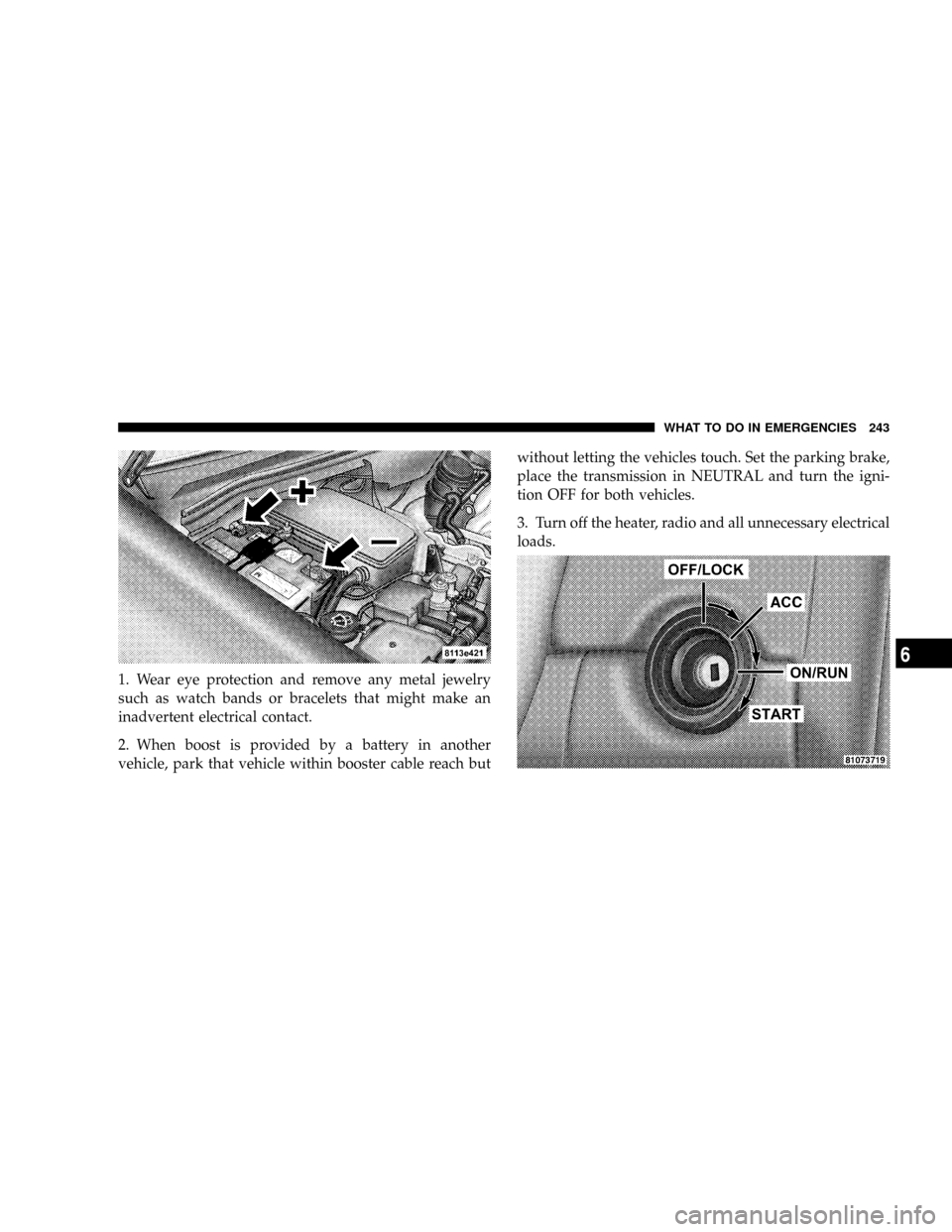
1. Wear eye protection and remove any metal jewelry
such as watch bands or bracelets that might make an
inadvertent electrical contact.
2. When boost is provided by a battery in another
vehicle, park that vehicle within booster cable reach butwithout letting the vehicles touch. Set the parking brake,
place the transmission in NEUTRAL and turn the igni-
tion OFF for both vehicles.
3. Turn off the heater, radio and all unnecessary electrical
loads.
WHAT TO DO IN EMERGENCIES 243
6
Page 246 of 358

4. Connect one end of a jumper cable to the positive
jump-start attachment of the booster battery. Connect the
other end of the same cable to the positive jump-start
attachment of the discharged battery.
5. Connect the other cable, first to the negative jump-
start attachment of the booster battery and then to the
engine of the vehicle with the discharged battery. Make
sure you have good contact on the engine.
6. Start the engine in the vehicle which has the booster
battery, let the engine idle a few minutes, then start the
engine in the vehicle with the discharged battery.
7. When removing the jumper cables, reverse the above
sequence exactly. Be careful of the moving belts and fans.
NOTE:If engine does not run after several unsuccessful
starting attempts, have it checked at the nearest autho-
rized dealer.FREEING A STUCK VEHICLE
In order to free a stuck vehicle you must turn off the
Electronic Stability Program (ESP) before attempting to
ªrockº the vehicle.
If your vehicle becomes stuck in mud, sand or snow, it
can often be moved by a rocking motion. Turn your
steering wheel right and left to clear the area around the
front wheels. Then shift back and forth between RE-
VERSE and DRIVE. Usually the least accelerator pedal
pressure to maintain the rocking motion without spin-
ning the wheels is most effective.
NOTE:ESP should be turned on again after freeing the
vehicle from a stuck condition.
244 WHAT TO DO IN EMERGENCIES