2008 CHEVROLET SILVERADO tire pressure
[x] Cancel search: tire pressurePage 252 of 596

TIGHTEN GAS CAP
This message may display along with the check engine
light on the instrument panel cluster if the vehicle’s
fuel cap is not tightened properly. SeeMalfunction
Indicator Lamp on page 3-49. Reinstall the fuel cap fully.
SeeFilling the Tank on page 5-10. The diagnostic
system can determine if the fuel cap has been left off or
improperly installed. A loose or missing fuel cap allows
fuel to evaporate into the atmosphere. A few driving trips
with the cap properly installed should turn this light
and message off.
TIRE LEARNING ACTIVE
If your vehicle has the Tire Pressure Monitor System
(TPMS), this message displays when the system
is re-learning the tire positions on your vehicle.
See “DIC Operation and Displays (Without DIC Buttons)”
earlier in this section for more information. The tire
positions must be re-learned after rotating the tires or
after replacing a tire or sensor. SeeTire Inspection and
Rotation on page 5-83,Tire Pressure Monitor System
on page 5-78, andInflation - Tire Pressure on page 5-76
for more information.
TRACTION CONTROL OFF
If your vehicle has StabiliTrak®, this message displays
when the Traction Control System (TCS) is turned
off. Adjust your driving accordingly. SeeStabiliTrak
®
System on page 4-6for more information.
TRAILER CONNECTED
On vehicles with the Integrated Trailer Brake Control
(ITBC) system, this message displays briey when
a trailer with electric brakes is rst connected to
the vehicle.
This message clears itself after several seconds.
This message also clears if you acknowledge it.
After this message clears, the TRAILER GAIN/OUTPUT
display appears in the DIC.
See “TRAILER GAIN/OUTPUT” underDIC Operation
and Displays (With DIC Buttons) on page 3-57or
DIC Operation and Displays (Without DIC Buttons)
on page 3-63and “Integrated Trailer Brake Control
System” underTowing a Trailer on page 4-55for
more information.
3-74
Page 317 of 596
Let us say the road is wet and you are driving safely.
Suddenly, an animal jumps out in front of you. You slam
on the brakes and continue braking. Here is what
happens with ABS:
A computer senses that wheels are slowing down. If
one of the wheels is about to stop rolling, the computer
will separately work the brakes at each front wheel
and at both rear wheels.
ABS can change the brake pressure faster than any
driver could. The computer is programmed to make the
most of available tire and road conditions. This can
help you steer around the obstacle while braking hard.
As you brake, the computer keeps receiving updates on
wheel speed and controls braking pressure accordingly.
Remember: ABS does not change the time you need to
get your foot up to the brake pedal or always decrease
stopping distance. If you get too close to the vehicle
in front of you, you will not have time to apply the brakes
if that vehicle suddenly slows or stops. Always leave
enough room up ahead to stop, even though you
have ABS.Using ABS
Do not pump the brakes. Just hold the brake pedal
down rmly and let antilock work for you. You might
feel the brakes vibrate or notice some noise, but this
is normal.
Braking in Emergencies
With ABS, you can steer and brake at the same time. In
many emergencies, steering can help you more than
even the very best braking.
Locking Rear Axle
If your vehicle has this feature, your locking rear axle
can give you additional traction on snow, mud, ice, sand
or gravel. It works like a standard axle most of the
time, but when one of the rear wheels has no traction
and the other does, this feature will allow the wheel with
traction to move the vehicle.
4-5
Page 341 of 596
Other Rainy Weather Tips
Besides slowing down, other wet weather driving tips
include:
Allow extra following distance.
Pass with caution.
Keep windshield wiping equipment in good shape.
Keep the windshield washer uid reservoir lled.
Have good tires with proper tread depth. SeeTires
on page 5-68.
Before Leaving on a Long Trip
To prepare your vehicle for a long trip, consider having
it serviced by your dealer/retailer before departing.
Things to check on your own include:
Windshield Washer Fluid:Reservoir full? Windows
clean — inside and outside?
Wiper Blades:In good shape?
Fuel, Engine Oil, Other Fluids:All levels checked?
Lamps:Do they all work and are lenses clean?
Tires:Are treads good? Are tires inated to
recommended pressure?
Weather and Maps:Safe to travel? Have
up-to-date maps?
Highway Hypnosis
Always be alert and pay attention to your surroundings
while driving. If you become tired or sleepy, nd a
safe place to park your vehicle and rest.
Other driving tips include:
Keep the vehicle well ventilated.
Keep interior temperature cool.
Keep your eyes moving — scan the road ahead
and to the sides.
Check the rearview mirror and vehicle instruments
often.
4-29
Page 349 of 596
The Tire and Loading Information label also shows
the size of the original equipment tires (C) and
the recommended cold tire ination pressures (D).
For more information on tires and ination see
Tires on page 5-68andInflation - Tire Pressure on
page 5-76.
There is also important loading information on the
vehicle Certication/Tire label. It tells you the
Gross Vehicle Weight Rating (GVWR) and
the Gross Axle Weight Rating (GAWR) for the
front and rear axles. See “Certication/Tire Label”
later in this section.
Steps for Determining Correct Load Limit
1.Locate the statement “The combined weight of
occupants and cargo should never exceed
XXX kg or XXX lbs” on your vehicle’s placard.
2.Determine the combined weight of the driver
and passengers that will be riding in your
vehicle.
3.Subtract the combined weight of the driver
and passengers from XXX kg or XXX lbs.
4.The resulting gure equals the available
amount of cargo and luggage load capacity.
For example, if the “XXX” amount equals
1400 lbs and there will be ve 150 lb
passengers in your vehicle, the amount of
available cargo and luggage load capacity is
650 lbs (1400−750 (5 x 150) = 650 lbs).
5.Determine the combined weight of luggage
and cargo being loaded on the vehicle. That
weight may not safely exceed the available
cargo and luggage load capacity calculated
in Step 4.
6.If your vehicle will be towing a trailer, the load
from your trailer will be transferred to your
vehicle. Consult this manual to determine how
this reduces the available cargo and luggage
load capacity of your vehicle. SeeTowing
a Trailer on page 4-55for important
information on towing a trailer, towing safety
rules and trailering tips.
4-37
Page 351 of 596
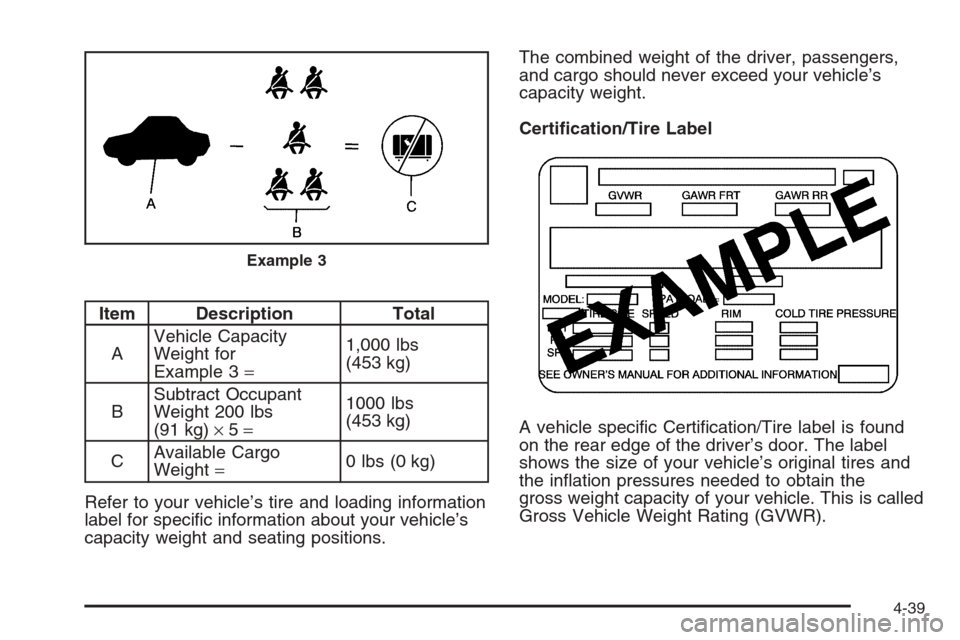
Item Description Total
AVehicle Capacity
Weight for
Example 3=1,000 lbs
(453 kg)
BSubtract Occupant
Weight 200 lbs
(91 kg)×5=1000 lbs
(453 kg)
CAvailable Cargo
Weight=0 lbs (0 kg)
Refer to your vehicle’s tire and loading information
label for specic information about your vehicle’s
capacity weight and seating positions.The combined weight of the driver, passengers,
and cargo should never exceed your vehicle’s
capacity weight.
Certication/Tire Label
A vehicle specic Certication/Tire label is found
on the rear edge of the driver’s door. The label
shows the size of your vehicle’s original tires and
the ination pressures needed to obtain the
gross weight capacity of your vehicle. This is called
Gross Vehicle Weight Rating (GVWR).
Example 3
4-39
Page 408 of 596
Bulb Replacement..........................................5-61
Halogen Bulbs..............................................5-61
Headlamps..................................................5-62
Center High-Mounted Stoplamp (CHMSL) and
Cargo Lamp.............................................5-63
Pickup Box Identication and
Fender Marker Lamps................................5-64
Taillamps, Turn Signal, Stoplamps and
Back-up Lamps.........................................5-64
License Plate Lamp......................................5-66
Replacement Bulbs.......................................5-66
Windshield Wiper Blade Replacement..............5-67
Tires..............................................................5-68
Tire Sidewall Labeling...................................5-69
Tire Terminology and Denitions.....................5-73
Ination - Tire Pressure.................................5-76
Dual Tire Operation.......................................5-77
Tire Pressure Monitor System.........................5-78
Tire Pressure Monitor Operation.....................5-79
Tire Inspection and Rotation...........................5-83
When It Is Time for New Tires.......................5-86
Buying New Tires.........................................5-86
Different Size Tires and Wheels......................5-88
Uniform Tire Quality Grading..........................5-89Wheel Alignment and Tire Balance..................5-90
Wheel Replacement......................................5-90
Tire Chains..................................................5-92
If a Tire Goes Flat........................................5-93
Changing a Flat Tire.....................................5-94
Removing the Spare Tire and Tools................5-95
Removing the Flat Tire and Installing the
Spare Tire..............................................5-100
Secondary Latch System..............................5-106
Storing a Flat or Spare Tire and Tools...........5-110
Spare Tire.................................................5-113
Appearance Care..........................................5-114
Interior Cleaning.........................................5-114
Fabric/Carpet..............................................5-115
Leather......................................................5-116
Instrument Panel, Vinyl, and Other Plastic
Surfaces.................................................5-117
Care of Safety Belts....................................5-117
Weatherstrips.............................................5-117
Washing Your Vehicle..................................5-118
Cleaning Exterior Lamps/Lenses....................5-118
Finish Care................................................5-119
Windshield and Wiper Blades.......................5-120
Aluminum or Chrome-Plated Wheels
and Trim................................................5-120
Section 5 Service and Appearance Care
5-2
Page 474 of 596
Tires
Your new vehicle comes with high-quality tires
made by a leading tire manufacturer. If you ever
have questions about your tire warranty and where
to obtain service, see your vehicle Warranty
booklet for details.
{CAUTION:
Poorly maintained and improperly used
tires are dangerous.
Overloading your vehicle’s tires can
cause overheating as a result of too
much exing. You could have an air-out
and a serious accident. SeeLoading
Your Vehicle on page 4-36.
Underinated tires pose the same
danger as overloaded tires. The
resulting accident could cause serious
injury. Check all tires frequently to
maintain the recommended pressure.
Tire pressure should be checked when
your vehicle’s tires are cold. See
Inflation - Tire Pressure on page 5-76.
CAUTION: (Continued)
CAUTION: (Continued)
Overinated tires are more likely to
be cut, punctured, or broken by a
sudden impact — such as when you
hit a pothole. Keep tires at the
recommended pressure.
Worn, old tires can cause accidents.
If the tire’s tread is badly worn,
or if your vehicle’s tires have been
damaged, replace them.
20-Inch Tires
If your vehicle has the optional 20-inch
P275/55R20 size tires, they are classied as
touring tires and are designed for on road use.
The low-prole, wide tread design is not
recommended for “off-road” driving or commercial
uses such as snow plowing. SeeOff-Road
Driving on page 4-12andAdding a Snow Plow or
Similar Equipment on page 4-43for additional
information.
5-68
Page 476 of 596
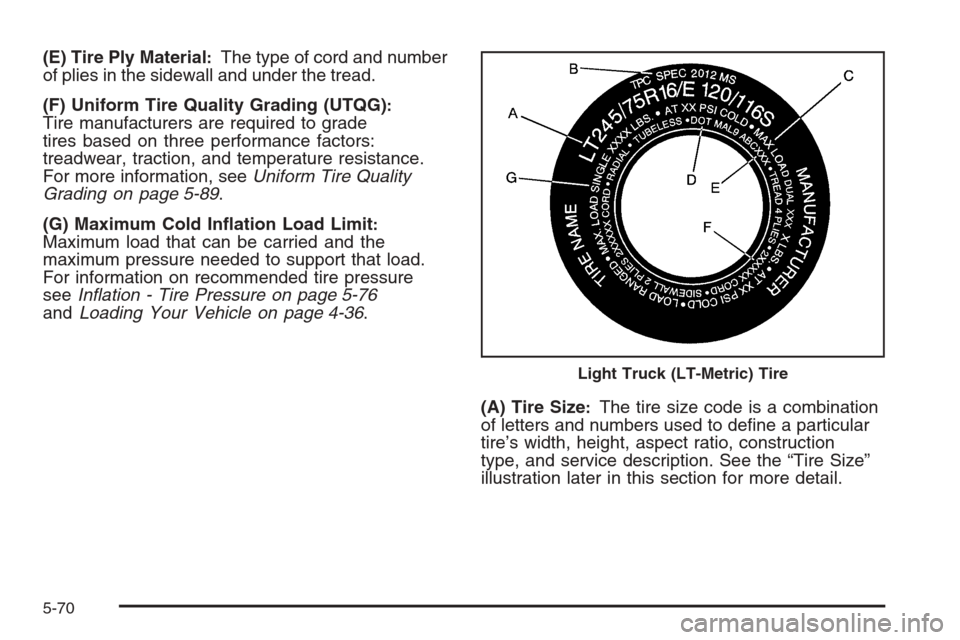
(E) Tire Ply Material:The type of cord and number
of plies in the sidewall and under the tread.
(F) Uniform Tire Quality Grading (UTQG)
:Tire manufacturers are required to grade
tires based on three performance factors:
treadwear, traction, and temperature resistance.
For more information, seeUniform Tire Quality
Grading on page 5-89.
(G) Maximum Cold Ination Load Limit
:Maximum load that can be carried and the
maximum pressure needed to support that load.
For information on recommended tire pressure
seeInflation - Tire Pressure on page 5-76
andLoading Your Vehicle on page 4-36.
(A) Tire Size
:The tire size code is a combination
of letters and numbers used to dene a particular
tire’s width, height, aspect ratio, construction
type, and service description. See the “Tire Size”
illustration later in this section for more detail.
Light Truck (LT-Metric) Tire
5-70