2008 CHEVROLET IMPALA charging
[x] Cancel search: chargingPage 107 of 400
The shift lock is always functional except in the case of a
an uncharged or low voltage (less than 9 volt) battery.
If your vehicle has an uncharged battery or a battery
with low voltage, try charging or jump starting the
battery. SeeJump Starting on page 5-43.
Console Shift
If your console shift cannot be moved out of PARK (P)
1. Apply and maintain the regular brakes.
2. Turn the ignition to ON/RUN position. SeeIgnition
Positions on page 2-22for more information.
3. Let up on the shift lever and make sure the shift
lever is pushed all the way into PARK (P).
4. Press the shift lever button
5. Then, move the shift into the desired gear.
If you still cannot move the shift lever from PARK (P),
consult your dealer or a professional towing service.
Column Shift
If your park lock cable cannot be moved out of PARK (P)
1. Apply and maintain the regular brakes.
2. Turn the ignition key to the ON/RUN position. See
Ignition Positions on page 2-22for more information.
3. Shift out of the PARK (P) position to the
NEUTRAL (N) position.
4. Move the vehicle to a safe location.
If you still cannot move the shift lever from PARK (P),
consult your dealer or a professional towing service.
Parking Over Things That Burn
{CAUTION:
Things that can burn could touch hot exhaust
parts under your vehicle and ignite. Do not
park over papers, leaves, dry grass, or other
things that can burn.
2-33
Page 125 of 400

Instrument Panel Overview...............................3-4
Hazard Warning Flashers................................3-6
Other Warning Devices...................................3-6
Horn.............................................................3-6
Tilt Wheel.....................................................3-6
Turn Signal/Multifunction Lever.........................3-7
Turn and Lane-Change Signals........................3-8
Headlamp High/Low-Beam Changer...................3-8
Flash-to-Pass.................................................3-9
Windshield Wipers..........................................3-9
Windshield Washer.......................................3-10
Cruise Control..............................................3-10
Exterior Lamps.............................................3-14
Delayed Headlamps......................................3-15
Daytime Running Lamps (DRL)/
Automatic Headlamp System.......................3-16
Fog Lamps..................................................3-16
Instrument Panel Brightness...........................3-17
Courtesy Lamps...........................................3-17
Dome Lamp.................................................3-17
Entry Lighting...............................................3-17Delayed Entry Lighting...................................3-18
Delayed Exit Lighting.....................................3-18
Parade Dimming...........................................3-18
Reading Lamps............................................3-19
Mirror Reading Lamps...................................3-19
Electric Power Management...........................3-19
Battery Run-Down Protection..........................3-20
Accessory Power Outlet(s).............................3-20
Ashtray(s) and Cigarette Lighter......................3-21
Climate Controls............................................3-22
Climate Control System.................................3-22
Outlet Adjustment.........................................3-25
Passenger Compartment Air Filter...................3-26
Warning Lights, Gages, and Indicators
............3-27
Instrument Panel Cluster................................3-28
Speedometer and Odometer...........................3-29
Tachometer.................................................3-29
Safety Belt Reminders...................................3-30
Airbag Readiness Light..................................3-31
Passenger Airbag Status Indicator...................3-32
Charging System Light..................................3-34
Section 3 Instrument Panel
3-1
Page 143 of 400
Reading Lamps
The vehicle has reading lamps that also act as the
dome lamp. Press the button to turn them on and off.
Mirror Reading Lamps
Your vehicle has reading lamps on the rearview mirror.
Push the button to turn the reading lamps on and off.
Electric Power Management
The vehicle has Electric Power Management (EPM)
that estimates the battery’s temperature and state
of charge. It then adjusts the voltage for best
performance and extended life of the battery.
When the battery’s state of charge is low, the voltage is
raised slightly to quickly put the charge back in. When
the state of charge is high, the voltage is lowered slightly
to prevent overcharging. If the vehicle has a voltmeter
gage or a voltage display on the Driver Information
Center (DIC), you may see the voltage move up or
down. This is normal. If there is a problem, an alert
will be displayed.The battery can be discharged at idle if the electrical
loads are very high. This is true for all vehicles.
This is because the generator (alternator) may not be
spinning fast enough at idle to produce all the power that
is needed for very high electrical loads.
A high electrical load occurs when several of the
following loads are on: headlamps, high beams, fog
lamps, rear window defogger, climate control fan at
high speed, heated seats, engine cooling fans, trailer
loads, and loads plugged into accessory power outlets.
EPM works to prevent excessive discharge of the
battery. It does this by balancing the generator’s output
and the vehicle’s electrical needs. It can increase
engine idle speed to generate more power, whenever
needed. It can temporarily reduce the power demands of
some accessories.
Normally, these actions occur in steps or levels, without
being noticeable. In rare cases at the highest levels of
corrective action, this action may be noticeable to the
driver. If so, a Driver Information Center (DIC) message
might be displayed, such as Battery Saver Active or
Service Battery Charging System. If this message is
displayed, it is recommended that the driver reduce the
electrical loads as much as possible. SeeDIC Warnings
and Messages on page 3-52.
3-19
Page 158 of 400
Charging System Light
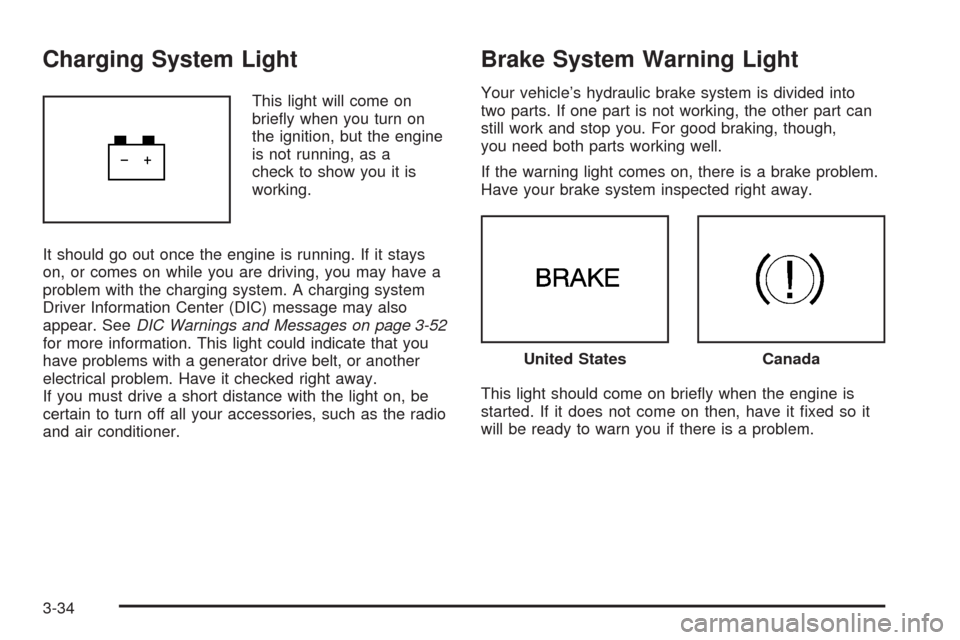
This light will come on
briey when you turn on
the ignition, but the engine
is not running, as a
check to show you it is
working.
It should go out once the engine is running. If it stays
on, or comes on while you are driving, you may have a
problem with the charging system. A charging system
Driver Information Center (DIC) message may also
appear. SeeDIC Warnings and Messages on page 3-52
for more information. This light could indicate that you
have problems with a generator drive belt, or another
electrical problem. Have it checked right away.
If you must drive a short distance with the light on, be
certain to turn off all your accessories, such as the radio
and air conditioner.
Brake System Warning Light
Your vehicle’s hydraulic brake system is divided into
two parts. If one part is not working, the other part can
still work and stop you. For good braking, though,
you need both parts working well.
If the warning light comes on, there is a brake problem.
Have your brake system inspected right away.
This light should come on briey when the engine is
started. If it does not come on then, have it xed so it
will be ready to warn you if there is a problem.
United StatesCanada
3-34
Page 180 of 400
SERVICE A/C (Air Conditioning)
SYSTEM
This message displays when the electronic sensors that
control the air conditioning and heating systems are
no longer working. Have the climate control system
serviced by your dealer/retailer if you notice a drop in
heating and air conditioning efficiency.
SERVICE AIR BAG
This message displays when there is a problem with the
airbag system. Have your vehicle serviced by your
dealer/retailer immediately. SeeAirbag Readiness Light
on page 3-31for more information.
SERVICE BATTERY CHARGING
SYSTEM
This message displays when there is a problem with the
generator and battery charging systems. Driving with
this problem could drain the battery. Turn off all
unnecessary accessories. Stop and turn off the vehicle
as soon as it is safe to do so. Have the electrical
system checked by your dealer/retailer immediately.
SERVICE BRAKE SYSTEM
This message displays when service is required on the
brake system. Have the brake system serviced by
your dealer/retailer as soon as possible. The brake
system warning light also appears on the instrument
panel cluster when this message appears on the DIC.
SeeBrake System Warning Light on page 3-34.
SERVICE POWER STEERING
This message displays when a problem is detected with
the power steering system. When this message is
displayed, you may notice that the effort required to
steer the vehicle increases or feels heavier, but you will
still be able to steer the vehicle. Have your vehicle
serviced by your dealer/retailer immediately.
SERVICE STABILITRAK
If your vehicle has Electronic Stability Control (ESC),
this message displays if there has been a problem
detected with ESC. The ESC/TCS light also appears on
the instrument panel cluster. SeeElectronic Stability
Control on page 4-7for more information.
If this message turns on while you are driving, pull off the
road as soon as possible and stop carefully. Try resetting
the system by turning the ignition off and then back on.
3-56
Page 388 of 400

Audio System(s).............................................3-69
Automatic Door Lock.......................................2-12
Automatic Transmission
Fluid..........................................................5-24
Operation...................................................2-26
B
Backglass Antenna..........................................3-88
Battery..........................................................5-42
Electric Power Management..........................3-19
Run-Down Protection...................................3-20
Brake
Emergencies................................................ 4-5
Brakes..........................................................5-39
System Warning Light..................................3-34
Braking........................................................... 4-3
Braking in Emergencies..................................... 4-5
Break-In, New Vehicle.....................................2-21
Bulb Replacement...........................................5-47
Halogen Bulbs............................................5-47
Headlamp Aiming........................................5-47
Headlamps, Front Turn Signal, Sidemarker,
and Parking Lamps..................................5-48Bulb Replacement (cont.)
License Plate Lamps....................................5-51
Replacement Bulbs......................................5-52
Taillamps, Turn Signal, Sidemarker,
Stoplamps, and Back-Up Lamps.................5-50
Buying New Tires...........................................5-71C
Calibration.....................................................3-49
California Fuel.................................................. 5-6
California Perchlorate Materials Requirements....... 5-4
California Proposition 65 Warning....................... 5-4
Canadian Owners................................................ ii
Capacities and Specications..........................5-103
Carbon Monoxide...................2-13, 2-34, 4-16, 4-27
Care of
Safety Belts................................................5-93
CD, MP3 .......................................................3-80
Center Console Storage Area...........................2-48
Center Seat..................................................... 1-8
Chains, Tire...................................................5-76
Charging System Light....................................3-34
Check
Engine Light...............................................3-39
Checking Things Under the Hood......................5-12
Chemical Paint Spotting...................................5-96
2
Page 393 of 400
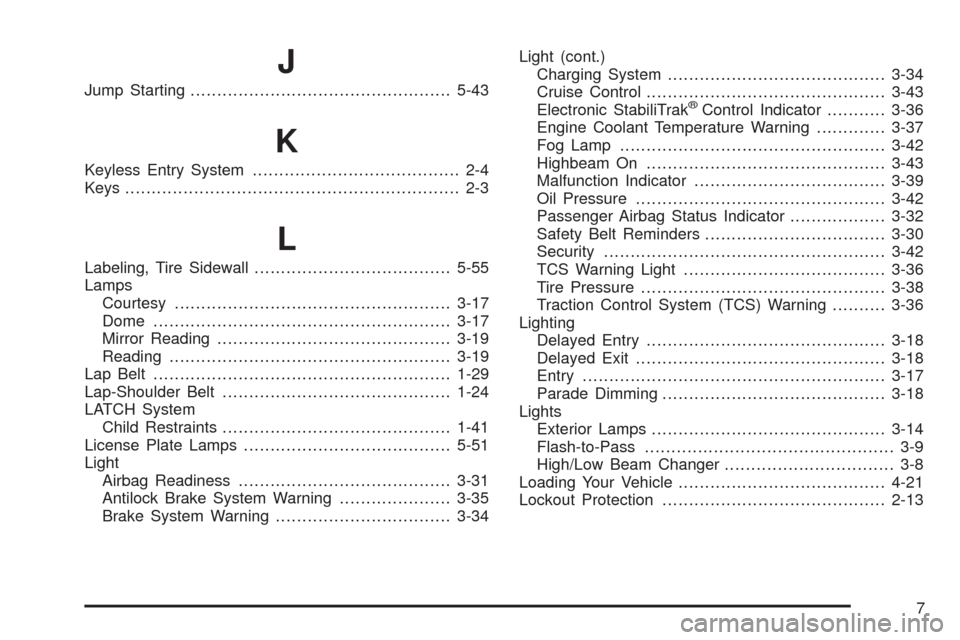
J
Jump Starting.................................................5-43
K
Keyless Entry System....................................... 2-4
Keys............................................................... 2-3
L
Labeling, Tire Sidewall.....................................5-55
Lamps
Courtesy....................................................3-17
Dome........................................................3-17
Mirror Reading............................................3-19
Reading.....................................................3-19
Lap Belt........................................................1-29
Lap-Shoulder Belt...........................................1-24
LATCH System
Child Restraints...........................................1-41
License Plate Lamps.......................................5-51
Light
Airbag Readiness........................................3-31
Antilock Brake System Warning.....................3-35
Brake System Warning.................................3-34Light (cont.)
Charging System.........................................3-34
Cruise Control.............................................3-43
Electronic StabiliTrak
®Control Indicator...........3-36
Engine Coolant Temperature Warning.............3-37
Fog Lamp..................................................3-42
Highbeam On.............................................3-43
Malfunction Indicator....................................3-39
Oil Pressure...............................................3-42
Passenger Airbag Status Indicator..................3-32
Safety Belt Reminders..................................3-30
Security.....................................................3-42
TCS Warning Light......................................3-36
Tire Pressure..............................................3-38
Traction Control System (TCS) Warning..........3-36
Lighting
Delayed Entry.............................................3-18
Delayed Exit...............................................3-18
Entry.........................................................3-17
Parade Dimming..........................................3-18
Lights
Exterior Lamps............................................3-14
Flash-to-Pass............................................... 3-9
High/Low Beam Changer................................ 3-8
Loading Your Vehicle.......................................4-21
Lockout Protection..........................................2-13
7