2008 CHEVROLET HHR fuse
[x] Cancel search: fusePage 6 of 430
Front Seats
Manual Seats
{CAUTION:
You can lose control of the vehicle if you try to
adjust a manual driver’s seat while the vehicle
is moving. The sudden movement could startle
and confuse you, or make you push a pedal
when you do not want to. Adjust the driver’s
seat only when the vehicle is not moving.
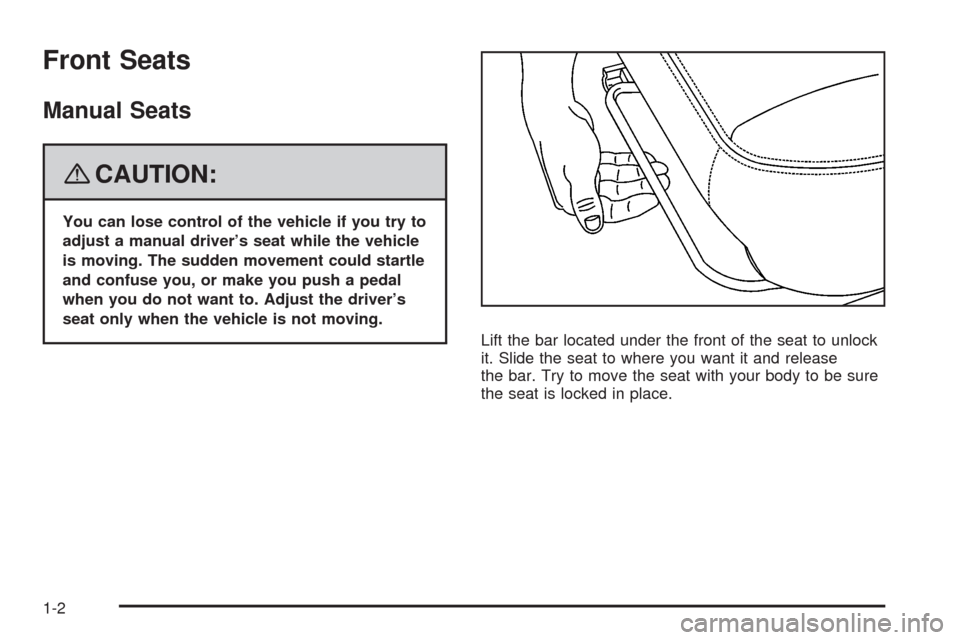
Lift the bar located under the front of the seat to unlock
it. Slide the seat to where you want it and release
the bar. Try to move the seat with your body to be sure
the seat is locked in place.
1-2
Page 9 of 430
Reclining Seatbacks
{CAUTION:
You can lose control of the vehicle if you try to
adjust a manual driver’s seat while the vehicle
is moving. The sudden movement could startle
and confuse you, or make you push a pedal
when you do not want to. Adjust the driver’s
seat only when the vehicle is not moving.
{CAUTION:
If the seatback is not locked, it could move
forward in a sudden stop or crash. That could
cause injury to the person sitting there. Always
push and pull on the seatback to be sure it is
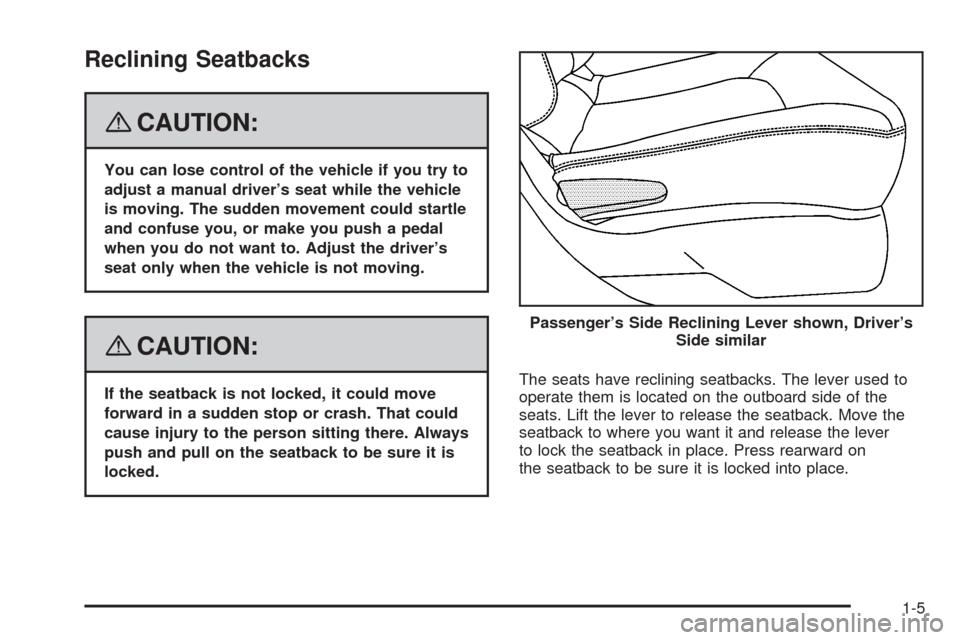
locked.The seats have reclining seatbacks. The lever used to
operate them is located on the outboard side of the
seats. Lift the lever to release the seatback. Move the
seatback to where you want it and release the lever
to lock the seatback in place. Press rearward on
the seatback to be sure it is locked into place.Passenger’s Side Reclining Lever shown, Driver’s
Side similar
1-5
Page 98 of 430
PASS-Key®III+ Operation
Your vehicle has PASS-Key®III+ (Personalized
Automotive Security System) theft-deterrent system.
PASS-Key
®III+ is a passive theft-deterrent system.
The system is automatically armed when the key
is removed from the ignition.
You do not have to manually arm or disarm the system.
The security light will come on if there is a problem
with arming or disarming the theft-deterrent system.
When the PASS-Key
®III+ system senses that someone
is using the wrong key, it prevents the vehicle from
starting. Anyone using a trial-and-error method to start
the vehicle will be discouraged because of the high
number of electrical key codes.
When trying to start the vehicle if the engine does not
start and the security light comes on, there may be
a problem with your theft-deterrent system. Turn
the ignition off and try again.
If the engine still does not start, and the key appears to be
undamaged, try another ignition key. At this time, you
may also want to check the fuse, seeFuses and Circuit
Breakers on page 5-119. If the engine still does not start
with the other key, your vehicle needs service.If your vehicle does start, the rst key may be faulty. See
your dealer/retailer who can service the PASS-Key
®III+
to have a new key made. In an emergency, contact
Roadside Assistance. SeeRoadside Assistance Program
on page 7-6, for more information.
It may be possible for the PASS-Key
®III+ decoder to
“learn” the transponder value of a new or replacement
key. Up to 10 keys may be programmed for the vehicle.
The following procedure is for programming additional
keys only. If all the currently programmed keys are
lost or do not operate, you must see your dealer/retailer
or a locksmith who can service PASS-Key
®III+ to
have keys made and programmed to the system.
See your dealer/retailer or a locksmith who can service
PASS-Key
®III+ to get a new key blank that is cut
exactly as the ignition key that operates the system.
To program the new key:
1. Verify that the new key has a
1stamped on it.
2. Insert the already programmed key in the ignition
and start the engine. If the engine will not start, see
your dealer/retailer for service.
3. After the engine has started, turn the key to
LOCK/OFF, and remove the key.
2-20
Page 140 of 430
Turn and Lane-Change Signals
The turn signal has two upward (for right) and two
downward (for left) positions. These positions allow you
to signal a turn or a lane change.
To signal a turn, move the lever all the way up or down.
When the turn is nished, the lever will return
automatically.
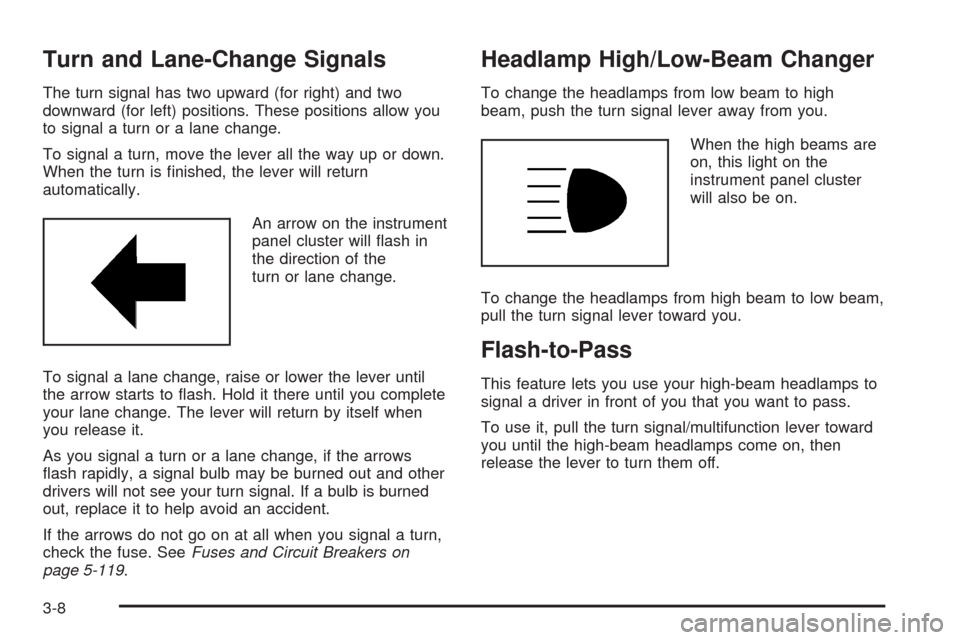
An arrow on the instrument
panel cluster will ash in
the direction of the
turn or lane change.
To signal a lane change, raise or lower the lever until
the arrow starts to ash. Hold it there until you complete
your lane change. The lever will return by itself when
you release it.
As you signal a turn or a lane change, if the arrows
ash rapidly, a signal bulb may be burned out and other
drivers will not see your turn signal. If a bulb is burned
out, replace it to help avoid an accident.
If the arrows do not go on at all when you signal a turn,
check the fuse. SeeFuses and Circuit Breakers on
page 5-119.
Headlamp High/Low-Beam Changer
To change the headlamps from low beam to high
beam, push the turn signal lever away from you.
When the high beams are
on, this light on the
instrument panel cluster
will also be on.
To change the headlamps from high beam to low beam,
pull the turn signal lever toward you.
Flash-to-Pass
This feature lets you use your high-beam headlamps to
signal a driver in front of you that you want to pass.
To use it, pull the turn signal/multifunction lever toward
you until the high-beam headlamps come on, then
release the lever to turn them off.
3-8
Page 153 of 430
Notice:Leaving electrical equipment plugged in for
an extended period of time while the vehicle is off
will drain the battery. Power is always supplied
to the outlets. Always unplug electrical equipment
when not in use and do not plug in equipment
that exceeds the maximum 20 ampere rating.
Certain electrical accessories may not be compatible
with the accessory power outlet and could result
in blown vehicle or adapter fuses. If you experience a
problem, see your dealer/retailer for additional
information on the accessory power outlet.
Notice:Adding any electrical equipment to your
vehicle may damage it or keep other components
from working as they should. The repairs would not
be covered by your warranty. Do not use equipment
exceeding maximum amperage rating of 20 amperes.
Check with your dealer/retailer before adding
electrical equipment.
When adding electrical equipment, be sure to follow the
installation instructions included with the equipment.
Notice:Improper use of the power outlet can cause
damage not covered by your warranty. Do not
hang any type of accessory or accessory bracket
from the plug because the power outlets are
designed for accessory power plugs only.Rear Power Plug for Converters
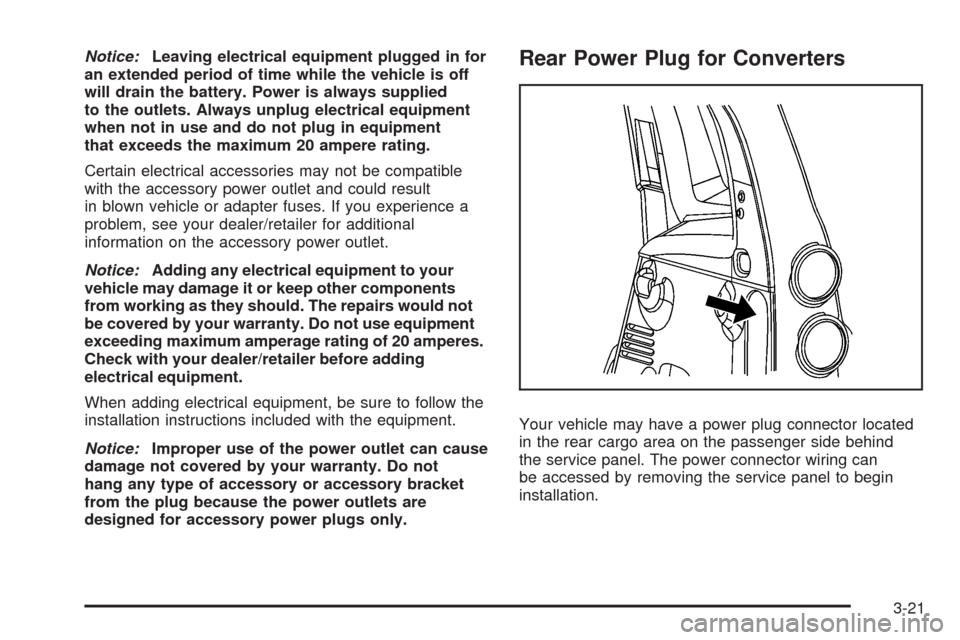
Your vehicle may have a power plug connector located
in the rear cargo area on the passenger side behind
the service panel. The power connector wiring can
be accessed by removing the service panel to begin
installation.
3-21
Page 154 of 430
This plug can be used to supply power to commercial
converters and contains four different circuits. The
functions of these circuits are as follows; a 40 Amp
battery service, a 10 Amp Accessory or Run service, a
15 Amp Delayed Accessory service and a Ground
circuit.
Notice:Adding any electrical equipment to your
vehicle may damage it or keep other components
from working as they should. The repairs would not
be covered by your warranty. Do not use equipment
exceeding maximum amperage rating of 40 amperes.
Check with your dealer/retailer before adding
electrical equipment.
When adding electrical equipment, be sure to follow the
installation instructions included with the equipment.
Notice:Improper use of the power outlet can cause
damage not covered by your warranty. Do not
hang any type of accessory or accessory bracket
from the plug because the power outlets are
designed for accessory power plugs only.
Notice:Leaving electrical equipment plugged in for
an extended period of time while the vehicle is off
will drain the battery. Power is always supplied
to the outlets. Always unplug electrical equipment
when not in use and do not plug in equipment
that exceeds the maximum 40 ampere rating.Ashtray(s) and Cigarette Lighter
Your vehicle may have an ashtray and cigarette lighter.
To use the lighter, located on the instrument panel
below the climate controls, push it in all the way and let
go. When it is ready, it will pop back out by itself.
Notice:Holding a cigarette lighter in while it is
heating will not allow the lighter to back away from
the heating element when it is hot. Damage from
overheating may occur to the lighter or heating
element, or a fuse could be blown. Do not hold a
cigarette lighter in while it is heating. Do not
use equipment exceeding maximum amperage rating
of 15 amperes.
To clean the center console ashtray, remove the entire
ashtray and empty it.
Notice:If you put papers, pins, or other ammable
items in the ashtray, hot cigarettes or other
smoking materials could ignite them and possibly
damage your vehicle. Never put ammable items in
the ashtray.
3-22
Page 246 of 430
To prevent the battery from draining while the vehicle is
being towed, remove the following fuse from the oor
console fuse block: 8 (Ignition Switch, PASS-Key
®III+).
SeeFloor Console Fuse Block on page 5-120for
more information.
Remember to reinstall the fuse once you have reached
your destination.
Notice:If you exceed 65 mph (105 km/h) while
towing your vehicle, it could be damaged. Never
exceed 65 mph (105 km/h) while towing your vehicle.
Notice:Towing your vehicle from the rear could
damage it. Also, repairs would not be covered by
the warranty. Never have your vehicle towed from
the rear.
Dolly Towing
Your vehicle cannot be dolly towed, but can be dinghy
towed. See “Dinghy Towing” earlier in this section.
Notice:Dolly towing your vehicle may cause
damage because of reduced ground clearance.
Always tow your vehicle using the dinghy towing
procedure listed in this section or put your vehicle
on a atbed truck.
Towing a Trailer (Manual Transaxle)
Do not tow a trailer if your vehicle is equipped with a
manual transaxle.
Towing a Trailer (Automatic
Transaxle)
{CAUTION:
If you do not use the correct equipment and
drive properly, you can lose control when you
pull a trailer. For example, if the trailer is too
heavy, the brakes may not work well — or even
at all. You and your passengers could be
seriously injured. You may also damage your
vehicle; the resulting repairs would not be
covered by your warranty. Pull a trailer only if
you have followed all the steps in this section.
Ask your dealer/retailer for advice and
information about towing a trailer with your
vehicle.
4-34
Page 256 of 430
Buying New Tires.........................................5-69
Different Size Tires and Wheels......................5-71
Uniform Tire Quality Grading..........................5-71
Wheel Alignment and Tire Balance..................5-73
Wheel Replacement......................................5-73
Tire Chains..................................................5-74
If a Tire Goes Flat........................................5-75
Tire Sealant and Compressor Kit....................5-76
Changing a Flat Tire.....................................5-86
Removing the Spare Tire and Tools................5-87
Removing the Flat Tire and Installing the
Spare Tire (SS Model)...............................5-90
Removing the Flat Tire and Installing the
Spare Tire (All Models Except SS).............5-101
Storing a Flat or Spare Tire and Tools...........5-106
Compact Spare Tire....................................5-109
Appearance Care..........................................5-110
Interior Cleaning.........................................5-110
Fabric/Carpet..............................................5-111
Instrument Panel, Vinyl, and Other Plastic
Surfaces.................................................5-112
Care of Safety Belts....................................5-112
Weatherstrips.............................................5-113
Washing Your Vehicle..................................5-113Cleaning Exterior Lamps/Lenses....................5-113
Finish Care................................................5-114
Windshield and Wiper Blades.......................5-114
Aluminum or Chrome-Plated Wheels
and Trim................................................5-115
Tires.........................................................5-116
Sheet Metal Damage...................................5-116
Finish Damage...........................................5-116
Underbody Maintenance...............................5-116
Chemical Paint Spotting...............................5-116
Vehicle Care/Appearance Materials................5-117
Vehicle Identication.....................................5-118
Vehicle Identication Number (VIN)
................5-118
Service Parts Identication Label...................5-118
Electrical System..........................................5-118
Add-On Electrical Equipment.........................5-118
Headlamp Wiring........................................5-119
Windshield Wiper Fuses...............................5-119
Power Windows and Other Power Options......5-119
Fuses and Circuit Breakers..........................5-119
Floor Console Fuse Block............................5-120
Engine Compartment Fuse Block...................5-122
Capacities and Specications........................5-125
Section 5 Service and Appearance Care
5-2