Page 329 of 430
If a Tire Goes Flat
It is unusual for a tire to blowout while you are driving,
especially if you maintain your vehicle’s tires properly.
If air goes out of a tire, it is much more likely to leak out
slowly. But if you should ever have a blowout, here
are a few tips about what to expect and what to do:
If a front tire fails, the at tire creates a drag that pulls
the vehicle toward that side. Take your foot off the
accelerator pedal and grip the steering wheel rmly.
Steer to maintain lane position, and then gently brake to
a stop well out of the traffic lane.
A rear blowout, particularly on a curve, acts much like a
skid and may require the same correction you would
use in a skid. In any rear blowout remove your foot from
the accelerator pedal. Get the vehicle under control
by steering the way you want the vehicle to go. It may
be very bumpy and noisy, but you can still steer.
Gently brake to a stop, well off the road if possible.{CAUTION:
Lifting a vehicle and getting under it to do
maintenance or repairs is dangerous without
the appropriate safety equipment and training.
The jack provided with your vehicle is
designed only for changing a at tire. If it is
used for anything else, you or others could be
badly injured or killed if the vehicle slips off
the jack. Use the jack provided with your
vehicle only for changing a at tire.
If a tire goes at, the next part shows how to use the
jacking equipment to change a at tire safely.
5-75
Page 334 of 430
7. Push the On/Off switch to the I (on) position.
The sealant and compressor kit injects sealant
and air into the tire. Sealant can leak from
the puncture until the vehicle is driven and the hole
has sealed.
The pressure gage will initially show a high pressure
while the compressor pushes the sealant into the
tire. Once the sealant is completely dispersed
into the tire, the pressure will quickly drop and start
to rise again as the tire inates with air.
8. Inate the tire to the recommended ination
pressure, found on the Tire and Loading Information
label located on the vehicle’s center pillar (B-pillar)
below the vehicle’s door latch, using the air pressure
gage on the top of the unit.
The pressure gage reads high while the compressor
is running. Turn the compressor off to get an
accurate pressure reading.
Notice:If the recommended pressure cannot be
reached after 15 minutes, the vehicle should not be
driven farther. Damage to the tire is severe and
the sealant will not be effective. Remove the
air compressor plug from the accessory power
outlet and unscrew the inating hose from the tire
valve. SeeRoadside Assistance Program on
page 7-6for more information.9. Push the sealant and compressor kit switch to the
O (off) position.
10. The tire is not sealed and will continue to leak air
until the vehicle is driven and the sealant is
distributed in the tire.
Steps 11 through 18 must be done right after
Step 9.
11. Unplug the air compressor accessory plug from the
accessory power outlet in the vehicle.
12. Disconnect the sealant lling hose from the tire
valve stem, by turning it counterclockwise, and
replace the tire valve stem cap.
Be careful when handling the tire inator
components as they could be hot after usage.
13. Wrap the sealant lling hose around the air
compressor channel to stow it in its original location.
14. Stow the air compressor accessory plug back in the
air compressor. To do this, wrap the air compressor
accessory plug, snap in the plug, and then push
in the bottom and then the top of the wrapped
air compressor accessory plug.
5-80
Page 339 of 430
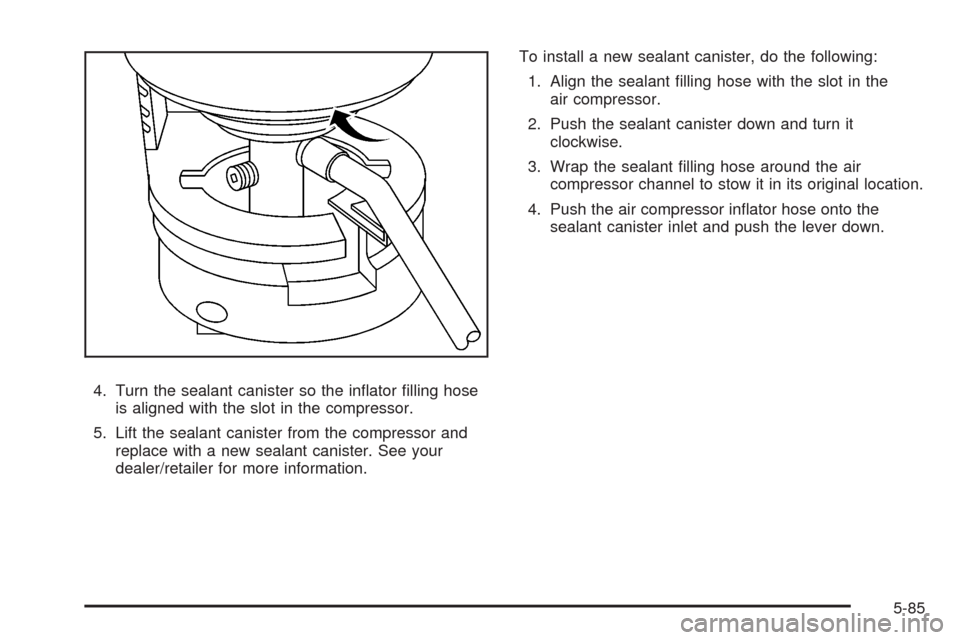
4. Turn the sealant canister so the inator lling hose
is aligned with the slot in the compressor.
5. Lift the sealant canister from the compressor and
replace with a new sealant canister. See your
dealer/retailer for more information.To install a new sealant canister, do the following:
1. Align the sealant lling hose with the slot in the
air compressor.
2. Push the sealant canister down and turn it
clockwise.
3. Wrap the sealant lling hose around the air
compressor channel to stow it in its original location.
4. Push the air compressor inator hose onto the
sealant canister inlet and push the lever down.
5-85
Page 341 of 430
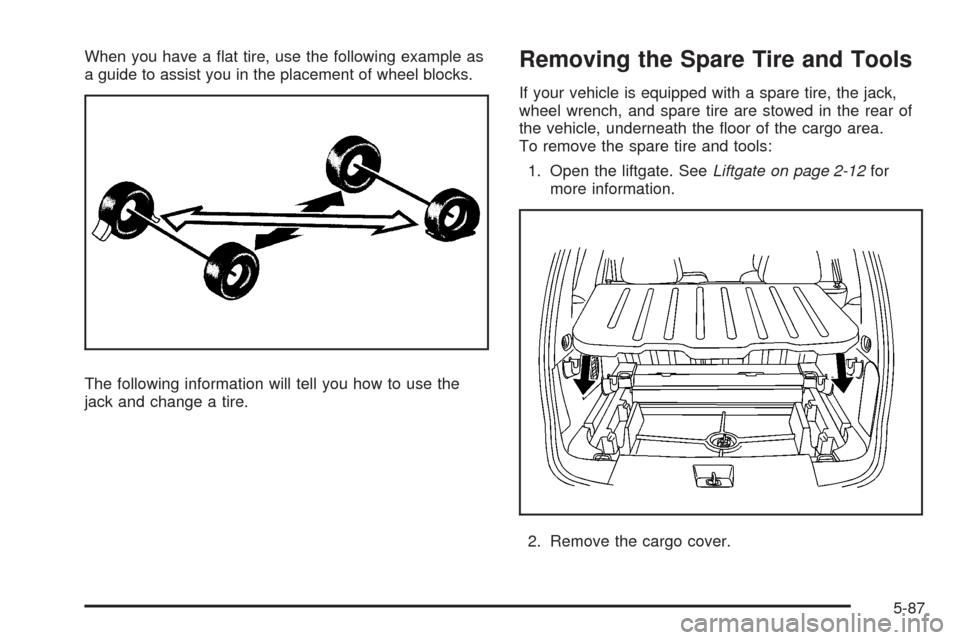
When you have a at tire, use the following example as
a guide to assist you in the placement of wheel blocks.
The following information will tell you how to use the
jack and change a tire.Removing the Spare Tire and Tools
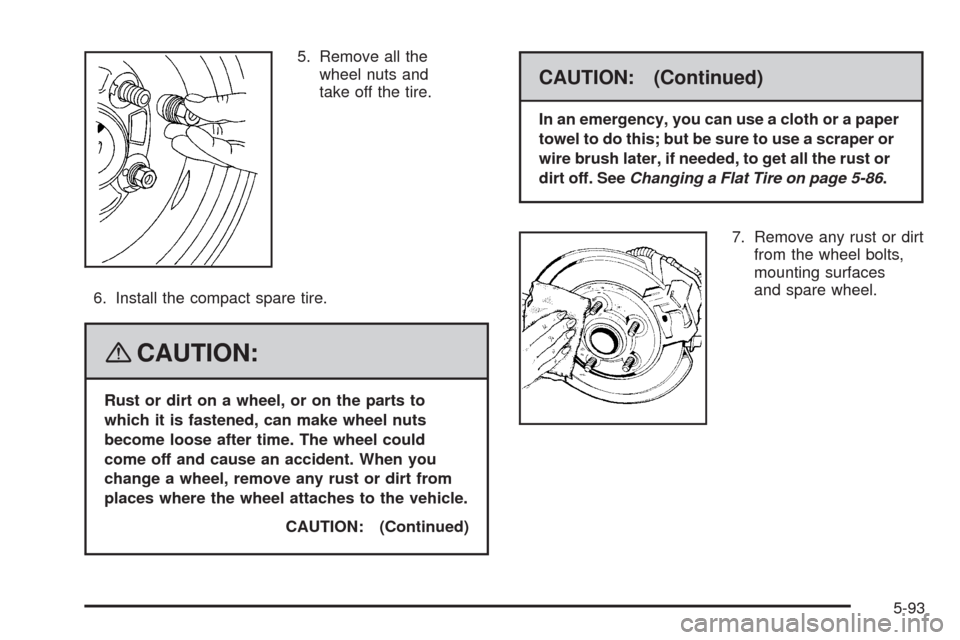
If your vehicle is equipped with a spare tire, the jack,
wheel wrench, and spare tire are stowed in the rear of
the vehicle, underneath the oor of the cargo area.
To remove the spare tire and tools:
1. Open the liftgate. SeeLiftgate on page 2-12for
more information.
2. Remove the cargo cover.
5-87
Page 347 of 430
5. Remove all the
wheel nuts and
take off the tire.
6. Install the compact spare tire.
{CAUTION:
Rust or dirt on a wheel, or on the parts to
which it is fastened, can make wheel nuts
become loose after time. The wheel could
come off and cause an accident. When you
change a wheel, remove any rust or dirt from
places where the wheel attaches to the vehicle.
CAUTION: (Continued)
CAUTION: (Continued)
In an emergency, you can use a cloth or a paper
towel to do this; but be sure to use a scraper or
wire brush later, if needed, to get all the rust or
dirt off. SeeChanging a Flat Tire on page 5-86.
7. Remove any rust or dirt
from the wheel bolts,
mounting surfaces
and spare wheel.
5-93
Page 348 of 430
8. Place the compact spare tire on the wheel-mounting
surface.
{CAUTION:
Never use oil or grease on studs or nuts.
Because the nuts might come loose.
The vehicle’s wheel could fall off, causing
a crash.
9. Reinstall the wheel nuts with the rounded end of
the nuts toward the wheel. Tighten each nut by
hand until the wheel is held against the hub.
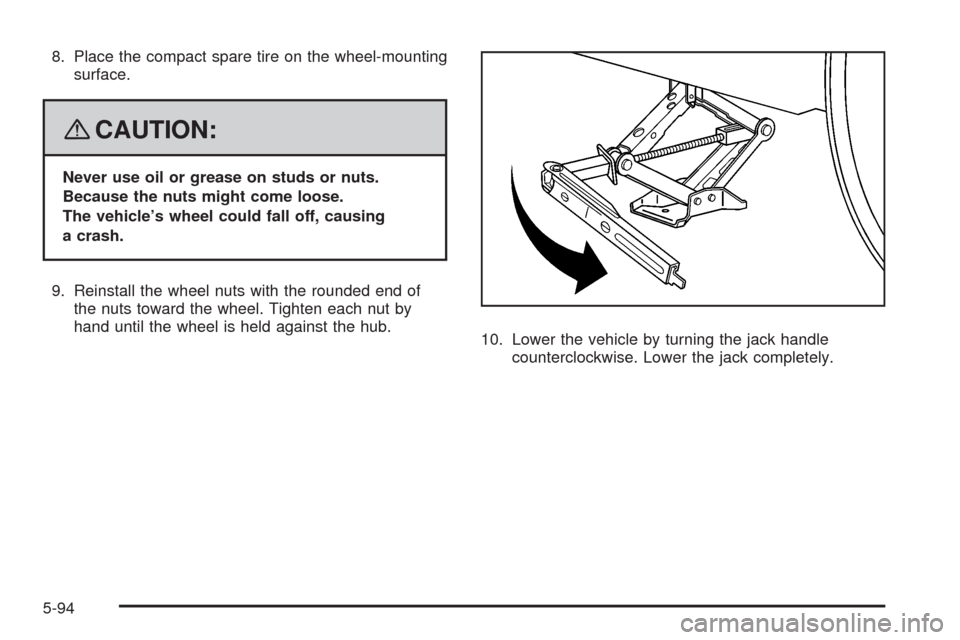
10. Lower the vehicle by turning the jack handle
counterclockwise. Lower the jack completely.
5-94
Page 352 of 430
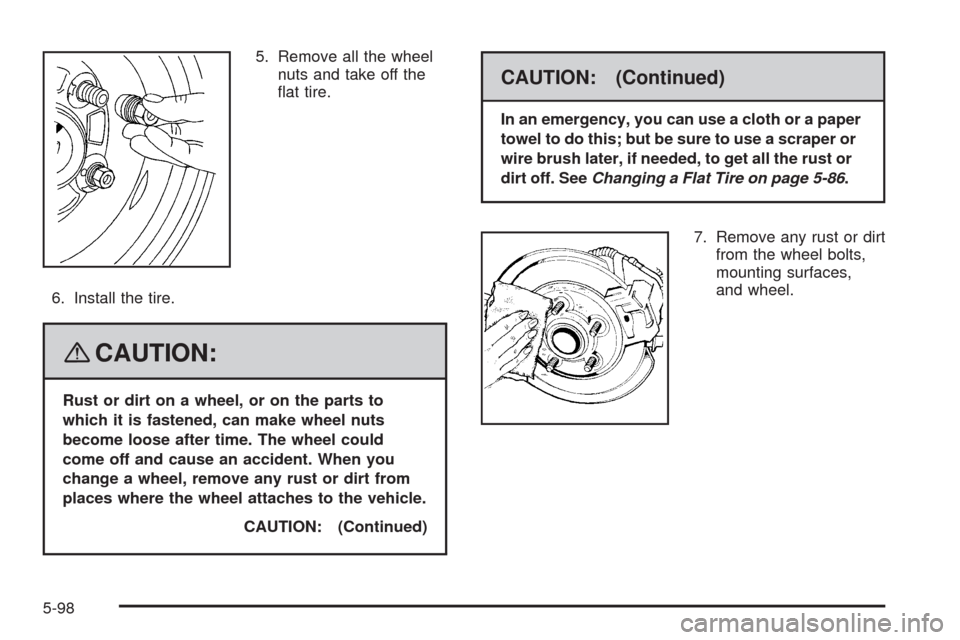
5. Remove all the wheel
nuts and take off the
at tire.
6. Install the tire.
{CAUTION:
Rust or dirt on a wheel, or on the parts to
which it is fastened, can make wheel nuts
become loose after time. The wheel could
come off and cause an accident. When you
change a wheel, remove any rust or dirt from
places where the wheel attaches to the vehicle.
CAUTION: (Continued)
CAUTION: (Continued)
In an emergency, you can use a cloth or a paper
towel to do this; but be sure to use a scraper or
wire brush later, if needed, to get all the rust or
dirt off. SeeChanging a Flat Tire on page 5-86.
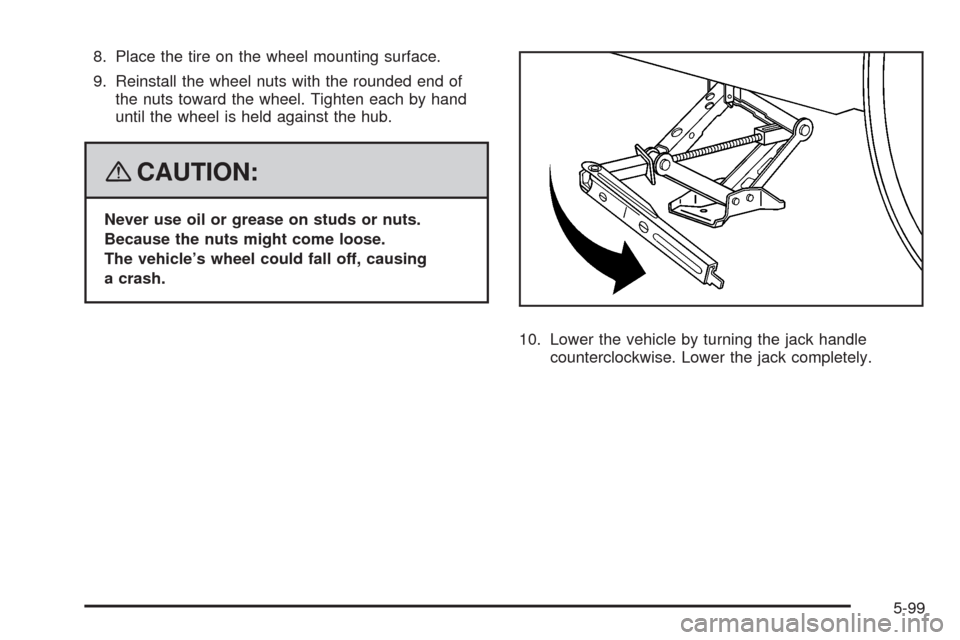
7. Remove any rust or dirt
from the wheel bolts,
mounting surfaces,
and wheel.
5-98
Page 353 of 430
8. Place the tire on the wheel mounting surface.
9. Reinstall the wheel nuts with the rounded end of
the nuts toward the wheel. Tighten each by hand
until the wheel is held against the hub.
{CAUTION:
Never use oil or grease on studs or nuts.
Because the nuts might come loose.
The vehicle’s wheel could fall off, causing
a crash.
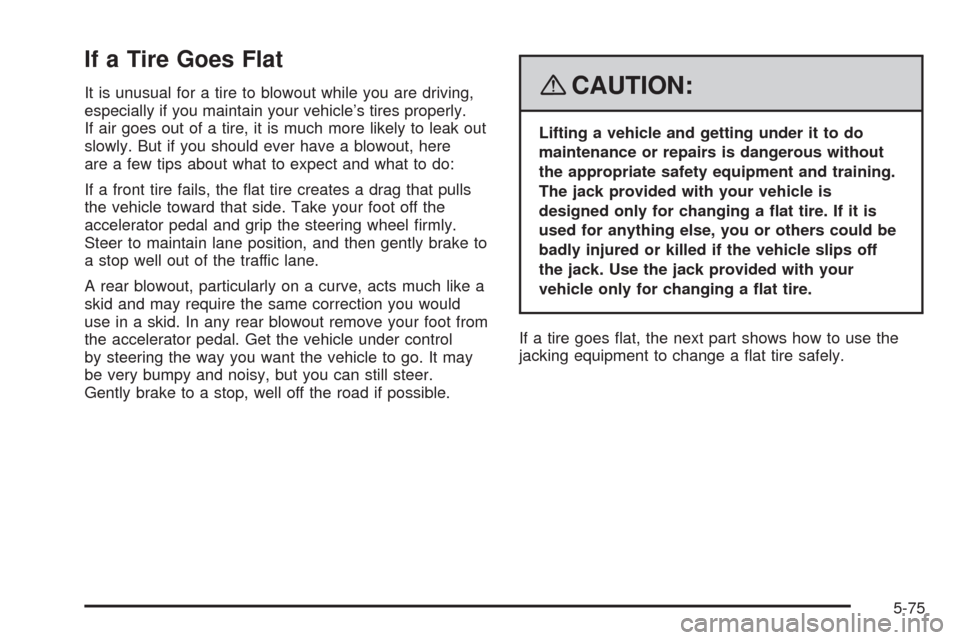
10. Lower the vehicle by turning the jack handle
counterclockwise. Lower the jack completely.
5-99