Page 38 of 432
Child Restraint Systems
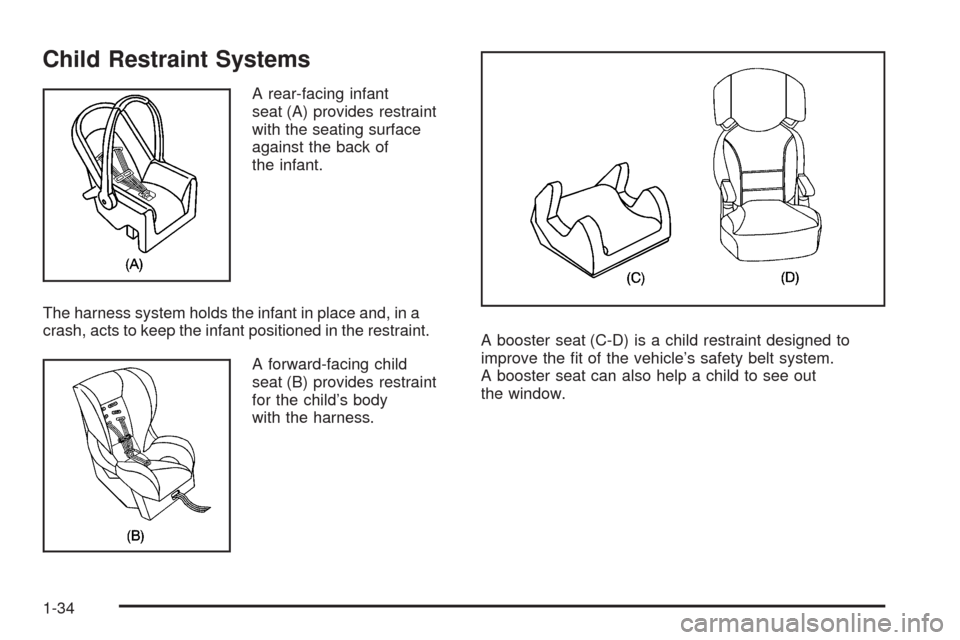
A rear-facing infant
seat (A) provides restraint
with the seating surface
against the back of
the infant.
The harness system holds the infant in place and, in a
crash, acts to keep the infant positioned in the restraint.
A forward-facing child
seat (B) provides restraint
for the child’s body
with the harness.A booster seat (C-D) is a child restraint designed to
improve the t of the vehicle’s safety belt system.
A booster seat can also help a child to see out
the window.
1-34
Page 39 of 432
Securing an Add-On Child Restraint in
the Vehicle
{CAUTION:
A child can be seriously injured or killed in a
crash if the child restraint is not properly
secured in the vehicle. Secure the child
restraint properly in the vehicle using the
vehicle’s safety belt or LATCH system,
following the instructions that came with
that child restraint and the instructions in
this manual.
To help reduce the chance of injury, the child restraint
must be secured in the vehicle. Child restraint systems
must be secured in vehicle seats by lap belts or the
lap belt portion of a lap-shoulder belt, or by the LATCH
system. SeeLower Anchors and Tethers for Children
(LATCH) (Z06 Models Only) on page 1-36orLower
Anchors and Tethers for Children (LATCH) (Coupe and
Convertible Models Only) on page 1-39for more
information. A child can be endangered in a crash if the
child restraint is not properly secured in the vehicle.When securing an add-on child restraint, refer to the
instructions that come with the restraint which may be on
the restraint itself or in a booklet, or both, and to this
manual. The child restraint instructions are important,
so if they are not available, obtain a replacement
copy from the manufacturer.
Keep in mind that an unsecured child restraint can
move around in a collision or sudden stop and injure
people in the vehicle. Be sure to properly secure
any child restraint in the vehicle — even when no child
is in it.
Securing the Child Within the Child
Restraint
{CAUTION:
A child can be seriously injured or killed in a
crash if the child is not properly secured in the
child restraint. Secure the child properly
following the instructions that came with that
child restraint.
1-35
Page 40 of 432
Lower Anchors and Tethers for
Children (LATCH) (Z06 Models Only)
Some child restraints have a LATCH system. As part
of the LATCH system, your child restraint may have
lower attachments and/or a top tether. The LATCH
system can help hold the child restraint in place during
driving or in a crash. Some vehicles have lower
and/or top tether anchors designed to secure a child
restraint with lower attachments and/or a top tether.
Your vehicle does not have lower anchors to
accommodate lower attachments. Your vehicle does
have a top tether anchor. If your child restraint has a top
tether, make sure your child restraint is properly installed
using the top tether anchor and the vehicle’s safety belt.
A child restraint must never be installed using only the
top tether and anchor. Refer to your child restraint
instructions and seeSecuring a Child Restraint in the
Right Front Seat Position on page 1-39for instructions
on securing your child restraint using the vehicle’s
safety belts.
In order to use the top tether anchors in your vehicle,
you need a child restraint equipped with a top tether.
The child restraint manufacturer will provide you
with instructions on how to use the child restraint and
its top tether. The following explains how to attach
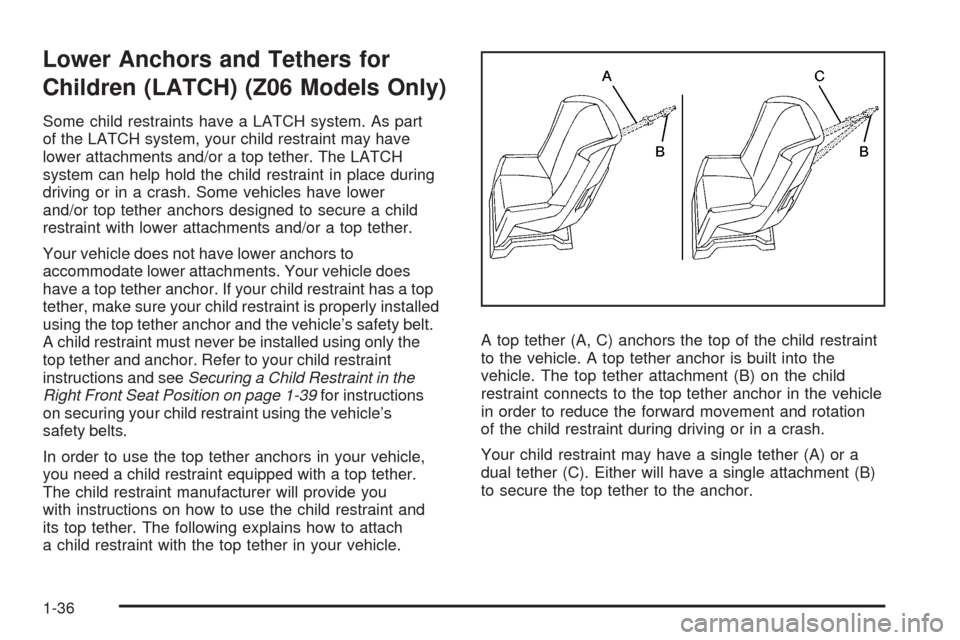
a child restraint with the top tether in your vehicle.A top tether (A, C) anchors the top of the child restraint
to the vehicle. A top tether anchor is built into the
vehicle. The top tether attachment (B) on the child
restraint connects to the top tether anchor in the vehicle
in order to reduce the forward movement and rotation
of the child restraint during driving or in a crash.
Your child restraint may have a single tether (A) or a
dual tether (C). Either will have a single attachment (B)
to secure the top tether to the anchor.
1-36
Page 42 of 432
Securing a Child Restraint with a Top Tether
{CAUTION:
If a LATCH-type child restraint is not attached
to anchors, the child restraint will not be able
to protect the child correctly. In a crash, the
child could be seriously injured or killed.
Install a LATCH-type child restraint properly
using the anchors, or use the vehicle’s safety
belts to secure the restraint, following the
instructions that came with the child restraint
and the instructions in this manual.
1. Secure the child restraint using the vehicle’s safety
belt. SeeSecuring a Child Restraint in the Right
Front Seat Position on page 1-39.
2. If the child restraint manufacturer recommends that
the top tether be attached, attach and tighten the
top tether to the top tether anchor, if equipped.
Refer to the child restraint instructions and
the following steps:
2.1. Find the top tether anchor.
2.2. Press the ribbed area of the trim cover to
open the cover and expose the anchor.2.3. Route, attach and tighten the top tether
according to your child restraint instructions
and the following instructions:
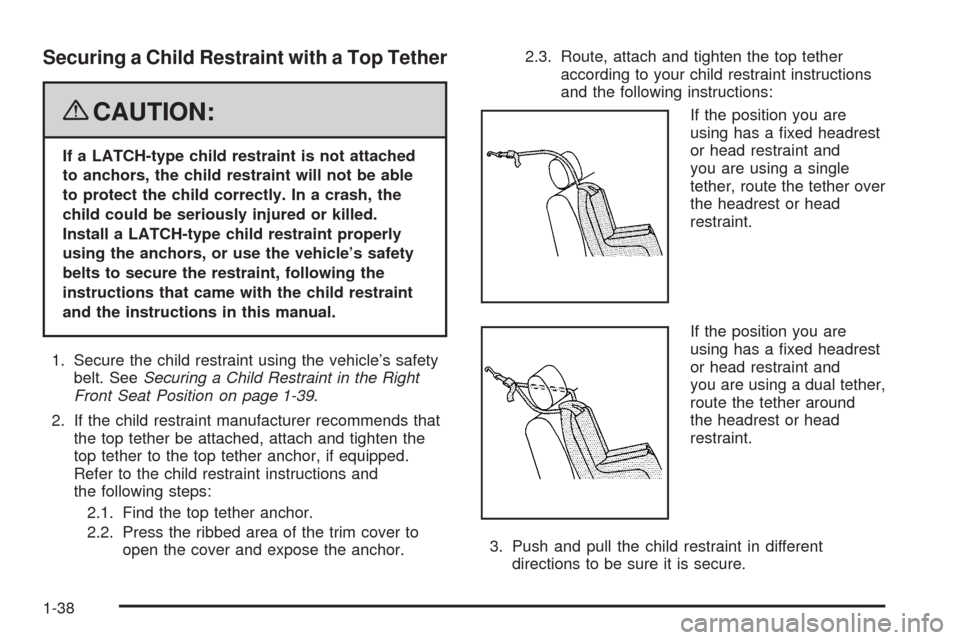
If the position you are
using has a xed headrest
or head restraint and
you are using a single
tether, route the tether over
the headrest or head
restraint.
If the position you are
using has a xed headrest
or head restraint and
you are using a dual tether,
route the tether around
the headrest or head
restraint.
3. Push and pull the child restraint in different
directions to be sure it is secure.
1-38
Page 43 of 432
Lower Anchors and Tethers for
Children (LATCH) (Coupe and
Convertible Models Only)
Some child restraints have a LATCH system. As part
of the LATCH system, your child restraint may have
lower attachments and/or a top tether. The LATCH
system can help hold the child restraint in place during
driving or in a crash. Some vehicles have lower
and/or top tether anchors designed to secure a child
restraint with lower attachments and/or a top tether.
Some child restraints with a top tether are designed
to be used whether the top tether is anchored or
not. Other child restraints require that the top tether
be anchored. A national or local law may require
that the top tether be anchored.
In Canada, the law requires that forward-facing child
restraints have a top tether, and that the tether be
attached.Your vehicle does not have lower anchors or top tether
anchors to secure a child restraint with the LATCH
system. If a national or local law requires that your
top tether be anchored, do not use a child restraint in
this vehicle because a top tether cannot be properly
anchored. You must use the safety belts to secure
your child restraint in this vehicle, unless a national or
local law requires that the top tether be anchored. Refer
to your child restraint instructions and instructions in
this manual for securing a child restraint using the
vehicle’s safety belts. SeeSecuring a Child Restraint in
the Right Front Seat Position on page 1-39.
Securing a Child Restraint in the
Right Front Seat Position
Your vehicle has airbags. In addition, your vehicle has a
passenger sensing system which is designed to turn
off the right front passenger’s frontal airbag and
seat-mounted side impact airbag (if equipped) under
certain conditions. SeePassenger Sensing System on
page 1-51andPassenger Airbag Status Indicator
on page 3-38for more information on this, including
important safety information.
1-39
Page 44 of 432
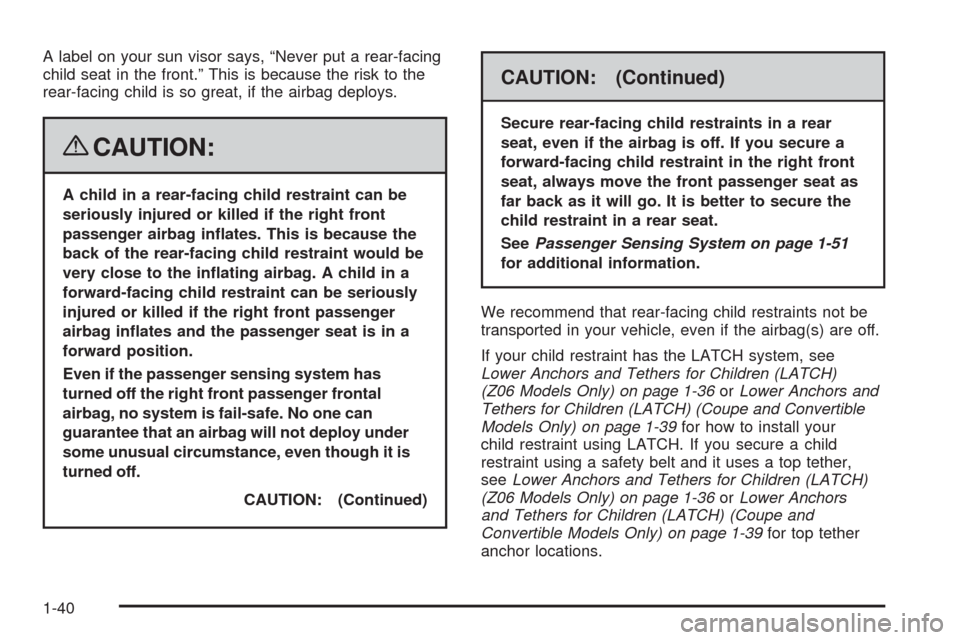
A label on your sun visor says, “Never put a rear-facing
child seat in the front.” This is because the risk to the
rear-facing child is so great, if the airbag deploys.
{CAUTION:
A child in a rear-facing child restraint can be
seriously injured or killed if the right front
passenger airbag inates. This is because the
back of the rear-facing child restraint would be
very close to the inating airbag. A child in a
forward-facing child restraint can be seriously
injured or killed if the right front passenger
airbag inates and the passenger seat is in a
forward position.
Even if the passenger sensing system has
turned off the right front passenger frontal
airbag, no system is fail-safe. No one can
guarantee that an airbag will not deploy under
some unusual circumstance, even though it is
turned off.
CAUTION: (Continued)
CAUTION: (Continued)
Secure rear-facing child restraints in a rear
seat, even if the airbag is off. If you secure a
forward-facing child restraint in the right front
seat, always move the front passenger seat as
far back as it will go. It is better to secure the
child restraint in a rear seat.
SeePassenger Sensing System on page 1-51
for additional information.
We recommend that rear-facing child restraints not be
transported in your vehicle, even if the airbag(s) are off.
If your child restraint has the LATCH system, see
Lower Anchors and Tethers for Children (LATCH)
(Z06 Models Only) on page 1-36orLower Anchors and
Tethers for Children (LATCH) (Coupe and Convertible
Models Only) on page 1-39for how to install your
child restraint using LATCH. If you secure a child
restraint using a safety belt and it uses a top tether,
seeLower Anchors and Tethers for Children (LATCH)
(Z06 Models Only) on page 1-36orLower Anchors
and Tethers for Children (LATCH) (Coupe and
Convertible Models Only) on page 1-39for top tether
anchor locations.
1-40
Page 45 of 432
Do not secure a child seat in a position without a top
tether anchor if a national or local law requires that
the top tether be anchored, or if the instructions
that come with the child restraint say that the top
strap must be anchored.
In Canada, the law requires that forward-facing child
restraints have a top tether, and that the tether be
attached.
You will be using the lap-shoulder belt to secure the
child restraint in this position. Follow the instructions
that came with the child restraint.
1. Move the seat as far back as it will go before
securing the forward-facing child restraint.
When the passenger sensing system has turned
off the right front passenger’s frontal airbag
and seat-mounted side impact airbag (if equipped),
the off indicator on the passenger airbag status
indicator should light and stay lit when you start
the vehicle. SeePassenger Airbag Status Indicator
on page 3-38.
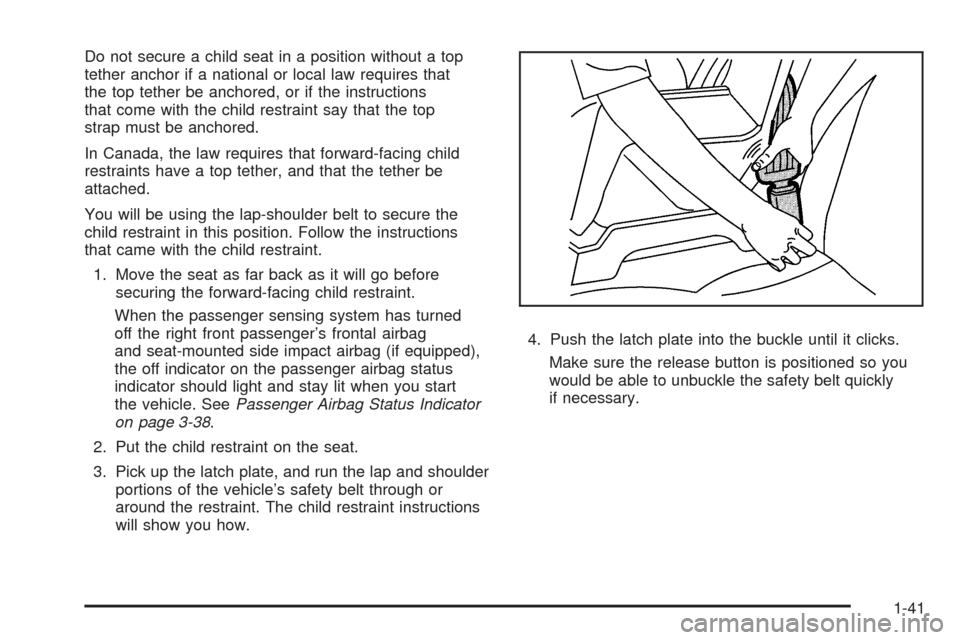
2. Put the child restraint on the seat.
3. Pick up the latch plate, and run the lap and shoulder
portions of the vehicle’s safety belt through or
around the restraint. The child restraint instructions
will show you how.4. Push the latch plate into the buckle until it clicks.
Make sure the release button is positioned so you
would be able to unbuckle the safety belt quickly
if necessary.
1-41
Page 46 of 432
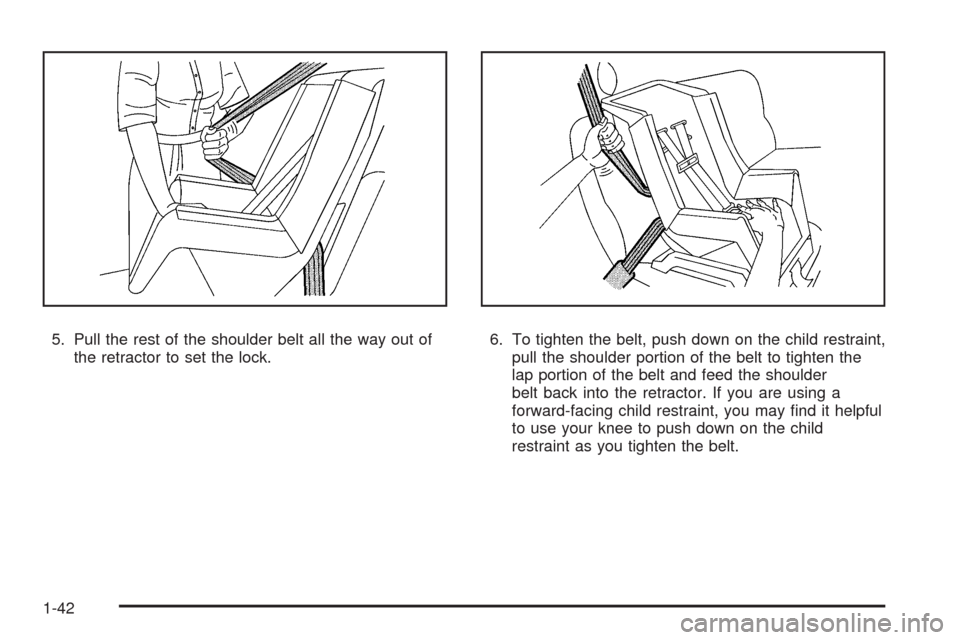
5. Pull the rest of the shoulder belt all the way out of
the retractor to set the lock.6. To tighten the belt, push down on the child restraint,
pull the shoulder portion of the belt to tighten the
lap portion of the belt and feed the shoulder
belt back into the retractor. If you are using a
forward-facing child restraint, you may nd it helpful
to use your knee to push down on the child
restraint as you tighten the belt.
1-42