Page 32 of 384
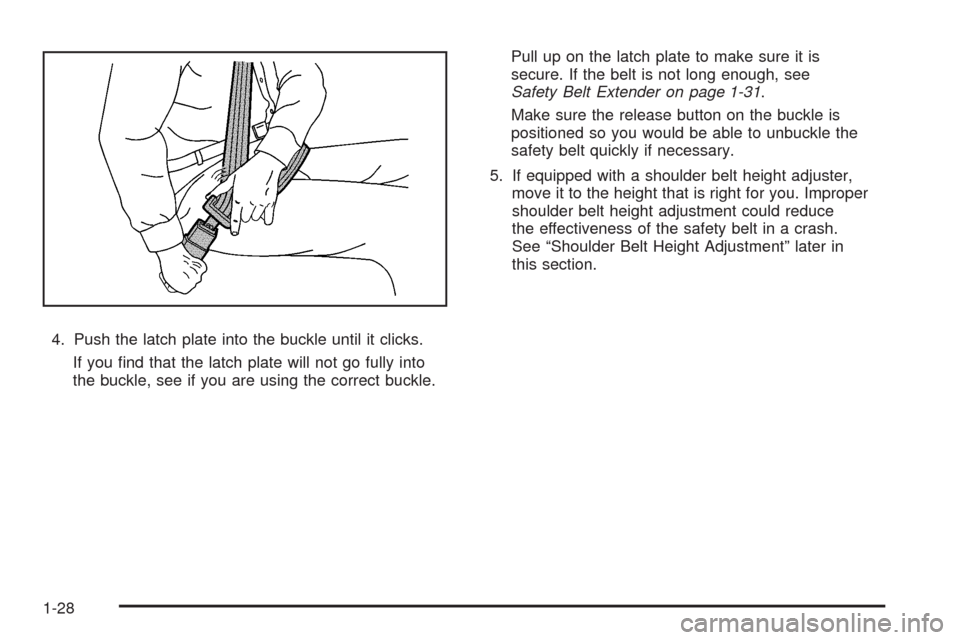
4. Push the latch plate into the buckle until it clicks.
If you find that the latch plate will not go fully into
the buckle, see if you are using the correct buckle.Pull up on the latch plate to make sure it is
secure. If the belt is not long enough, see
Safety Belt Extender on page 1-31.
Make sure the release button on the buckle is
positioned so you would be able to unbuckle the
safety belt quickly if necessary.
5. If equipped with a shoulder belt height adjuster,
move it to the height that is right for you. Improper
shoulder belt height adjustment could reduce
the effectiveness of the safety belt in a crash.
See “Shoulder Belt Height Adjustment” later in
this section.
1-28
Page 34 of 384
Shoulder Belt Height Adjuster
Your vehicle has a shoulder belt height adjuster for
the driver and right front passenger.
Adjust the height so that the shoulder portion of the
belt is centered on your shoulder. The belt should be
away from your face and neck, but not falling off your
shoulder. Improper shoulder belt height adjustment could
reduce the effectiveness of the safety belt in a crash.
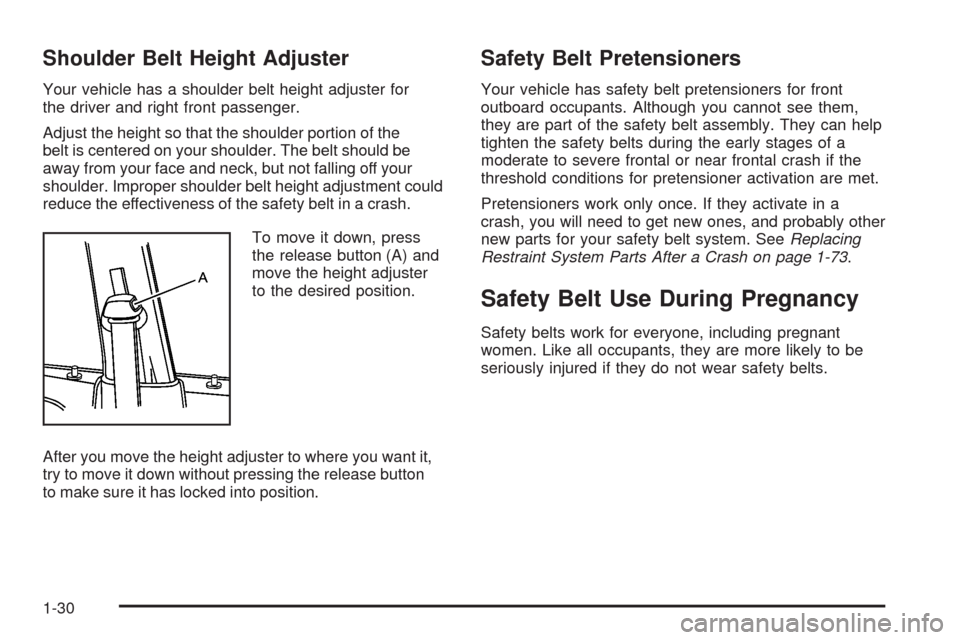
To move it down, press
the release button (A) and
move the height adjuster
to the desired position.
After you move the height adjuster to where you want it,
try to move it down without pressing the release button
to make sure it has locked into position.
Safety Belt Pretensioners
Your vehicle has safety belt pretensioners for front
outboard occupants. Although you cannot see them,
they are part of the safety belt assembly. They can help
tighten the safety belts during the early stages of a
moderate to severe frontal or near frontal crash if the
threshold conditions for pretensioner activation are met.
Pretensioners work only once. If they activate in a
crash, you will need to get new ones, and probably other
new parts for your safety belt system. SeeReplacing
Restraint System Parts After a Crash on page 1-73.
Safety Belt Use During Pregnancy
Safety belts work for everyone, including pregnant
women. Like all occupants, they are more likely to be
seriously injured if they do not wear safety belts.
1-30
Page 257 of 384
Brake Pedal Travel
See your dealer/retailer if the brake pedal does not
return to normal height, or if there is a rapid increase in
pedal travel. This could be a sign that brake service
might be required.
Brake Adjustment
Every time you make a moderate brake stop, the disc
brakes adjust for wear. If you rarely make a moderate or
heavier stop, then the brakes might not adjust correctly.
If you drive in that way, then — very carefully — make a
few moderate brake stops about every 1,000 miles
(1 600 km), so the brakes will adjust properly.
If the brake pedal goes down farther than normal,
the rear drum brakes might need adjustment. Adjust
them by backing up and firmly applying the brakes
a few times.
Replacing Brake System Parts
The braking system on a vehicle is complex. Its many
parts have to be of top quality and work well together if
the vehicle is to have really good braking. Your vehicle
was designed and tested with top-quality brake parts.When you replace parts of the braking system — for
example, when the brake linings wear down and you
need new ones put in — be sure you get new approved
replacement parts. If you do not, the brakes might not
work properly. For example, if someone puts in brake
linings that are wrong for your vehicle, the balance
between the front and rear brakes can change — for the
worse. The braking performance you have come to
expect can change in many other ways if someone puts
in the wrong replacement brake parts.
Battery
Your vehicle has a maintenance free battery. When it
is time for a new battery, see your dealer/retailer for
one that has the replacement number shown on
the original battery’s label. SeeEngine Compartment
Overview on page 5-12for battery location.
Warning:Battery posts, terminals, and related
accessories contain lead and lead compounds,
chemicals known to the State of California to cause
cancer and reproductive harm. Wash hands after
handling.
5-35