15. Lower the vehicle by turning the wheel wrench
counterclockwise. Lower the jack completely.
{CAUTION:
Incorrect or improperly tightened wheel nuts
can cause the wheel to come loose and even
come off. This could lead to a crash. If you have
to replace them, be sure to get new original
equipment wheel nuts. Stop somewhere as
soon as you can and have the nuts tightened
with a torque wrench to the proper torque
specication. SeeCapacities and Specifications
on page 5-99for wheel nut torque specication.
Notice:Improperly tightened wheel nuts can lead
to brake pulsation and rotor damage. To avoid
expensive brake repairs, evenly tighten the wheel
nuts in the proper sequence and to the proper torque
specication. SeeCapacities and Specifications on
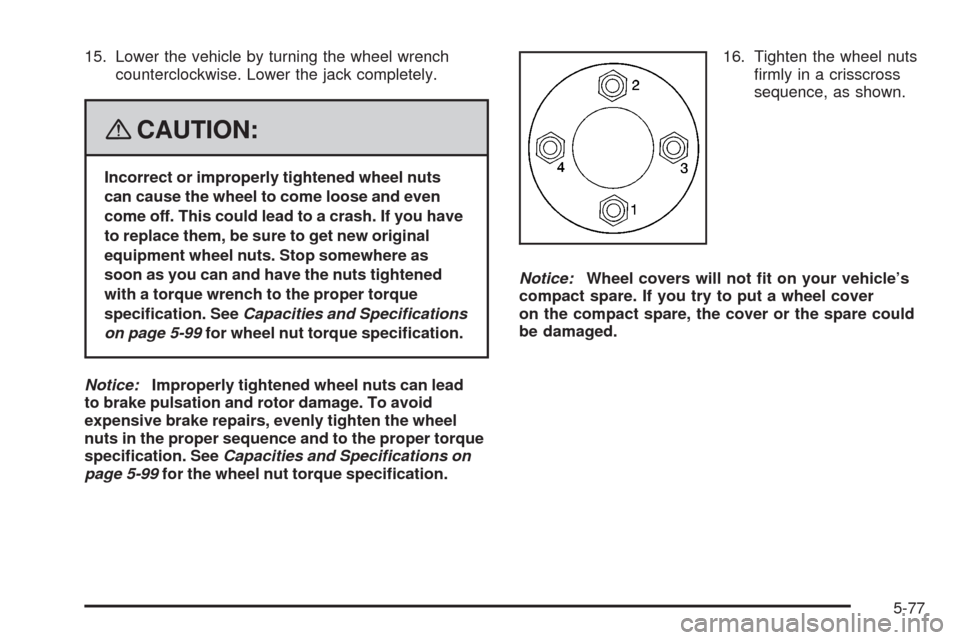
page 5-99for the wheel nut torque specication.16. Tighten the wheel nuts
firmly in a crisscross
sequence, as shown.
Notice:Wheel covers will not t on your vehicle’s
compact spare. If you try to put a wheel cover
on the compact spare, the cover or the spare could
be damaged.
5-77
Part C: Periodic Maintenance
Inspections
Listed in this part are inspections and services which
should be performed at least twice a year, for instance,
each spring and fall.You should let your dealer/retailer
do these jobs. Make sure any necessary repairs
are completed at once.
Proper procedures to perform these services can be
found in a service manual. SeeService Publications
Ordering Information on page 7-17.
Steering, Suspension and Front
Drive Axle Boot and Seal Inspection
Inspect the front and rear suspension and steering system
for damaged, loose or missing parts, signs of wear or lack
of lubrication. Inspect the power steering lines and hoses
for proper hook-up, binding, leaks, cracks, chafing, etc.
Clean and then inspect the drive axle boot seals for
damage, tears or leakage. Replace seals if necessary.
Exhaust System Inspection
Inspect the complete exhaust system. Inspect the body
near the exhaust system. Look for broken, damaged,
missing, or out-of-position parts as well as open seams,
holes, loose connections, or other conditions which could
cause a heat build-up in the floor pan or could let exhaust
fumes into the vehicle. SeeEngine Exhaust on page 2-30.
Fuel System Inspection
Inspect the complete fuel system for damage or leaks.
Engine Cooling System Inspection
Inspect the hoses and have them replaced if they
are cracked, swollen or deteriorated. Inspect all pipes,
fittings and clamps; replace as needed. Clean the
outside of the radiator and air conditioning condenser.
To help ensure proper operation, a pressure test of
the cooling system and pressure cap is recommended
at least once a year.
Brake System Inspection
Inspect the complete system. Inspect brake lines and
hoses for proper hook-up, binding, leaks, cracks, chafing,
etc. Inspect disc brake pads for wear and rotors for
surface condition. Also inspect drum brake linings for
wear and cracks. Inspect other brake parts, including
drums, wheel cylinders, calipers, parking brake, etc.
Check parking brake adjustment. You may need to have
your brakes inspected more often if your driving habits or
conditions result in frequent braking.
6-22