Page 283 of 384

TPMS Malfunction Light
The TPMS will not function properly if one or more of
the TPMS sensors are missing or inoperable. When
the system detects a malfunction, the low tire warning
light flashes for about one minute and then stays
on for the remainder of the ignition cycle. The low tire
warning light comes on at each ignition cycle until
the problem is corrected. Some of the conditions that
can cause the malfunction light to come on are:
•One of the road tires has been replaced with the
spare tire. The spare tire does not have a TPMS
sensor. The TPMS malfunction light and DIC
message should go off once you re-install the
road tire containing the TPMS sensor.
•One or more TPMS sensors are missing or
damaged. The TPMS malfunction light should go
off when the TPMS sensors are installed and
the sensor matching process is performed
successfully. See your dealer/retailer for service.
•Replacement tires or wheels do not match your
vehicle’s original equipment tires or wheels. Tires
and wheels other than those recommended for your
vehicle could prevent the TPMS from functioning
properly. SeeBuying New Tires on page 5-64.
•Operating electronic devices or being near facilities
using radio wave frequencies similar to the TPMS
could cause the TPMS sensors to malfunction.If the TPMS is not functioning it cannot detect or
signal a low tire condition. See your dealer/retailer for
service if the TPMS malfunction light and DIC message
comes on and stays on.
TPMS Sensor Identication Codes
Each TPMS sensor has a unique identification code.
Any time you replace one or more of the TPMS sensors,
or rotate the vehicle’s tires, the identification codes
need to be matched to the new tire/wheel position.
The sensors are matched, to the tire/wheel positions,
in the following order: driver side front tire, passenger
side front tire, passenger side rear tire, and driver
side rear tire using a TPMS diagnostic tool. See your
dealer/retailer for service.
Tire Inspection and Rotation
We recommend that you regularly inspect your
vehicle’s tires, including the spare tire, for signs
of wear or damage. SeeWhen It Is Time for
New Tires on page 5-63for more information.
Tires should be rotated every 5,000 to 8,000 miles
(8 000 to 13 000 km). SeePart A: Scheduled
Maintenance Services on page 6-4.
The purpose of a regular tire rotation is to achieve a
uniform wear for all tires on the vehicle. This will
ensure that your vehicle continues to perform most
like it did when the tires were new.
5-61
Page 311 of 384
Headlamp Wiring
The headlamp wiring is protected by fuses in the fuse
block. An electrical overload will cause the lamps
to turn off. If this happens, have your headlamp wiring
checked right away.
Windshield Wiper Fuses
The windshield wiper motor is protected by a circuit
breaker and a fuse. If the motor overheats due to heavy
snow, etc., the wiper will stop until the motor cools.
If the overload is caused by some electrical problem,
have it fixed.
Power Windows and Other
Power Options
Circuit breakers in the fuse block protect the power
windows and other power accessories. When the
current load is too heavy, the circuit breaker opens
and closes, protecting the circuit until the problem is
fixed or goes away.
Fuses and Circuit Breakers
The wiring circuits in your vehicle are protected from
short circuits by a combination of fuses, circuit breakers
and fusible thermal links. This greatly reduces the
chance of fires caused by electrical problems.
Look at the silver-colored band inside the fuse. If the
band is broken or melted, replace the fuse. Be sure you
replace a bad fuse with a new one of the identical
size and rating.
If you ever have a problem on the road and don’t have
a spare fuse, you can borrow one that has the same
amperage. Just pick some feature of your vehicle
that you can get along without – like the radio or
cigarette lighter – and use its fuse, if it is the correct
amperage. Replace it as soon as you can.
5-89
Page 313 of 384
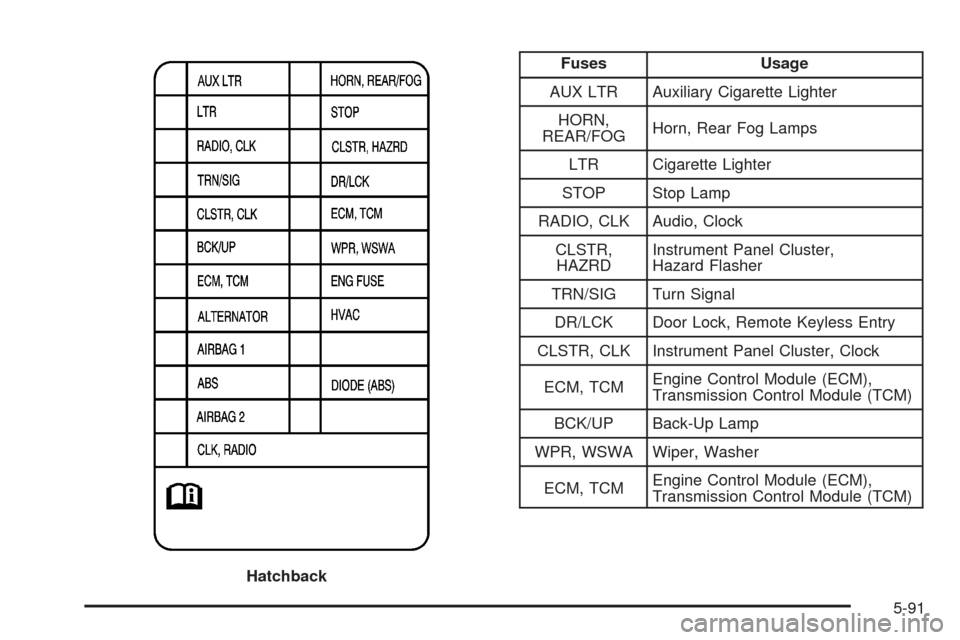
Fuses Usage
AUX LTR Auxiliary Cigarette Lighter
HORN,
REAR/FOGHorn, Rear Fog Lamps
LTR Cigarette Lighter
STOP Stop Lamp
RADIO, CLK Audio, Clock
CLSTR,
HAZRDInstrument Panel Cluster,
Hazard Flasher
TRN/SIG Turn Signal
DR/LCK Door Lock, Remote Keyless Entry
CLSTR, CLK Instrument Panel Cluster, Clock
ECM, TCMEngine Control Module (ECM),
Transmission Control Module (TCM)
BCK/UP Back-Up Lamp
WPR, WSWA Wiper, Washer
ECM, TCMEngine Control Module (ECM),
Transmission Control Module (TCM)
Hatchback
5-91
Page 314 of 384
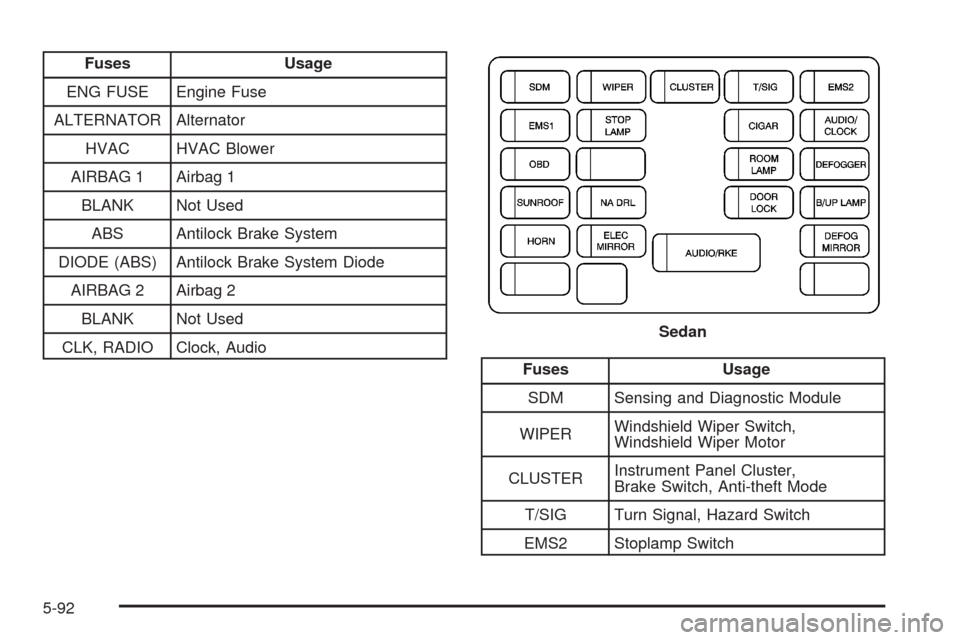
Fuses Usage
ENG FUSE Engine Fuse
ALTERNATOR Alternator
HVAC HVAC Blower
AIRBAG 1 Airbag 1
BLANK Not Used
ABS Antilock Brake System
DIODE (ABS) Antilock Brake System Diode
AIRBAG 2 Airbag 2
BLANK Not Used
CLK, RADIO Clock, Audio
Fuses Usage
SDM Sensing and Diagnostic Module
WIPERWindshield Wiper Switch,
Windshield Wiper Motor
CLUSTERInstrument Panel Cluster,
Brake Switch, Anti-theft Mode
T/SIG Turn Signal, Hazard Switch
EMS2 Stoplamp SwitchSedan
5-92
Page 315 of 384
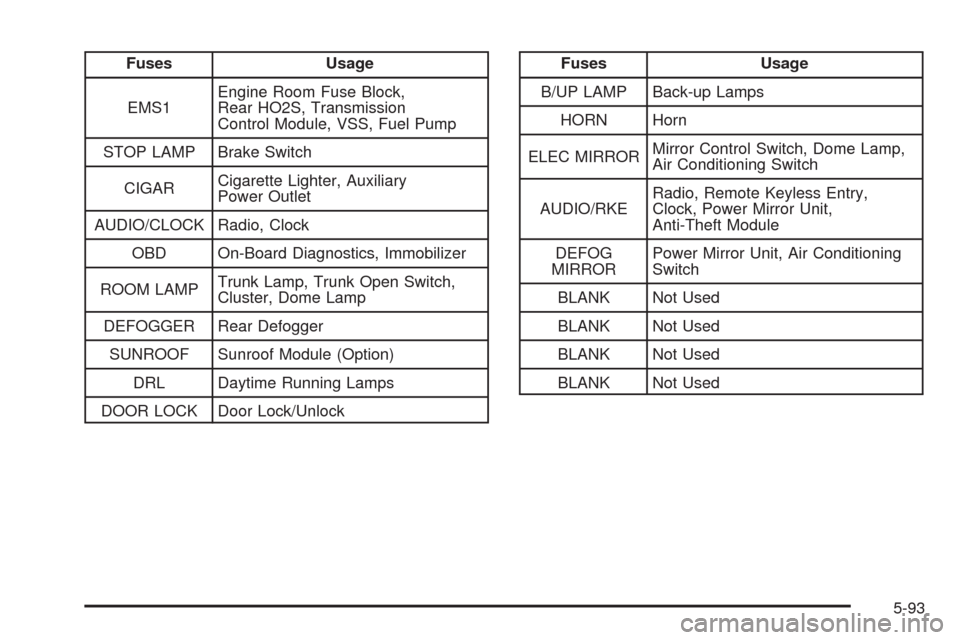
Fuses Usage
EMS1Engine Room Fuse Block,
Rear HO2S, Transmission
Control Module, VSS, Fuel Pump
STOP LAMP Brake Switch
CIGARCigarette Lighter, Auxiliary
Power Outlet
AUDIO/CLOCK Radio, Clock
OBD On-Board Diagnostics, Immobilizer
ROOM LAMPTrunk Lamp, Trunk Open Switch,
Cluster, Dome Lamp
DEFOGGER Rear Defogger
SUNROOF Sunroof Module (Option)
DRL Daytime Running Lamps
DOOR LOCK Door Lock/UnlockFuses Usage
B/UP LAMP Back-up Lamps
HORN Horn
ELEC MIRRORMirror Control Switch, Dome Lamp,
Air Conditioning Switch
AUDIO/RKERadio, Remote Keyless Entry,
Clock, Power Mirror Unit,
Anti-Theft Module
DEFOG
MIRRORPower Mirror Unit, Air Conditioning
Switch
BLANK Not Used
BLANK Not Used
BLANK Not Used
BLANK Not Used
5-93
Page 351 of 384
Customer Assistance and Information...............7-2
Customer Satisfaction Procedure......................7-2
Online Owner Center......................................7-5
Customer Assistance for Text
Telephone (TTY) Users................................7-6
Customer Assistance Offices............................7-6
GM Mobility Reimbursement Program................7-7
Roadside Assistance Program..........................7-8
Scheduling Service Appointments....................7-10
Courtesy Transportation.................................7-11
Collision Damage Repair................................7-13
Reporting Safety Defects................................7-16
Reporting Safety Defects to the
United States Government..........................7-16Reporting Safety Defects to the
Canadian Government................................7-17
Reporting Safety Defects to
General Motors.........................................7-17
Service Publications Ordering
Information...............................................7-17
Vehicle Data Recording and Privacy................7-18
Event Data Recorders...................................7-19
OnStar
®......................................................7-20
Navigation System........................................7-20
Radio Frequency Identification (RFID)..............7-20
Section 7 Customer Assistance Information
7-1
Page 368 of 384

Current and Past Model Order Forms
Technical Service Bulletins and Manuals are
available for current and past model GM vehicles.
To request an order form, specify year and model
name of the vehicle.
ORDER TOLL FREE: 1-800-551-4123
Monday-Friday 8:00 AM - 6:00 PM
Eastern Time
For Credit Card Orders Only
(VISA-MasterCard-Discover), visit Helm, Inc.
on the World Wide Web at: www.helminc.com
Or you can write to:
Helm, Incorporated
P.O. Box 07130
Detroit, MI 48207
Prices are subject to change without notice and without
incurring obligation. Allow ample time for delivery.
Note to Canadian Customers: All listed prices are
quoted in U.S. funds. Canadian residents are to make
checks payable in U.S. funds.
Vehicle Data Recording
and Privacy
Your GM vehicle has a number of sophisticated
computers that record information about the vehicle’s
performance and how it is driven. For example,
your vehicle uses computer modules to monitor
and control engine and transmission performance,
to monitor the conditions for airbag deployment
and deploy airbags in a crash and, if so equipped,
to provide antilock braking to help the driver control the
vehicle. These modules may store data to help your
dealer/retailer technician service your vehicle. Some
modules may also store data about how you operate
the vehicle, such as rate of fuel consumption or average
speed. These modules may also retain the owner’s
personal preferences, such as radio pre-sets, seat
positions, and temperature settings.
7-18
Page 370 of 384
OnStar®
If your vehicle has OnStar®and you subscribe to
the OnStar®services, please refer to the OnStar®
Terms and Conditions for information on data collection
and use.
Navigation System
If your vehicle has a navigation system, use of the
system may result in the storage of destinations,
addresses, telephone numbers, and other trip
information. Refer to the navigation system operating
manual for information on stored data and for
deletion instructions.
Radio Frequency
Identication (RFID)
RFID technology is used in some vehicles for functions
such as tire pressure monitoring and ignition system
security, as well as in connection with conveniences
such as key fobs for remote door locking/unlocking and
starting, and in-vehicle transmitters for garage door
openers. RFID technology in GM vehicles does not use
or record personal information or link with any other
GM system containing personal information.
7-20