2008 CHEVROLET AVEO Coolant
[x] Cancel search: CoolantPage 252 of 384
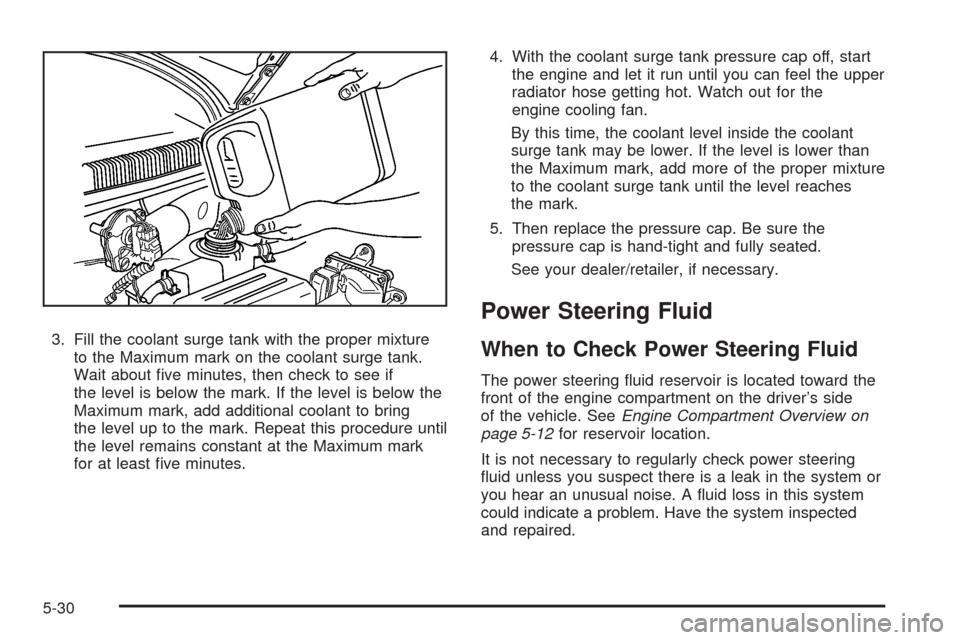
3. Fill the coolant surge tank with the proper mixture
to the Maximum mark on the coolant surge tank.
Wait about five minutes, then check to see if
the level is below the mark. If the level is below the
Maximum mark, add additional coolant to bring
the level up to the mark. Repeat this procedure until
the level remains constant at the Maximum mark
for at least five minutes.4. With the coolant surge tank pressure cap off, start
the engine and let it run until you can feel the upper
radiator hose getting hot. Watch out for the
engine cooling fan.
By this time, the coolant level inside the coolant
surge tank may be lower. If the level is lower than
the Maximum mark, add more of the proper mixture
to the coolant surge tank until the level reaches
the mark.
5. Then replace the pressure cap. Be sure the
pressure cap is hand-tight and fully seated.
See your dealer/retailer, if necessary.
Power Steering Fluid
When to Check Power Steering Fluid
The power steering fluid reservoir is located toward the
front of the engine compartment on the driver’s side
of the vehicle. SeeEngine Compartment Overview on
page 5-12for reservoir location.
It is not necessary to regularly check power steering
fluid unless you suspect there is a leak in the system or
you hear an unusual noise. A fluid loss in this system
could indicate a problem. Have the system inspected
and repaired.
5-30
Page 254 of 384
Adding Washer Fluid
Open the cap with the
washer symbol on it.
Add washer fluid until the
tank is full. SeeEngine
Compartment Overview on
page 5-12for reservoir
location.
Notice:
When using concentrated washer uid, follow
the manufacturer’s instructions for adding
water.
Do not mix water with ready-to-use washer uid.
Water can cause the solution to freeze and
damage your washer uid tank and other parts
of the washer system. Also, water does not
clean as well as washer uid.
Fill the washer uid tank only three-quarters full
when it is very cold. This allows for uid
expansion if freezing occurs, which could
damage the tank if it is completely full.
Do not use engine coolant (antifreeze) in your
windshield washer. It can damage the vehicle’s
windshield washer system and paint.
Brakes
Brake Fluid
Your vehicle has one
reservoir for both the brake
and clutch hydraulic
systems. It is filled with
DOT-3 brake fluid.
SeeEngine Compartment
Overview on page 5-12
for the location of the
reservoir.
There are only two reasons why the brake fluid level in
the reservoir might go down. The first is that the
brake fluid goes down to an acceptable level during
normal brake lining wear. When new linings are put in,
the fluid level goes back up. The other reason is
that fluid is leaking out of the brake or clutch hydraulic
system. If it is, you should have the brake/clutch
hydraulic system fixed, since a leak means that sooner
or later the brakes will not work well.
5-32
Page 276 of 384

(D) Construction Code:A letter code is used
to indicate the type of ply construction in the tire.
The letter R means radial ply construction; the
letter D means diagonal or bias ply construction;
and the letter B means belted-bias ply
construction.
(E) Rim Diameter
:Diameter of the wheel in
inches.
(F) Service Description
:These characters
represent the load range and the speed rating of
a tire. The load range represents the load
carry capacity a tire is certified to carry. The speed
rating is the maximum speed a tire is certified to
carry a load. Speed ratings range from A to Z.
Tire Terminology and Denitions
Air Pressure:The amount of air inside the
tire pressing outward on each square inch of
the tire. Air pressure is expressed in pounds
per square inch (psi) or kilopascal (kPa).
Accessory Weight
:This means the combined
weight of optional accessories. Some examples of
optional accessories are, automatic transmission,
power steering, power brakes, power windows,
power seats, and air conditioning.Aspect Ratio
:The relationship of a tire’s height
to its width.
Belt
:A rubber coated layer of cords that is
located between the plies and the tread. Cords
may be made from steel or other reinforcing
materials.
Bead
:The tire bead contains steel wires wrapped
by steel cords that hold the tire onto the rim.
Bias Ply Tire
:A pneumatic tire in which the plies
are laid at alternate angles less than 90 degrees
to the centerline of the tread.
Cold Tire Pressure
:The amount of air pressure
in a tire, measured in pounds per square inch (psi)
or kilopascals (kPa) before a tire has built up heat
from driving. SeeInflation - Tire Pressure on
page 5-57.
Curb Weight
:The weight of a motor vehicle
with standard and optional equipment including
the maximum capacity of fuel, oil, and coolant,
but without passengers and cargo.
5-54
Page 336 of 384
90,000 Miles (150 000 km)
❑Change engine oil and filter (or every 3 months,
whichever occurs first).An Emission Control Service.
❑Replace passenger compartment air filter. If you
drive regularly under dusty conditions, the filter
may require replacement more often.
❑Replace engine air cleaner filter. SeeEngine Air
Cleaner/Filter on page 5-17for more information.
❑Rotate tires. SeeTire Inspection and Rotation on
page 5-61for proper rotation pattern and additional
information.(See footnote +.)
❑Replace spark plugs.An Emission Control Service.
❑Replace fuel filter.An Emission Control Service.
(See footnote †.)
❑Inspect drive belt(s).
❑Inspect EVAP canister, vapor lines, and EVAP
vent solenoid valve.An Emission Control Service.
(See footnote †.)
❑Inspect PCV system.An Emission Control Service.
(See footnote †.)
93,000 Miles (155 000 km)
❑Change engine oil and filter (or every 3 months,
whichever occurs first).An Emission Control Service.
96,000 Miles (160 000 km)
❑Change engine oil and filter (or every 3 months,
whichever occurs first).An Emission Control Service.
❑Rotate tires. SeeTire Inspection and Rotation
on page 5-61for proper rotation pattern and
additional information.(See footnote +.)
99,000 Miles (165 000 km)
❑Change engine oil and filter (or every 3 months,
whichever occurs first).An Emission Control Service.
150,000 Miles (240 000 km)
❑Drain, flush, and refill cooling system. This service
can be complex; you should have your dealer/retailer
perform this service. SeeEngine Coolant on
page 5-22for what to use. Inspect hoses. Clean
radiator, condenser, pressure cap, and neck.
Pressure test the cooling system and pressure cap.
An Emission Control Service.
6-12
Page 341 of 384
90,000 Miles (150 000 km)
❑Change engine oil and filter (or every 12 months,
whichever occurs first).An Emission Control
Service.
❑Replace engine oil pan drain plug washer.
❑Replace passenger compartment air filter. If you
drive regularly under dusty conditions, the filter
may require replacement more often.
❑Replace engine air cleaner filter. SeeEngine Air
Cleaner/Filter on page 5-17for more information.
❑Rotate tires. SeeTire Inspection and Rotation on
page 5-61for proper rotation pattern and additional
information.(See footnote +.)
❑Replace spark plugs.An Emission Control Service.
❑Replace fuel filter.An Emission Control Service.
(See footnote †.)
❑Inspect drive belt(s).
❑Inspect EVAP canister, vapor lines and EVAP
vent solenoid valve.An Emission Control Service.
(See footnote †.)
❑Inspect PCV system.An Emission Control Service.
(See footnote †.)
97,500 Miles (162 500 km)
❑Change engine oil and filter (or every 12 months,
whichever occurs first).An Emission Control
Service.
❑Rotate tires. SeeTire Inspection and Rotation on
page 5-61for proper rotation pattern and additional
information.(See footnote +.)
150,000 Miles (240 000 km)
❑Drain, flush, and refill cooling system. This service
can be complex; you should have your dealer/retailer
perform this service. SeeEngine Coolant on
page 5-22for what to use. Inspect hoses. Clean
radiator, condenser, pressure cap, and neck.
Pressure test the cooling system and pressure cap.
An Emission Control Service.
6-17
Page 342 of 384
Part B: Owner Checks and Services
Listed in this part are owner checks and services
which should be performed at the intervals specified
to help ensure the safety, dependability and emission
control performance of your vehicle.
Be sure any necessary repairs are completed at once.
Whenever any fluids or lubricants are added to your
vehicle, make sure they are the proper ones, as
shown in Part D.
At Each Fuel Fill
It is important to perform these underhood checks
at each fuel fill.
Engine Oil Level Check
Notice:It is important to check the engine oil
regularly and keep it at the proper level. Failure to
keep the engine oil at the proper level can cause
damage to the engine not covered by your warranty.
Check the engine oil level and add the proper oil if
necessary. SeeEngine Oil on page 5-13.
Engine Coolant Level Check
Check the engine coolant level and add DEX-COOL®
coolant mixture if necessary. SeeEngine Coolant
on page 5-22.
Windshield Washer Fluid Level Check
Check the windshield washer fluid level in the windshield
washer fluid reservoir and add the proper fluid if
necessary.
At Least Once a Month
Tire Ination Check
Inspect the tires and make sure the tires are inflated to
the correct pressures. Do not forget to check the spare
tire. SeeInflation - Tire Pressure on page 5-57.
At Least Twice a Year
Restraint System Check
Make sure the safety belt reminder light and safety belt
assemblies are working properly. Look for any other
loose or damaged safety belt system parts. If you see
anything that might keep a safety belt system from
doing its job, have it repaired. Have any torn or frayed
safety belts replaced. Also seeChecking the Restraint
Systems on page 1-72.
6-18
Page 347 of 384
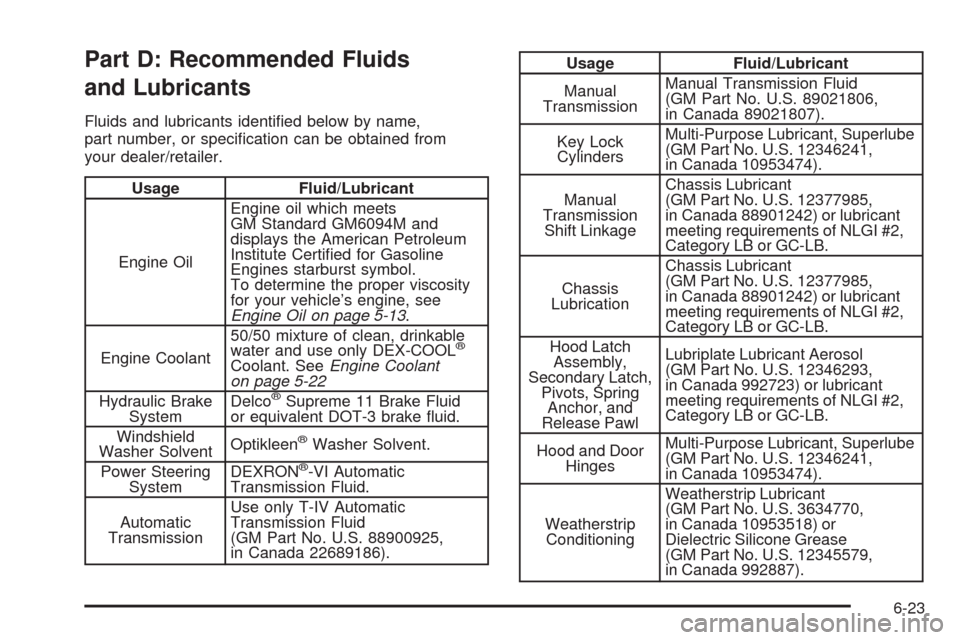
Part D: Recommended Fluids
and Lubricants
Fluids and lubricants identified below by name,
part number, or specification can be obtained from
your dealer/retailer.
Usage Fluid/Lubricant
Engine OilEngine oil which meets
GM Standard GM6094M and
displays the American Petroleum
Institute Certified for Gasoline
Engines starburst symbol.
To determine the proper viscosity
for your vehicle’s engine, see
Engine Oil on page 5-13.
Engine Coolant50/50 mixture of clean, drinkable
water and use only DEX-COOL
®
Coolant. SeeEngine Coolant
on page 5-22
Hydraulic Brake
SystemDelco
®Supreme 11 Brake Fluid
or equivalent DOT-3 brake fluid.
Windshield
Washer SolventOptikleen
®Washer Solvent.
Power Steering
SystemDEXRON
®-VI Automatic
Transmission Fluid.
Automatic
TransmissionUse only T-IV Automatic
Transmission Fluid
(GM Part No. U.S. 88900925,
in Canada 22689186).
Usage Fluid/Lubricant
Manual
TransmissionManual Transmission Fluid
(GM Part No. U.S. 89021806,
in Canada 89021807).
Key Lock
CylindersMulti-Purpose Lubricant, Superlube
(GM Part No. U.S. 12346241,
in Canada 10953474).
Manual
Transmission
Shift LinkageChassis Lubricant
(GM Part No. U.S. 12377985,
in Canada 88901242) or lubricant
meeting requirements of NLGI #2,
Category LB or GC-LB.
Chassis
LubricationChassis Lubricant
(GM Part No. U.S. 12377985,
in Canada 88901242) or lubricant
meeting requirements of NLGI #2,
Category LB or GC-LB.
Hood Latch
Assembly,
Secondary Latch,
Pivots, Spring
Anchor, and
Release PawlLubriplate Lubricant Aerosol
(GM Part No. U.S. 12346293,
in Canada 992723) or lubricant
meeting requirements of NLGI #2,
Category LB or GC-LB.
Hood and Door
HingesMulti-Purpose Lubricant, Superlube
(GM Part No. U.S. 12346241,
in Canada 10953474).
Weatherstrip
ConditioningWeatherstrip Lubricant
(GM Part No. U.S. 3634770,
in Canada 10953518) or
Dielectric Silicone Grease
(GM Part No. U.S. 12345579,
in Canada 992887).
6-23
Page 373 of 384
Check
Engine Light.......................................3-36, 3-49
Checking Things Under the Hood......................5-10
Chemical Paint Spotting...................................5-86
Child Restraints
Child Restraint Systems...............................1-38
Infants and Young Children...........................1-34
Lower Anchors and Tethers for Children..........1-42
Older Children.............................................1-32
Securing a Child Restraint in a
Rear Seat Position...................................1-49
Securing a Child Restraint in the
Right Front Seat Position..........................1-52
Where to Put the Restraint...........................1-40
Cigarette Lighter.............................................3-19
Cleaning
Aluminum Wheels........................................5-85
Exterior Lamps/Lenses.................................5-83
Fabric/Carpet..............................................5-80
Finish Care.................................................5-83
Instrument Panel, Vinyl, and Other
Plastic Surfaces.......................................5-82
Interior.......................................................5-79
Leather......................................................5-81
Tires..........................................................5-85
Underbody Maintenance...............................5-86Cleaning (cont.)
Washing Your Vehicle...................................5-83
Weatherstrips..............................................5-82
Windshield and Wiper Blades........................5-84
Climate Control System...................................3-20
Air Filter, Passenger Compartment.................3-24
Outlet Adjustment........................................3-24
Clock....................................................3-20, 3-44
Clutch, Hydraulic.............................................5-21
Collision Damage Repair..................................7-13
Compact Spare Tire........................................5-78
Control of a Vehicle.......................................... 4-3
Coolant
Engine Temperature Gage
............................3-35
Heater, Engine............................................2-20
Surge Tank Pressure Cap.............................5-25
Cooling System..............................................5-26
Cruise Control................................................3-13
Cruise Control Light................................3-40, 3-53
Cupholder(s)..................................................2-35
Customer Assistance Information
Courtesy Transportation................................7-11
Customer Assistance for Text
Telephone (TTY) Users............................... 7-6
Customer Assistance Offices........................... 7-6
Customer Satisfaction Procedure..................... 7-2
3