Page 17 of 384
{CAUTION:
A safety belt that is improperly routed, not
properly attached, or twisted will not provide
the protection needed in a crash. The person
wearing the belt could be seriously injured.
After raising the rear seatback, always check
to be sure that the safety belts are properly
routed and attached, and are not twisted.
5. Lift the seatback up and push it back to its original
latched position.
6. Unhook the safety belts in the outboard seating
positions from the retaining clips.
7. Return the safety belt buckles and the center seat
safety belt to their original position between the
rear seatback and the seat cushion. Make sure
the straps of the safety belt and buckles are
not twisted.8. To reattach the center seat safety belt to the mini
buckle, pull it from the retractor.
9. Reattach the center safety belt by pushing the latch
plate into the buckle until it clicks.
{CAUTION:
If the seatback is not locked, it could move
forward in a sudden stop or crash. That could
cause injury to the person sitting there. Always
push and pull on the seatback to be sure it
is locked.
10. Push down and rearward firmly on the top of
the seatback until it latches securely in the fully
upright position.
1-13
Page 18 of 384
Safety Belts
Safety Belts: They Are for Everyone
This part of the manual tells you how to use safety
belts properly. It also tells you some things you should
not do with safety belts.
{CAUTION:
Do not let anyone ride where he or she cannot
wear a safety belt properly. If you are in a
crash and you are not wearing a safety belt,
your injuries can be much worse. You can hit
things inside the vehicle harder or be ejected
from it and be seriously injured or killed.
In the same crash, you might not be, if you
are buckled up. Always fasten your safety
belt, and check that your passenger(s) are
restrained properly too.
{CAUTION:
It is extremely dangerous to ride in a cargo
area, inside or outside of a vehicle. In a
collision, people riding in these areas are more
likely to be seriously injured or killed. Do not
allow people to ride in any area of your vehicle
that is not equipped with seats and safety
belts. Be sure everyone in your vehicle is in
a seat and using a safety belt properly.
Your vehicle has indicators as a reminder to buckle your
safety belts. SeeSafety Belt Reminders on page 3-30.
In most states and in all Canadian provinces, the
law requires wearing safety belts. Here is why:
You never know if you will be in a crash. If you do have
a crash, you do not know if it will be a serious one.
A few crashes are mild, and some crashes can be so
serious that even buckled up, a person would not
survive. But most crashes are in between. In many of
them, people who buckle up can survive and sometimes
walk away. Without belts they could have been badly
hurt or killed.
1-14
Page 26 of 384
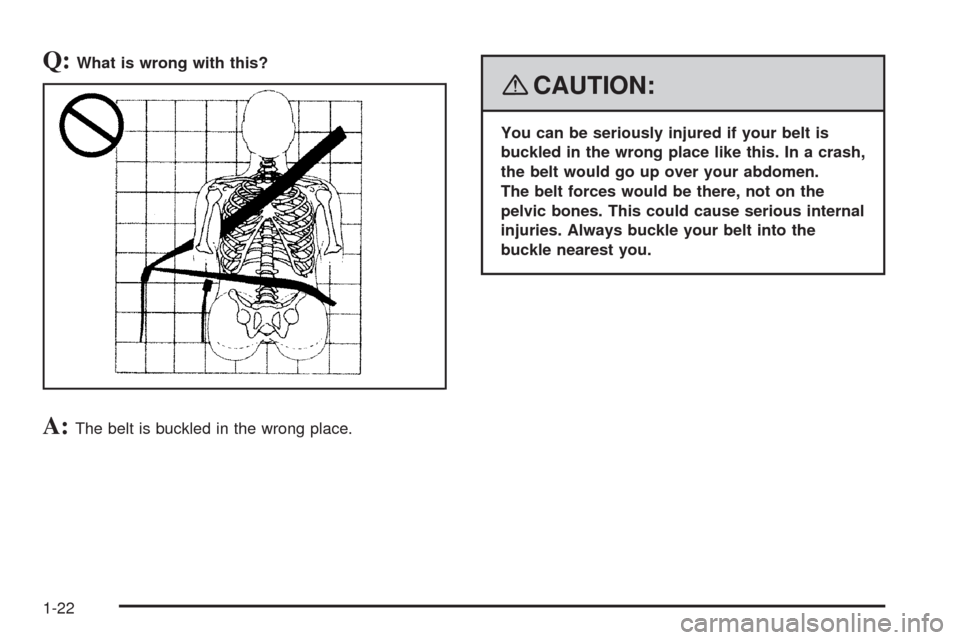
Q:What is wrong with this?
A:The belt is buckled in the wrong place.
{CAUTION:
You can be seriously injured if your belt is
buckled in the wrong place like this. In a crash,
the belt would go up over your abdomen.
The belt forces would be there, not on the
pelvic bones. This could cause serious internal
injuries. Always buckle your belt into the
buckle nearest you.
1-22
Page 27 of 384
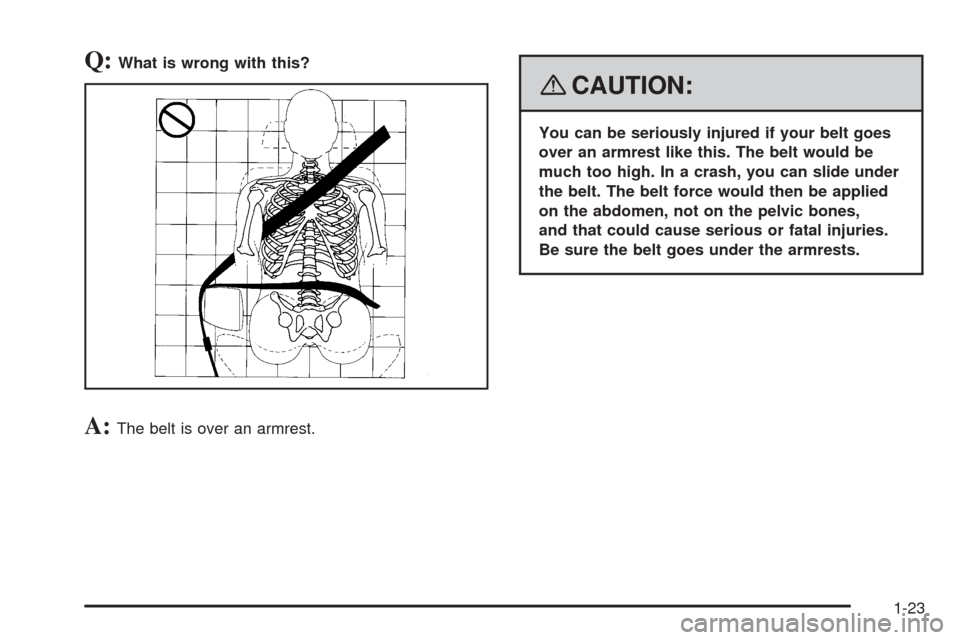
Q:What is wrong with this?
A:The belt is over an armrest.
{CAUTION:
You can be seriously injured if your belt goes
over an armrest like this. The belt would be
much too high. In a crash, you can slide under
the belt. The belt force would then be applied
on the abdomen, not on the pelvic bones,
and that could cause serious or fatal injuries.
Be sure the belt goes under the armrests.
1-23
Page 28 of 384
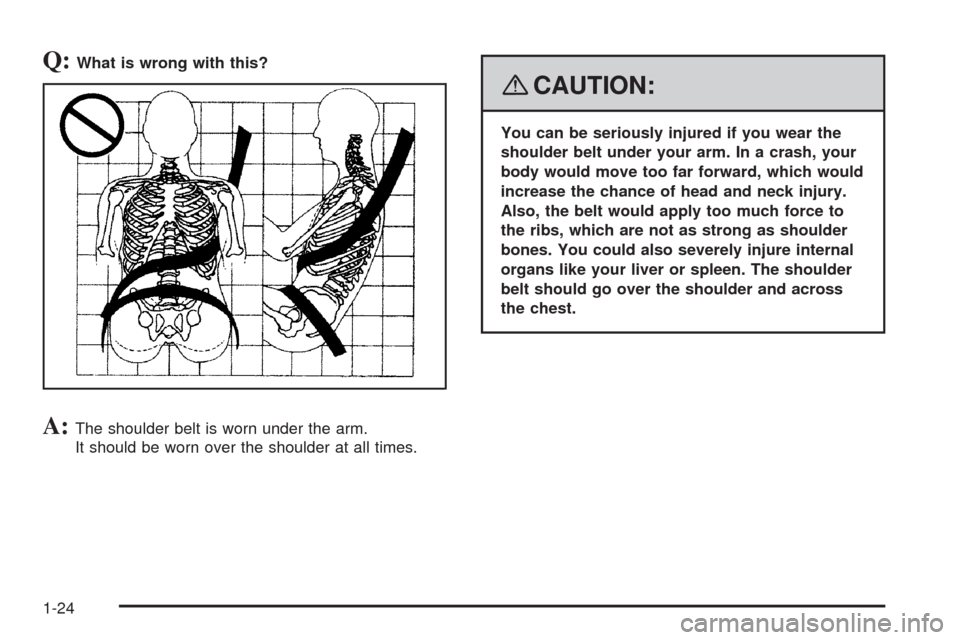
Q:What is wrong with this?
A:The shoulder belt is worn under the arm.
It should be worn over the shoulder at all times.
{CAUTION:
You can be seriously injured if you wear the
shoulder belt under your arm. In a crash, your
body would move too far forward, which would
increase the chance of head and neck injury.
Also, the belt would apply too much force to
the ribs, which are not as strong as shoulder
bones. You could also severely injure internal
organs like your liver or spleen. The shoulder
belt should go over the shoulder and across
the chest.
1-24
Page 29 of 384
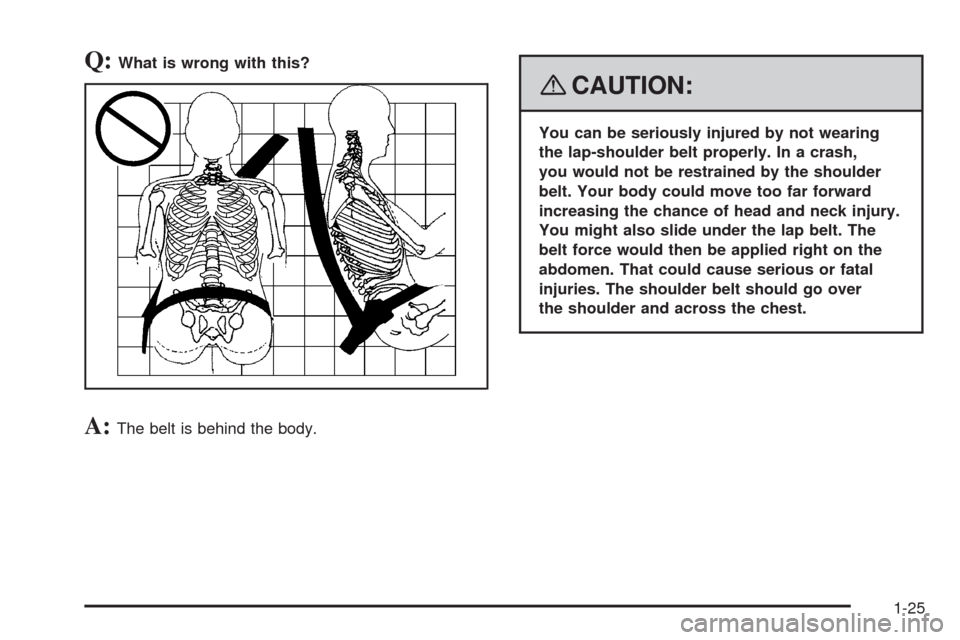
Q:What is wrong with this?
A:The belt is behind the body.
{CAUTION:
You can be seriously injured by not wearing
the lap-shoulder belt properly. In a crash,
you would not be restrained by the shoulder
belt. Your body could move too far forward
increasing the chance of head and neck injury.
You might also slide under the lap belt. The
belt force would then be applied right on the
abdomen. That could cause serious or fatal
injuries. The shoulder belt should go over
the shoulder and across the chest.
1-25
Page 30 of 384
Q:What is wrong with this?
A:The belt is twisted across the body.
{CAUTION:
You can be seriously injured by a twisted belt.
In a crash, you would not have the full width
of the belt to spread impact forces. If a belt
is twisted, make it straight so it can work
properly, or ask your dealer/retailer to x it.
1-26
Page 32 of 384
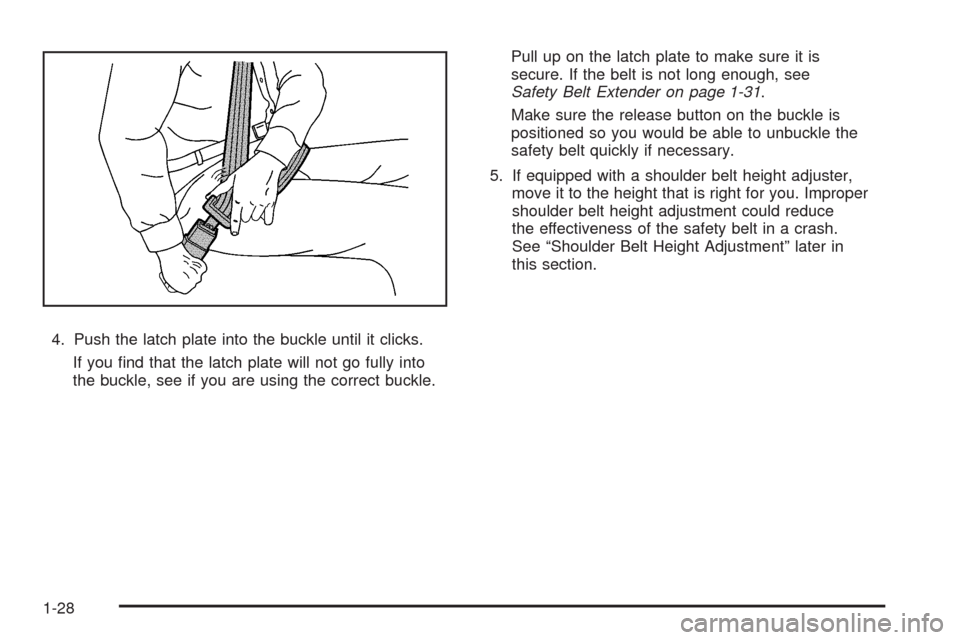
4. Push the latch plate into the buckle until it clicks.
If you find that the latch plate will not go fully into
the buckle, see if you are using the correct buckle.Pull up on the latch plate to make sure it is
secure. If the belt is not long enough, see
Safety Belt Extender on page 1-31.
Make sure the release button on the buckle is
positioned so you would be able to unbuckle the
safety belt quickly if necessary.
5. If equipped with a shoulder belt height adjuster,
move it to the height that is right for you. Improper
shoulder belt height adjustment could reduce
the effectiveness of the safety belt in a crash.
See “Shoulder Belt Height Adjustment” later in
this section.
1-28