2008 CHEVROLET AVEO heater
[x] Cancel search: heaterPage 59 of 384
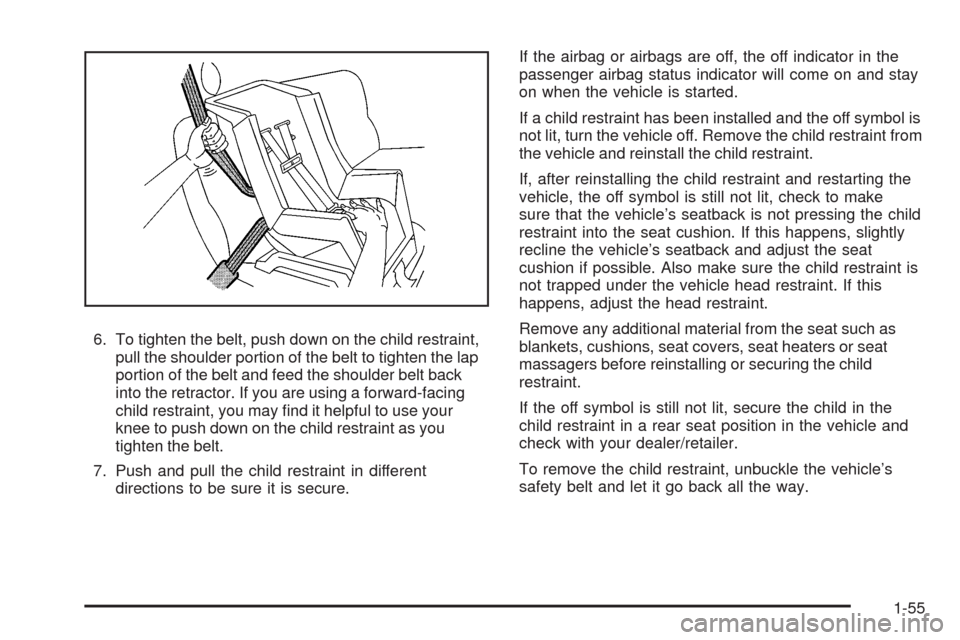
6. To tighten the belt, push down on the child restraint,
pull the shoulder portion of the belt to tighten the lap
portion of the belt and feed the shoulder belt back
into the retractor. If you are using a forward-facing
child restraint, you may find it helpful to use your
knee to push down on the child restraint as you
tighten the belt.
7. Push and pull the child restraint in different
directions to be sure it is secure.If the airbag or airbags are off, the off indicator in the
passenger airbag status indicator will come on and stay
on when the vehicle is started.
If a child restraint has been installed and the off symbol is
not lit, turn the vehicle off. Remove the child restraint from
the vehicle and reinstall the child restraint.
If, after reinstalling the child restraint and restarting the
vehicle, the off symbol is still not lit, check to make
sure that the vehicle’s seatback is not pressing the child
restraint into the seat cushion. If this happens, slightly
recline the vehicle’s seatback and adjust the seat
cushion if possible. Also make sure the child restraint is
not trapped under the vehicle head restraint. If this
happens, adjust the head restraint.
Remove any additional material from the seat such as
blankets, cushions, seat covers, seat heaters or seat
massagers before reinstalling or securing the child
restraint.
If the off symbol is still not lit, secure the child in the
child restraint in a rear seat position in the vehicle and
check with your dealer/retailer.
To remove the child restraint, unbuckle the vehicle’s
safety belt and let it go back all the way.
1-55
Page 72 of 384
If a child restraint has been installed and the off
symbol is not lit, turn the vehicle off. Remove the
child restraint from the vehicle and reinstall the child
restraint following the child restraint manufacturer’s
directions and refer toSecuring a Child Restraint in
the Right Front Seat Position on page 1-52.
If, after reinstalling the child restraint and restarting the
vehicle, the off symbol is still not lit, check to make
sure that the vehicle’s seatback is not pressing the child
restraint into the seat cushion. If this happens, slightly
recline the vehicle’s seatback and adjust the seat
cushion if possible. Also make sure the child restraint
is not trapped under the vehicle head restraint.
If this happens, adjust the head restraint. SeeHead
Restraints on page 1-6.
Remove any additional material from the seat such
as blankets, cushions, seat covers, seat heaters,
or seat massagers before reinstalling or securing the
child restraint.
If the off symbol is still not lit, secure the child in the
child restraint in a rear seat position in the vehicle
and check with your dealer/retailer.The passenger sensing system is designed to enable
(may inflate) the right front passenger’s frontal airbag and
seat-mounted side impact airbag (if equipped) anytime
the system senses that a person of adult size is sitting
properly in the right front passenger’s seat. When the
passenger sensing system has allowed the airbag or
airbags to be enabled, the off symbol will not light.
For some children who have outgrown child restraints
and for very small adults, the passenger sensing system
may or may not turn off the right front passenger’s
frontal airbag and seat-mounted side impact airbag
(if equipped), depending upon the person’s seating
posture and body build. Everyone in your vehicle who
has outgrown child restraints should wear a safety
belt properly — whether or not there is an airbag for
that person.
If a person of adult-size is sitting in the right front
passenger’s seat, but the off symbol is lit, it could be
because that person is not sitting properly in the seat.
If this happens, turn the vehicle off, remove any additional
material from the seat, such as blankets, cushions,
seat covers, seat heaters or seat massagers and ask
the person to place the seatback in the fully upright
position, then sit upright in the seat, centered on the seat
cushion, with the person’s legs comfortably extended.
1-68
Page 74 of 384
A thick layer of additional material, such as a blanket
or cushion, or aftermarket equipment such as seat
covers, seat heaters, and seat massagers can affect
how well the passenger sensing system operates.
We recommend that you not use seat covers or other
aftermarket equipment other than any that GM has
approved for your specific vehicle. SeeAdding
Equipment to Your Airbag-Equipped Vehicle on
page 1-71for more information about modifications
that can affect how the system operates.
{CAUTION:
Stowing of articles under the passenger’s
seat or between the passenger’s seat cushion
and seatback may interfere with the proper
operation of the passenger sensing system.
Servicing Your Airbag-Equipped
Vehicle
Airbags affect how your vehicle should be serviced.
There are parts of the airbag system in several places
around your vehicle. Your dealer/retailer and the service
manual have information about servicing your vehicle
and the airbag system. To purchase a service manual,
seeService Publications Ordering Information on
page 7-17.
{CAUTION:
For up to 10 seconds after the ignition is
turned off and the battery is disconnected,
an airbag can still inate during improper
service. You can be injured if you are close
to an airbag when it inates. Avoid yellow
connectors. They are probably part of the
airbag system. Be sure to follow proper
service procedures, and make sure the person
performing work for you is qualied to do so.
1-70
Page 75 of 384

Adding Equipment to Your
Airbag-Equipped Vehicle
Q:Is there anything I might add to or change
about the vehicle that could keep the airbags
from working properly?
A:Yes. If you add things that change your vehicle’s
frame, bumper system, height, front end or side
sheet metal, they may keep the airbag system from
working properly. Changing or moving any parts
of the front seats, safety belts, the airbag sensing
and diagnostic module, steering wheel, instrument
panel, front sensors, or airbag wiring can affect
the operation of the airbag system.
In addition, your vehicle has a passenger sensing
system for the right front passenger’s position,
which includes sensors that are part of the
passenger’s seat. The passenger sensing system
may not operate properly if the original seat
trim is replaced with non-GM covers, upholstery
or trim, or with GM covers, upholstery or trim
designed for a different vehicle. Any object, such
as an aftermarket seat heater or a comfort
enhancing pad or device, installed under or on
top of the seat fabric, could also interfere with
the operation of the passenger sensing system.This could either prevent proper deployment of
the passenger airbag(s) or prevent the passenger
sensing system from properly turning off the
passenger airbag(s). SeePassenger Sensing
System on page 1-65.
If you have any questions about this, you should
contact Customer Assistance before you modify
your vehicle. The phone numbers and addresses
for Customer Assistance are in Step Two of
the Customer Satisfaction Procedure in this manual.
SeeCustomer Satisfaction Procedure on page 7-2.
Q:Because I have a disability, I have to get
my vehicle modied. How can I nd out whether
this will affect my airbag system?
A:If you have questions, call Customer Assistance.
The phone numbers and addresses for Customer
Assistance are in Step Two of the Customer
Satisfaction Procedure in this manual. See
Customer Satisfaction Procedure on page 7-2.
In addition, your dealer/retailer and the service manual
have information about the location of the airbag
sensors, sensing and diagnostic module and airbag
wiring.
1-71
Page 79 of 384
Keys...............................................................2-2
Remote Keyless Entry (RKE) System................2-3
Remote Keyless Entry (RKE) System
Operation...................................................2-4
Doors and Locks.............................................2-6
Door Locks....................................................2-6
Central Door Unlocking System........................2-7
Door Ajar Reminder........................................2-7
Rear Door Security Locks................................2-8
Lockout Protection..........................................2-8
Trunk............................................................2-9
Liftgate (Hatchback)......................................2-11
Windows........................................................2-12
Manual Windows..........................................2-12
Power Windows............................................2-13
Sun Visors...................................................2-14
Theft-Deterrent Systems..................................2-14
Theft-Deterrent System..................................2-14
Immobilizer..................................................2-16
Immobilizer Operation....................................2-16
Starting and Operating Your Vehicle................2-17
New Vehicle Break-In....................................2-17
Ignition Positions..........................................2-18
Starting the Engine.......................................2-19Engine Coolant Heater..................................2-20
Automatic Transmission Operation...................2-21
Manual Transmission Operation......................2-25
Parking Brake..............................................2-26
Shifting Into PARK (P)
(Automatic Transmission)............................2-27
Shifting Out of PARK (P)...............................2-28
Parking Your Vehicle
(Manual Transmission)...............................2-29
Parking Over Things That Burn.......................2-30
Engine Exhaust............................................2-30
Running the Engine While Parked..................
.2-31
Mirrors...........................................................2-32
Manual Rearview Mirror.................................2-32
Outside Manual Mirrors..................................2-32
Outside Power Mirror....................................2-33
Outside Convex Mirror...................................2-34
Outside Heated Mirrors..................................2-34
Storage Areas................................................2-34
Glove Box...................................................2-34
Cupholder(s)................................................2-35
Sunglasses Storage Compartment...................2-35
Sunroof.........................................................2-36
Section 2 Features and Controls
2-1
Page 98 of 384

3. If the engine still will not start, or starts but then
stops, it could be flooded with too much gasoline.
Try pushing your accelerator pedal all the way to the
floor and holding it there as you hold the key in
START for about three seconds. If the vehicle starts
briefly but then stops again, do the same thing, but
this time keep the pedal down for five or six seconds.
This clears the extra gasoline from the engine.
Notice:The engine is designed to work with the
electronics in your vehicle. If electrical parts or
accessories are added, you could change the way
the engine operates. Before adding electrical
equipment, check with your dealer/retailer. If you
do not, the engine might not perform properly.
Any resulting damage would not be covered by
your vehicle’s warranty.
Engine Coolant Heater
The engine coolant heater, if available, can help in cold
weather conditions at or below 0°F (−18°C) for easier
starting and better fuel economy during engine warm-up.
Plug in the coolant heater at least four hours before
starting your vehicle.
To Use the Engine Coolant Heater
1. Turn off the engine.
2. Open the hood and unwrap the electrical cord.
The cord is located on the driver’s side of the
engine compartment, near the battery.
3. Plug it into a normal, grounded 110-Volt AC outlet.
{CAUTION:
Plugging the cord into an ungrounded outlet
could cause an electrical shock. Also, the
wrong kind of extension cord could overheat
and cause a re. You could be seriously injured.
Plug the cord into a properly grounded
three-prong 110-volt AC outlet. If the cord
will not reach, use a heavy-duty three-prong
extension cord rated for at least 15 amps.
4. Before starting the engine, be sure to unplug and
store the cord as it was before to keep it away
from moving engine parts. If you do not, it could
be damaged.
2-20
Page 99 of 384
How long should you keep the coolant heater plugged in?
The answer depends on the outside temperature, the
kind of oil you have, and some other things. Instead of
trying to list everything here, we ask that you contact your
dealer/retailer in the area where you will be parking your
vehicle. The dealer/retailer can give you the best advice
for that particular area.
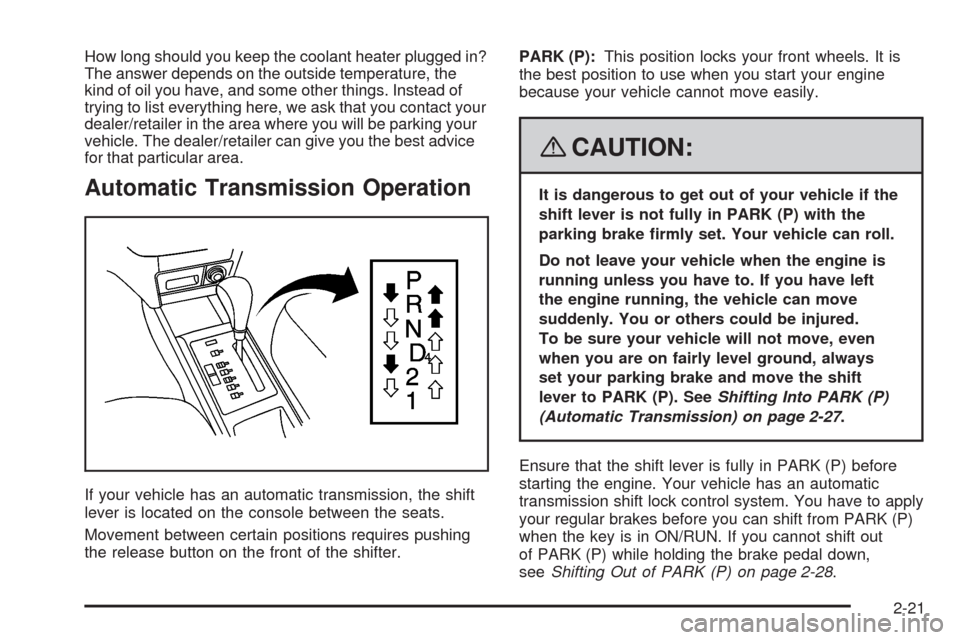
Automatic Transmission Operation
If your vehicle has an automatic transmission, the shift
lever is located on the console between the seats.
Movement between certain positions requires pushing
the release button on the front of the shifter.PARK (P):This position locks your front wheels. It is
the best position to use when you start your engine
because your vehicle cannot move easily.
{CAUTION:
It is dangerous to get out of your vehicle if the
shift lever is not fully in PARK (P) with the
parking brake rmly set. Your vehicle can roll.
Do not leave your vehicle when the engine is
running unless you have to. If you have left
the engine running, the vehicle can move
suddenly. You or others could be injured.
To be sure your vehicle will not move, even
when you are on fairly level ground, always
set your parking brake and move the shift
lever to PARK (P). SeeShifting Into PARK (P)
(Automatic Transmission) on page 2-27.
Ensure that the shift lever is fully in PARK (P) before
starting the engine. Your vehicle has an automatic
transmission shift lock control system. You have to apply
your regular brakes before you can shift from PARK (P)
when the key is in ON/RUN. If you cannot shift out
of PARK (P) while holding the brake pedal down,
seeShifting Out of PARK (P) on page 2-28.
2-21
Page 210 of 384
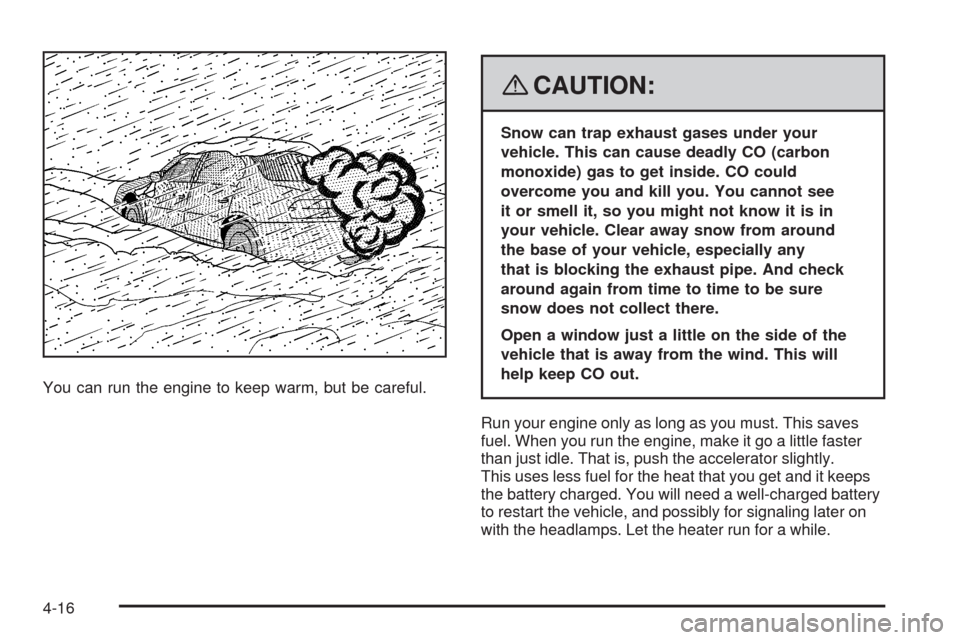
You can run the engine to keep warm, but be careful.
{CAUTION:
Snow can trap exhaust gases under your
vehicle. This can cause deadly CO (carbon
monoxide) gas to get inside. CO could
overcome you and kill you. You cannot see
it or smell it, so you might not know it is in
your vehicle. Clear away snow from around
the base of your vehicle, especially any
that is blocking the exhaust pipe. And check
around again from time to time to be sure
snow does not collect there.
Open a window just a little on the side of the
vehicle that is away from the wind. This will
help keep CO out.
Run your engine only as long as you must. This saves
fuel. When you run the engine, make it go a little faster
than just idle. That is, push the accelerator slightly.
This uses less fuel for the heat that you get and it keeps
the battery charged. You will need a well-charged battery
to restart the vehicle, and possibly for signaling later on
with the headlamps. Let the heater run for a while.
4-16