2008 BMW X3 3.0SI lock
[x] Cancel search: lockPage 111 of 140

Reference
At a glance
Controls
Driving tips
Mobility
109
bracket. To do so, loosen the bolt, refer to
arrow, and place the reservoir to one side.
Bear in mind that the windshield washing
system reservoir is heavy. Failure to take
this into account can lead to personal injury or
damage to the vehicle.<
For bulb replacement procedure, refer to
Driver's side.
Halogen high beams
H7 bulb, 55 watts
Always wear gloves and eye protection –
the atmosphere inside the H7 bulb is
pressurized. Failure to observe this precaution
can lead to injuries should the bulb be dam-
aged.<
For checking and adjusting headlamp
aim, please contact your BMW Sports
Activity Vehicle Center.<
Driver's side
1.Open the clip and remove the lamp cover.
2.Press the bulb holder downward and
remove, refer to Low beams.
3.Pull off the lamp base; plug in a new lamp
base.
4.Place the lamp base with the lower edge
against the bracket and press it in until the
lamp base locks into place.
Make sure that the cover does not fall into
the engine compartment; otherwise, the
vehicle can be damaged or other road users can
be endangered.<
Front passenger side
Before replacing the bulb, remove the reservoir
of the windshield washer system from the
bracket, refer to Halogen low beams on
page108.
For bulb replacement procedure, refer to
Driver's side.
Parking and roadside parking lamps
W5W bulb, 5 watts
A bulb is located over each high beam.
1.Remove bulb cover for high beams, refer to
Halogen high beams.
2.Remove bulb holder.
3.Remove and replace the bulb.
Turn signal, front
PSY24WSV bulb, 24 watts
Access to the turn signal is at the edge of the
lamp unit, refer to arrow.
Make sure that the lamp base does not fall
into the engine compartment; otherwise,
the vehicle can be damaged or other road users
can be endangered.<
1.Turn the lamp base and remove it.
2.Replace the bulb.
3.Insert the lamp base. If it does not snap into
place immediately, turn the lamp base until
it does.
Page 113 of 140
Reference
At a glance
Controls
Driving tips
Mobility
111
Brake lamp:
1.Remove bulb holder, refer to arrow 2.
2.Remove and replace the bulb.
License plate lamps
C5W bulb, 5 watts
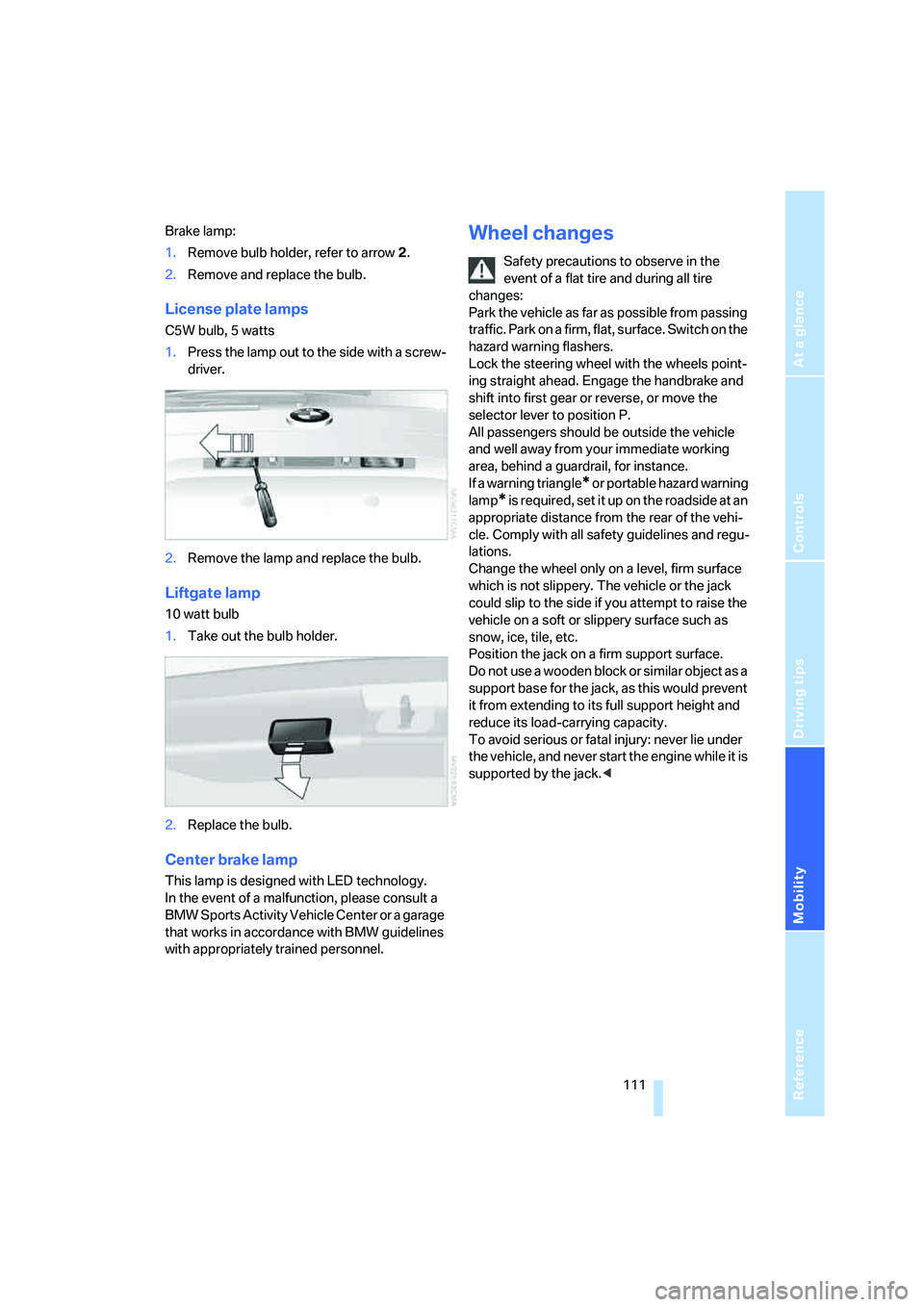
1.Press the lamp out to the side with a screw-
driver.
2.Remove the lamp and replace the bulb.
Liftgate lamp
10 watt bulb
1.Take out the bulb holder.
2.Replace the bulb.
Center brake lamp
This lamp is designed with LED technology.
In the event of a malfunction, please consult a
BMW Sports Activity Vehicle Center or a garage
that works in accordance with BMW guidelines
with appropriately trained personnel.
Wheel changes
Safety precautions to observe in the
event of a flat tire and during all tire
changes:
Park the vehicle as far as possible from passing
traffic. Park on a firm, flat, surface. Switch on the
hazard warning flashers.
Lock the steering wheel with the wheels point-
ing straight ahead. Engage the handbrake and
shift into first gear or reverse, or move the
selector lever to position P.
All passengers should be outside the vehicle
and well away from your immediate working
area, behind a guardrail, for instance.
If a warning triangle
* or portable hazard warning
lamp
* is r e q u ir e d , s et i t up o n t h e ro a d s id e a t a n
appropriate distance from the rear of the vehi-
cle. Comply with all safety guidelines and regu-
lations.
Change the wheel only on a level, firm surface
which is not slippery. The vehicle or the jack
could slip to the side if you attempt to raise the
vehicle on a soft or slippery surface such as
snow, ice, tile, etc.
Position the jack on a firm support surface.
Do not use a wooden block or similar object as a
support base for the jack, as this would prevent
it from extending to its full support height and
reduce its load-carrying capacity.
To avoid serious or fatal injury: never lie under
the vehicle, and never start the engine while it is
supported by the jack.<
Page 118 of 140
Giving and receiving assistance
116
Giving and receiving assistance
Receiving assistance
The Roadside Assistance of the BMW Group
offers you assistance in the event of a break-
down around the clock, as well as on weekends
and public holidays.
The phone numbers of the Roadside Assis-
tance control center in your home country can
be found in the Contact brochure.
In the case of vehicles with the corresponding
equipment, you can use buttons in the head-
liner to contact Roadside Assistance or initiate
an emergency call.
When the emergency call is initiated, a tele-
phone connection is established to the BMW
Assist Response Center.
In vehicles with BMW Assist enabled, if the cur-
r e n t p o s i t io n o f yo ur v e h ic le c a n b e d e t er m i n ed ,
it will be transmitted to the BMW Assist
Response Center.
The conditions for initiating an emergency call
or contacting Roadside Assistance:
>Ignition key in position 1 or higher
>The car phone is logged on to a mobile tele-
phone network
>The emergency call system is operable
Access to buttons*
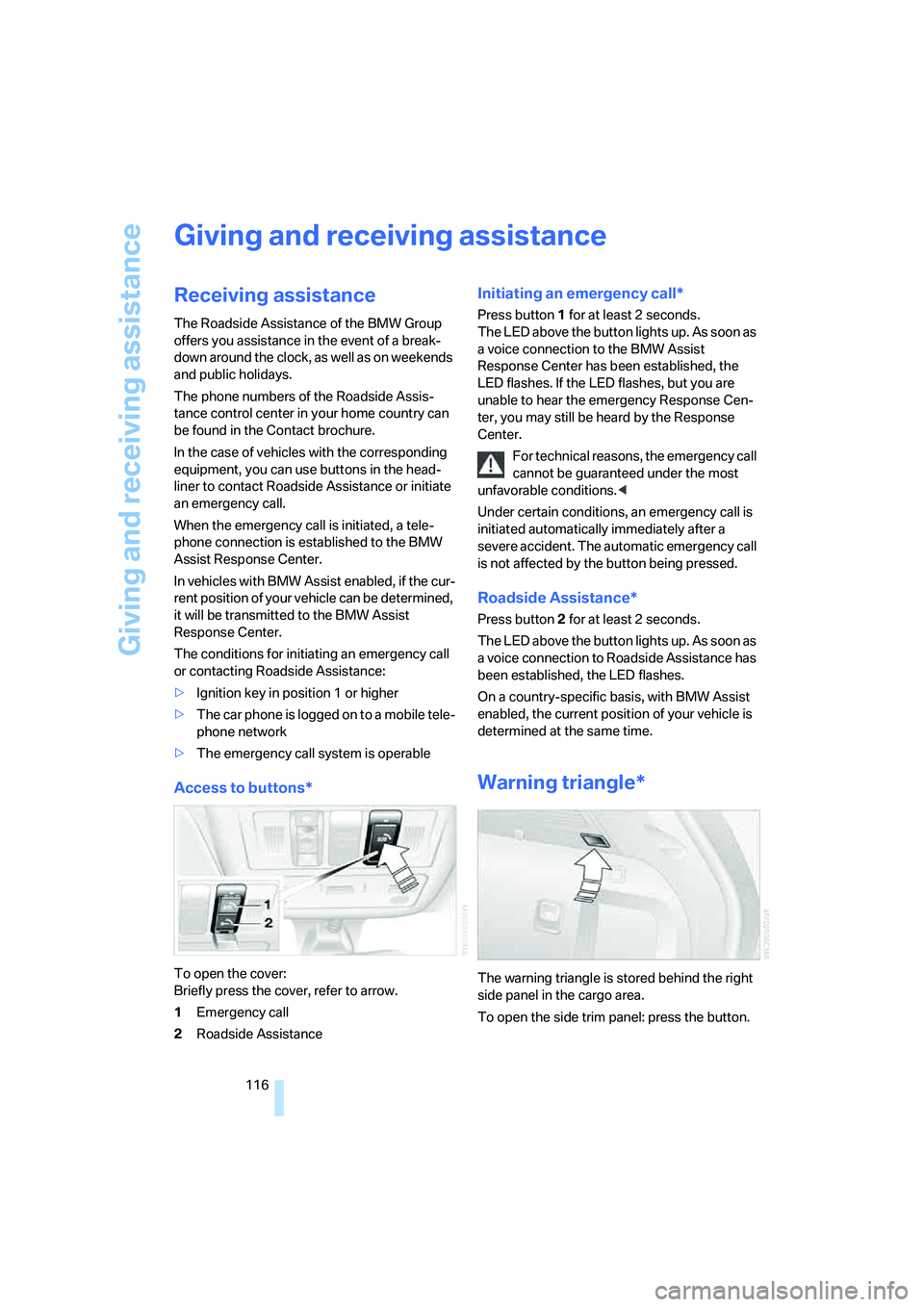
To open the cover:
Briefly press the cover, refer to arrow.
1Emergency call
2Roadside Assistance
Initiating an emergency call*
Press button 1 for at least 2 seconds.
The LED above the button lights up. As soon as
a voice connection to the BMW Assist
Response Center has been established, the
LED flashes. If the LED flashes, but you are
unable to hear the emergency Response Cen-
ter, you may still be heard by the Response
Center.
For technical reasons, the emergency call
cannot be guaranteed under the most
unfavorable conditions.<
Under certain conditions, an emergency call is
initiated automatically immediately after a
severe accident. The automatic emergency call
is not affected by the button being pressed.
Roadside Assistance*
Press button 2 for at least 2 seconds.
The LED above the button lights up. As soon as
a voice connection to Roadside Assistance has
been established, the LED flashes.
On a country-specific basis, with BMW Assist
enabled, the current position of your vehicle is
determined at the same time.
Warning triangle*
The warning triangle is stored behind the right
side panel in the cargo area.
To open the side trim panel: press the button.
Page 120 of 140

Giving and receiving assistance
118
Starting engine
1.Start the engine of the assisting vehicle and
let it run at a slightly elevated idling speed
for a few minutes.
2.Start the engine on the other vehicle in the
usual way.
If the first start attempt is not successful,
wait a few minutes before another attempt
in order to allow the discharged battery to
recharge.
3.Let the engines run for a few minutes.
4.Disconnect the jumper cables by reversing
the connection sequence.
If need be, have the battery checked and
recharged.
Never use spray fluids to start the
engine.<
Tow starting and towing
Obey all applicable laws and guidelines
for tow starting and towing.<
Do not allow any passengers other than
the driver to ride in a vehicle that is being
towed.<
Using tow fitting
The threaded tow fitting is stored in the
onboard tool kit, refer to page107, and must
always remain in the vehicle. It can be screwed
in at the front or rear of the BMW.
Only use the tow fitting that comes with
the vehicle and screw it in as far as it will
go. Use the tow fitting only for towing on roads.
Avoid lateral loading of the tow fitting, e.g. do
not lift the vehicle by the tow fitting. Otherwise,
the tow fitting and the vehicle can be dam-
aged.<
Access to screw thread
Front
Push the cover in the bumper out of the recess
with a screwdriver.
Rear
Press on the mark provided on the cover.
Being towed
Make sure that the ignition key is in posi-
tion 1; otherwise, the steering lock will
engage, making it impossible to steer the vehi-
cle. There is no power assist with the engine
switched off. It is therefore necessary to exert
increased effort for braking and steering.<
Switch on the hazard warning flashers depend-
ing on the local regulations. If the electrical sys-
tem fails, mark the vehicle to be towed, e.g. with
a sign or warning triangle in the rear window.
Manual transmission
Gearshift lever in neutral.
Automatic transmission
Selector lever in position N.
Changing selector lever positions, refer to
page40.
Do not exceed a towing speed of
45 mph/70 km/h and a towing distance
of 90 miles/150 km; otherwise, the automatic
transmission may be damaged.<
Page 121 of 140

Reference
At a glance
Controls
Driving tips
Mobility
119
Towing methods
To avoid damage, do not lift the vehicle by
the tow fitting or body and suspension
parts.<
In some countries, towing with tow bars or
ropes on public roads is not permitted. Familiar-
ize yourself with the regulations on towing in the
specific country.
With tow bar
The towing vehicle must not be lighter
than the vehicle to be towed; otherwise,
it will not be possible to safely control vehicle
response.<
The tow fittings used should be on the same
side on both vehicles. Should it prove impossi-
ble to avoid mounting the tow bar at an offset
angle, please observe the following:
>Clearance and maneuvering capability will
be strictly limited in corners.
>When mounted at an angle, the tow bar will
exert lateral forces, tending to push the
vehicle sideways.
Secure the tow bar to the tow fittings
only. Otherwise, other vehicle parts could
be damaged.<
With tow-rope
When starting off in the towing vehicle, make
sure that the tow-rope is taut.
To avoid jerking and the associated
stresses on vehicle components when
towing, always use nylon ropes or nylon straps.
Secure the tow rope to the tow fittings only.
Otherwise, other vehicle parts could be dam-
aged.<
With tow truck
Do not tow the X3 with only the front or
rear axle raised; otherwise, the wheels
could lock and the transfer case could be dam-
aged.<
Have the X3 transported only on a flat bed.
Tow starting
If possible, do not tow start the vehicle; jump
start the engine instead, refer to page117.
Vehicles equipped with catalytic convertors
should only be tow started when the engine is
cold. It is not possible to tow start an engine
equipped with an automatic transmission.
1.Switch on hazard warning flashers, comply
with local regulations.
2.Switch on ignition, refer to page38.
3.Shift into 3rd gear.
4.Have the vehicle tow-started with the clutch
depressed and slowly release the clutch.
After the engine starts, immediately
depress the clutch again.
5.Stop at a suitable location, remove the tow
bar or rope and switch off the hazard warn-
ing flashers.
6.Have the vehicle checked.
Do not activate the HDC Hill Descent
Control during tow starting, refer to
page52.<
Page 128 of 140

Everything from A to Z
126
Everything from A to Z
Index
A
ABS Antilock Brake
System51
– indicator lamp12
Acceleration assistance
– refer to Acceleration
assistant53
– refer to DSC51
Acceleration assistant53
Accessories, refer to For your
own safety5
Accident, refer to Receiving
assistance116
Activated-charcoal filter68
Adaptive Head Light60
Adding engine oil103
Adjusting seats28
– electrically28
– mechanically28
– mechanically, Sports seat29
Airbags57
– front passenger side,
deactivating35,57
– indicator lamp for front
passenger airbags58
– sitting safely27
– warning lamp58
Air circulation, refer to
Recirculated-air
mode64,68
Air conditioner63
Air distribution
– air conditioner64
– automatic climate control67
Airing, refer to
Ventilation65,68
Air outlets, refer to
Ventilation65,68
Air pressure, refer to Tire
inflation pressure94Air vents, refer to
Ventilation65,68
Air volume64
– adjusting manually67
AKI, refer to Fuel
specifications93
Alarm system25
– avoiding unintentional
alarms26
All-season tires, refer to
Special characteristics of
winter tires98
All wheel drive, refer to
xDrive52
Anchorage points78
Antifreeze
– coolant104
– washer fluid43
Antilock Brake System
ABS51
– indicator lamp12
Anti-theft alarm system, refer
to Alarm system19,25
Approved axle load, refer to
Weights124
Approved engine oils103
Approved gross vehicle
weight, refer to Weights124
Armrest
– front73
– rear73
Artificial leather, refer to
Caring for your vehicle
brochure
Ashtray74
AUC Automatic recirculated-
air control68
Audio device, external74
Automatic
– air distribution67
– air volume67
– recirculated-air control
AUC68Automatic car wash, refer to
Caring for your vehicle
brochure
Automatic climate control66
Automatic cruise control44
Automatic curb monitor33
Automatic deactivation of
front passenger airbags57
Automatic headlamp
control60
Automatic transmission with
Steptronic40
– indicator lamp41
– interlock38
– selector lever interlock40
– shiftlock40
– towing118
– tow starting119
AUTO program67
Average fuel consumption49
– setting units48
Average speed49
– setting units48
Avoiding unintentional
alarms26
Axle loads, refer to
Weights124
B
Backrest, refer to Seats28
Backrest contour, refer to
Lumbar support29
Backup lamps, bulb
replacement110
Bandages, refer to First-aid
kit117
Bar, towing119
Page 129 of 140

Reference
At a glance
Controls
Driving tips
Mobility
127
Battery114
– charging114
– disposal114
– indicator lamp12
– jump starting117
– power failure114
– remote control18
– warning lamp114
Belts, refer to Safety belts32
Beverage holder, refer to Cup
holders72
Blower, refer to
– Air volume64
– Air volume, adjusting
manually67
BMW homepage4
BMW maintenance
system105
Bottle holder, refer to Cup
holders72
Brake assistant51
– warning lamp53
Brake fluid104
– level104
– warning lamp104
Brake force display56
Brake lamps110
– indicator lamp, defective
bulb12,59
– replacing bulbs110
– two-stage56
Brake pads85
– breaking-in82
– warning lamp85
Brake pedal, refer to Safe
braking84
Brake rotors
– brake system82
– breaking-in82
Brakes84,104
– ABS51,84
– brake fluid104
– brake pads85
– breaking-in82
– handbrake39
– indicator/warning lamp12Brake system104
– brake fluid104
– brake pads85
– breaking-in82
– disk brakes85
– warning lamp
104
Brake wear warning
– refer to Brake pads85
– warning lamp104
Breakdown service, refer to
Receiving assistance116
Breaking-in82
Bulb replacement, refer to
Lamps and bulbs107
Buttons on steering wheel13
C
California law
– Event Data Recorders106
– Proposition 65 Warning5
Calling, refer to telephone
Owner's Manual
Can holder, refer to Cup
holders72
Capacities124
Capacity, cargo area124
Car care, refer to Caring for
your vehicle brochure
Car care products, refer to
Caring for your vehicle
brochure
Care, refer to Caring for your
vehicle brochure
Cargo, securing86
Cargo area22,76
– capacity124
– cover77
– emergency release, refer to
Opening manually22
– enlarging76
– floor cover78
– foldable rear backrest76
– hatch, refer to Liftgate22
– lashing eyes78
– opening from outside22
– opening with remote
control20
– power socket74Cargo loading85
– load86
– securing cargo86
– stowing cargo86
– vehicle85
Caring for artificial leather,
refer to Caring for your
vehicle brochure
Caring for carpet, refer to
Caring for your vehicle
brochure
Caring for leather, refer to
Caring for your vehicle
brochure
Caring for plastic, refer to
Caring for your vehicle
brochure
Caring for vehicle finish, refer
to Caring for your vehicle
brochure
Car keys, refer to Key set18
Car phone, refer to separate
Owner's Manual
Car phone preparation75
Car radio, refer to Owner's
Manual for Radio/Onboard
Computer
Car wash84
– refer to Caring for your
vehicle brochure
Cassette operation, refer to
Owner's Manual for Radio/
Onboard Computer
CD operation, refer to Owner's
Manual for Radio/Onboard
Computer
Cellphone, refer to separate
operating instructions
Central locking system19
– interior21
Changes, technical, refer to
For your own safety5
Changing a wheel111
Changing gears
– automatic transmission with
Steptronic41
– manual transmission40
Changing wheels97
Page 130 of 140

Everything from A to Z
128 Charge-current indicator
lamp12,114
Check Gas Cap, warning
lamp12,92
Child's seats, refer to Child
restraint systems35
Child restraint fixing system
LATCH36
Child restraint systems35
– installing35
– with tether strap36
Child-safety locks37
Child seat security35
Chock112
Chrome parts, care, refer to
Caring for your vehicle
brochure
Cigarette lighter74
Circulation of air, refer to
Recirculated-air
mode64,68
Cleaning, vehicle, refer to
Caring for your vehicle
brochure
Cleaning rear window43
Clock47,48
– 12 or 24 hour mode48
– setting, also refer to Owner's
Manual for Radio/Onboard
Computer
– setting time47
Closing
– from inside21
– with the remote control19
Clothes hooks74
Clutch82
– breaking-in82
Cockpit10
Cold start, refer to Starting
engine38
Combination of wheel/tire98
Compact wheel, wheel
changes112
Compartments, refer to
Storage compartments73
Compartments in cargo area,
refer to Behind side trim
panel78Compass, digital70
Computer48
– also refer to Owner's Manual
for Onboard Computer
– functions48
Condensation, refer to When
the vehicle is parked84
Confirmation signal for
locking/unlocking
vehicle19,21
Connecting car vacuum
cleaner, refer to Connecting
electrical devices74
Connecting electrical
devices74
Consumption, refer to
Average fuel
consumption49
Consumption indicator, refer
to Fuel gauge46
Controls, refer to Cockpit10
Convenience operation
– from outside21
– panorama glass sunroof21
– windows21
Coolant104
– level104
– temperature gauge47
– warning lamp104
Cooling, refer to
Temperature64,67
Copyright2
Correct wheels and tires98
Courtesy lamps61
Cruise control44
– buttons on steering
wheel13
– indicator lamp44
Cruising range49
Cup holders72
Curb weight, refer to
Weights124
Cylinders, refer to Engine
data122
D
Dashboard lighting, refer to
Instrument lighting61
Dashboard system, refer to
Cockpit10
Data, technical122
– dimensions123
– engine122
– filling capacities124
– weights124
Daytime running lamps59
Deactivating front passenger
airbags35,57
Defective lamp59
Defects7
Defrosting windows64,67
– air conditioner64
– automatic climate control67
Defrosting windows and
removing condensation
– air conditioner64
– automatic climate control67
Defrost position, refer to
Defrosting windows64,67
Digital clock47
Digital compass70
Dimensions123
Dimming mirror34
Directional indicators, refer to
Turn signals41
Disk brakes85
Displacement, refer to Engine
data122
Display illumination, refer to
Instrument lighting61
Display lighting, refer to
instrument lighting61
Displays, refer to Instrument
cluster11
Disposal, vehicle battery114
Disposal of the vehicle, refer
to Caring for your vehicle
brochure
Distance warning, refer to
PDC Park Distance
Control50
Door exit lighting61
Door handle lighting59