2008 BMW X3 3.0SI brake sensor
[x] Cancel search: brake sensorPage 53 of 140
Reference
At a glance
Controls
Driving tips
Mobility
51
Malfunction
The LED in the button flashes and a short con-
tinuous tone sounds. PDC is malfunctioning.
Switch off PDC. Have the system checked.
To prevent this problem, keep the sensors
clean and free of ice or snow in order to ensure
that they will continue to operate effectively.
When using high-pressure washers, do not
spray sensors for long periods and keep the
sprayer at least 4 in/10 cm away from the sen-
sors.
System limits
Even with PDC, final responsibility for
estimating the distance between the
vehicle and any obstructions always remains
with the driver. Even when sensors are involved,
there is a blind spot in which objects cannot be
detected. The system is also subject to the
physical limits that apply to all forms of ultra-
sonic measurement, such as those encoun-
tered with tow bars and trailer couplings, or thin
and wedge-shaped objects. Low objects
already displayed, e.g. curb edges, can come
into the blind spot of the sensors before or after
a continuous tone sounds. The system may fail
to detect higher obstacles such as projections
from walls.
Loud sources of sound, inside and outside the
vehicle, could drown out the PDC signal tone.<
Driving stability control
systems
Your BMW is equipped with an extended array
of systems designed to enhance and maintain
vehicle stability even under unfavorable driving
conditions.
ABS Antilock Brake System
ABS prevents the wheels from locking during
braking. Safe steering response is maintained
even during full braking. This results in an
increase in the active safety.
ABS is operational every time you start the
engine. Safe braking, refer to page84.
Electronic brake-force distribution
The system controls the brake pressure in the
rear wheels to ensure a stable braking behavior.
Brake assistant
When the brake pedal is depressed quickly, this
system automatically generates a maximum
braking force distribution and thus helps keep
the braking distance to a minimum during full
braking. This system exploits all of the benefits
provided by ABS.
As long as you want full braking to continue, do
not reduce pressure on the brake.
DSC Dynamic Stability Control
DSC prevents slip at the drive wheels when
starting off and accelerating. The system also
detects unstable driving conditions, such as a
fishtailing of the vehicle's rear end or the sliding
of the vehicle on its front wheels. In these cir-
cumstances, DSC helps keep the vehicle on a
safe path, within physical limits, by reducing
engine output and by applying the brakes in
individual wheels.
The laws of physics cannot be repealed,
even with DSC. An appropriate driving
style always remains the responsibility of the
driver. Do not squander the additional margin of
safety by driving dangerously; otherwise, you
run the risk of causing an accident.<
Deactivating DSC
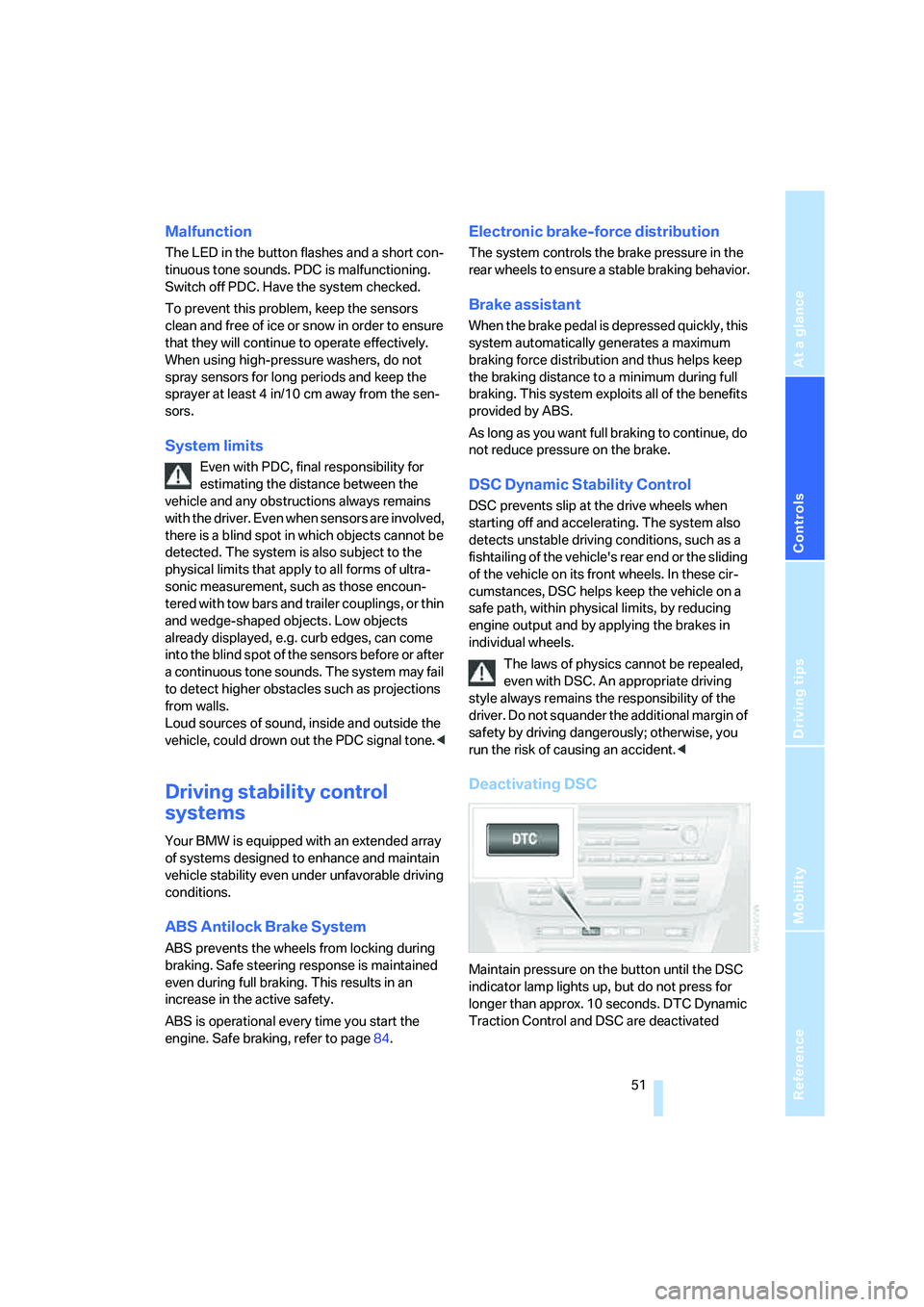
Maintain pressure on the button until the DSC
indicator lamp lights up, but do not press for
longer than approx. 10 seconds. DTC Dynamic
Traction Control and DSC are deactivated
Page 86 of 140

Things to remember when driving
84
General driving notes
Closing the liftgate
Operate the vehicle only when the liftgate
is completely closed; otherwise, exhaust
fumes could enter the interior of the vehicle.<
If special circumstances should make it abso-
lutely necessary to operate the vehicle with the
liftgate open:
1.Close all windows and the panorama glass
sunroof.
2.Greatly increase the air supply of the air
conditioning system or automatic climate
control, refer to page64 or67.
Hot exhaust system
High temperatures occur in the exhaust
system of every vehicle. Do not remove
the heat shields installed adjacent to various
sections of the exhaust system, and never apply
undercoating to them. When driving, standing
at idle, and parking, take care to avoid possible
contact between the hot exhaust system and
any highly flammable materials such as hay,
leaves, grass, etc. Such contact could lead to
a fire, resulting in serious personal injury and
property damage. Do not touch hot exhaust
pipe, it can cause burns.<
When the vehicle is parked
Condensation forms in the air conditioner/auto-
matic climate control system during operation,
and then exits under the vehicle. Traces of con-
densed water under the vehicle are therefore
normal.
Before driving into a car wash
Fold in the exterior mirrors, refer to page33;
otherwise, they could be damaged due to the
width of the vehicle.
Deactivate the rain sensor; otherwise, damage
could result from undesired wiper activation,
refer to page42.
Hydroplaning
When driving on wet or slushy roads,
reduce road speed. If you do not, a wedge
of water can form between tires and road sur-
face. This phenomenon is referred to as hydro-
planing, and is characterized by a partial or
complete loss of contact between tires and
road surface, ultimately undermining your abil-
ity to steer and brake the vehicle.<
The danger of hydroplaning increases as tire
tread depth decreases, also refer to Minimum
tread depth on page97.
Driving through water
Do not drive through water on the road if it
is deeper than 20 in/50 cm, and then only
at walking speed. Otherwise, the vehicle's
engine, the electrical systems, and the trans-
mission may be damaged.<
Using handbrake on inclines
Do not hold the vehicle in place on slopes
by slipping or riding the clutch, use the
handbrake instead. Otherwise, greater clutch
wear will result.<
Safe braking
Your BMW is equipped with ABS as standard
equipment. In situations in which it is required, it
is best to apply the brakes fully. Since the vehi-
cle maintains steering responsiveness, you can
nevertheless avoid possible obstacles with a
minimum of steering effort.
Pulsation at the brake pedal combined with
sounds from the hydraulic circuits indicates to
the driver that ABS is in its active mode.
Wet roads
On wet roads or in heavy rain, briefly apply light
pressure to the brake pedal every few miles.
Watch traffic conditions to ensure that this
maneuver does not endanger other road users.
The heat that is generated by the brake applica-
tions helps to dry the brake pads and rotors.
The full braking force will then be available
when you need it.
Page 135 of 140

Reference
At a glance
Controls
Driving tips
Mobility
133
Power failure
– battery114
– panorama glass sunroof24
– windows23
Power seat adjustment28
Power socket
– in cargo area74
– refer to Cigarette lighter
socket74
Power windows22
– initializing23
– safety switch23
Precious wood, refer to Caring
for your vehicle brochure
Pressure, tires94
Pressure monitoring,
tires54,55
Programming settings, refer
to Vehicle Memory, Key
Memory18
Puncture, Flat Tire Monitor54
R
Radiator, refer to Coolant104
Radio, refer to Owner's
Manual for Radio/Onboard
Computer
Radio-control key, refer to
Master key with remote
control18
Radio navigation, refer to
separate Owner's Manual
Rain sensor42
Range, setting units48
Reading lamps
– front61
– rear62
Rear armrest, refer to Armrest,
rear73
Rear backrests, folding76
Rear lamps and reflector, refer
to Tail lamps110
Rear seat back, folding76
Rearview mirrors, exterior33
Rear window defroster
– air conditioner64
– automatic climate control68Rear window safety switch23
Rear window wiper43
– wiper blade
replacement107
Rechargeable flashlight73
Recirculated-air mode
– air conditioner64
– automatic climate control68
Refueling92
Remaining distance, refer to
Cruising range49
Remaining distance until
service47
Remote control19
– garage-door opener69
– liftgate20
– malfunction20
Removing condensation,
windows
– air conditioner64
– automatic climate control67
Replacement fuses115
Replacing bulbs, refer to
Lamps and bulbs107
Replacing tires
– new wheels and tires97
– wheel changes111
Replacing windshield
wipers107
Reporting an accident, refer to
Initiating an emergency
call116
Reporting safety defects7
Required oil grades, refer to
Approved engine oils103
Reserve indicator lamp, refer
to Fuel gauge46
Restraint systems
– for children35
– refer to Safety belts
32
Reverse gear
– automatic transmission with
Steptronic41
– manual transmission40
Roadside Assistance, refer to
Receiving assistance116
Roadside parking lamps60Roller cover for cargo area,
refer to Cargo area cover77
Roll-up cover, refer to Cargo
area cover77
Roof load capacity, refer to
Weights124
Roof-mounted luggage
rack87
Rope, refer to Tow starting
and towing118
Rotating coin holder, refer to
Storage compartments73
Run-flat indicator, refer to Flat
Tire Monitor54
S
Safety belts32
– safe sitting position27
– warning lamp32
Safety belt tensioners, refer to
Safety belts32
Safety defects7
Safety feature, windows23
Safety systems, refer to
– ABS Antilock Brake
System51
– Airbags57
– DSC Dynamic Stability
Control51
– xDrive52
Screw thread for tow
fitting118
Seat heating31
Seat memory, refer to Seat
and mirror memory31
Seats
– adjusting electrically28
– adjusting sports seat29
– heating31
– memory, refer to Seat and
mirror memory31
– sitting safely27
– storing the setting31
Securing cargo, refer to Cargo
loading85
Securing vehicle, with the
remote control19