At a glance
Controls
Driving tips
Mobility Reference
11
Instrument cluster
1Speedometer
2Indicator and warning lamps12
3Tachometer46
Indicator and warning lamps12
4Coolant temperature gauge47
5Fuel gauge46
6Button for
>Displaying the time47
>Service Interval Display47
>Checking oil level102
7Selector lever and program displays for
automatic transmission
*408Button for
>Resetting trip odometer46
>Setting time47
9Display for
>Trip odometer/odometer46
>Time47
>Service Interval47
>Computer48
>Checking oil level102
Wheels and tires
94
Wheels and tires
Tire inflation pressure
Information for your safety
The condition of the tires and the maintenance
of the specified tire pressure are crucial not only
to the tire's service life, but also to driving com-
fort and most importantly, driving safety.
Checking pressure
Only check tire inflation pressure when the tires
are cold. This means after a maximum of
1.25 miles/2 km driving or when the vehicle has
been parked for at least 2 hours. When tires are
warm, the tire inflation pressure increases.
Check the tire inflation pressure regularly
and correct it as needed, even on the
compact wheel: at least twice a month and
before starting long trips. If you fail to observe
this precaution, you may be driving on tires with
incorrect tire pressures, a condition that can not
only compromise your vehicle's driving stability,
but also lead to tire damage and the risk of an
accident.
Do not drive with deflated, i.e. flat tires. A flat tire
will seriously impair your vehicle's handling and
braking response. Attempts to drive on a flat tire
can lead to loss of control over the vehicle.<
After correcting the tire inflation pressure,
reinitialize the Flat Tire Monitor
* or
reset the Tire Pressure Monitor
*, refer to
pages54, 55.<
Pressure specifications
The table on the next page provides all the cor-
rect inflation pressures for the specified tire
sizes at ambient temperature.
The inflation pressures in the table apply
to BMW-approved tire sizes and recom-
mended tire brands. Your BMW Sports Activity
Vehicle Center will be glad to supply this infor-
mation.
tion pressure for your tires, please note the fol-
lowing:
>Tire size for your vehicle
>Load status
>Maximum permissible driving speed
Tire inflation pressures for speeds
up to 100 mph/160 km/h
For normal driving at speeds of up to 100 mph/
160 km/h and to achieve optimum driving com-
fort, take note of the tire inflation pressures
listed on the following page in the column for
speeds up to max. 100 mph/160 km/h and
adjust your tire pressure as needed.
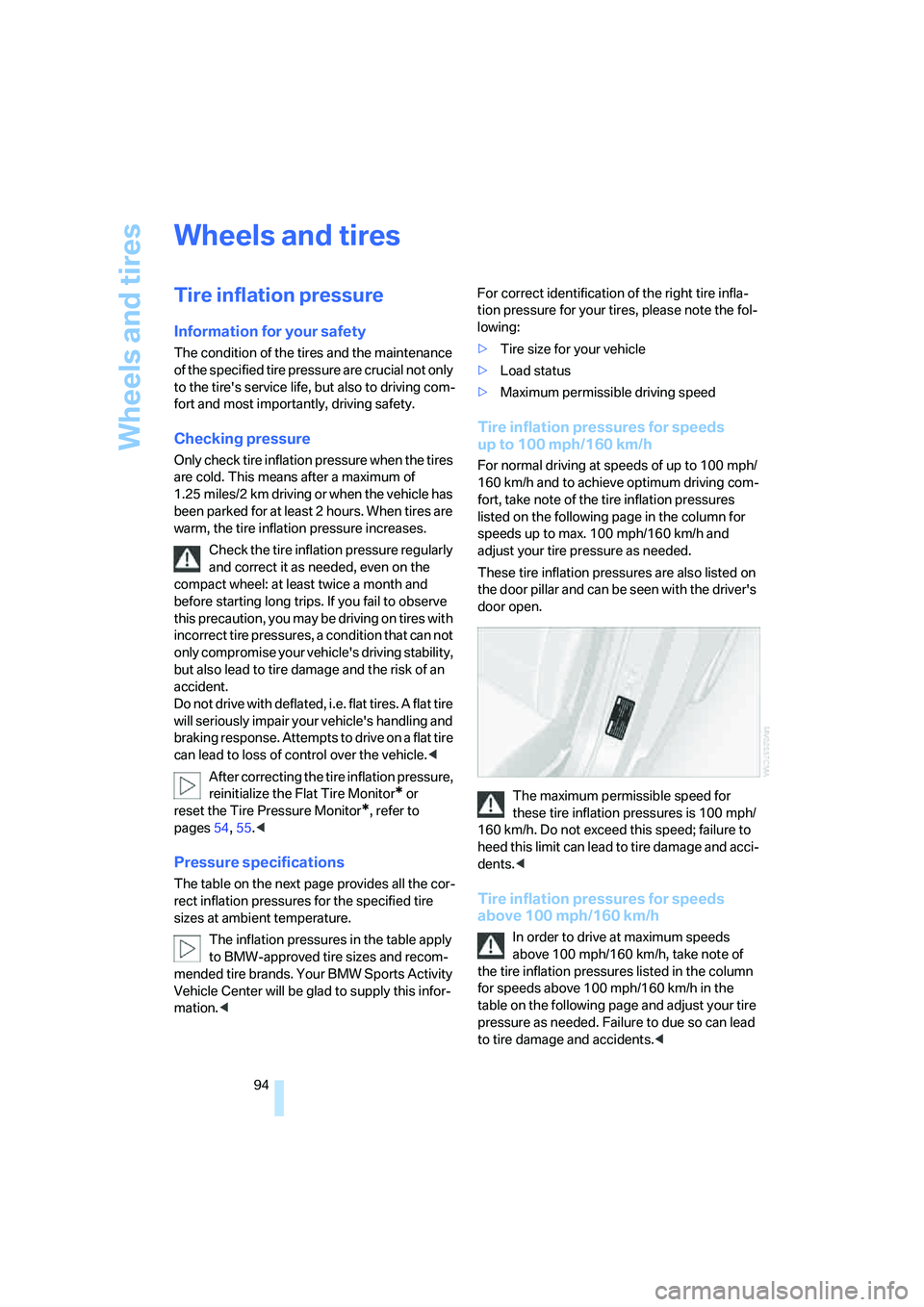
These tire inflation pressures are also listed on
the door pillar and can be seen with the driver's
door open.
The maximum permissible speed for
these tire inflation pressures is 100 mph/
160 km/h. Do not exceed this speed; failure to
heed this limit can lead to tire damage and acci-
dents.<
Tire inflation pressures for speeds
above 100 mph/160 km/h
In order to drive at maximum speeds
above 100 mph/160 km/h, take note of
the tire inflation pressures listed in the column
for speeds above 100 mph/160 km/h in the
table on the following page and adjust your tire
pressure as needed. Failure to due so can lead
to tire damage and accidents.<
Everything from A to Z
134 Selector lever
– automatic transmission40
– automatic transmission with
Steptronic40
Selector lever interlock, refer
to Shiftlock40
Selector-lever positions,
automatic transmission40
Service, refer to Receiving
assistance116
Service and warranty6
Service Engine Soon38,106
Service Interval
Display47,105
Setting interior
temperature64,67
Shifting gears in automatic
transmission with
Steptronic41
Shiftlock40
Side airbags57
Side tilt, permissible87
Side turn signals, bulb
replacement110
Signal horn, refer to Horn10
Sitting safely27
– with airbags27
– with head restraint27
– with safety belt27
Ski bag75
Smokers' package, refer to
Ashtray74
Snow chains99
Soft drink can holder, refer to
Cup holders72
SOS, refer to Initiating an
emergency call116
Spare fuses115
Spare key18
Spare wheel, refer to Compact
wheel112
Speed
– with compact wheel114
– with winter tires98
Speedometer, refer to
Instrument cluster11
Split rear backrest, refer to
Enlarging cargo area76Sport program, automatic
transmission with
Steptronic41
Sports seat29
Stability control, refer to
Driving stability control
systems51
Starting, refer to Starting
engine38
Starting difficulties
– at very low temperatures39
– jump starting117
Starting engine38
Starting off uphill, refer to
Acceleration assistant53
Status of passenger
airbags58
Status of this Owner's Manual
at time of printing5
Steering lock38
Steering wheel10,13
– adjustment34
– buttons on steering
wheel13
– heater34
– lock38
Steering wheel with
buttons13
Steptronic40
Storage compartments73
Storage package73
Storage package nets73
Storage space, refer to Cargo
area76
Storing desired speed, refer to
Cruise control44
Storing seat position, refer to
Seat and mirror memory31
Storing tires98
Straps, refer to Cargo
loading85
Sunroof, refer to Panorama
glass sunroof23
Switches, refer to Cockpit10
Switching cooling function on/
off64,67
Switching off engine39
Symbols4
T
Tachometer46
Tail lamps110
– indicator lamp, defective
bulb59
– replacing bulbs110
Tank, washing systems, refer
to Washer fluid43
Tank capacity124
Technical data122
Technical modifications5
Telephone, refer to separate
operating instructions
Temperature
– air conditioner64
– automatic climate control67
– tires97
Temperature display
– outside temperature48
– outside temperature
warning48
– setting units48
Temperature gauge47
Temperature of coolant, refer
to Coolant thermometer47
Temperature warning48
Tempomat, refer to Cruise
control44
Thigh support adjustment29
Three point safety belts32
Tightening torque of lug bolts,
refer to After mounting113
Tilt alarm sensor
– remote control20
– switching off20,26
Tilt function, passenger-side
mirror33
Tire inflation pressures94
– monitoring, refer to Tire
Pressure Monitor55
– restoring94
Tire Pressure Monitor55
– malfunction warnings55
– resetting system55
– system limitations55
– warning lamp55
Tire replacement97