2008 AUDI TT ROADSTER tow
[x] Cancel search: towPage 145 of 316
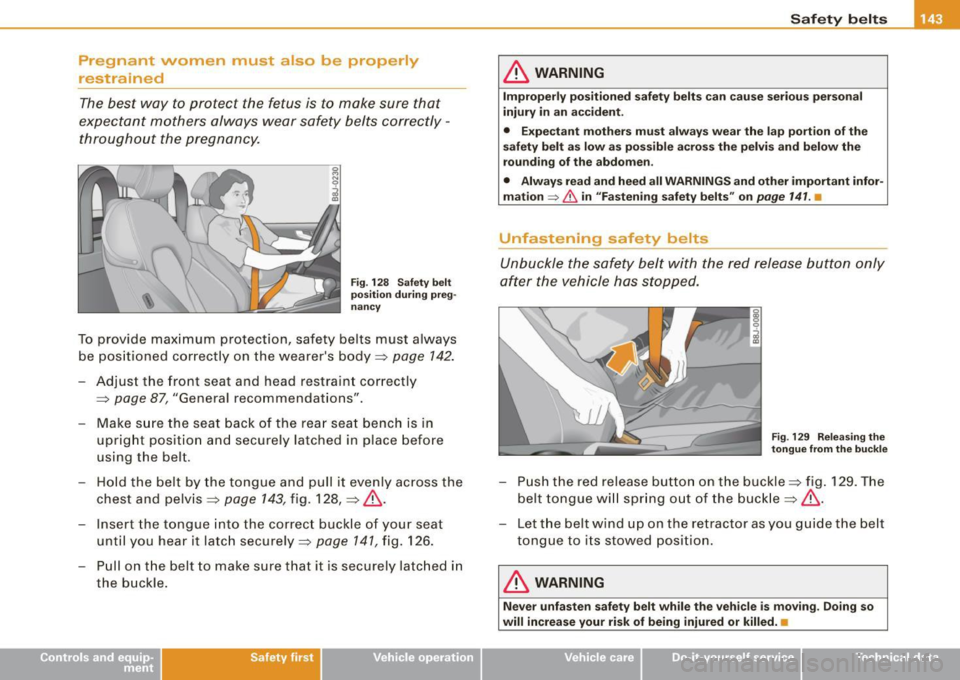
Pregnant women must also be properly
restrained The best way to protect the fetus is to make sure that
expectant mothers always wear safety belts correctly -
throughout the pregnancy.
Fig . 128 Safety belt
position during preg
nancy
To provide maximum protection, safety belts must always
be positioned correctly on the wearer's body=>
page 142.
-Adjust the front seat and head restraint correctly
=> page 87, "General recommendations".
- Make sure the seat back of the rear seat bench is in
upright position and securely latched in place before
using the belt.
- Hold the belt by the tongue and pull it evenly across the
chest and pelvis::::,
page 143, fig. 128, => &.
- Insert the tongue into the correct buckle of your seat
until you hear it latch securely =>
page 141, fig. 126.
- Pull on the belt to make sure that it is securely latched in
the buckle.
Safety first
Safety belts
& WARNING
Improperly positioned safety belts can cause serious personal
injury in an accident.
• Expectant mothers must always wear the lap portion of the
safety belt as low as possible across the pelvis and below the
rounding of the abdomen.
• Always read and heed all WARNINGS and other important infor
mation ~
& in "Fastening safety belts" on page 141. •
Unfastening safety belts
Unbuckle the safety belt with the red release button only
after the vehicle has stopped.
Fig . 129 Releasing the
tongue from the buckle
- Push the red release button on the buckle=> fig. 129. The
belt tongue will spring out of the buckle =>
&.
- Let the belt wind up on the retractor as you guide the belt
tongue to its stowed position.
& WARNING
Never unfasten safety belt while the vehicle is moving . Doing so
will increase your risk of being injured or killed .•
Vehicle care
I I irechnical data
Page 156 of 316
_,___A_ ir_ b_ a.::g <-- s--
• Never carry sharp object s in your pockets or place them on the
seat.
If the weight- sen sing mat in the passenger seat is punctured
it cannot work properly .
• Never carry things on your lap or ca rry objects on the
passenger seat. Such items can increase the weight registered by
the weight -sen sing mat and send the wrong information to the
a irbag control unit .
• Never store item s under the front pas senge r seat . Part s of the
Advanced Airbag System under the passenger seat could be
damaged , preventing them and the airbag system from working
properly .
• Never place seat covers or replacement upholstery that ha ve
not been specifically approved by Audi on the front seats.
• Seat covers can prevent the Advan ced Airbag System from
recognizing child restraints or occupants on the front pa ssenger
seat and prevent the side airbag in the seat backrest from
deploying properly .
• Never use cushions , pillows , blankets or similar items on the
front passenger seat. The additional padding will prevent the
weight -sen sing mat in the seat from accurately registering the
child restraint or person on the seat and prevent the Advanced
Airbag System from functioning properly .
• If you must use a child re straint on the front passenger seat
and the ch ild restra int manufacturer' s instructions require the use
of a towel , foam cushion or something else to properly position
the child restraint , make certain that the PASSENG ER AIR BAG OFF
light comes on and stays on whenever the child restraint is
installed on the front passenger seat .
• If the PASSENGER AIR BAG OFF light does not come on and stay
on , have the airbag system inspected by your Audi dealer. •
How the Advanced Airbag System
components work together
The front Advanced Ai rbag System and the side airbags s upplement
th e pro tec tion offered by t he fro nt three -po int safety belts w ith
pretensioners and load limite rs and the adjustab le head restraints
t o help reduce the risk o f injury in a w ide ra nge o f acc ide nt and
crash situations . Be sure to read the important information about
sa fe ty an d heed the WAR NINGS in this chapte r.
D ep loyment of the Advanced Airbag System and the activation of
th e safe ty be lt pre tens ioners depends on th e decele ra tion
measu red by the crash se nsors and regist ered by the electronic
con trol un it. Crash seve rity depe nds on speed a nd decele ra tion a s
w ell as the mass a nd st iffne ss of the ve hicle or objec t in vo lv ed in th e
crash .
When t he elect ronic control unit registe rs a low sever ity crash and
the safety belt is be ing used, the airbag wi ll not deploy. If the safety
belt is no t being used, the fir s t stage de ploy s, f ollowed by th e
second stage after a much later time in the crash sequence .
I f the electronic control unit registers a crash of medium severity,
th e first stage o f the a irba g dep loys followed by the second sta ge at
a much later time in the crash sequence -regardless of whether the
sa fe ty belt is bein g use d or not. In hig her se ver ity cras hes as r eg is
tered by the electronic control unit, both the first and second stages
deploy al most at the same tim e.
On the passe nger s ide, regardless of safety belt use, the airbag wi ll
be tu rned off if the weight on the passenger seat is less than the
amount programmed in the e lectronic control unit. The front airbag
on the passenger side wi ll a lso be turned off if one of the child
sa fet y seats that has been cer tified under F ederal Mo to r V ehi cle
Safety Standard 208 has been recognized on the seat. The
PASSENGER AIR BAG OFF light co mes on and stays o n to tell y ou
when the front Advanced Airbag on the passenger side has been
t ur ned off ~
pag e 147, " C hi ld re stra int s on t he fro nt seat -so m e
important things to know". .,
Page 182 of 316
___ C_ h_ il_ d _S_ a_f e _ ty ______________________________________________ _
& WARNIN G (co ntinued )
• Always read and heed all WARNINGS whenever u sing a child
re strained in a v ehicle i s being used
=> page 168 . Special p re ca u
tion s appl y when inst alling a chi ld safety se at o n the front
pa sseng er sea t =>
page 14 7, "Child restr aint s on the front seat -
s ome important thing s to know ".•
Deactivating the convertible locking retractor
The convertible locking retractor for child restraints will
be deactivated automatically when the belt is wound all
the way back into the retractor.
- Press the red button on the safety belt buckle. The belt
tongue will pop out of the buckle.
- Guide t he belt a ll the way back into its stowed position.
Always let the safety belt retract complete ly into its stowed position .
The safety belt can now be used as an ordinary safety belt without
the convertible locking retractor for child restraints.
If the conve rtible locking retractor should be activa ted inadvert
ently, the safety belt must be unfastened and guided completely
back in to its stowed posi tion to deactiva te this feature. If the
convertible locking retractor is not deactivated, the safety belt will
gradually become tighter and uncom fortable to wear .
& WARNING
Improperly in stalled child safe ty seat s inc rea se th e risk of serious
personal injur y and death in a c ollisio n.
• Never unfa sten the safet y belt to deacti vate the convertibl e
lo cking retr actor for ch ild restra int s w hile the veh icle is movin g.
You would not be re strained and could be seriou sly injured in an
acc ident .
& WARN IN G (c ontinued )
• Always read and h eed all WARNINGS whenever u sing a child
restr ained in a vehi cle is being u sed
=> page 1 68 . Spe cial pre cau
tio ns appl y when inst alling a child safet y s eat on the front
p ass enger seat =>
pag e 147 , "Child re strain ts on the front seat -
s ome i mport ant things to know ".•
Additional Information
Where can I get additional information about
child restraint application and usage?
T here are a number of sources of additional information about child
r estraint selection, installation and usage:
NH TSA advises that the best child safety seat is the one that fits
you r child and fits in your vehicle, and that you wi ll use correctly and
consistently.
T ry before you buy!
N atio nal High way Tra ffi c Safety Ad ministr ati on
Tel. : (888) DASH -2 -DOT
www.nhtsa.dot.gov
Nat iona l SAFE KID S Campaign
Tel.: (202) 662 -0600
www .sa fekids.org
Safety BeltSafe U .S .A
Tel.: (800) 745 -SAFE (Eng lish)
Tel. : (800) 747 -SANO (Spanish)
www.carseat.org
Tran sport Canad a
Tel.: (800! 333-0371
www .tc .gc .ca
Page 191 of 316

Faults in the brake syst em
If you shou ld notice a sudden i ncrease in brake pedal travel, then
one of the two brake circuits may have failed=>
& -
Low brake fluid level
Ma lfunctions can occur in the brake system if the brake fluid leve l is
t oo low. The brake fluid level is moni tored e lect ronica lly .
Brake pow er assist unit
The brake p ow er assist un it increas es th e pressure that you
generate with the brake peda l. It works only when the engine is
running.
& WARNING
• You should perform braking maneuver s for the purpose of
c leaning the brake system only if road conditions permit . Other
road users must not be put at ri sk -you may cause an accident!
• Before des cending a steep grade , redu ce speed and sh ift trans
mi ssion into a lower gear or lower driving position . Do not ride the
br akes or hold the pedal down too long or too often . This could
cause the brakes to get hot and diminish braking efficiency .
• Do not "ride the brakes " by resting your foot on the pedal when
you do not intend to brake . Thi s may cause the brakes to overheat,
premature we ar and increased stopping distan ce .
• Under certain cl imatic and operating condit ions such as
pas sing through water , driv ing in heavy rain or after washing the
vehicle, the effectiveness of the brake s can be reduced . In winter ,
ice can ac cumulate on the brake pads , linings , discs and drums .
Cautiously apply brakes for a te st. Brakes will dry and ice coatings
will be cleaned off after a few cautious brake appli cations .
• Driving for an extended period of time on salt -covered road s
without using your brakes can also affect brak ing effic iency . Clean
off accumulated salt coating from brake discs and pads with a few
c autiou s brake applications .
Controls and equip ment Safety first Vehicle operation
Intelligent technology
& W
ARNING (continued )
• If you damage the front spo iler , or if you install a different
s poiler , be sure the air flow to the front brakes is not obstructed.
Otherwise the brake system could overheat redu cing the effective
ness of the entire br ake system.
• Failure of one brake circuit will impair the braking capability
resulting in an increa sed stopping distance. Avoid driving the
vehicle and have it towed to the nearest Audi dealer or qualified
workshop.
• Never let the veh icle roll to a stop with the engine shut off .
• If the b rake booster is not working , for e xample when towing
your vehicle, or because the brake booster has somehow been
damaged , the brake pedal must be pre ssed considerably harder to
make up for the lack of booster assistance . •
Anti- lock brake system (ABS)
ABS p revents the wheel s from loc king unde r br ak ing.
The anti -lock brake sys te m (ABS) makes a major contri but ion to
i ncreasing act ive d riv in g sa fety . You should not expect that brakin g
distances wi ll be
shortened unde r all c ircums tances wi th ABS.
B rak in g distance may even become somewhat
longer , for e xa m ple ,
on gravel or in new snow on s lippery ground, even if you are driving
carefully and slowly.
ABS operation
W hen a veh icle speed o f about 10 mph (20 km/ h) is reac hed , an au to
matic test sequence is run. Some noise from the pum p may be
audible.
I f the speed of a wheel s lows down too much re lative to vehicle
speed and i t starts to lock, br ake pressu re to th is whee l is reduce d.
T his adjustment process can be felt as a
pulsing motion of the b rake
pedal ,
accompanied by some noises. Yo u as the d rive r are in tent io n
a lly being g iven the in fo rmation that the wh eels a re tendin g to lock
Vehicle care Do-it-yourself service Technical data
Page 193 of 316
![AUDI TT ROADSTER 2008 Owners Manual [ i ] Tips
• If the pow er st eering sy stem sho uld fa il, or if the e ng ine is not
running (for examp le , whi le being towed), you will stil l be able to
st eer the ve hicl](/manual-img/6/57671/w960_57671-192.png "AUDI TT ROADSTER 2008 Owners Manual [ i ] Tips
• If the pow er st eering sy stem sho uld fa il, or if the e ng ine is not
running (for examp le , whi le being towed), you will stil l be able to
st eer the ve hicl")
[ i ] Tips
• If the pow er st eering sy stem sho uld fa il, or if the e ng ine is not
running (for examp le , whi le being towed), you will stil l be able to
st eer the ve hicle . How eve r, more e ffort w ill be required to do so.
• I f the powe r steering system is not f unctioning pr ope rly, contact
your authorized Audi dea ler immediate ly.
Ap plies to vehicles : wit h A ll Wheel Driv e
Driving w ith your quattro®
With All Wheel Drive, all four w heels ar e dri ven.
General information
With All W hee l Dr ive, power is d is tr ibute d to all fou r whee ls . T his
happens automat ica lly depending on your driving style and the
r oad cond itio ns at the time. See also =>
page 186, "E lec tronic diffe r
entia l lock ( EDU" .
Winter tires
When driving in the winter, your vehic le with All Wheel Drive has an
advantage, even wi th regula r t ir es . In winter road conditions it may
be advisable to mount winter tires (or all -season tires) for improved
driveabi lit y an d braking : these tires m ust be mounted on
all four
wheels .
See also=> page 254 , "Win ter t ires" .
Snow chains
Where tire cha ins are mandatory on certain roads, this normally
a lso a pplies t o vehic le s wi th Al l Wheel Drive =>
page 255, "Sn ow
chains".
Replacing wheels /tires
Vehicles with A ll Wheel Drive must always have tires of the same
s iz e. Also av oid t ires w it h d iff eren t tr ead dep ths. For details see
page=>
page 249, " New tires and replacing tires and whee ls " .
Controls and equip
ment Safety first Vehicle operation
Intelligent technology
Off
-Road driving?
Your Audi d oes not have en ough gr ound clea rance to be use d as a n
off -road vehicle. It is therefore best to avoid roug h tracks and
u neven terrain as much as possible. A lso refer to=>
page 194.
& WARNING
Always adjust your driving to road and traffic conditions. Do not
let the extra safety afforded by All Wheel Drive tempt you into
taking extra risks .
• Although the All Wheel Drive is very effective , always
remember that braking capacity is limited by tire traction. You
should therefore not drive at e xcessive speeds on icy or slippery
road surfaces.
• On wet road su rfaces , be careful not to dr ive too fast because
the front wheels could begin to slide on top of the water (aqua
planing ).
If this should occur , you will have no warning from a
sudden increase in engine speed as with a front -wheel drive
vehicle . Always d rive at speeds which are suited to the road condi
tions. -risk of cra sh. •
Vehicle care Do-it-yourself service Technical data
Page 195 of 316

New brake pads
Remember that new brake pads do not have a full braking
effec t during the first 250 miles (400 kilometres) after they
are installed.
New brake pads have to be "burnished in" before they have optima l
grab=> &.
During the break -in period, you should avoid putting severe loads
on the brakes. Severe loads include, for example, sudden hard
braking, in particular at very high speeds or, for example, on moun
tain passes.
& WARNING
U ntil the y develop the m axim um "b ite " fo r be st stoppi ng p owe r,
th e s urfaces on new br ake p ads re quir e some " brea king -in " during
th e ini tia l 100 to 150 miles 1 150 to 200 k ilom etres) of nor ma l c ity
driving . You can comp ensa te fo r thi s by press ing the brak e ped al
more fi rml y. T his appl ie s w henev e r ne w pad s a re in sta lled . •
Catalytic converter
It is very important that your emission control system
(catalytic converter) is fu nctioning properly to ensure that
y o ur vehicle is running in an environmentally s ound
manner.
- Always use lead-free gasoline~ page 214, "Fuel supply".
- Never run the tank down a ll the way to empty.
- Never put too much motor o il in your engine~
page 225,
"Adding engine oi l 'l=:;r\11
•
- Neve r try to push -or tow -s tart your ve hicle.
Controls and equip
ment Safety first Vehicle operation
Dri
ving and environm ent
The catalytic converter is an efficient "clean-up" device built into the
exhaust system of the vehicle . The cataly tic converter burns many
of the pollutants in the exhaust gas before they are re leased into the
atmosphere.
The exclusive use of un leaded fuel is critica lly important for the l ife
of the catalytic converter and proper functioning of the engine.
& WARNING
• Do not park or oper ate th e ve hi cle in are a s whe re the hot
exha ust sys te m may c ome in conta ct wi th dr y grass, bru sh , fu el
s pill or other mat eri al which can cau se a fi re.
• Do not app ly a dditi onal u nder co at ing or ru stpr oofing on or
near the exhau st m anifold , exh au st pipe s, cata ly tic convert er or
he at shi elds. During dri ving, the s ubstance use d f or und ercoa ting
c ould ov erheat an d ca u se a fire.
0 Note
• Be aware that just one tank fi lling with
le ad ed fuel wi ll a lready
seriously degrade the performance of the catalytic converter.
• Do not exceed the correct engine oil level =>
page 225.
• Do not drive until the fuel tank becomes completely empty. The
engine could misfire . Unburned fuel could a lso get into the exhaust
system and this could cause the catalytic converter to overheat .
• Do not turn off the igni tion wh ile the vehicle is moving.
• Do not continue to operate your vehicle under these conditions,
as otherwise fue l can reach the cata lytic converter. This could resu lt
in overheating of the converter, requiring its replacement .
• To assure efficient operation of the Emiss ion Control System:
- Have your vehicle maintained properly and in accordance with
the service recommendations in your Maintenance & Warranty
booklet.
Vehicle care Do-it-yourself service Technical data
Page 198 of 316
___ D_ r_iv _ in_... g"'- a_ n_ d_ e_ n_ v_i_r _ o _n_ m __ e_n _ t _______________________________________________ _
The engine and catalytic converter have to reach their optimal oper
ating temperature
to reduce fuel consumption and noxious emis
sions effectively.
• Just after starting, a cold engine in a mid -size car burns the fuel
at a poor rate of 6-8 miles per gallon (30-40 l/100kml. Half a mile
down the road, the mileage improves to 12 MPG (20 1/100 kml. It will
take the engine no less than
two and a half miles (4 km) of driving to
warm up to its proper operating temperature and operate at an
economic mileage. This explains why taking the car for short trips is
a rather wasteful convenience.
• The
outside temperature is also critical in this regard. Your car
consumes more fuel in the winter than in the summer.
Trailer towing
General information
Your Audi TT Roadster is not designed to tow a trailer.
Towing a trailer with your Audi TT Roadster is not recommended
and can cause damage to the car. Damaged caused by towing a
traile r is not covered by your Audi Warranty. •
Page 207 of 316
_____________________________________________ C_ l_ e _a_ n_ in_ g_a _ n_d_ p_ r_ o_ t _e_ c_t _io _ n __ _
•
Occasiona lly apply a co lorless vinyl or leather preservative to retain
t he material's luster and pliability.
& WARNING
Alway s read and he ed all WARNING S and the information
~ pag e 200. •
Aluminum trim
Use only neutr al- pH products to remove spots and deposits from
a lum inum surfaces . Chrome care products and alka line cleaners
wi ll attack aluminum surfaces and can damage them over time.
& WARNING
Alway s read and heed all WARNINGS and the information
~ pa ge2 00.•
Touch -up paint
Min or paint damages should be touched up immediately.
- Use e ither a touch -up pa int stick or spray paint to cover
m ino r scratches and nicks.
Your Audi dealer has touch -up paint for minor scra tches and stone
chips. Scratches shou ld be touched up soon after they occur to
prevent corrosion .
The nu mber for the or iginal vehicle paint can be found on the
vehicle identification label~
page 288 .
& WARNING
Always re ad and h eed all W ARNINGS and the inf ormation
:=> page 200 . •
Windows
Clear vision to all sides .
Clean a ll windows regu lar ly to remove road film and
ca rwas h wax bu ildup.
Remove snow f rom windows us ing a b rush .
- Use a plastic ice sc rape r to rem ove ice from windows a nd
m irr ors .
- Rem ove o ther res idue on the wind ows with a spray-o n
glass clea ner.
Wipe the windows dry with a c lean piece of cloth or
kitchen p aper towel.
The best way to remove snow from windows and mirrors is to use a
brush . Use a non -abrasive
plastic ice s craper -better still, a spray
deicer -to remove
ic e from windows and mirrors .
The windows must not be c leaned with insect remover or wax since
these can interfere with the function of the windshield wiper b lades
(chatter).
Oil, grease or silicone residue can be removed w ith
glas s cle ane r or
sil ic one remo ver . However, wax residue requires the use of a
specially formulated so lvent . Please contact your Audi dealer for
advice on safe products for wax removal.
Windows should also be cleaned on the ins ide at regular intervals . ..,_
Vehicle care I t •