2008 AUDI S8 seat adjustment
[x] Cancel search: seat adjustmentPage 127 of 404

Warm and cold -
-----------------'
Rear climate controls
Ap plies to vehic les: with rear a ir co ndition ing
Controls
This overview is to assist you in familiarizing yourself with
the air conditioning controls .
Fig . 140 Air co ndi
t io ning contr ols
The left side of the display shows the temperature selected for the
rear passenger on the left, the right side shows the temperature
selected for the rear passenger on the right . If the air conditioning
settings are changed, this appears briefly in the corresponding area
of the display.
Functions are turned on and off by to uching the buttons . The LED in
the switch illuminates when the function is turned on .
By pressing the
sa fet y swi tc h ® in the driver's door ~ page 63 the
climate controls in the rear are deactiva ted. The message
P AS SIV E
appears in the display. In this mode the rear climate control can only
be operated by the driver through the contro ls in the front compar t
ment.
I ON /OFF] Tu rni ng o n and off
The air conditioning can be turned on and off by pressing the
I ON /OFF] button. With the ignit ion Off, the residual heat function
can be activated by pressing the button . The residual heat from the
Contro ls a nd eq uip
ment
coolant can be used to heat the vehicle interior. The residual heat
f unction is turned off au tomatica lly after 30 minu tes .
Se tting th e te mp era tu re
Temperature can be adjus ted over a range from 64 °F (+ 18 °C) to 80
°F (+26 °C)
(!) A ir di st ribu tion
You can adjust the air circulation so that air flows from specific
vents.
• In the @setting, al l the air flows from the v ents in the center
conso le and the outlets in the door pillars.
• In the
-Or setting, air flows from the outlets under the front seats.
• In
the~ setting, air flows from ou tlets in the center console and
the door pil lars as we ll as from the outlets under the front seats .
To regulate air distribution automatical ly, swi tch to !AUTO].
~ H ea ted se ats*
In posit ion O the heating for the seats is turned off. The range of
adjustment is from 1 to 6 .
The seats can be pre -heated for about 10 minutes us ing the heating.
However , the heating is turned off if the seat sensors do not detect
the weight of an occupant during this period .
[ty) Ventil ate d seats*
The seat cushion and the seat back surfaces of the fron t seats can
be ventilated. In position
O the seat ventilation is turned off. The
range of adjustment is from 1 to 6 .
! AU TO
I Autom ati c o pera tion
Air tempe rature, volume of air and air dis tribu tion are automatically
regulated to achieve or maintain the desired temperatures as
quickly as possible .
.,
Vehicle care I I irechnical data
Page 130 of 404

___ O_ n_t_ h_ e_ ro_ a_d __________________________________________________ _
On the road
Steering
Adjusting steering wheel position
The steering wheel position can be adjusted for height
and reach .
First, adjust t he driver's seat correctly.
Height adjustment
Fig . 14 3 Sw itch fo r
s te erin g whe el a dju st
me nt
-P u sh the sw itch @ up or down :=> fig. 143 . The steering
wheel height changes fo r as l ong as you press the sw itch.
Rea ch adjustment
Push the switch @forward o r bac kward => fig. 143 . The
steering wheel reach changes for as long as you press
the switch.
There must be at least 10 inches (25 cm) between your chest and the
center of the steer ing wheel. If you cannot sit more than 10 inches
(25 cm) from the steering wheel, see if adaptive equipment is avail- able to help you reach the pedals and increase the distance from the
steering wheel.
For detailed in formation on how to adjust the driver's seat, see
=> page 87 .
The steering wheel can be adjusted even when the ig nition is turned
Of f. For vehicles w ith seat memory, the individual positions for the
steering wheel can be stored a long with the seat position.
& WARNING
Improper u se of steering wheel adju stment and improper seating
po sition can cause se rious per sonal inju ry .
• Adjust the steering wheel column only when the vehicle is not
mo ving to prevent los s of vehi cle control.
• Adjust the driver' s seat or steering wheel so that there is a
minimum of 10 in ches (25 cm ) bet ween your chest and the
s teering wheel
=> pag e 200 , fig. 216 . If you cannot maintain this
minimum di sta nce , the ai rbag sy stem can not prote ct you prop
erly .
• If physical limitations prevent you from s itting 10 inche s (25
cm ) or more from the steering wheel , check with your authori zed
Audi dealer to see if adapti ve equipment i s available .
• If the steering whee l is aligned with your face, the supple
mental drive r's airbag cannot provide as mu ch pr otection
in an
ac cident. Alway s make sure that the steerin g wheel i s aligned with
your che st .
• Alway s hold the steering wheel with your hand s at the 9 o'clock
and 3 o'clo ck posit ion s to reduce the ri sk of pers ona l injury if the
driv er's airbag deploys.
• Never hold the ste ering wheel at th e 12 o' clo ck position or with
your hand s inside the steerin g wheel rim or on the steering wheel
hub . Holding the steering wheel the wrong wa y can cau se ser ious ..,,
Page 200 of 404

___ D_ r
_ i_v _i_n ..;::g :;_ S_ a_ f_ e_, ly'----------------------------------------------------
Driving Safely
General notes
Safe driving habits
Please remember -safety first!
This chapter conta ins important informat ion, tips, instructions and
warnings that you need to read and observe for your own safety, the safety of your passenge rs and othe rs. We have summarized here
what you need to know about safety be lts, airbags, child restraints
as wel l as chi ld safety . Y o ur safety is for us
priority number 1 . Always
observe the information and warnings in this section
-for your own
safety as we ll as that of your passengers .
The information in this sect ion appl ies to al l model vers ions of your
vehic le. Some of the features described in this sections may be
standard equ ipmen t on some mode ls, or may be op tiona l equip
ment on others. If you are not sure, ask your authorized Audi dealer .
& WARNING
• Always mak e sure that you follo w the instru ctions and heed
the WARNINGS in this Manual. It is in your interest and in the interest of your passengers .
• Alway s keep the complete Owner' s Liter ature in your Audi
when you lend or sell your vehi cle so that th is important informa
tion will always be available to the driver and pas seng ers.
• Always keep the Owner's literature handy so that you can find
it e asily if you have question s. •
Safety equipment
The s afe ty featur es are par t of the occu pant restraint
system an d wor k together t o help red uce the risk of injury
in a wide variety of accident situati ons.
Your safety and the safety of your passengers should not be left to
chance . Advances in technology have made a variety of features
avai lable to help reduce the risk of injury in an accident. The
fo llo w ing is a l ist of just a few of the sa fe ty feat ures in your A udi :
• sophisticated safety belts for driver and a ll passenger seating
posit ions,
• safety be lt pretensioners,
• safety be lt force l imiters for the fr ont seats,
• safety be lt height adjustment systems for the front seats,
• front airbags,
• knee airbags for the front seats
• side airbags in the front seats and outer rear seats,
• side curtain a irbags (SIDEGUARD),
• special LATCH anchorages for chi ld restra ints,
• head restraints for each seating position,
• adjus table steer ing colum n.
T hese individua l safety features, can work together as a system to
help protect you and you r passengers in a wide ra nge of acc idents .
T hese features cannot work as a system if they are not always
correctly adjusted and correct ly used .
Safety i s everybody' s responsibility! •
Page 205 of 404
Driving Safely fflll
---------------------------------------------:::....---=--
Proper adjustment of head restraints
Correctly adjusted head restraints are an important part
of your vehicle's occupant restraint system and can help to reduce the risk of injuries in accident situations.
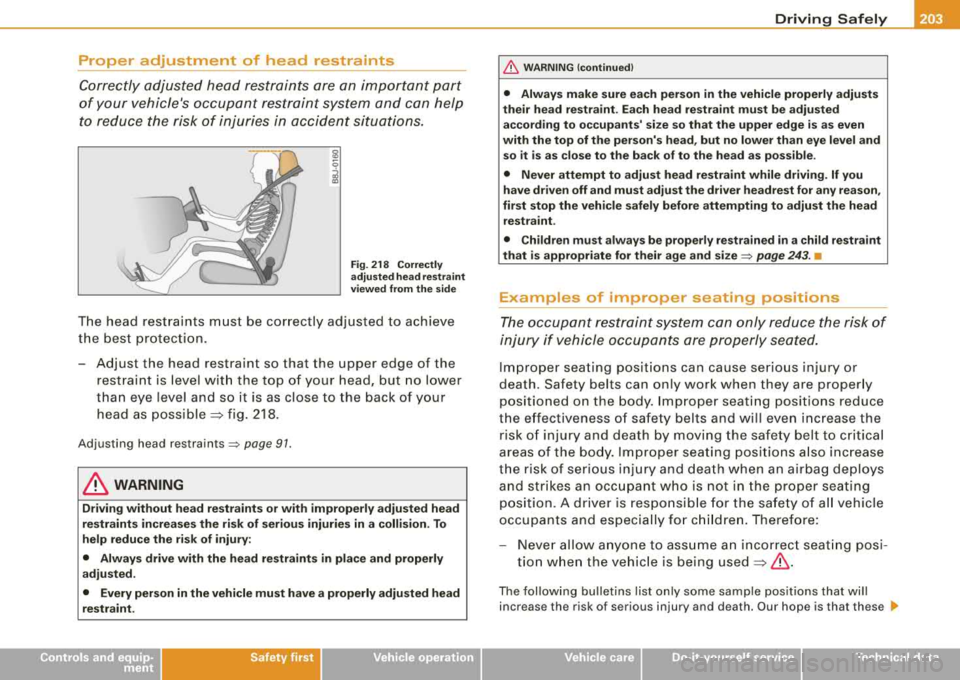
Fig . 218 Correctly
adjusted head restraint
viewed from the side
The head restraints must be correctly adjusted to achieve
the best protection.
- Adjust the head restraint so that the upper edge of the
restraint is level with the top of your head, but no lower
than eye level and so it is as close to the back of your
head as
possible ~ fig. 218.
Adjusting head restraints=> page 91.
& WARNING
Driving without head restraints or with improperly adjusted head
restraints increases the risk of serious injuries in a collision. To
help reduce the risk of injury:
• Always drive with the head restraints in place and properly
adjusted.
• Every person in the vehicle must have a properly adjusted head
restraint.
Controls and equip ment Safety first Vehicle operation
&, WARNING
(continued)
• Always make sure each person in the vehicle properly adjusts
their head restraint. Each head restraint must be adjusted according to occupants' size so that the upper edge is as even
with the top of the person's head, but no lower than eye level and
so it is as close to the back of to the head as possible .
• Never attempt to adjust head restraint while driving. If you
have driven off and must adjust the driver headrest for any reason,
first stop the vehicle safely before attempting to adjust the head
restraint.
• Children must always be properly restrained in a child restraint
that is appropriate for their age and size
=> page 243. •
Examples of improper seating positions
The occupant restraint system can only reduce the risk of
injury if vehicle occupants are properly seated.
Improper seating positions can cause serious injury or
death . Safety belts can only work when they are properly
positioned on the body. Improper seating positions reduce
the effectiveness of safety belts and will even increase the
risk of injury and death by moving the safety belt to critical
areas of the body. Improper seating positions also increase
the risk of serious injury and death when an airbag deploys
and strikes an occupant who is not in the proper seating
position. A driver is responsible for the safety of all vehicle
occupants and especially for children. Therefore:
- Never allow anyone to assume an incorrect seating posi
tion when the vehicle is being
used ~& .
The following bulletins list only some sample positions that will
increase the risk of serious injury and death. Our hope is that these
.,_
Vehicle care Do-it-yourself service Technical data
Page 216 of 404

-Safety belts
---=---------------------------------
Automatic safety belt retractors
Every safety belt is equipped with an automatic belt retractor on the
shoulder belt. This feature locks the belt when the belt is pulled out
fast, during hard braking and in an accident. The belt may also lock
when you drive up or down a steep hill or through a sharp curve. During normal driving the belt lets you move freely.
Safety belt pretensioners
The safety belts are equipped with a belt pretensioner that helps to
tighten the safety belt and remove slack when the pretensioner is
activated. The function of the pretensioner is monitored by a
warning
light=> page 19.
Switchable locking feature
Every safety belt except the one on the driver seat is equipped with
a switchable locking feature that
must be used when the safety belt
is used to attach a child seat. Be sure to read the important informa
tion about this
feature => page 253.
& WARNING
Improperly positioned safety belts can cause serious injury in an
accident=> page 214, "Safety belt position" .
• Safety belts offer optimum protection only when the seat back
is upright and belts are properly positioned on the body.
• Never attach the safety belt to the buckle for another seat.
Attaching the belt to the wrong buckle will reduce safety belt
effectiveness and can cause serious personal injury.
• A passenger who is not properly restrained can be seriously
injured by the safety belt itself when it moves from the stronger
parts of the body into critical areas like the abdomen.
• Always lock the convertible locking retractor when you are
securing a child seat in the vehicle
=> page 255. •
Safety belt position
Correct belt position is the key to getting maximum
protection from safety belts.
., N
8
~
Fig . 226 Head restraint
and safety belt
posi
tion as seen from the
side
Use the height adjustment to change the position of the shoulder
belt of the front safety belts.
& WARNING
Improperly positioned safety belts can cause serious personal
injury in an accident .
• The shoulder belt portion of the safety belt must be positioned
over the middle of the occupant's shoulder and never across the
neck or throat.
• The safety belt must lie flat and snug on the occupant's upper
body
=> fig. 226. Pull on the belt to tighten if necessary.
• The lap belt portion of the safety belt must be positioned as
low as possible across pelvis and never over the abdomen. Make
sure the belt lies flat and snug
=> fig. 226. Pull on the belt to
tighten if necessary.
• A loose-fitting safety belt can cause serious injuries by shifting
its position on your body from the strong bones to more vulner-
able, soft tissue and cause serious injury.
...
Page 218 of 404

___ s_a _f _e _t -=-y _ b_ e_lt _s ______________________________________________ _
Adjusting safety belt height Use the safety belt height adjustment to change belt posi
tion on the shoulder.
Fig . 229 Adjusting
shoulder belt height
The safety belt height adjustors for the front seats can be
used to adjust the height of the shoulder portion of the
safety belt so that it is positioned correctly.
- Push the
latch ~ fig. 229 up or down so that the shoulder
portion of the safety belt is positioned nearly midway
over the
shoulder ~ & in "Safety belt position" on
page 214.
& WARNING
Always read and heed all WARNINGS and other important informa
tion
~ page 212. •
Improperly worn safety belts
Incorrectly positioned safety belts can cause severe inju
ries.
Wearing safety belts improperly can cause serious injury or
death. Safety belts can only work when they are correctly positioned on the body. Improper seating
positions reduce
the effectiveness of safety belts and will even increase the
risk of injury and death by moving the safety belt to critical
areas of the body. Improper seating positions also increase
the risk of serious injury and death when an airbag deploys
and strikes an occupant who is not in the correct seating position. A driver is responsible for the safety of all vehicle
occupants and especially for children. Therefore:
- Never permit anyone to assume an incorrect sitting posi
tion in the vehicle while
traveling ~& .
& WARNING
Improperly worn safety belts increase the risk of serious personal
injury and death whenever a vehicle is being used.
• Always make sure that all vehicle occupants are correctly
restrained and stay in a correct seating position whenever the
vehicle is being used.
• Always read and heed all WARNINGS and other important infor
mation
~ page 212. •
Safety belt pretensioners
How safety belt pretensioners work
In front, side and rear-end collisions above a particular
severity, safety belts are tensioned automatically.
The safety belts are equipped with safety belt pretensioners . The
system is activated by sensors in front, side and rea r-end collisions
of great severity . This tightens the belt and takes up belt
slack ~ &
in "Service and disposal of safety belt pretensioner" on page 217.
Taking up the slack helps to reduce forward occupan t movement
during a collision.
•
Page 220 of 404

___ A_ ir_b _ a_ g=- s-a. y_s _t _e _m _________________________________________________ _
Airbag system
Important things to know
Importance of wearing safety belts and
sitting properly
Airbags are only supplemental restraints. For airbags to
do their jo b, occu pants must always properly we ar their
safety belts and be in a proper seating position.
Fo r your safe ty a nd the safety o f your passen gers, before
dr iving o ff, a lways:
- Adjust the driver 's seat and steering wheel proper ly
=> page 200,
- Adjust the front passenger's seat properly=> page 87,
-Wear safety be lts proper ly=> page 212,
- Always properly use the proper chi ld restrain t to pro tect
ch ildren
=> page 243 .
In a collision airbags mus t inflate with in t he blink of an eye and with
considerable force . The supplemental airbags can cause injuries if
t he driver or the fron t seat passenger is not seated properly. There
fore in order to help the airbag to do its job, it is important, both as a driver and as a passenger to sit properly at a ll ti mes.
By keep ing room between your body and t he steer ing wheel and the
front of the passenger compartment, the airbag can inflate fu lly and
comp letely and prov ide supplementa l protection in certain frontal
collisions => page 200, "Proper occupant seating positions". For
deta ils on the operation of t he seat adjustment
controls => page 87.
It's especia lly important that chi ldren are proper ly restrained
=> page 243 .
There is a lot that the driver and the passengers can and must do to
help the individual safety features installed in your Audi work
together as a system.
P roper seating position is important so that the front airbag on the
driver side ca n do its job. I f yo u have a physical impairment or
condition that prevents you from sitting properly on the driver seat
wi th the safety belt p roperly fastened and reaching the pedals, o r if
you have concerns with regard to the function or operation of the
Advanced Airbag System, p lease contact your authorized Audi
dea ler or qua lif ied workshop, or call Audi Customer CAR E at 1 -800-
822 -2834 for possib le modifications to your vehicle .
When the a irbag system deploys, a gas generator wi ll fil l the
airbags, break open the padded covers, and inflate between the
steer ing wheel and the dr iver and between the inst rume nt panel
and the front passenger. The airbags wi ll deflate immediate ly after
deployment so that the front occupants can see through the wind
shield again without interruption .
A ll of this takes p lace in the b link of an eye, so fast that many people
do n't even rea lize that the a irbags have dep loyed . T he airbags also
inflate with a great dea l of force and nothing should be in their way
when they dep loy. Fron t airbags in combinati on wi th properly worn
safety belts slow down and limit the occupant's forward movement.
Together t hey help to prevent the driver and front seat passenger
from hitting parts of the inside the vehicle while reducing the forces act ing on the occupant during the crash . In this way they he lp to
reduce the r isk of injury to the head and upper body in the crash .
Airbags do not protect the arms or the lower parts of the body .
Both front a irbags w ill not in flate i n all fro ntal col lis io ns. The trig
gering of the airbag system depends on the vehic le dece lerat ion
r ate caused by the co llision and registe red by the electr onic c ontro l
unit . If this rate is be low the reference value programmed into the
co ntrol unit, the ai rbags w il l not be t riggered, even tho ug h the car
may be bad ly damaged as a result of the collision . Vehicle damage,
~
Page 223 of 404

as defined in the elec tronic control unit~ page 230 , "PA SSENGER
AI R BAG OFF ligh t".
A lways r em ember, a ch ild seat or infant carrier install ed on th e front
seat may be st ruck and knocked out of position by the rap idly
i n fl ating pass enger's airbag in a fr ontal co llisio n. T he airb ag co uld
greatly reduce the effectivenes s of the chi ld restraint and even seri
ously inju re t he c hild duri ng i nflatio n .
F or this reason, and because the bac k seat is the safest place for
chi ldr en -w hen pro perly res traine d acc ording to th eir age an d size
- w e stron gly recomm end that c hildren a lways sit in th e bac k seat
~ page 243, "C hil d Safe ty" .
& WARNING
A child in a rearward -facing child seat installed on the front
passenger seat will be seriously injured and can be killed if the
front airbag inflates - even with an Advanced Airbag System.
• The inflating airbag will hit the child seat or infant car rier with
great force and will smash the child seat and child against the
backrest , center arm rest, door or roof .
• Always install rear-facing child seats on the rear seat.
• If you must install a rearward facing child seat on the front
passenger seat because of exceptional circumstances and the
PASSENGER AIR BAG OFF light does not come on and stay on,
immediately install the rear-facing child seat in a rear seating posi
tion and have the airbag system inspected by your Audi dealer.
• Forward -facing child seats installed on the front passenger's
seat may interfere with the deployment of the airbag and cause
serious personal injury to the child .
& WARNING
If, in exceptional circumstances, you must install a forward-facing
child restraint on the front passenger's seat:
Controls and equip ment Safety first
Vehicle operation
Airbag system
&, WARNING (continued )
• Always make sure the forward-facing seat has been designed
and certified by its manufacturer for use on a front seat with a
passenger front and side airbag .
• Never put the forward-facing child restraint up against or very
near the instrument panel .
• Always move the passenger seat into its rearmost position in
the seat's fore and aft adjustment range, as far away from the
airbag as possible before installing the forward-facing child
restraint. The backrest must be adjusted to an upright position .
• Make sure that the PASSENGER AIR BAG OFF light comes on
and stays on all the time whenever the ignition is switched on.
& WARNING
To reduce the risk of serious injury, make sure that the PASSENGER
AIR BAG OFF light will be displayed whenever a child restraint is
installed on the front passenger seat and the ignition is switched
on.
• If the PASSENGER AIR BAG OFF light does not stay on , perform
the checks described
~ page 229 , "Monitoring the Advanced
Airbag System" .
• Take the child restraint off the front passenger seat and install
it properly at one of the rear seat positions if the PASSENGER AIR
BAG OFF light does not stay on .
• Have the airbag system inspected by your Audi dealer immedi
ately .
• Always carefully follow instructions from child restraint manu
facturers when installing child restraints .
& WARNING
If, in exceptional circumstances, you must install a forward or
rearward -facing child restraint on the front passenger's seat:
Vehicle care Do-it-yourself service Technical data