2008 AUDI S6 service
[x] Cancel search: servicePage 355 of 390

Emerg ency situ ations -
-------------=--=----
•
Connect POSITIVE (+ ) to PO SITIVE (+ ) (r ed )
- Open the red cover on the pos itive pole => page 352,
fig. 261.
1. Connect one end of the positive cable (red) on the
jump
start bolt=>
page 352, fig. 262 G) (Bolts under red cover
= "positive") of the vehicle to be started @.
2. Connect the other end to the positive terminal@ of the
booster battery ®·
Conn ect NEGATIVE (- ) to NEGATIVE (-) (black )
3. Connect one end to the negat ive termi nal 0 of t he
boos ter battery ®·
4 . Connect the other end of the negative cable (black) to the
jump sta rt bolt 0 (Bolts with hex head = "n egative") of
the vehicle to be s tarted @.
Startin g th e e ngin e
-Start the engine of the veh icle w ith the booster battery .
Run t he engine at a moderate speed .
- Start engine with discharged ve hicle battery in the usual
ma nner.
- If the engine fails to s tart: do not keep the star ter
cranking for longer than 10 seconds. Wait for about
30 seconds and then try again.
- With engine running, remove jumper cables from both
vehicles in the exact reverse order.
- Close the red cover on the positive pole.
The battery is vented to the outside to prevent gases from entering
the vehic le interior . Make sure that the jumper clamps are well connected with their
metal parts in full contact with the battery
t erminals .
& WARNING
To avoid seriou s per sonal in jur y a nd d amage to the vehicle , heed
a ll wa rning s and in stru ction s o f th e jum per ca ble man ufa cturer . If
in doubt , call for ro ad serv ice.
• Jump er c abl es m ust b e lo ng eno ugh so that the vehi cle s d o not
touch .
• When conne cting jumpe r cable s, ma ke sure th at the y cann ot
g et caught in an y mo ving p arts i n the engine comp art m ent .
• Before you che ck anyth ing in the en gin e com partm ent , a lwa ys
r ea d and h eed all W ARNIN GS~ pag e
289, "Engine compa rtm ent ".
0 Note
Improper hook -up of jumper cables can ruin the generato r.
• Always connect POSITIVE(+) to POS ITIVE( +), and NEGATIVE( -) to
NEGATIVE( -) ground post of the battery manager control unit.
• Check that al l screw p lugs on the battery ce lls are screwed in
firm ly . If not, tighten plugs prior to connecting clamp on negative
battery termi nal.
• Please note that the procedure for connecting a jumper cab le as
described above applies specifical ly to the case of your vehicle
being jump started. When you are giving a jump start to another
vehicle, do not connect the negative(-) cable to the negative (-1
terminal on the discharged battery©~ page 352, fig. 262. Instead,
securely connect the negative ( -1 cable to either a solid metal
component that is firmly bolted to the engine b lock or to the engine
block itself . If the battery that is being charged does not vent to the
outside, escap ing battery gas could ignite and exp lode! •
Do-it-yourself service
Page 357 of 390
Emergency situations -
----------------=-~----
When it is no longer needed, unscrew the towing loop and put it
back into the vehicle toolkit. Be sure to have the towing loop stored
in the vehicle at all times.
& WARNING
If the towing loop is not screwed in as far as it will go, the thread
can pull out when the vehicle is towed -potential risk of an
accident. •
Rear towing loop
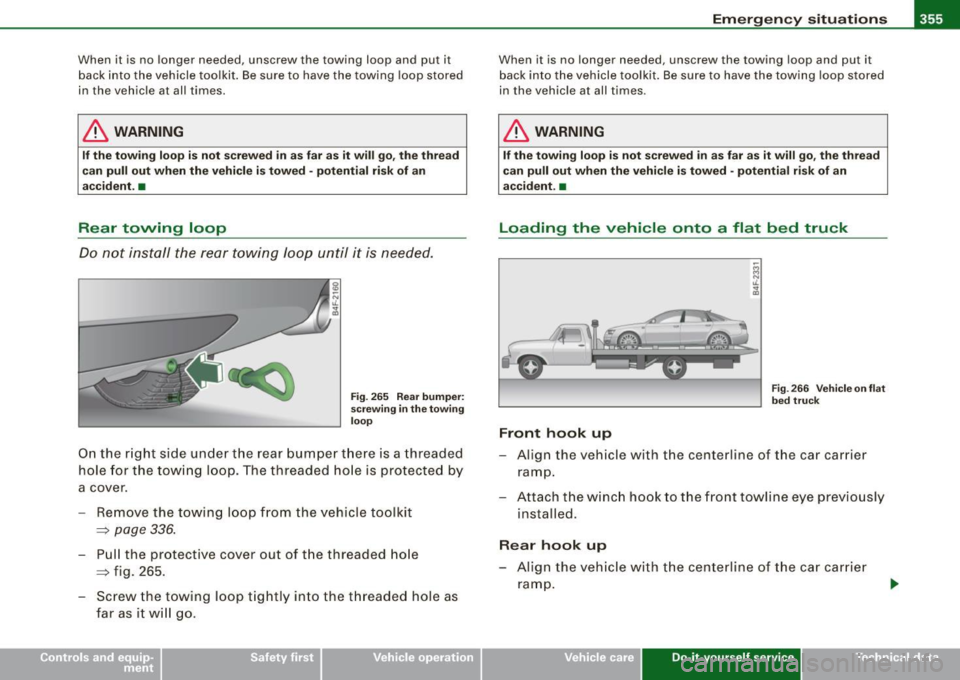
Do not install the rear towing loop until it is needed.
Fig. 265 Rear bumper:
screwing in the towing
loop
On the right side under the rear bumper there is a threaded
hole for the towing loop. The threaded hole is protected by
a cover.
- Remove the towing loop from the vehicle toolkit
=> page 336.
- Pull the protective cover out of the threaded hole
~ fig. 265 .
- Screw the towing loop tightly into the threaded hole as far as it will go .
When it is no longer needed, unscrew the towing loop and put it
back into the vehicle toolkit. Be sure to have the towing loop stored
in the vehicle at all times.
& WARNING
If the towing loop is not screwed in as far as it will go, the thread
can pull out when the vehicle is towed -potential risk of an
accident. •
Loading the vehicle onto a flat bed truck
Front hook up
Fig. 266 Vehicle on flat
bed truck
- Align the vehicle with the centerline of the car carrier
ramp.
- Attach the winch hook to the front towline eye previously
installed .
Rear hook up
-Align the vehicle with the centerline of the car carrier
ramp.
Vehicle care Do-it-yourself service irechnical data
Page 359 of 390

________________________________________________ E _m_ e_r.:g :;,. e_ n_c ...: y:.- s_ i_ t _u _a_ t_ i_ o _ n_ s __ lll
•
& WARNING
• To reduce the risk of serious injury and vehicle damage.
-Always lift the vehicle only at the special workshop hoist and
floor jack lift points illustrated
=> page 356, fig. 267 and
=> page 356, fig. 268.
- Failure to lift the vehicle at these points could cause the
vehicle to tilt or fall from a lift if there is a change in vehicle
weight distribution and balance. This might happen, for
example, when heavy components such as the engine block or
transmission are removed.
• When removing heavy components like these, anchor vehicle
to hoist or add corresponding weights to maintain the center of
gravity. Otherwise, the vehicle might tilt or slip off the hoist,
causing serious personal injury.
0 Note
• Be aware of the following points before lifting the vehicle:
- The vehicle should never be lifted or jacked up from under
neath the engine oil pan, the transmission housing, the front or
rear axle or the body side members . This could lead to serious
damage.
- To avoid damage to the underbody or chassis frame, a rubber
pad must be inserted between the floor jack and the lift points.
- Before driving over a workshop hoist, check that the vehicle
weight does not exceed the permissible lifting capacity of the hoist .
- Before driving over a workshop hoist, ensure that there is
sufficient clearance between the hoist and low parts of the
vehicle. •
Do-it-yourself service
Page 363 of 390

_________________________________________________ G_ e_ n_ e_r _a _l_ i_n _f_o _ r_ m_ a_ t _i _o _ n __ lllll
v e hic le identificatio n number of your vehic le (p erforation) as well as
th e G ro ss V ehic le We ight Rat ing (GVWR) an d the Gro ss A xle We ig ht
R ating (GAWRl .
The high voltage warning label is located on the lock carrier.
The spark ignition system meets all requirements of the Canadian Interference -Ca using Equipment Regulations . •
Displaying Vehicle Identification
Number in the MMI
Fig . 2 7 1 MMI display :
Vehicle ID number
( VIN )
You c an also disp lay the Ve hic le I dentification Num be r of
y o ur vehi cle in t he MM I.
- Press the
I C A R I funct io n bu tton.
- Se lect
Vehicle ID number (VIN). T he Vehicle ID number
(VIN)
me nu a ppear s :::::;, fig . 271 . •
Controls and equip
ment Safety first Vehicle operation
Weights
Gross Vehicle Weight Rating
The G ross Ve hicle We ight Rating (GVWR), a nd the Gross A xle Weight
R ating (GAW R) for front and rear are l isted on a stic ker on the left
doo r jamb .
T he G ross Ve hicle We igh t R ating includes t he weight o f the bas ic
vehic le plus full fue l tank , oil and coo lant, p lus maximum load,
w hi ch includes passe nger we ight (1 50 lbs/68 kg per des ignat ed
seat ing position) and luggage weight .
Gross Axle Weight Rating
The Gross Axle Weight Rating is the maximum load that can be
ap plied at each axl e of the vehicle~ &.
Vehicle capacity weight
The vehic le capacity weig ht (max. load) is list ed e ither on the
driver's side B -pillar or ins ide the fuel fi ller flap.
Roof weight
The maxi mum pe rm is s ible roof we ig ht i s 220 lb (100 kg ). The ro of
we ight is made up of th e wei ght of t he roof rack system and the
we igh t of t he o bjec t being tra nspo rted ~ page
102, "Lo ading the
roo f rack".
& WARNING
• The actual Gross Axle Weight Rating at the front and rear axles
should not exceed the permissible weights , and their combination
must not exceed the Gross Vehicle Weight Rating.
• Exceeding permissible weight ratings can result in vehicle
damage , accidents and personal injury .
Vehicle care Do-it-yourself service Tec hn ica l da ta
Page 365 of 390

_____________________________________________________ D_a_ t_ a __ llll
Data
Ap plies to veh icles: wit h 3.2 lit er 6 -c ylinde r en gine
255 hp, 6-cylinder engine
En gin e da ta
Maximum output SAE net
Maximum torque SAE net
No . of cylinders
Displacement
Stroke
Bore
Compression ratio
Fuel
Dim ension s (app rox.)
Length (with licence plate bracket)
Width (with outside mirrors fo lded)
Height (unloaded)
Turning circle diameter (curb to curb)
Ca pac ities (a pprox.)
F u el t ank
-Total capacity
- Reserve (of total capacity)
Wind shi eld and he adli ght * was her fluid container
E ngine oil
with filter change
Controls and equip
ment Safety first
hp@rpm
lb-ft@ rpm
CID (cm
3
)
in (mm)
in (mm)
255@ 6500
243@3250
6 cylinder
191 (3123)
3.65 (92.8)
3.33 (84.5) 12.5 : 1
Premium unleaded (91 AKI) Recommended for maximum engine performance. Fur
ther details =>
page 297, "Gasoline"
in (mm)
in (mm)
in (mm)
ft (ml
193 .5 (49 16)
73.0 (1855) 57 .4 (1459)
39 .0 (11.9)
gal Oiters)
gal (liters)
quarts (liters)
quarts (liters ) 21.1 (80.0)
1 .8-2 .4 (7 -9)
5 .1 (4 .8)
6 .9 (6 .5)
•
Vehicle operation Vehicle care Do-it-yourself service Tec hn ica l da ta
Page 367 of 390
_______________________________________________ C _o_ n _ s_u _ m_ e_ r_l_n _f_o _ r_ m_ a_ t _i _o _ n __ lffllll
Consumer Information
Warranty coverages
Y o ur A udi i s covere d by the f ollowi ng wa rrant ie s:
• Limited New Vehicle Warranty
• Limited Warranty Against Corrosion Perforation
• Emissions Control System Warranty
• Emissions Performance Warranty
• California Emissions Control Warranty (USA vehicles only)
• California Emissions Performance Warranty (USA vehicles only)
Detai led information regarding your warrant ies can be found in
your
Mainten an ce & Warr ant y booklet .•
Reporting safety defects
Applicable to U.S.A . only
If you believe that your vehicle has a defect which cou ld cause a
crash or cou ld cause injury or death, you should immediately inform
the National Highway Traffic Safety Administration (NH TSAl in addi
tion to notifying Audi of America, Inc .
If NHTSA receives simi lar complaints, it may open an invest igation,
and if it finds that a safety defects exists in a group of vehicles, it
may order a recall and remedy campaign. However, NHTSA cannot
become invo lved in individual problems between you, your dealer ,
or Audi of America, Inc .
To contact N HTSA, you may cal l the Vehic le Safety Hotline toll -free
at:
T el.: 1-888 -327-4236 ( TTY: 1-800 -424 -9153)
or write to:
Controls and equip ment Safety first Vehicle operation
Administrator
N ational Highway Traffic Safety Administration
400 Seventh Street, S.W.
Washington, D.C. 20590
You can also obtain other informat ion about motor vehicle safety
from :
www .safer car.gov •
Applicable to Canada only
Canad ian custome rs who wish to repo rt a safety -re lated defect to
Transport Canada, Defect Investiga tions and Recalls, may telephone
the toll free hotline:
Tel.: 1 -800-333 -0371
or contact Transport Canada by mail at :
Road Safety and Motor Vehic le Regulation Directorate
Transport Canada
Tower C, Place de Ville, 330 Sparks S treet
Ottawa, ON
K1 A O N 5
For additional road safe ty informatio n, p lease visit the Road Safety
website at:
http ://www .tc.gc .ca/roadsafety/men u.htm •
Operating your vehicle outside the
U.S.A. or Canada
Governmen t regulations in the Un ited States and Canada require
that automobiles meet specific emission regu lations and safety .,_
Vehicle care Do-it-yourself service Tec hn ica l da ta
Page 368 of 390

___ C_ o_n_ s_ u_m _ e_ r_ ln_ f_ o _r _m _ a_ t_ i_o _n ______________________________________________ _
standards. Therefore, vehicles built for the U.S .A. and Canada differ
from vehicles sold in other countries.
If you plan to take your vehicle outside the continental limits of the
United States or Canada, there is the possibility that
• unleaded fuels for vehicles with catalytic converter may not be
available;
• fuel may have a considerably lower octane rating. Improper fuel
may cause engine damage;
• service may be inadequate due to lack of proper service facilities,
tools or testing equipment;
• replacement parts may not be readily available .
• Navigation systems for vehicles built for the U.S.A. and Canada
will not necessarily work in Europe , and may not work in other coun
tries outside of North America.
0 Note
Audi cannot be responsible for mechanical damage that could
result from inadequate fuel , service or parts availability .•
Audi Service Repair Manuals and
Literature
Audi Official Factory Service Manuals are published as soon as
possible after model introduction. Service manuals are available
from :
Audi Technical Literature Ordering Center
Call toll -free:
Tel.: 1 (800) 544-8021
(from 8:00 AM to 8:00 PM, EST, Monday through Friday)
or access their website www.audi.ddsltd.com on the Internet to
order repair manuals and other Audi literature. •
Maintenance
General
Your vehicle has been designed to help keep maintenance require
ments to a minimum. However, a certain amount of regular mainte
nance is still necessary to assure your vehicle 's safety, economy and
reliability. For detailed vehicle maintenance consult your Mainte
nance & Warranty booklet .
Under difficult operating conditions, for example at extremely low
outside temperatures, in very dusty regions, when towing a trailer
very frequently, etc., some service work should be performed
between the intervals specified. This applies particularly to:
• oil changes , and
• cleaning or replacing the air filter.
~ For the sake of the environment
By regularly maintaining your vehicle, you help make sure that emis
sion standards are maintained, thus minimizing adverse effects on
the environment. •
Important considerations for you and your
vehicle
The increasing use of electronics, sophisticated fuel injection and
emission control systems, and the generally increasing technical
complexity of today's automobiles, have steadily reduced the scope
of maintenance and repairs which can be carried out by vehicle
owners. Also, safety and environmental concerns place very strict
limits on the nature of repairs and adjustments to engine and trans
mission parts which an owner can perform.
Maintenance, adjustments and repairs usually require special tools,
testing devices and other equipment available to specially trained .,_
Page 369 of 390

_______________________________________________ C _o_ n _ s_u _ m_ e_ r_l_n _f_o _ r_ m_ a_ t _i _o _ n __ PII
workshop personne l in order to assure proper performance, reli
abil ity and sa fe ty of the vehicle a nd i ts many sys te m s.
I mproper maintenance, adjustments and repairs can impair the
operation and reliabil ity of your vehicle and even void your vehicle
war ra nty. T here fore, proof o f serv ic ing in accorda nce with the main
tenance schedule may be a condition for uphold ing a possible
war ra nty claim made withi n th e warranty per iod .
Above all, operat ional safety can be adverse ly affected, creating
unnece ssary risks fo r you and you r passengers .
If in doubt about a ny servici ng, have it do ne by your authorized Aud i
dea ler or any other properly equipped and qua lified workshop. We
str ongly u rge you to give your auth orized Audi dealer the oppo rtu
nity to perform al l scheduled maintenance and necessary repairs.
You r deale r has the facil ities, origi nal par ts and trained special is ts
to keep your vehic le running proper ly.
Performing limited maintenance yourself
T he fo llow ing pages describe a limited numbe r of procedures which
can be perfo rme d on you r vehicle wi th ordi nary too ls, should the
need arise and trained personne l be unavailab le. Before performing
any of these proced ures, always thor oug hly read a ll of th e appli
cable text and carefu lly fo llow the instructions given. Always rigor
ously observe the WARNINGS provided.
Before you check anything in the engine compartment , alway s read
and heed all WARNINGS:::>
& and:::> & in "Wo rking in the engine
compartment" on
page 297.
& WARNING
• Ser ious persona l injury may occur as a result of improperly
performed maintenance , adjustments or repairs.
• Always be e xtremely careful when working on the vehicle .
Always follow commonly accepted safety practices and general
c ommon sense . Never ri sk per sonal injury .
Controls and equip ment Safety first
Vehicle operation
& WARNING (continued )
• Do not attempt any of the maintenance , checks or repairs
described on the following pages if you are not fully familiar with
these or other pro cedures with respect to the vehicle , or are uncer
tain how to proceed.
• Do not do any work without the proper tools and equipment.
Have the necessary work done by your autho rized Audi dealer or
another properly equipped and qualified workshop .
• The engine compartment of any motor vehicle is a potentially
hazardous area . Never reach into the area around or touch the
radiator fan . It i s temperature controlled and can switch on
suddenly - even when the engine is off and the ignition key has
been removed . The radiator fan switche s on automatically when
the coolant reaches a certain tempe rature and will continue to run
until the coolant temperature drops .
• Always remove the ignition key before anyone gets under the
vehicle.
• Always support your vehicle with safety stands if it is neces
sary to work underneath the vehicle. The jack supplied with the
vehicle is not adequate for this purpose and could collapse
causing serious personal injury .
• If you must work underneath the vehicle with the wheels on
the ground, always make sure the vehicle is on level ground , that
the wheels are always securely blocked and that the engine
cannot be started .
• Always make sure the transmission selector lever (automatic
transmission) is in "P " (Park position) and the park br ake is firmly
appl ied .
ffi For the sake of the environment
• Changing the engine settings wi ll adverse ly affect emission
leve ls. T his is detrimenta l to the envi ro nmen t and i ncreas es fu el
consumption.
Vehicle care Do-it-yourself service Tec hn ica l da ta