2008 AUDI S6 ESP
[x] Cancel search: ESPPage 194 of 390

........ _o_ r_iv _i_ n""' g::;._ S_ a_f _e _ly =---------------------------------------------------
Driving Safely
General notes
Safe driving habits
Please remember -safety first!
This chapter contains important information, tips, suggestions and
warnings that you need to read and observe for your own safety, the safety of your passengers and others. We have summarized here
what you need to know about safety belts, airbags, child restraints as well as child safety. Your safety is for us
priority number 1. Always
observe the information and warnings in this section -for your own
safety as well as that of your passengers.
The information in this section applies to all model versions of your
vehicle. Some of the features described in this sections may be
standard equipment on some models, or may be optional equip
ment on others. If you are not sure, ask your au thorized Audi dealer .
& WARNING
• Always make sure that you follow the suggestions and heed
the WARNINGS in this Manual. It is in your interest and in the interest of your passengers.
• Always keep the complete Owner's Literature in your Audi
when you lend or sell your vehicle so that this important informa
tion will always be available to the driver and passengers.
• Always keep the Owner's literature handy so that you can find
it easily if you have questions. •
Safety equipment
The safety features are part of the occupant restraint
system and work together to help reduce the risk of injury
in a wide variety of accident situations.
Your safety and the safety of your passengers should not be left to
chance. Advances in technology have made a variety of features
available to help reduce the risk of injury in an accident. The
following is a list of just a few of the safety features in your Audi:
• sophisticated safety belts for driver and all passenger seating
positions,
• safety belt pretensioners,
• safety belt force limiters for the front seats,
• safety belt height adjustment systems for the front seats,
• automatic safety belt height adjustment for the rear seats,
• front airbags,
• side airbags in the front seats and outer rear seats *,
• side curtain airbags (SIDEGUARD),
• special LATCH anchorages for child restraints,
• head restraints for each seating position ,
• adjustable steering column.
These individual safety features, can work together as a system to
help protect you and your passengers in a wide range of accidents.
These features cannot work as a system if they are not always correctly adjusted and correctly used.
Safety is everybody's responsibility! •
Page 195 of 390

________________________________________________ D_r_iv _ i _n_ g~ S_ a_ fe_ ly __ l!III
Important things to do before driving
Safety is everybody's job! Vehicle and occupant safety
always depends on the informed and careful driver.
For your safety and the safety of your passengers, before
driving always:
-Make sure that all lights and signals are operat ing
correctly.
- Make sure that the tire pressure is correct.
- Make sure that all windows are clean and afford good
visibility to the outside.
- Secure all luggage and other items carefully~
page 107.
-Make sure that noth ing can interfere w ith the pedals.
- Adjust front seat, head restraint and mirrors correctly for your height .
- Instruct passengers to adjust the head restraints
according to their height.
- Make sure to use the right ch ild restraint correctly to
protect children ~
page 234, "Child Safety ".
- Sit properly in your seat and make sure that your passen
gers do the same~
page 87, "General recommenda
tions".
- Fasten your safety belt and wear it p roperly. Also instruct
your passengers to fasten the ir safety belts properly
~ page 202. •
Controls and equip
ment Safety first
Vehicle operation
What impairs driving safety?
Safe driving is directly related to the condition of the
vehicle, the driver as well as the driver's ability to concen
trate on the road without being distracted.
The driver is responsible for the safety of the vehicle and all
of its occupants. If your ability to drive is impaired, safety
risks for everybody in the vehicle increase and you also
become a hazard to everyone else on the road ~& .There
fore:
Do not let yourself be distracted by passengers or by
using a cellular telephone .
NEVER drive when your driving ability is impaired (by
medications, alcohol, drugs, etc.).
- Observe all traffic laws, rules of the road and speed limits
and plain common sense .
- ALWAYS adjust your speed to road, traffic and weather
conditions.
- Take frequent breaks on long trips. Do not drive for more
than two hours at a stretch.
- Do NOT drive when you are tired, under pressure or when
you are stressed .
& WARNING
Impaired driving safety increases the risk of serious personal
injury and death whenever a vehicle is being used. •
Vehicle care Do-it-yourself service Technical data
Page 200 of 390
_,___D_ r_iv _i_ n...: g=- S_ a_f _e _ly =-- -------------------------------------------------
position. A driver is responsible for the safety of all vehicle
occupants and especially for children. Therefore:
Never allow anyone to assume an incorrect seating posi
tion when the vehicle is being used=>& .
The following bulletins list only some sample positions that will
increase the risk of serious injury and death. Our hope is that these
examples will make you more aware of seating positions that are
dangerous.
Therefore, whenever the vehicle is moving:
• never stand up in the vehicle
• never stand on the seats
• never kneel on the seats
• never ride with the seatback reclined
• never lie down on the rear seat
• never lean up against the instrument panel
• never sit on the edge of the seat
• never sit sideways
• never lean out the window
• never put your feet out the window
• never put your feet on the instrument panel
• never rest your feet on the seat cushion or back of the seat
• never ride in the footwell
• never ride in the cargo area
& WARNING
Improper seating positions increase the risk of serious personal
injury and death whenever a vehicle is being used.
• Always make sure that all vehicle occupants stay in a proper
seating position and are properly restrained whenever the vehicle
is being used. •
Pedal area
Pedals
The pedals must always be free to move and must never
be interfered with by a floor mat or any other object.
Make sure that all pedals move freely without interference and that
nothing prevents them from returning to their original positions.
Only use floor mats that leave the pedal area free and can be
secured with floor mat fasteners.
If a brake circuit fails, increased brake pedal travel is required to
bring the vehicle to a full stop.
& WARNING
Pedals that cannot move freely can cause loss of vehicle control
and increase the risk of serious injury.
• Never place any objects in the driver's footwell. An object could
get into the pedal area and interfere with pedal function. In case
of sudden braking or an accident, you would not be able to brake
or accelerate!
• Always make sure that nothing can fall or move into the
driver's footwell. •
Floor mats on the dr iver side
Always use floor mats that can be securely attached to
the floor mat fasteners and do not interfere with the free
movement of the pedals.
Make sure that the floor mats are properly secured and
cannot move and interfere with the pedals=>& . .,
Page 202 of 390
........ _o_ r_iv _i_ n""' g::;._ S_ a_f _e _ly =---------------------------------------------------
& WARNING
Improperly stored luggage or other items can fly through the
vehicle causing serious personal injury in the event of hard braking or an accident. To help reduce the risk of serious personal injury:
• Always put objects, for example, luggage or other heavy items
in the luggage compartment.
• Always secure objects in the luggage compartment using the
tie-down eyelets and suitable straps.
& WARNING
Heavy loads will influence the way your vehicle handles. To help
reduce the risk of a loss of control leading to serious personal
injury :
• Always keep in mind when transporting heavy objects, that a
change in the center of gravity can also cause changes in vehicle
handling:
-Always distribute the load as evenly as possible.
- Place heavy objects as far forward in the luggage compart-
ment as possible.
• Never exceed the Gross Axle Weight Rating or the Gross
Vehicle Weight Rating specified on the safety compliance sticker on the left door jamb. Exceeding permissible weight standards
can cause the vehicle to slide and handle differently.
• Please observe information on safe driving~
page 192.
& WARNING
To help prevent poisonous exhaust gas from being drawn into the
vehicle, always keep the rear lid closed while driving.
• Never transport objects larger than those fitting completely
into the luggage area because the rear lid cannot be fully closed.
& WARNING (continued)
• If you absolutely must drive with the rear lid open, observe the
following notes to reduce the risk of poisoning :
- Close all windows,
- Close the power roof*,
- Open all air outlets in the instrument panel,
- Switch off the air recirculation,
- Set the fresh air fan to the highest speed.
& WARNING
Always make sure that the doors , all windows, the power roof*
and the read lid are securely closed and locked to reduce the risk
of injury when the vehicle is not being used.
• After closing the rear lid, always make sure that it is properly
closed and locked .
• Never leave your vehicle unattended especially with the rear lid
left open. A child could crawl into the vehicle through the luggage
compartment and close the rear lid becoming trapped and unable
to get out . Being trapped in a vehicle can lead to serious personal
injury.
• Never let children play in or around the vehicle.
• Never let passengers ride in the luggage compartment. Vehicle
occupants must always be properly restrained in one of the
vehicle's seating positions.
[ i] Tips
• Air circulation helps to reduce window fogging. Stale air escapes
to the outside through vents in the trim panel, on the left side of the
luggage compartment. Be sure to keep these slots free and open.
• The tire pressure must correspond to the load -see the tire pres
sure sticker on the fuel filler door.•
Page 204 of 390
lffl)....__S_a _ fe_ t _y=-- b_ e_ lt_s ________________________________________________ _
Safety belts
General notes
Always wear safety belts!
Wearing safety belts correctly saves lives!
This chapter explains why safety belts are necessary, how
they work and how to adjust and wear them correctly.
- Read all the information that follows and heed all of the
instructions and WARNINGS.
& WARNING
Not wearing safety belts or wearing them improperly increases
the risk of serious personal injury and death.
• Safety belts are the single most effective means available to
reduce the risk of serious injury and death in automobile acci
dents. For your protection and that of your passengers, always
wear the safety belts properly when the vehicle is moving.
• Pregnant women, injured, or physically impaired persons must
also use safety belts. Like all vehicle occupants, they are more
likely to be seriously injured if they do not wear safety belts. The
best way to protect a fetus is to protect the mother - throughout
the entire pregnancy. •
Number of seats
Your Audi has a total of five seating positions: two in the front and
three in the rear. Each seating position has a safety belt .
& WARNING
Not wearing safety belts or wearing them improperly increases
the risk of serious personal injury and death.
• Never strap more than one person, including small children,
into any belt. It is especially dangerous to place a safety belt over
a child sitting on your lap.
• Never let more people ride in the vehicle than there are safety
belts available.
• Be sure everyone riding in the vehicle is properly restrained
with a separate safety belt or child restraint. •
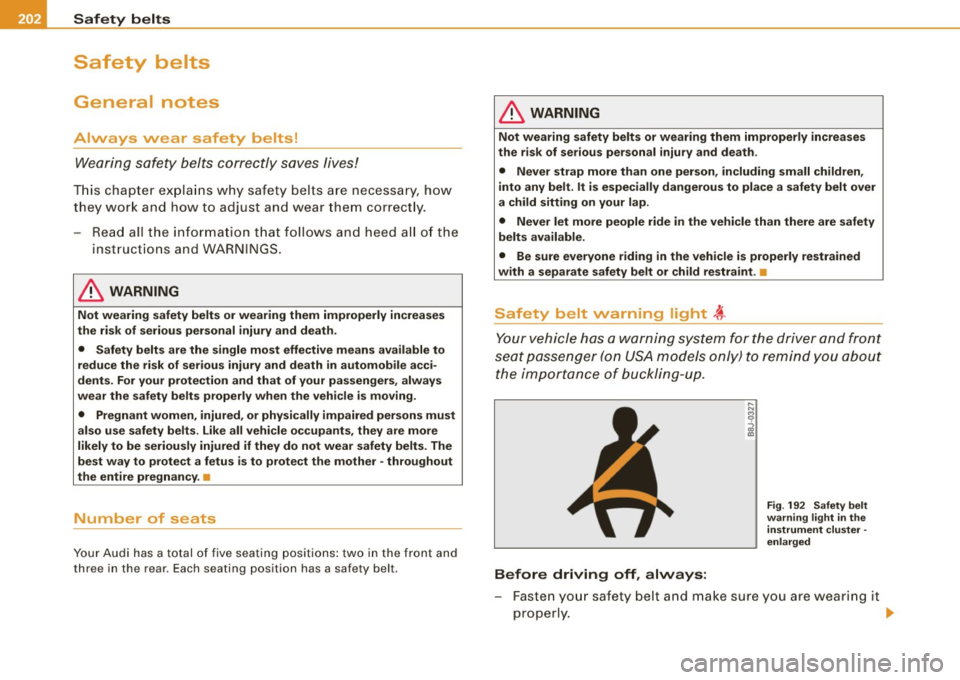
Safety belt warning light ~
Your vehicle has a warning system for the driver and front
seat passenger (on USA models only) to remind you about
the importance of buckling-up.
Before driving off, always:
Fig . 192 Safety belt
warning light in the
instrument cluster -
enlarged
- Fasten your safety belt and make sure you are wearing it
properly. ._
Page 209 of 390
- Insert the t ongue into the corre ct buckle of your seat
unt il you hear it la tc h securely=> fig. 198.
- Pu ll on t he belt to make su re t hat it is securely latc hed i n
the buckle.
Automati c safet y belt r etracto rs
Eve ry safety belt is equipped with an automatic belt retractor on the
shou lder belt. This feature locks the belt when the belt is pulled out
fast, during hard braking and in an accident . T he belt may also lock
when you drive up or down a steep hill or through a sharp curve .
During normal driving the belt lets you move free ly.
S afety belt pretensi oners
The safety belts are equipped with a belt pretensioner that helps to
tighten the safety belt and remove slack when the prete nsioner is
activat ed . The function of the pretension er is monitored by a
warning light=>
page 20.
Switchable locking feature
Every safety belt except the one on the d river seat is equipped with
a switchable locking feature that
must be used when the safety belt
is used to attach a ch ild sa fety sea t. Be sure to read the important
information about this feature=>
page 244.
& WARNING
Improperly po sitioned safety belts can cau se seriou s injury in an
accident =>
page 207 , "Safety belt po sition ".
• Safet y belts offer optimum prote ction onl y when the seat bac k
i s upright and belt s are proper ly po sit ioned on the bod y.
• Alway s make sure that the rear seat backrest to which the
c ent er re ar safet y belt i s att ached i s se curely l atched whene ver
the re ar center safety b elt is being us ed. If the b ackre st is not
se curely latched , the p asseng er will mo ve forw ard with the back
rest d uring sudde n br aking, in a sudden maneu ver and especi ally
in a crash.
Safety first
Safety belts
& WARNING !continued )
• Never attach the safety belt to th e buckle for another seat.
Atta ch ing the belt to the wrong b uckle will reduce safety belt
effe ct iv eness and c an cause ser ious person al injury .
• A p assenger who i s not p roperly re str ained c an be ser iously
injur ed by the saf ety belt itself when it move s from the stronger
p art s of the b ody into critic al are as like the abdomen .
• Alway s lock the convertible locking retractor when you are
s e cu ring a child safet y seat in the vehi cle
=> page 246. •
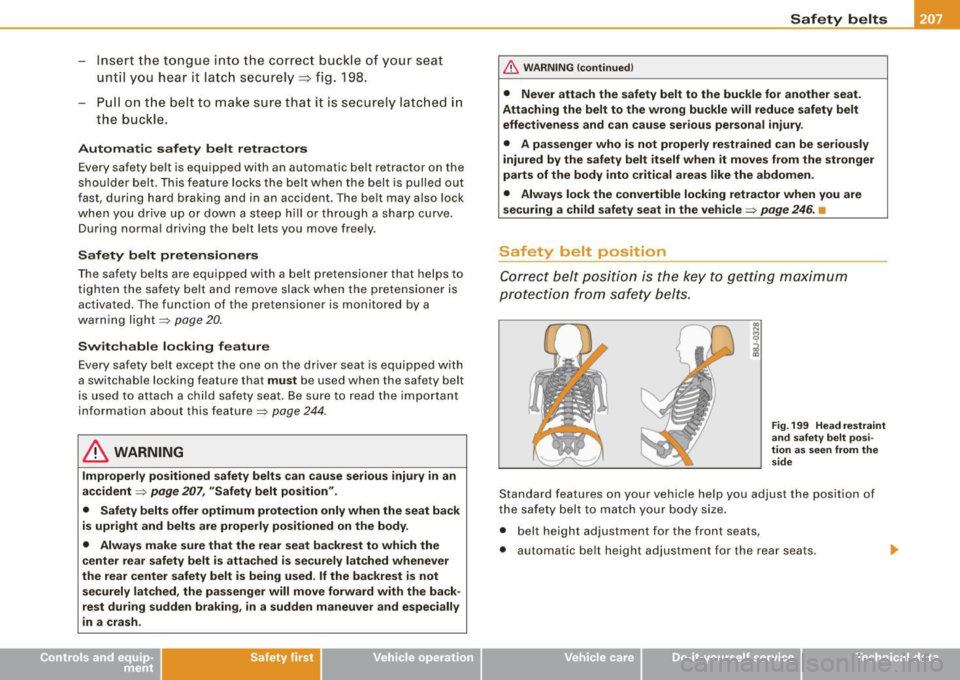
Safety be lt position
Cor rect bel t position is the key to getting maximum
protec tio n from s afety belts.
Fig . 199 He ad r estrain t
a n d sa fe ty b elt p osi
tion as seen from th e
s ide
Standard features on your vehicle he lp you adjust the position of
the safety belt to match your body size.
• belt height adjustment for the front seats,
• automatic be lt height adjustment for the rear seats .
Vehicle care I I irechnical data
Page 212 of 390
• ....__S_ a_ fe_ t _y=-- b_ e_ lt_s ________________________________________________ _
• With the front sea ts, the height adjustment of the seat can also
be used to adjust the position of the safety belts. •
Improperly worn safety belts
Incorrectly positioned safety belts can cause severe inju
nes.
Wearing safety belts improperly can cause serious injury or
death. Safety belts can only work when they are correctly positioned on the body. Improper seating positions reduce
the effectiveness of safety belts and w ill even increase the
risk of injury and death by moving the safety belt to critical
areas of the body. Improper seating positions also increase
the risk of serious injury and death when an airbag deploys
and strikes an occupant who is not in the correct seating
position. A driver is responsible for the safety of all vehicle
occupants and especially for children. Therefore:
-Never permit anyone to assume an incorrect sitting pos i
tion in the vehicle while traveling ~& .
& WARNING
Improperly worn safety belts increase the risk of serious personal
injury and death whenever a vehicle is being used.
• Always make sure that all vehicle occupants are correctly
restrained and stay in a correct seating position whenever the
vehicle is being used.
• Always read and heed all WARNINGS and other important infor
mation
~ page 205. •
Safety belt tensioners
How safety belt pretensioners work
In front, side and rear collisions above a particular
severity, safety belts are tensioned automatically.
The safety belts are equipped with safety belt pretensioners . The
system is activated by sensors in front, side and rear collisions of
great severity . This tightens the belt and takes up belt slack~
& in
"Service and disposal of safety belt pretensioner" on
page 211.
Taking up the slack helps to reduce forward occupant movemen t
during a collision.
0 Note
Never let the belt remain over a rear seat back that has been folded
forward .
[ i] Tips
The safety belt pretensioner can only be activated once.
• In minor frontal, side and rear -end collisions, in a rollover and in
accidents involving very little impact force, the safety belt preten
sioner are not activated .
• When the safety belt pretensioners are activated, a fine dust is
released. This is normal and is not caused by a fire in the vehicle.
• The relevant safety requirements must be observed when the
vehicle or components of the system are scrapped. A qualified deal
ership is familiar with these regulations and will be pleased to pass
on the information to you.
• Be sure to observe all safety, environmental and other regula
tions if the vehicle or individual parts of the system, particularly the
safety belt or airbag , are to be disposed . We recommend you have
your authorized Audi dealer perform this service for you. •
Page 214 of 390

-Airbag s yste m Ptrf _______________ _
Airbag system
Important things to know
Importance of wearing safety belts and
sitting properly
Airbags are only supplemental restraints. For airbags to
do their job, occupants must always properly wear their
safety belts and be in a proper seating position.
For your safe ty a nd the safety of your passengers, before
driving o ff, a lways:
- Adjust the driver's seat and steering wheel properly
~ page 194,
-Adjust the front passenger's seat properly~ page 88,
- Wear safety belts properly~ page 205,
-Always properly use the proper child restraint to pro tect
children~
page 234 .
In a col lision airbags must inflate within the blink of an eye and with
considerable force. The supplemental airbags can cause injuries if
the driver or the front seat passenger is not seated properly. There
fore in order to help the airbag to do its job, it is important, both as
a driver and as a passenger to sit properly at a ll times.
By keep ing room between your body and the steering wheel and the
front of the passenger compartment, the airbag can inflate fu lly and
comp letely and prov ide supplementa l protection in certain frontal
collisions =>
page 194, "Proper occupant seating positions". For
detai ls on the operation of the seat adjustment controls=>
page 88.
It's especially important that children are properly restrained
=>
page 234 .
There is a lot that the driver and the passengers can and must do to
help the individual safety features installed in your Audi work
together as a system.
P roper seating position is important so that the front airbag on the
driver side can do its job. I f you have a physical impairment or
condition that prevents you from sitting properly on the driver seat
with the safety belt properly fastened and reaching the pedals, o r if
you have concerns with regard to the function or operation of the
Advanced Airbag System, p lease contact your authorized Audi
dea ler or qua lif ied workshop, or call Audi Customer CARE at 1-800-
822 -2834 for possib le modifications to your vehicle.
When the airbag system deploys, a gas generator wi ll fill the
airbags, break open the padded covers, and inflate between the
steering wheel and the driver and be tween the instrument panel
and the front passenger. The airbags wil l deflate immediate ly after
deployment so that the front occupants can see through the wind
shield again without interruption .
A ll of this takes p lace in the b link of an eye, so fast that many people
don't even rea lize that the airbags have dep loyed . The airbags also
inflate with a great deal of force and nothing should be in their way
when they dep loy. Fron t airbags in combination wi th properly worn
safety belts slow down and limit the occupant's forward movement.
T ogether they help to prevent the driver and front seat passenger
from hitting parts of the inside the vehicle while reducing the forces act ing on the occupant during the crash . In this way they he lp to
reduce the r isk of injury to the head and upper body in the crash.
Airbags do not protect the arms or the lower parts of the body .
Both front airbags will not in flate in al l fro ntal col lisions . The trig
gering of the airbag system depends on the vehic le decelerat ion
r ate caused by the colli sion and registe red by the electronic contro l
unit. If this rate is below the reference value programmed into the
cont rol unit, the airbags w ill not be t riggered, even though the car
may be bad ly damaged as a result of the collision. Vehicle damage, .,,,.