2008 AUDI S6 battery
[x] Cancel search: batteryPage 161 of 390

_________________________________________________ A_ u_t_ o_ m_ a_t _i _ c _ t _ra_ n_s_ m __ is_ s_ io_ n _ __.1!111
Ap plies to vehicle s: with 6-speed automat ic transmission
Emergency release for selector lever
If the vehicle's power supply fails, the selector lever can
be released in an emergency.
Fig . 156 Remove the
as htray i nsert
Fig . 157 Eme rge ncy
r elease fo r se lecto r
l ever
The emergency release is located under the insert for the
ashtray.
- Slide open the cover for the ashtray .
- Grasp the ashtray insert~ fig. 156 by the recesses on
both sides and pull it upward and out.
- Now you can see a sma ll cover in t he as htray holder.
- Release and remove this cover from the ashtray holder.
Con tro ls and eq uip
ment
Using a screwdriver or a similar tool, press down on the
screw in the m iddle of the ashtray holder, which is now
accessib le, and hold it down
~ fig. 157 .
Now press the interlock and move the selector lever to
the
N position.
The selector lever can only be moved from the P position if the igni
tion key is in the lock and the ignition is turned on. If the vehicle has
to be pushed or towed if the power supply fails (e.g. battery is discharged), the selector lever must be moved to the N position
using the emergency locking device .•
multitronic ®
Applies to veh icles: with multitronic® Continuously Variable Transm ission (CVT l
General information
Your vehicle is equipped with a electronically controlled continu
ously variable transmission (multitronic ®l. Inside the multitronic ®
system, the gear ratios are not shi fted in finite steps as in a conven
tional automatic transmission, but rather
co ntin uously. As a result,
engine power is applied smoothly and comfortably, and better fuel
economy is achieved.
The transmission selects the appropriate gear ratio (upshifts and
downshifts) automatically based on set driving programs
=> page 163, "Dynamic shift program (DSP)".
You can also manually select a shift program (tiptronic®)
=> page 164.
You should note, that the multitronic transmission differs from a conventiona l Automatic Transmission . In the multitronic transmis
sion the engine power is transferred via a link -plate chain, rather
than by a conventional torque converter. The multitronic transmis
sion greatly reduces vehicle "creep'"' when at a standsti ll and the
transmission is in
D Sor R. •
Vehicle care I I Technical data
Page 168 of 390
•L---=A....::...: u:;.. t:..: o:..::....: m.....;::. a..;:t :;..ic ~ t:..: r..;: a ..:..; n.....;::. s..:.m ;.;..:. is::.. s .::....:. io::....:. n;__ ____________________________________________ _
Applies to vehic les: with mul tit roni c® Cont inuous ly Variab le Transmission (CVTl
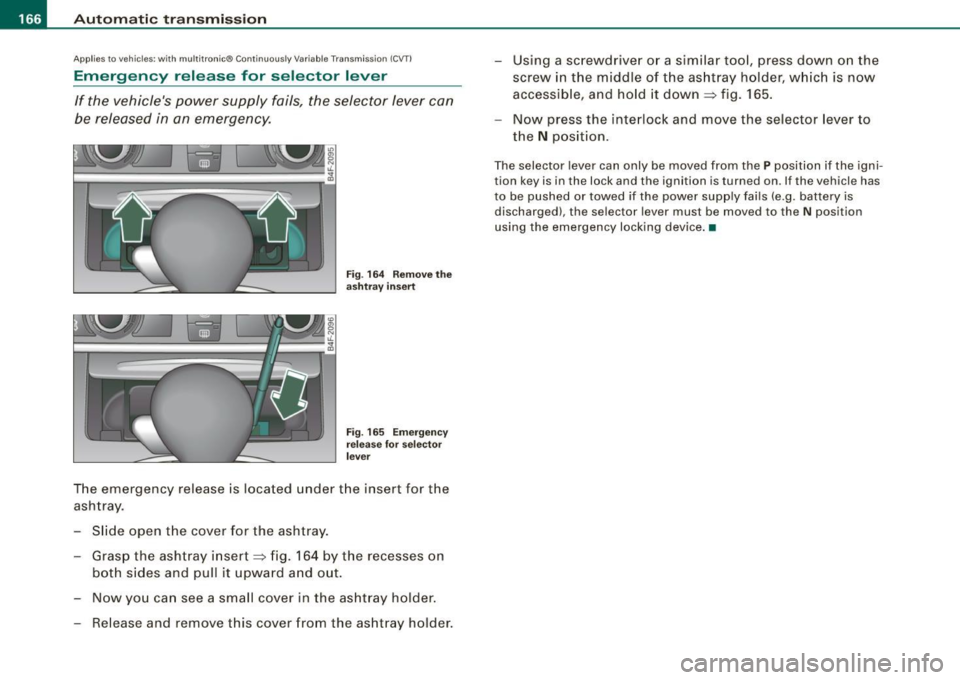
Emergency release for selector lever
If the vehicle's power supply fails, the selector lever can
be released in an emergency.
Fig. 164 Remove the
ashtray insert
Fig. 165 Emergency
release for selector
lever
The emergency release is located under the insert for the
ashtray.
- Slide open the cover for the ashtray.
- Grasp the ashtray insert~ fig. 164 by the recesses on
both sides and pull it upward and out.
- Now you can see a small cover in the ashtray holder.
- Release and remove this cover from the ashtray holder. -
Using a screwdriver or a similar tool, press down on the
screw in the middle of the ashtray holder, which is now
accessible, and hold it down
~ fig. 165.
- Now press the interlock and move the selector lever to
the
N position.
The selector lever can only be moved from the P position if the igni
tion key is in the lock and the ignition is turned on. If the vehicle has
to be pushed or towed if the power supply fails (e .g. battery is
discharged), the selector lever must be moved to the N position
using the emergency locking device. •
Page 229 of 390

__________________________________________________ A_ i_ r _b _a...; g::- s_ y=--- s_t _e _m __ lll
& W ARNING (continued )
• Always make sure that the side airbag can inflate without inter
ference :
- Never install seat covers or replacement upholstery over the
front seatbacks that have not been specifically approved by
Audi.
- Never use additional seat cushions that cover the areas
where the side airbags inflate.
- Damage to the or iginal seat covers or to the seam in the area
of the side airbag module must always be repaired immedi
ately by an authorized Audi dealer.
• The airbag system can be activated only once. After an airbag
has inf lated , it must be replaced by an authorized Audi dealer or
qualified technician who has the technical information , training
and special equipment necessary .
• The airbag system can be deployed only once . After an airbag
has been deployed, it must be replaced with new replacement
parts designed and approved especially for your Audi model
version. Replacement of complete airbag systems or airbag
components must be performed by qualified workshops only .
Make sure that any airbag service action is entered in you r Audi
Maintenance
& Warranty booklet under AIRBAG REPLACEMENT
RECORD .
• In accidents when an airbag is deployed , the vehicle battery
separates the alternator and the starter from the vehicle electrical
system for safety reasons with a pyrotechnic circuit interrupter.
-Work on the pyrotechnic circuit interrupter must only be
performed by a qualified dealer -risk of an accident!
- If the vehi cle or the circuit interrupter is scrapped, all appli
c able safety precautions must be followed . •
Controls and equip ment Safety first
Vehicle operation
Other things that can affect Advanced Airbag
performance
Changing the veh ic le 's suspen sion system can change the way that
the Adva n ced Air bag Syst em perfor ms in a crash . For e xamp le,
u sing tire -r im co mbinations not ap proved by Audi , lowering the
v ehi cle, c hang ing the s tiff ness of the susp ens ion, inclu d in g t he
springs, s uspension struts, shock absorbers etc. can change the
fo rce s t hat ar e meas ured by t he airbag sens ors and sent t o the e lec
tronic control unit. Some suspens ion changes can, for example,
i nc rease t he for ce leve ls mea sured by th e sen sors and make th e
airbag system dep loy in crash es in wh ich it wou ld not deploy if the
ch anges had no t been m ade. O th er ki nds of change s may red uce
the force levels measured by t he sensors and prevent t he airba g
fr om d eploying when it shoul d.
T he se nso rs in t he safety b elt b uckle for the driver a nd front
passenger seat te ll the electronic control module if the safety belt is
l a tc h e d or n ot. If t he safet y bel t is bei ng use d, the front ai rbag w ill
dep lo y at a s lightly hig her rate of veh ic le dece leration than
if the
safe ty belt i s not be ing used . The re fo re, in a pa rticu la r colli sion, i t is
poss ible that an airbag will not deploy at a s eating position where
t he safe ty be lt is b ein g us ed b ut will infl ate a t th e po siti on where the
safety belt is not being used. It is important that nothi ng int erfer e
with the safety belt b uckl es so that the sens ors can send the correct
i n formation about safety belt use to the electronic control u nit.
& WARNING
Chang ing the vehicle's suspension includ ing use of unapproved
tire -rim combinations can change Advanced Airbag performance
and increase the risk of serious personal injury in a crash.
• Never install suspension components that do not have the
same performance characteristics as the components originally
installed on your vehicle.
• Never use tire-rim combinations that have not been approved
by Audi. ...
Vehicle care Do-it-yourself service Technical data
Page 267 of 390

Energy management
Starting ability is optimized
Energy management controls the distribution of electrical
energy and thus optimizes the availability of electrical
energy for starting the engine.
If a vehicle with a conventional energy system is not driven for a
long period of time, the battery is discharged by idling current
consumers (e.g. immobilizer). In certain circumstances it can resu lt
in there being insufficient energy available to start the engine .
Intelligent energy management in your vehicle handles the distribu
tion of electrical energy . Starting ability is markedly improved and
the life of the battery is extended.
Basical ly, energy management consists of
battery di agn osis, idling
current mana gement
and dynami c en ergy management .
Batter y diagn osis
Battery diagnosis continuously deter min es the state of the battery.
Sensors determine battery vo ltage, battery current and battery
temperature . This determines the cu rrent state of charge and the
power of the battery .
Idling c urrent man ag em en t
Idling current management reduces energy consumption while the
vehicle is standing. With the ign it ion switched off, it controls the
energy supply to the various electrical components. Data from
battery diagnos is is considered .
Depending on the battery's state of charge, individual consumers
are gradually turned off to prevent excessive discharge of the
battery and thus maintain starting capability.
Dynamic energ y managem ent
While the vehic le is being driven, dynamic energy management
distributes the energy gene rated acco rding to the needs of the indi -
Controls and equip
ment Safety first Vehicle operation
In
te llig ent tec hn olo gy
vidual components . It regulates consumption, so that more e lec
trical energy is not being used than is being ge nerated and ensures
an optimal state of charge for the battery.
[ i ] Tips
• But even energy management cannot negate the limits of
physics. Consider that the power and life of a battery are limited .
• I f starting ability is threatened, you are informed by a warning
=> page 266, "Drive r notifica tion i n the instrument cluster
display" .•
What you should know
The highes t pri ority is given to main tain ing starting capa
bility.
The battery is severe ly taxed in short-distance driving, in city traffic
and during the co ld time of year. Abundant electrical energy is
required, but only a little is generated. It is also critical if the engine
is not running and elect rica l components are turned on. In this
instance energy is being consumed but none is being generated .
I t is in precisely these situations that you will notice energy manage
ment active ly regula ting the distr ibut ion of energy.
Vehicle stands fo r an extended period
If you do not drive your vehicle over a period of several days or
weeks, electrical components are gradually cut back or switched off.
This reduces energy consumption and maintains starting capability
over a longer period.
Take into considerat ion that when you un lock your veh icle, some
convenience functions, such as the remote key or power seat
adjustment, may not be availab le . T he conven ience functions will be
available again when you turn on the ignition and start the engine.
Vehicle care Do-it-yourself service Technical data
Page 268 of 390

-Intelligent technology
----'""------- ~---------------------------------------
With the engine turned off
If you listen to the radio, for example, with the engine turned off or
use other MMI functions, the battery is being discharged.
If starting capability is jeopardized due to energy consumption , the
following warning appears in the MMI display:
Please start engine, otherwise system will switch off in
3 minutes.
The warning indicates that the system will be turned off automati
cally after 3 minutes. If you wish to continue using the functions,
you have to start the engine.
With the engine running
Although electrical energy is generated when the vehicle is being
driven, the battery can become discharged. This happens mostly
when little energy is being generated and a great deal consumed
and the battery's state of charge is not optimal.
To bring the energy balance back into equilibrium , consumers
which require especially large amounts of energy are temporarily cut back or switched off. Heating systems in particular require a
great deal of energy. If you notice, for example, that the heated
seats* or the heated rear window are not heating, they have been
temporarily cut back or switched off. These systems will be available
again as soon as the energy balance has been restored.
You will also notice that engine idle speed has been increased
slightly . This is normal and not a cause for concern. By increasing
engine idle speed the additional energy required is generated and
the battery is charged. •
Driver notification in the instrument cluster
d isplay
If battery power drops into the range where it can limit the ability of
the engine to start, this is shown in the instrument cluster display
with the following driver message:
'-' Low battery charge: battery will be charged while driving
This notification reminds you that the starting capability of the
engine may be limited. As soon as you start driving again, the
battery will be recharged and the notification will go out.
Driver notification appears and goes out again
If this driver notification appears after the ignition is turned on or
while driving and it goes out again after a while, the battery has
been adequately recharged.
Driver notification appears and does not go out again
If this driver notification appears after the ignition is turned on or
while driving and does not go out again, the battery's state of
charge is not in the optimal range. Starting ability is restricted . Have
the battery checked as soon as possible at a dealership. •
Page 299 of 390

___________________________________________ C_ h:....:e :....: c:....: k..:..: i..:.. n :..::g ::.....:: a:..:.n ..:..: d=---.:. f..:..:il ..:..:li ..:..n :.:::g !--_!11
•
Closing the engine hood
- Pull the hood down until the pressure from the struts is
reduced .
- Let the hood
drop down and latch in place. Do not try to
push it shut;
it may fail to engage => &.
& WARNING
A hood that is not completely latched could fly up and block your
view while driving.
• When you close the engine hood, check it to make sure the
safety catch has properly engaged. The hood should be flush with
the surrounding vehicle body parts.
• If you notice while driving that the hood is not secured prop
erly, stop at once and close it. •
Working in the engine compartment
Be especially careful whenever you work in the engine
compartment.
Whenever you must perform any work in the engine compartment,
for example checking and filling different fluids, there is a risk of injury, burns and accidents. To prevent personal injury always
observe the following WARNINGS. The engine compartment of any
vehicle is a hazardous area
~ & .
& WARNING
To help avoid injury, before you check anything under the hood :
• Turn off the engine.
• Remove the ignition key.
• Apply the parking brake .
& WARNING (continued)
• Move selector lever to "P" (Park).
• Always let the engine cool down. Hot components will burn
skin on contact.
• To reduce the risk of being burned, never open the hood if you
see or hear steam or coolant escaping from the engine compart
ment. Wait until no steam or coolant can be seen or heard before
carefully opening the hood.
• Keep children away from the engine compartment .
• Never spill fluids on hot engine components. They can cause a
fire.
• Never touch the radiator fan. The auxiliary electric fan is
temperature controlled and can switch on suddenly.
• Never open the coolant reservoir cap when the engine is still
warm . The coolant system is pressurized and hot coolant could
spray out.
• Protect your face, hands and arm from steam or hot engine
coolant by placing a thick rag over the cap when you open the
coolant reservoir.
• If work on the fuel system or the electrical system is necessary :
- Always disconnect the battery.
- Never smoke or work near heaters or open flames . Fluids in
the engine compartment could start a fire.
- Keep an approved fire extinguisher immediately available.
• To avoid electrical shock and personal injury while the engine
is running or being started, never touch:
- Ignition cables
- Other components of the high voltage electronic ignition system.
• If you must perform a check or repair with the engine running: -First, fully apply the parking brake, move selector lever to "P"
(Park). .,
Vehicle care
I t •
Page 300 of 390

___ C_h_ e_ c_k _in --== g'-- a_n _d_ f_il _li _n ..:::g:::..- ___________________________________________ _
& WARNING (continued )
-Always u se extreme caution to prevent cloth ing , jewelry, or
long hair from getting caught in the radiator fan , V-belt s or
other moving parts , or from contacting hot parts . Tie back hair
before starting , and do not wear clothing that will hang or
droop into the engine .
• Minimize exposure to emis sion and chemical hazards
::::> & .
& WARNING
California Proposition 65 W arn ing :
• Engine exhaust , some of its constituents , and certain vehicle
c omponents cont ain or emit chemicals known to the State of Cali
fornia to cause cancer and birth defects and reproductive harm. In addition , certain fluids contained in vehi cles and certa in products
of component wear contain or emit chemicals known to the State
of California to cause cancer and birth defect s or other reprodu c
tive harm.
• Battery posts , terminals and related ac cessories conta in lead
and lead compounds , chemicals known to the State of California
to cause cancer and reproductive harms. Wash hands after
handling.
0 Note
When adding f luids, always make sure that they are poured into the
proper container or filler ope ning, otherwise serious damage to
vehic le systems wi ll occur.
ci> For the sake of the environment
To detect leaks in time, inspect the vehicle floor pan from under
n eath regu larly. If you see spots fro m oil o r o th e r v eh icle flu ids, hav e
your vehicle inspected by an author ized Audi dea ler. •
Engine compartment
These are th e m ost im porta nt items th at you can ch ec k.
Fig. 231 Typical layout for containe rs, engine oi l d ipstick and engine oil filler
cap
0 Jum p star t connector( +) under a cover,( -) w ith hex
head screw .... ... .... ..... ... .. .. ........... .. 310, 351
@ B rake fluid reservoir ( ) . . . . . . . . . . . . . . . . . . . . . . . . 3 06
© Coo lant e xpansio n tank (- L ) . . . . . . . . . . . . . . . . . . . . . . 304
© Eng in e oil fill er cap ('l=:11) . . . . . • . . . . . . • . . . • . . . . . . . 30 2
© E ng ine oil d ipstick (orange) .............. ....... .
©
0
Power steering reservoir ....................... •.
Windshield/ headlight washer container( ~) ....... . 3
01
263
312 ~
Page 309 of 390

___________________________________________ C_ h_e _c_ k_ i_n _g _ a_n _d_ f_il _li _n _g __ lll
•
T he fluid level may drop slightly after some time due to the auto
m atic adjustment of the brake pads. This is not cause for alarm .
If the brake fluid level fal ls
considerably below the "MIN" mark , the
brake warning/indicator light (U.S. models :
BRAKE, Canadian models:
{(j))) will come on~ page 23 and ~ page 32. Do not continue to
operate the vehic le. The complete brake system should be thor
oughly checked by an authorized Audi dealer or other qua lified
facili ty and the cause corrected . If the brake fluid level is too low, the
brake warning/indicator l ight will illuminate. Contact an au thorized
Audi dea ler
immediate ly .•
Changing brake fluid
Have the brake fl uid changed by an experienced techni
ci an.
Brake fluid absorbs moisture from the air. If the water content in the
brake fluid is too h igh, corrosion in the brake system may result
after a period of time. The boiling point of the brake fluid will also
decrease considerab ly and decrease braking performance .
Therefore , the brake fluid must be changed
e v ery tw o year s. Always
use new brake fluid which conforms to Federal Motor Vehic le Stan
dard "FMVSS 116 DOT 4".
T he brake fluid res ervoir can b e difficult to reach, th erefore, we
recommend that you have the brake fluid changed by your autho
rized
Audi de aler . Your dealer has the correct tools, the right brake
fl uid and the know -how to do t his fo r you .
& WARNING
• Brake fluid is poi sonous . It mu st be stored onl y in the clo sed
o riginal cont ainer out of the rea ch of children!
• Brake failure c an re sult from old or inappropri ate br ake flu id .
Obs erv e the se pre caution s:
& WAR N IN G (c ontinued )
-Use only brake fluid that meet s SAE specification J 1703 and
c onfo rm s to Feder al Moto r Vehicle St andard 116 . Al wa ys check
w ith your authori zed Audi dealer to make sure you are u sin g
the corre ct b rake flu id. The cor rect type of br ake fluid is als o
indic ated on the brake fl uid reservoir .
- The brake fluid mus t be ne w. Heav y use of th e brake s can
ca use a vapor lock if the bra ke fluid i s left in the sy stem too
long . Thi s can seriou sly affect the efficiency of the brake s as
w ell as your s afety . This could r esult in an a ccident .
0 Note
Brake fluid will damage the paint of your vehicle .
the special too ls required and the necessary expertise, we recom
mend that you have the brake fluid changed by your authori zed Audi
dea ler .•
Battery
General information
Und er n ormal operating conditions, the battery in your Audi does
not need any maintenance. With
high outside temperatures or long
daily drives we recommend that you have the electrolyte level
checked by a se rvice facility . The e lectrolyte level should a lso be
checked each time the battery is charged~
page 310 .
Have the batte ry checked when you take your vehic le in for service.
You are well advised to replace a battery that is o lder than 5 years . _,,
Vehicle care I t •