2008 AUDI S6 air condition
[x] Cancel search: air conditionPage 181 of 390

_____________________________________________ A_u_ d_ i _P _a_ r_ k_ i_n -=g a..- S-=y'--- s_ t_ e_ m __ ....JJIIII
Ap plies to vehicles: with Audi Par king System (r ear) and rea r-vie w came ra
Adjusting the chimes -option 2
The menu for adjusting signal sounds can also be called
up via the control button with the "settings" function.
Fig. 180 MMI Display:
Rear-view camera
picture
Fig . 181 MMI Display:
Audi Parking System
- Activate the Audi Parking System=> page 169. The rear
view camera picture appears in the
MMI Display.
- Select
Settings => fig. 180. The menu for adjusting Rear
volume
and Rear frequency appears in the MMI Display
=> fig.
181.
Select Rear volume if you want to change the volume of
the chimes from the rear signal generator.
Contro ls and eq uip
ment
Select Rear frequency when you want to change the
frequency of the chimes from the rear signal generator.
Select
Settings => fig. 181, or
Press the [RETURN] button . T he rear-v iew camera picture
appears in the
MMI D isplay again.
When adjusting the volume and frequency , the new setting will
sound for about 2 seconds from each audible signal generator. The
volume and frequency settings are automatically stored and
assigned to the master key with remote control.
& WARNING
Always make sure that the volume and frequency of the chimes is
adjusted so that you can easily hear the acoustic distance signal
even if the radio is playing, the air-conditioner blower is on High or
there is a high level of outside noise. Check the settings whenever
someone else has driven the vehicle before you. •
Safety tips
Applies to vehic les: with Audi Par king System {rear) and rea r-v iew came ra
Acoustic parking system error message
If a warning tone is audible for about five seconds when you turn on
the ignition, there is a malfunction in the system. Have the problem
corrected by your authorized Audi dealer.
Keep the sensors in the rear bumper clean and free from ice so that
the acoustic park assist system can function properly.•
Vehicle care I I irechnical data
Page 182 of 390

• .___A_ u_d_ i _P _a_ r_ k_ i_ n ..:g=-- S_ y=-- s_t _ e _m _____________________________________________ _
Applies to vehic les: with Audi Park ing System (rearl and rear-view camera
Rear-view camera tips
We recommend that you practice parking with t he rear -view camera
in a traff ic -free location, or parking lot, to become fami liar with the
system, the orientati on line s, a nd th eir functi on. When doi ng this,
there should be good light and weather conditions.
In the MMI Display, objects or vehicles ap pea r closer or further away
i f:
• you are driving in reverse gear from a level surface onto an
inc lin e, o r a downwa rd sl ope,
• you are driving in reverse gear toward protruding objects,
• the ve hicle is carrying too much load in the rear.
The accuracy of the orientation lines and blue surfaces diminishes if :
• the Adaptive Air Suspension* is defective, or th e dynamic, off
road, o r lift mode is swi tched on,
• the rear -view camera does not provide a reliable image, for
exam ple, in po or vi sibi lit y c ondi tio ns or if the lens is dirt y,
• the image on the screen is not visible due to sun g lare and reflec
t ion .
Caring for the rear-view camera lens:
• Dampen the lens with a household a lcoho l- based g lass c leaner,
and c lean th e lens wit h a dry cl oth.
• Remove snow with a hand brush.
• Remove ice, preferably with de -icing spray~
0.
& WARNING
• The rear-v iew camera does not replace the view to the rear and
the rear view mirrors .
• The rear-view camer a - because of technical limitat ions -does
not show the entire area behind the vehicle~
page 17 3, fig. 171.
& WARNING (continued )
Be especially careful to che ck for small children and animals
before backing up . Small children and animals will not alway s be
shown in the rear-view display .
• The Audi Parking System is not a sub stitute for being careful
and alert when back ing up . Be especially careful during parking
and similar maneuver s. Always watch where you are driving and
make su re that nothing is in the way .
• Do not allow yourself to be distracted from traffic by the rear
view camera pi ctures .
• When maneuvering or parking , do not only u se the MMI Display
for orientat ion . Certain obje cts - depending on the screen resolu
tion -may not, or not entirely, be displayed ; for example tr ailer
hitches , cha ins , narrow posts , or fences .
• Only use the rear -view camera for aid if it shows a good , clear
picture . The image may be obscured , for example , by the sun
shining into the lens, dirt on the lens, or as the result of a defect -
danger of accident!
• If the image i s hazy when the MMI Display is switched on or the
area behind the vehicle is not visible (for e xample , as the result of
a dirty or defective lens ), the rear -view camera must not be used
for aid in maneuver ing - danger of accident!
• The rear -view camera generates two -dimensional images . For
this reason , please note that recesses in the ground and
protruding parts on another vehicle , or protruding objects fixed to
the ground , will be more difficult or impossible to recognize on the
MMI Di splay, due to the missing spacial depth .
• If the position and the installation angle of the camera has
changed, for example , after a rear end collision , do not continue to
use the system for safety reasons . Have it checked by an autho
rized Audi dealer or qualified work shop .
• Only use the rear-v iew camera when the rear lid is fully closed .
Make sure that objects mounted on the rear are not obscuring the
camera v iew .
Page 184 of 390

• .___A_ d_ a --=- p_t_ i_v _e _ A_ ir_ S_u_ s_,_ p_e_ n_ s_io _ n _____________________________________________ _
Adaptive Air Suspension
Adaptive Air Suspension and
Damping
A pplies to veh icles: with Adaptive Air Suspens ion
Description
Adaptive Air Suspension and damping can be regulated
and they adapt automatically to a request from the driver
and the driving situation at the time.
Adaptive Air Suspension is an electronically controlled springing
and damping system . Th is chassis system makes it easier on the
driver by adapting to the particular situation through imperceptible
control processes.
The
Adaptive Air Suspension component regulates ground clear
ance depending on vehicle speed, load condition and driver input.
When the system is in automatic mode, accelerating to a speed above a predetermined limit will make the vehicle lower itself. On
the other hand, driving more slowly results in the vehicle raising
again at specific speeds.
The
damping component provides individual control of the
damping forces. For example, with damping characteristics set to
provide greater comfort, damping is set somewhat harder for a brief
period only as required, for example, when going around a curve or
over rough road surfaces as well as when braking.
Settings
Adaptive Air Suspension provides the driver with the opportunity to
set the chassis characteristics also to their individual preference.
With the driving modes
standard, automatic and dynamic the driver
has three chassis settings available, ranging from comfort to sporty .
In addition,
lift provides a fourth mode which can be selecting for
driving over poor stretches of road :::::,
page 183, "Chassis controls". The modes are set in
MMI:::::,
page 183.
& WARNING
The height of the parked vehicle can change due to temperature
fluctuations or changes in load.
0 Note
• Whenever you park your vehicle, always make sure there is
adequate clearance above and below the vehicle. The height of the parked vehicle can change as the result of temperature fluctuations,
changes in load condition and changes in the driving mode (ground
clearance!.
• If the vehicle is being transported (e.g. by tow truck, train, ship,
etc.), mount the tie -down chains/cables over the running surface
(circumference) of the tires . Never secure the vehicle by the axle, the
suspension struts or the front or rear towline eye. For technical
reasons, the pressure in the suspension struts may change during
the transport, which could result in the vehicle no longer being
secured properly.
• To prevent damage to the vehicle underbody, remember that
your vehicle is not an off-road vehicle, even in the "lift" mode. The
ground clearance is insufficient for this type of operation.
• If you are going to tow a trailer, you must activate the trailer oper
ation mode :::::,
page 184.
[ i] Tips
Before you raising your vehicle using the vehicle jack (for example,
when changing a flat tire) you must activate the jacking mode
=> page 184. •
Page 187 of 390
____________________________________________ A_ d_a--' p=-- t_iv _e_ A_ ir_ S_u_ s-=- p_e _ n_ s _ io_ n __ llll
- Press the I SETUP I functio n button . The menu Ad aptiv e
Air
Su spen sion appears~ page 784, fig. 184.
- Select
Trailer towing mode on or off as requ ired .
Leve l Adjus tment w he n t ow ing a tra il e r
• Before hitching up the trailer and before adjusting the tongue
weight at the trailer, the automatic or standard mode
mu st be
selected, so that the vehicle is at normal level=>
page 183, "Setting
the driving modes".
• If driving in dynamic mode is desired, this mode
mu st be
selected before hitching up the tra iler and before adjust ing the
tongue weight . However, note that your vehicle is lowered and
ground c learance is reduced .
• If you have to drive under difficult road conditions, you can
select lift mode after hitching up the trailer or after adjusting the
tongue weight .
Restri ctions when op erating wit h a trailer
When operating wi th a trailer, the lift mode can only be selected up
to about 25 mph (40 km/h) . The system automatically goes out of li ft
mode when speed exceeds about 31 mph (50 km/hl.
If the veh icle is in automatic, standard or lift mode before the tra iler
towing mode is activated, the dynamic mode cannot be activated.
If the vehic le is in dynamic mode before towing operation is acti
vated, it can be driven in this mode. If the suspension is switched
from this mode to automatic mode, dynamic mode cannot be re
selected.
[ i ) Tips
If the trai ler towing mode has been activated, the vehicle will not
sink to the dynamic level if selected. •
Controls and equip
ment I • •
Page 195 of 390

________________________________________________ D_r_iv _ i _n_ g~ S_ a_ fe_ ly __ l!III
Important things to do before driving
Safety is everybody's job! Vehicle and occupant safety
always depends on the informed and careful driver.
For your safety and the safety of your passengers, before
driving always:
-Make sure that all lights and signals are operat ing
correctly.
- Make sure that the tire pressure is correct.
- Make sure that all windows are clean and afford good
visibility to the outside.
- Secure all luggage and other items carefully~
page 107.
-Make sure that noth ing can interfere w ith the pedals.
- Adjust front seat, head restraint and mirrors correctly for your height .
- Instruct passengers to adjust the head restraints
according to their height.
- Make sure to use the right ch ild restraint correctly to
protect children ~
page 234, "Child Safety ".
- Sit properly in your seat and make sure that your passen
gers do the same~
page 87, "General recommenda
tions".
- Fasten your safety belt and wear it p roperly. Also instruct
your passengers to fasten the ir safety belts properly
~ page 202. •
Controls and equip
ment Safety first
Vehicle operation
What impairs driving safety?
Safe driving is directly related to the condition of the
vehicle, the driver as well as the driver's ability to concen
trate on the road without being distracted.
The driver is responsible for the safety of the vehicle and all
of its occupants. If your ability to drive is impaired, safety
risks for everybody in the vehicle increase and you also
become a hazard to everyone else on the road ~& .There
fore:
Do not let yourself be distracted by passengers or by
using a cellular telephone .
NEVER drive when your driving ability is impaired (by
medications, alcohol, drugs, etc.).
- Observe all traffic laws, rules of the road and speed limits
and plain common sense .
- ALWAYS adjust your speed to road, traffic and weather
conditions.
- Take frequent breaks on long trips. Do not drive for more
than two hours at a stretch.
- Do NOT drive when you are tired, under pressure or when
you are stressed .
& WARNING
Impaired driving safety increases the risk of serious personal
injury and death whenever a vehicle is being used. •
Vehicle care Do-it-yourself service Technical data
Page 214 of 390

-Airbag s yste m Ptrf _______________ _
Airbag system
Important things to know
Importance of wearing safety belts and
sitting properly
Airbags are only supplemental restraints. For airbags to
do their job, occupants must always properly wear their
safety belts and be in a proper seating position.
For your safe ty a nd the safety of your passengers, before
driving o ff, a lways:
- Adjust the driver's seat and steering wheel properly
~ page 194,
-Adjust the front passenger's seat properly~ page 88,
- Wear safety belts properly~ page 205,
-Always properly use the proper child restraint to pro tect
children~
page 234 .
In a col lision airbags must inflate within the blink of an eye and with
considerable force. The supplemental airbags can cause injuries if
the driver or the front seat passenger is not seated properly. There
fore in order to help the airbag to do its job, it is important, both as
a driver and as a passenger to sit properly at a ll times.
By keep ing room between your body and the steering wheel and the
front of the passenger compartment, the airbag can inflate fu lly and
comp letely and prov ide supplementa l protection in certain frontal
collisions =>
page 194, "Proper occupant seating positions". For
detai ls on the operation of the seat adjustment controls=>
page 88.
It's especially important that children are properly restrained
=>
page 234 .
There is a lot that the driver and the passengers can and must do to
help the individual safety features installed in your Audi work
together as a system.
P roper seating position is important so that the front airbag on the
driver side can do its job. I f you have a physical impairment or
condition that prevents you from sitting properly on the driver seat
with the safety belt properly fastened and reaching the pedals, o r if
you have concerns with regard to the function or operation of the
Advanced Airbag System, p lease contact your authorized Audi
dea ler or qua lif ied workshop, or call Audi Customer CARE at 1-800-
822 -2834 for possib le modifications to your vehicle.
When the airbag system deploys, a gas generator wi ll fill the
airbags, break open the padded covers, and inflate between the
steering wheel and the driver and be tween the instrument panel
and the front passenger. The airbags wil l deflate immediate ly after
deployment so that the front occupants can see through the wind
shield again without interruption .
A ll of this takes p lace in the b link of an eye, so fast that many people
don't even rea lize that the airbags have dep loyed . The airbags also
inflate with a great deal of force and nothing should be in their way
when they dep loy. Fron t airbags in combination wi th properly worn
safety belts slow down and limit the occupant's forward movement.
T ogether they help to prevent the driver and front seat passenger
from hitting parts of the inside the vehicle while reducing the forces act ing on the occupant during the crash . In this way they he lp to
reduce the r isk of injury to the head and upper body in the crash.
Airbags do not protect the arms or the lower parts of the body .
Both front airbags will not in flate in al l fro ntal col lisions . The trig
gering of the airbag system depends on the vehic le decelerat ion
r ate caused by the colli sion and registe red by the electronic contro l
unit. If this rate is below the reference value programmed into the
cont rol unit, the airbags w ill not be t riggered, even though the car
may be bad ly damaged as a result of the collision. Vehicle damage, .,,,.
Page 220 of 390
___ A_ ir_ b_ a-g _ s_y _s_ t_ e_ m _________________________________________________ _
When a person is detected on the front passenger seat, weighing
m ore tha n the to tal weigh t of a c hild that is ab out 1 year old
restra ined in one of the rear -fac ing or forward -facing infant
r es traints (listed in Fede ra l M oto r Vehicle Safe ty S ta ndard
208 with
which the Advanced Airba g System in your ve hic le was certified),
the fro nt airbag on the pas se nge r si de may o r may not dep loy .
The
PASSENGER AIR BAG OFF li gh t com es o n when the elect ro ni c
contro l unit detects a total weight on the front passenger seat that
requ ires th e front ai rbag to be tur ned off. If th e
PASSENGER AIR BAG
OFF
light does not come on, the front airbag on the passenger side
h as not been tu rned off by the c ontrol unit and can depl oy if the
control unit senses an impact that meets the conditions stored in its memo ry .
If t he to tal we ight on the fro nt passen ge r seat is more t han t hat of
a typical
1 year -old, but less than the weight of a small adult, the
fro nt a irba g on t he passen ger side may dep loy (the
PASSENGER AIR
BAG OFF
li ght does not come onl.
For example, the airbag may deploy if:
• a small ch ild that is heav ie r th a n a typ ical 1 yea r-old ch ild is o n
the front passenger seat (regardless of whether the child is in one
o f th e ch ild sa fety seats listed=>
page 236),
• a ch ild wh o ha s ou tg rown chi ld re strain ts is on the fron t
passen ger seat.
If the front passenge r airbag is turned off, the
PASSENGER AIR BAG
OFF
lig ht in the ce nter of t he inst rument panel wi ll co me on a nd stay
on.
The fron t airb ag o n the passenger side may
not deploy (the
PASSENGER AIR BAG OFF lig ht does not i llu m ina te and s ta y lit) i f:
• a small adu lt or teenager is on the front passenger seat
• a passenger who is no t sitt ing up rig ht with the ir back aga inst a
non -reclined bac krest with their feet on the vehicle f loor in front of
t h e seat is on th e fro nt pass enger se at.
If the front passenger airbag deploys, the Federa l Standard requires
t he a irbag to m eet th e "low ri sk" deploy ment criter ia to he lp reduce the risk of injury through interaction with the airbag. "
Low risk"
d eployme nt occ urs in those cras hes that ta ke place a t lower de ce l
e rations as defined in the electron ic contro l unit .=:>
page 223
Always remember : Even though your vehicle is equipped with
A dva nced Air bags , th e sa fes t place fo r chi ldren is properly
r estra ined on the back seat. Please be sure to read the important
i nf orm atio n in t he sect ions t hat follow and b e sur e to hee d all of the
WARN INGS.
& WARNING
To reduce the risk of injury when an airbag inflates, always wear
safety belts properly.
• If you are unrestrained, leaning forward , sitting sideways or out
of posit ion in any way, your risk of injury is much higher.
• You will also receive serious injuries and could even be killed if
you are up against the airbag or too close to it when it inflates -
even with an Advanced Airbag=:>
page 212.
& WARNING
A child in a rearward -facing child safety seat installed on the front
passenger seat will be seriously injured and can be killed if the
front airbag inflates -even with an Advanced Airbag System .
• Although the Advanced Airbag System in your vehicle is
de signed to turn off the front airbag when a rearward -facing child
restraint has been installed on the front passenger seat , nobody
can absolutely guarantee that deployment is impossible in all
conceivable situations that may happen dur ing the useful life of
your vehicle.
• The inflating airbag will hit the child safety seat or infant
carrier with great force and will smash the child safety seat and
c hild against the backrest , center arm rest , door , or roof .
• Always install rearward -facing child restraints in the back seat . ..,.
Page 226 of 390
llffll,___A_ ir_ b_ a.::g <-- s--
Iii
Fig . 206 Sec tio n fr om
th e i nstrument pan el:
PAS SENGER AIR BAG
OFF light
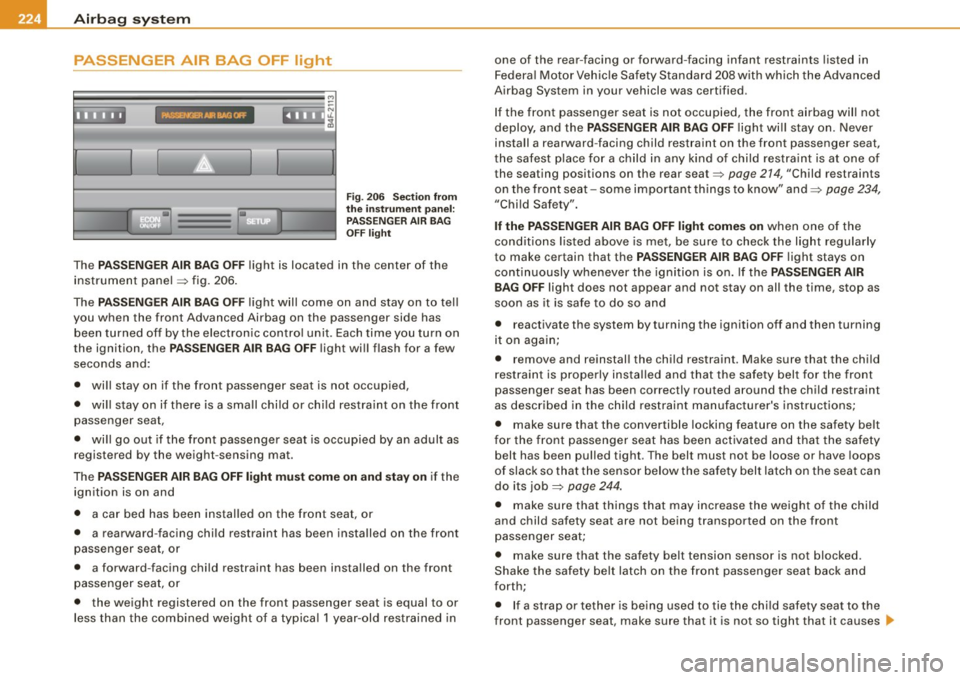
The PASSENGER AIR BAG OFF light is located in the center of the
instrument pane l => fig. 206 .
The
PASSENGER AIR BAG OFF light will come on and stay on to tel l
you when the front Advanced Airbag on the passenger side has
been turned off by the electronic contro l unit . Each time you turn on
the ignition, the
PAS SENGER AIR BAG OFF light wi ll flash for a few
seconds and :
• will stay on if the front passenger seat is not occupied,
• will stay on if there is a small chi ld or chi ld restraint on the front
passenger seat ,
• will go out if the front passenger seat is occupied by an adult as
registered by the weight -sensing mat .
The
PASSENGER AIR BAG OFF light must come on and stay on if the
ignition is on and
• a car bed has been installed on the front seat, or
• a rearward-facing child restraint has been installed on the front
passenger seat, or
• a forward-facing child restraint has been insta lled on the front
passenger seat, or
• the weight registered on the front passenger seat is equal to or
less than the combined weight of a typical 1 year-old restrained in one of the rear
-facing or forward-facing infant restraints listed in
Federa l Motor Vehicle Safety Standard 208 with which the Advanced
Airbag System in your vehicle was certified .
I f the front passenger seat is not occupied, the front airbag wil l not
deploy, and the
PASSENGER AIR BAG OFF li ght wi ll stay on. Never
install a rearward -facing child restraint on the front passenger seat,
the safest place for a child in any kind of child restraint is at one o f
the seating posi tions on the rear seat=>
page 214, "Child restraints
o n the front seat -some important things to know" and=>
page 234,
"Chi ld Safety".
If the PASSENGER AIR BAG OFF light comes on when one of the
conditions listed above is met , be sure to check the light regularly
to make certain that the
PASSENGER AIR BAG OFF light stays on
continuously whenever the ignition is on. If the
PASSENGER AIR
BAG OFF
light does not appear and not stay on all the time, stop as
soon as it is safe to do so and
• reactivate the system by turning the ignition off and then turning
it on again;
• remove and reinstal l the child restraint. Make sure that the child
restraint is properly insta lled and that the safety belt for the front
passenger seat has been correctly routed around the child restraint
as described in the child restraint manufacturer's instructions;
• make sure that the convertible locking feature on the safety belt
for the front passenger seat has been activated and that the safety
belt has been pulled tight . The belt must not be loose or have loops
of slack so that the sensor below the safety belt latch on the seat can
do its job =>
page 244.
• make sure that things that may increase the weight of the child
and child safety seat are not being transported on the front
passenger seat;
• make sure that the safety belt tension sensor is not blocked .
Shake the safety belt latch on the front passenger seat back and
forth;
• If a strap or tether is being used to tie the child safety seat to the
front passenger seat, make sure that it is not so tight that it causes -.,