2008 AUDI S6 air condition
[x] Cancel search: air conditionPage 302 of 390

-~_C_ h_e _c _ k_ i_n ...:::g::;...._ a_n_ d_ f_ i_ll _in -'g:::;.._ ___________________________________________ _
current list of oils (manufacturers, brand names etc.) that conform
t o Audi oi l standard VW 502 00 .
Changin g the engine oil
The engine oil and oil filter must be changed according to the
mi leage (ki lometers) and time intervals specified in your vehicle's
Maintenance
& Warranty booklet. Do not exceed these interva ls -
harmful deposits from old engine oil can reduce engine perfor
mance and can lead to expensive engine repairs.
Changing the oi l at the recommended intervals is so very important
because the lubricating prope rties of oi l decrease gradual ly during
normal vehicle use . If you are not sure when you have your oil
changed, ask your author ized Audi Serv ice Advisor.
Under some circumstances the engine oil should even be changed
more frequently. Change oil more often if you dr ive mostly short
distances, operate the vehicle in dusty areas or mostly under stop
and -go t raffic conditions, or when you use your vehicle where
temperatures stay be low freezing point for long per iods.
Detergent additives in the oil will make fresh oil look dark after the
engine has been running for a short time . This is normal and is not
a reason to change the oil more often than recommended.
Damag e or malfunctions due to lack o f mainten anc e
It is essentia l that you change your oi l at the recommended interva ls
using on ly engine oil that complies with Audi oil standard
VW 502 00. Your Limited New Vehicle Warranty does not cover damage or ma lfunctions due to failure to follow recommended
main tenance and use requirements as set forth in the Aud i Owner's
Manual and Maintenance
& Warranty booklet. Your dealer wi ll have
t o deny warranty cove rage unless you present to the dealer p ro o f in
the form of Service or Repair Orders that all schedu led maintenance
was pe rformed in a timely manner. •
Engine oil consumption
The engine in your vehicle depends on an adeq uate
amount of oil t o lubric ate and c ool all of its m oving parts.
In order to provide effective lubrication and coo ling of interna l
engine components, al l interna l combustio n eng ines consume a
certain amount of oil. Oil consumption varies from engine to engine
and may change significant ly over the life of the engine . Typ ically,
engines with a specified break-in period (see=> page 267) consume
more oil du ring the break-in period than they consume after oil
consumption has stabi lized .
Unde r normal conditions, the rate of oil consumption depends on
the quality and v iscosity of the oil, the RPM (revolutions per minute)
at which the engine is operated, the ambient temperature and road
cond itions. Fur ther factors are the amount of oil di lu tion from wate r
condensation or fue l residue and the oxidation leve l of the oi l. As
any engine is subject to wear as mileage bu ilds up, t he oil consump
tion may increase over time until replacement of worn components
may become necessa ry .
With all these variables coming into play, no standard rate o f oi l
consumption can be established or specified . There is no alternative
t o regula r and frequent checking of the oil level, see
Note .
If the yel low engine oil level warning symbo l in the instrument
clus ter lights up, yo u should check the oil level as soon as
possible with the oil dipstick=> page 301. Top off the oil at your
ea rliest convenience => page 302 .
& WARNING
Before you check anything in the engine compartment , always
read and heed all WARNING S
=> & in "Working in the engine
compartment " on
page 297.
Page 306 of 390

___ C_h_ e_ c_k _in --== g'-- a_n _d_ f_il _li _n ..:::g:::..- ___________________________________________ _
le as t 50% b ut not mor e th an 60 % to maintain antifreeze protection
and cooling efficiency . If the coo lant frost protection is too low, the
coo lant could freeze and damage the vehicle heating and engine
cooling system.
For year -round driving, antifreeze is added at the factory for temper
atures down to:
• -31 °F ( -35 °C) USA
• -40 °F ( -40 °C) Canada.
You can m ix the
Gl 2 + coolant additive with other add itives (for
example
Gl 1 or Gl 2). A lways check with your authorized Audi
dea ler .
& WARNING
Before you check anyt hing in the engine comp artment , alw ays
re ad and heed all WARNINGS ~
& in "Working in the eng ine
co mpar tm ent " o n
pag e 297.
0 Note
• Before win ter sets in, have the coolant checked to see if the
coolant additive in your vehicle is sufficient to meet the climate
conditions. This is especia lly important if you live in a region where
the winter is extremely cold. I f necessary, increase the proportion of
coo lant additive to 60%.
• When adding coolant additive to your coo ling system,
remember:
-We recommend using only coolant additive
Gl 2+ (check the
label) for your vehicle. This coolant addit ive is available at autho
rized Audi dealers. Other types of antifreeze can significantly
reduce corrosion protect ion . T he resulting corrosion can cause a
loss of coolant and serious engine damage.
• Do not add any type of radiator leak sealant to your vehicle's
engine coolant. Adding radiator repair fluid may adversely affect the function and performance of your cooling system and cou
ld result
in damage not c overed by your New Vehicle Limited Warranty. •
Checking the engine coolant level
The engine coolant level can be checked with a quick
glance.
F ig . 235 Eng ine
c o mpartm ent : Cool ant
ex pa nsion tank
Before you check anything in the engine compartment,
always read and heed all WARNINGS~
& in "Working in
the e ngin e compa rtment" on
page 297 .
Turn off the ignition.
Re ad the en gine coo lant leve l from the coo lant exp an
sio n ta n k~ fig. 235. With a cold eng ine, the coolan t leve l
sho uld be between the "m in" and "max" markings. W hen
t h e eng ine is warm, the level may be s lightly abov e the
"max" marking .
The location of the coolant expansion tank can be seen in the
engine compartment illustration~
page 298.
To obtain an accurate reading, the engine must be switched off .
T he expansion tank in your vehicle is equipped with an e lectric
coo lant leve l sensor.
Page 309 of 390

___________________________________________ C_ h_e _c_ k_ i_n _g _ a_n _d_ f_il _li _n _g __ lll
•
T he fluid level may drop slightly after some time due to the auto
m atic adjustment of the brake pads. This is not cause for alarm .
If the brake fluid level fal ls
considerably below the "MIN" mark , the
brake warning/indicator light (U.S. models :
BRAKE, Canadian models:
{(j))) will come on~ page 23 and ~ page 32. Do not continue to
operate the vehic le. The complete brake system should be thor
oughly checked by an authorized Audi dealer or other qua lified
facili ty and the cause corrected . If the brake fluid level is too low, the
brake warning/indicator l ight will illuminate. Contact an au thorized
Audi dea ler
immediate ly .•
Changing brake fluid
Have the brake fl uid changed by an experienced techni
ci an.
Brake fluid absorbs moisture from the air. If the water content in the
brake fluid is too h igh, corrosion in the brake system may result
after a period of time. The boiling point of the brake fluid will also
decrease considerab ly and decrease braking performance .
Therefore , the brake fluid must be changed
e v ery tw o year s. Always
use new brake fluid which conforms to Federal Motor Vehic le Stan
dard "FMVSS 116 DOT 4".
T he brake fluid res ervoir can b e difficult to reach, th erefore, we
recommend that you have the brake fluid changed by your autho
rized
Audi de aler . Your dealer has the correct tools, the right brake
fl uid and the know -how to do t his fo r you .
& WARNING
• Brake fluid is poi sonous . It mu st be stored onl y in the clo sed
o riginal cont ainer out of the rea ch of children!
• Brake failure c an re sult from old or inappropri ate br ake flu id .
Obs erv e the se pre caution s:
& WAR N IN G (c ontinued )
-Use only brake fluid that meet s SAE specification J 1703 and
c onfo rm s to Feder al Moto r Vehicle St andard 116 . Al wa ys check
w ith your authori zed Audi dealer to make sure you are u sin g
the corre ct b rake flu id. The cor rect type of br ake fluid is als o
indic ated on the brake fl uid reservoir .
- The brake fluid mus t be ne w. Heav y use of th e brake s can
ca use a vapor lock if the bra ke fluid i s left in the sy stem too
long . Thi s can seriou sly affect the efficiency of the brake s as
w ell as your s afety . This could r esult in an a ccident .
0 Note
Brake fluid will damage the paint of your vehicle .
the special too ls required and the necessary expertise, we recom
mend that you have the brake fluid changed by your authori zed Audi
dea ler .•
Battery
General information
Und er n ormal operating conditions, the battery in your Audi does
not need any maintenance. With
high outside temperatures or long
daily drives we recommend that you have the electrolyte level
checked by a se rvice facility . The e lectrolyte level should a lso be
checked each time the battery is charged~
page 310 .
Have the batte ry checked when you take your vehic le in for service.
You are well advised to replace a battery that is o lder than 5 years . _,,
Vehicle care I t •
Page 320 of 390
-~_T_ ir_e_ s_ a_ n_d _ w_ h_ e_e _l_s _________________________________________________ _
for the vehicle at its maximum capacity weight and tires that were
on your vehic le at the time it was manufactured.
If you w is h t o improve co mfort w hen opera ting the vehicle a t
n ormal lo ad (up t o 3 o ccupant s), you can a djust ti re pre ss ure s to
tho se s pecified for norm al v ehi cle load . B efore operating the vehi cle
at m aximum lo ad , y ou must i ncreas e the t ire p re ss ure s to tho se
s pe cifi ed for m axim um vehicle lo ad
=> & .
Bear in mind that the tire pressure monitoring system can only
monitor the tire pressures you have stored. The system does not
recognize the load condition of your vehic le.
The effectiveness of the tire pressure monitoring system will be impaired if you store normal load pressures but then operate the
vehic le at its maximum load=>&. See the
illustration=>
page 317, fig. 240 for the location of the label
either on driver's side B -p illar or inside the fuel fi ller flap (color of
the actual label and exact location on the vehicle will vary slight ly).
Note that the fol lowing tab le is accurate at the time of going to
press and is subject to change . In the event of discrepanc ies, the tire
pressure label (on USA vehicles, the tire pressure label is located on
the dr iver's side B-pi llar; on Canada vehicles, the tire pressure labe l
is located either on the driver's side B-pillar or inside the fue l fi ller
fl ap) always takes precedence.
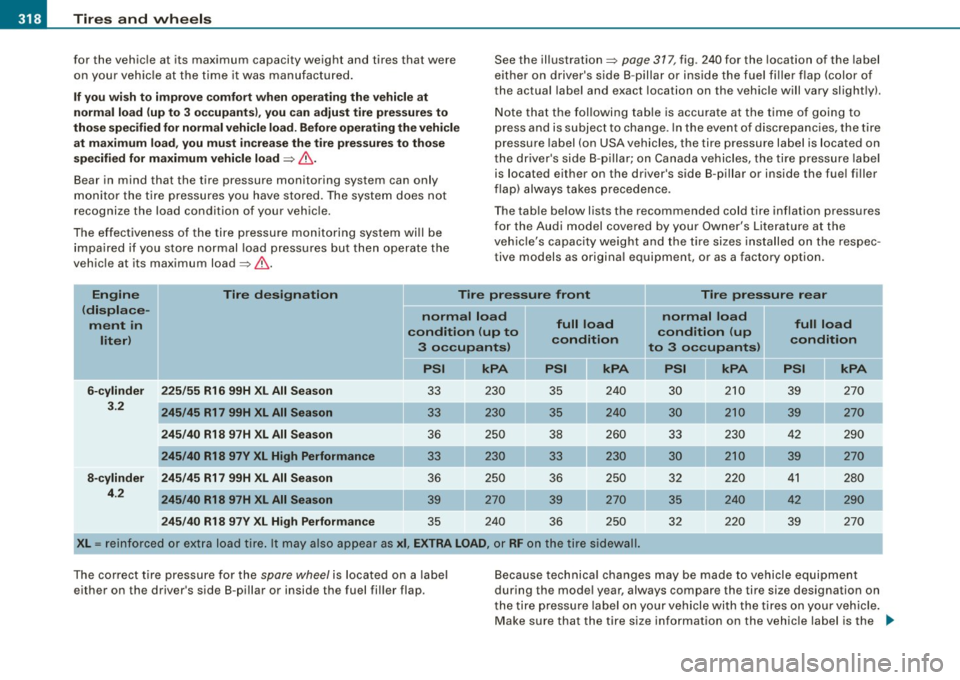
T he table below lists the recommended cold tire inflation pressures
for the Audi model covered by your Owner's Literature at the
vehic le's capacity weight and the tire sizes installed on the respec
tive models as origina l equipment, or as a factory option.
En gin e Tire des ig nation Tir e pr essur e fro nt Tir e p re ssur e rea r
( di spl ac e-
no rm al l oa d no rm al l oa d
m ent in
conditi on (up t o full lo
ad
condition (u p full lo
ad
lit er)
condition condition 3 occupants ) to 3 occ upant s)
PSI kPA kPA kPA
6-cylinder 225/5 5 R16 99H XL All Sea son 33 230 35 240
30 210
39 270
3.2
245 /45 R17 99H XL All Season 33 230 35 240 30 2 10 39 270
2 45 /40 R1 8 97 H XL All Season 36 250
38 260 33 230 42 290
245
/40 R18 97V XL Hi gh Performan ce 33 230 33 230 30 210
39 270
8
-c ylind er 245 /45 R17 99H XL All Sea son 36 250 36 250 32 220 41 280
4.2
245/40 R18 97 H XL All S eason 39 270 39 270 35 240 42 290
2
45 /40 R18 97V XL High Perf orma nce 35 240
36 250 32 220 39 270
X
L = reinforced or extra load t ire . It may also appea r as xi, EX TRA LOAD , or RF on the tire sidewall.
The correct t ire pressure for the
spare wheel is located on a label
either on the driver's side B-pillar or inside the fuel fil ler flap. Because technica
l changes may be made to vehicle equipment
during the mode l year, always compare the tire size designation on
the tire pressure label on your vehicle with the tires on your vehic le .
Make sure that the tire size information on the vehic le label is the _.,
Page 327 of 390
Tires and wheels -_______________ _____.
New tires and replacing tires and wheels
New tires and wheels have to be broken in.
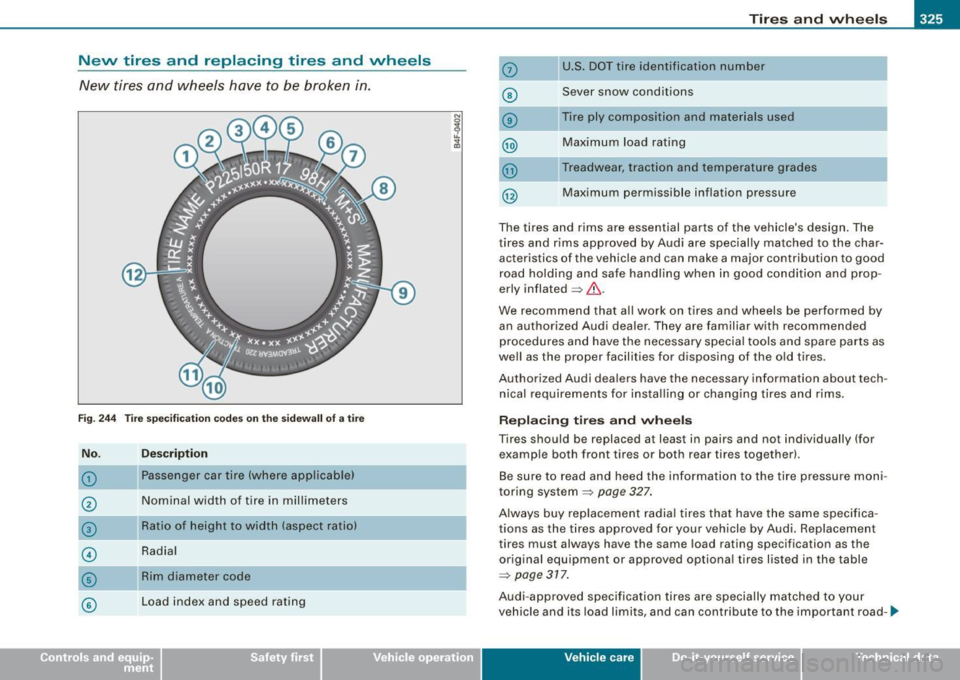
Fig. 244 Tire specification codes on the sidewall of a tire
No.
G)
@
©
©
©
©
Description
Passenger car tire (where appl icable)
Nominal width of tire in millimeters
Ratio of height to width (aspect ratio)
Radial
Rim diameter code
Load index and speed rating
0
©
U.S. DOT tire identificat ion number
Sever snow conditions
Tire ply composition and materials used
Maximum load rating
@ Treadwear, traction and temperature grades
@ Maximum permissible inflation pressure
The tires and rims are essential parts of the vehicle's design. The
tires and rims approved by Audi are specially matched to the char acteristics of the vehicle and can make a major contribution to good
road holding and safe handling when in good condition and prop
erly inflated =>& .
We recommend that all work on tires and wheels be performed by
an authorized Audi dealer. They are familiar with recommended
procedures and have the necessary special tools and spare parts as
well as the proper facilities for disposing of the old tires.
Authorized Audi dealers have the necessary information about tech
nical requirements for installing or changing tires and rims.
Replacing tires and wheels
Tires should be replaced at least in pairs and not individually (for
example both front tires or both rear tires together).
Be sure to read and heed the information to the tire pressure moni
toring system =>
page 327.
Always buy replacement radial tires that have the same specifica
tions as the tires approved for your vehicle by Audi. Replacement
tires must always have the same load rating specification as the original equipment or approved optional tires listed in the table
=> page 317.
Audi -approved specification tires are specially matched to your
vehicle and its load limits, and can contribute to the important road-.,_
Vehic le care I I irechnical data
Page 329 of 390

________________________________________________ T_ i _r_e _s_ a_n_ d_ w_ h_ e_e _ l_s __ ,n
•
ture . For example, the numbers 2207 mean that the tire was
produced in the 22th week of 2007. The other numbers are
marketing codes that may or may not be used by the tire manufac
turer. This information is used to contact consumers if a tire defect
requires a recall.
Tire ply composition and materials used
The number of plies indicates the number of layers of rubber-coated
fabric in the tire. In general, the greater the number of plies, the
more weight a tire can support . Tire manufacturers also must indi
cate the materials in the tire, which include steel, nylon, polyester,
and others .
Maximum Load Rating
This number indicates the maximum load in kilograms and pounds
that can be carried by the tire.
Tire quality grading for treadwear, traction, and
temperature resistance
Tread wear, traction and temperature grades~ page 328.
Maximum Permissible Inflation Pressure
This number is the greatest amount of air pressure that should ever
be put in the tire under normal driving conditions.
Replacing tires or rims on vehicles equipped with tire
pressure monitoring system
The wheels on your vehicle are equipped with a sensor which
constantly monitors the air pressure inside the tire, and then trans
mits this information to the tire pressure monitoring system. If you
are going to replace the wheel rims on your vehicle, make sure the
new rims also have these sensors . The sensors must be compatible
with the tire pressure monitoring system on your vehicle.
If you install rims, which do not have the sensors, or have sensors
which are not compatible, then the tire pressure monitoring system
will not work properly. In this case, the tire pressure monitoring system would not be able to monitor the
tire pressure or warn you
if it is necessary.
• The battery inside of the tire pressure sensor has a limited
service life.
• Always drive with the valve stem caps securely mounted. We
recommend using factory installed valve stem caps. Ask your autho
rized Audi dealer to replace lost valve stem caps .
The installation of replacement tires with steel cord body plies in
the tire sidewall may cause malfunction of the tire pressure moni
toring system, and is not recommended (cord material information
in molded on the tire sidewall).
Always check your tire pressure monitoring system indicator after replacing one or more tires on your vehicle. If the tire pressure
monitoring system indicator flashes, or is on, your system is not
working properly. Your replacement tire might be incompatible with
your tire pressure monitoring system, or some component of the
tire pressure monitoring system may be damaged.
& WARNING
• Using incorrect or unmatched tires and/ or wheels or improper
tire and wheel combinations can lead to loss of control, collision
and serious personal injury.
• Always use tires, rims and wheel bolts that meet the specifica
tions of original factory-installed tires or other combinations that
have been specifically approved by the vehicle manufacturer.
• Tires age even if they are not being used and can fail suddenly,
especially at high speeds. Tires that are more than 6 years old can
only be used in an emergency and then with special care and at
lower speeds.
• Never mount used tires on your vehicle if you are not sure of
their "previous history." Old used tires may have been damaged
even though the damage cannot be seen that can lead to sudden
tire failure and loss of vehicle control.
~
Vehicle care I t •
Page 331 of 390

________________________________________________ T_ i _r_e _s_ a_n_ d_ w_ h_ e_e _ l_s __ llll
•
Quality grades can be found where applicable on the tire side wall
between tread shoulder and maximum section width =>
page 325,
fig. 244.
For example: Tread wear 200, Traction AA, Temperature A.
All passenger car tires must conform to Federal Safety Require
ments in addition to these grades .
Tread wear
The tread wear grade is a comparative rating based on the wear rate
of the tire when tested under controlled conditions on a specified
government test course.
For example, a tire graded 150 would wear one and one half (1 1/2)
times as well on the government course as a tire graded 100.
The relative performance of tires depends upon the actual condi
tions of the ir use, however, and may depart significantly from the
norm due to variations in driving habits, service practices and differ
ences in road characteristics and c limate .
Traction
The traction grades, from highest to lowest , are AA, A, Band C .
Those grades represent the tire 's ability to stop on wet pavement as
measured under controlled conditions on specified government
test surfaces of asphalt and concrete. A tire marked C may have
poor traction performance =>& .
Temperature
The temperature grades are A (the highest), B, and C, representing
the tire 's resistance to the generation of heat and its ability to dissi
pate heat when tested under controlled conditions on a specified
indoor laboratory test wheel.
Sustained high temperature can cause the material of the tire to
degenerate and reduce tire life, and excessive temperature can lead
to sudden tire failure =>& .
The grade C corresponds to a level of performance which all
passenger car tires must meet under the Federal Motor Vehicle Safety
Standard No. 109. Grades Band A represent higher leve ls of
performance on the laboratory test wheel than the minimum
required by law.
& WARNING
The traction grade assigned to this tire is based on straight-ahead
braking traction tests, and does not include acceleration,
cornering, hydroplaning or peak traction characteristics.
& WARNING
The temperature grade for this tire is established for a tire that is
properly inflated and not overloaded. Excessive speed, underinfla
tion, or excess ive loading, either separately or in combination, can
cause heat buildup and possible tire failure . •
Winter tires
Winter tires can improve vehicle handling on snow and
ice. At temperatures below 45 °F (7 °C) we recommend
changing to winter tires.
In some heavy snow areas, local governments may require true
winter or "snow" tires, those with very deeply cut tread. These tires
should only be used in pairs and be installed on all four wheels .
Make sure you purchase snow tires that are the same size and
construction type as the other tires on your vehicle.
If your vehicle is equipped with al l-wheel drive *, this will improve
traction during winter dr iving, even with the standard tires.
However, we strongly recommend that you always equip all four
wheels on your vehicle with correctly fi tted winter tires or all-season
tires, when winter road conditions are expected . T his also improves
the vehicle 's braking performance and reduces stopping distances.
Summer tires provide less grip on ice and snow.
Vehicle care I t •
Page 334 of 390
-Tires and wheels
PW-------------------
possible with a torque wrench -preferably by an authorized Audi
dealer or qualified workshop. •
Low aspect ratio tires
Your Audi is factory-equipped with low aspect ratio tires . These tires
have been thoroughly tested and been selected specifically for your
model for their superb performance, road feel and hand ling under
a variety of driving conditions . Ask your authorized Audi dealer for
more details.
The low aspect ratio of these tires is indicated by a numeral of
55 or
less
in the tire's size designation. The numeral represents the ratio
of the tire's sidewa ll height in relat ion to its tread width expressed
in percentage. Conventional tires have a height/width ratio of 60 or
more.
The performan ce of low -aspect-ratio tires is particularly sensitive to
improper inflation pressure. It is therefore important that low
aspect ratio tires are inflated to the specified pressure and that the
inflation pressure is regularly checked and maintained. T ire pres
s ures should be checked at least once a month and always before a
long trip => page 379,
"Checking tire pressure".
What you can do to avoid tire and rim damage
Low aspect ratio tires can be damaged more easily by impact with
potho les, curbs, gullies or ridges on the road, particularly if the tire
is underinflated.
In order to minimize the occurrence of impact damage to the tires
of your vehicle, we recommend that you observe the following precautions:
• Always ma inta in recommended inflation pressures. Check your
tire pressure every 2,000 miles (3,000 km) and add air if necessary.
• Drive carefully on roads with potholes, deep gu llies or ridges.
The impact from driving through or over such obstacles can
damage your tires. Impact with a curb may also cause damage to
your tires . •
After any impact, immediately inspect your tires or have them
inspected by the nearest authorized Audi dealer. Replace a
damaged tire as soon as possible.
• Inspect your tires every 2,000 miles (3,000 km) for damage and
wear. Damage is not always easy to see. Damage can lead to loss of
air and underinflation, which could eventually cause tire failure. If
you believe that a tire may have been damaged, replace the tire as
soon as possib le.
• T hese tires may wear more quickly than others .
• Please also remember that, whi le these tires deliver respons ive
handling, they may ride less comfortably and make more noise than
other choices .
Reduced performance in winter /cold season
conditions
A ll tires are designed for certain purposes. The low aspect ratio,
u ltr a high performance tires originally installed on your vehic le are
intended for maximum dry and wet road performance and handling.
They are not suitable for cold, snowy or icy weather conditions. If
you drive under those circumstances, you should equip your vehic le
with all -season or winter tires , wh ich offer better traction under
those conditions. We suggest you use the recommended snow or all -season tires specified for your vehicle, or their equivalent .
Refer to=>
page 329for more detailed information regarding winter
tires. •