2008 AUDI S6 wheel
[x] Cancel search: wheelPage 333 of 390

Tires and wheels -________________ w-.
•
Remove wheel center covers and trim discs before putting snow
chains on you r veh icle =>
(D. For sa fety reasons c ove r cap s m ust
then be fitted over the wheel bo lts . These are avai lable from autho
r ized Aud i deale rs.
& WARNING
Using the wrong snow chains for your vehicle or in stalling them
incorrectly can increase the risk of loss of control leading to
serious personal injury.
• Snow ch ains are available in different sizes . Always make sure
to follow the instructions provided by the snow chain manufac
turer .
• When driving with snow chains never drive faster than the
speed permitted for your specific snow chains .
• Always observe local regulations .
0 Note
• Remove sn ow chai ns b efore d rivin g on roads not cove red w ith
snow to avoid damaging tires and wearing the snow chains down
u n n ecessa r i ly.
• Snow chains , which come into d irect contact with t he whee l rim,
ca n scratc h or da mage it. T herefore, ma ke sur e tha t th e snow chains
are suitably covered.
• I f the Adaptive Air Suspensio n* shou ld malfunction, do no t
mount or use snow chains because the vehicle will be extremely
l o w. I f yo u do drive w ith snow c hai ns o n w hi le t he ve hicle is a t thi s
level, the snow cha ins might severe ly damage the wheelhouse and
ot her parts o f the vehicle.
[ i ] Tips
W her e sn ow c hai ns are manda tory on certa in roa ds, t his no rm ally
a lso app lies to vehic les with Al l Wheel Drive. •
Wheel bolts
Wheel bo lts must alw ays be t ig hte ned to the correct
to rq ue .
The design of wheel bo lts is matched to the factory instal led rims. If
d iffere nt rim s are fitted, the corr ect w heel bo lts w it h t he rig ht le ngth
and correctly shaped bolt heads must be used. This ensures that
w he els are fitted securely and that the brake sys tem func tions
correctly.
I n certa in c ircums ta nces, you may not use wheel bo lts from
a
different vehicle -even if it is the same model=> page 368.
& WARNING
Improperly tightened or maintained wheel bolts can become loose
causing loss of control , a collision and serious personal injury .
• Always keep the wheel bolts and the threads in the wheel hubs
clean so the wheel bolts can turn easily and be properly tightened.
• Never grease or oil the wheel bolts and the threads in the wheel
hubs. They can become loose while driving if greased or oiled,
even if tightened to the specified torque .
• Only use wheel bolts that belong to the rim being installed .
• Never use different wheels bolts on your vehicle.
• Always maintain the correct tightening torque for the wheel
bolts to reduce the risk of a wheel loss.
If the tightening torque of
the wheel bolts is too low , they can loosen and come out when the
vehicle is moving . If the tightening torque is too high, the wheel
bolts and threads can be damaged and the wheel can become
loose .
0 Note
The specified torque for the wheel bolts is 9 0 ft lb (120 Nm) with a
to lera nce of± 7,4 ft lb(± 10 Nm). Torque whee l b o lt s d ia go nally.
Af ter changing a wheel, the torque must be checked as soon as .,_
Vehicle care I t •
Page 334 of 390
-Tires and wheels
PW-------------------
possible with a torque wrench -preferably by an authorized Audi
dealer or qualified workshop. •
Low aspect ratio tires
Your Audi is factory-equipped with low aspect ratio tires . These tires
have been thoroughly tested and been selected specifically for your
model for their superb performance, road feel and hand ling under
a variety of driving conditions . Ask your authorized Audi dealer for
more details.
The low aspect ratio of these tires is indicated by a numeral of
55 or
less
in the tire's size designation. The numeral represents the ratio
of the tire's sidewa ll height in relat ion to its tread width expressed
in percentage. Conventional tires have a height/width ratio of 60 or
more.
The performan ce of low -aspect-ratio tires is particularly sensitive to
improper inflation pressure. It is therefore important that low
aspect ratio tires are inflated to the specified pressure and that the
inflation pressure is regularly checked and maintained. T ire pres
s ures should be checked at least once a month and always before a
long trip => page 379,
"Checking tire pressure".
What you can do to avoid tire and rim damage
Low aspect ratio tires can be damaged more easily by impact with
potho les, curbs, gullies or ridges on the road, particularly if the tire
is underinflated.
In order to minimize the occurrence of impact damage to the tires
of your vehicle, we recommend that you observe the following precautions:
• Always ma inta in recommended inflation pressures. Check your
tire pressure every 2,000 miles (3,000 km) and add air if necessary.
• Drive carefully on roads with potholes, deep gu llies or ridges.
The impact from driving through or over such obstacles can
damage your tires. Impact with a curb may also cause damage to
your tires . •
After any impact, immediately inspect your tires or have them
inspected by the nearest authorized Audi dealer. Replace a
damaged tire as soon as possible.
• Inspect your tires every 2,000 miles (3,000 km) for damage and
wear. Damage is not always easy to see. Damage can lead to loss of
air and underinflation, which could eventually cause tire failure. If
you believe that a tire may have been damaged, replace the tire as
soon as possib le.
• T hese tires may wear more quickly than others .
• Please also remember that, whi le these tires deliver respons ive
handling, they may ride less comfortably and make more noise than
other choices .
Reduced performance in winter /cold season
conditions
A ll tires are designed for certain purposes. The low aspect ratio,
u ltr a high performance tires originally installed on your vehic le are
intended for maximum dry and wet road performance and handling.
They are not suitable for cold, snowy or icy weather conditions. If
you drive under those circumstances, you should equip your vehic le
with all -season or winter tires , wh ich offer better traction under
those conditions. We suggest you use the recommended snow or all -season tires specified for your vehicle, or their equivalent .
Refer to=>
page 329for more detailed information regarding winter
tires. •
Page 335 of 390
Tires and wheels -
----------------
• Vehicle care I t •
Page 338 of 390

lllffll.,___W_ h_ a _ t_d_ o_ l _d _o_ n_ o_ vv_ ? ______________________________________________ _
What do I do now?
Trunk escape handle
In case of an emergency, the rear lid can be opened from
the inside using the trunk escape handle.
To open rear lid
Fig. 245 Trunk escape
handle: View from
inside the closed trunk
- Pull the hand le down towards the bumper ::} fig. 245.
The trunk escape handle inside the rear lid is made of fluorescent
material to glow in the dark.
& WARNING
The trunk escape handle is to be used only in an emergency.
[ i ] Tips
The emergency release lever should never be used as a handle for
closing the rear lid.•
Jack, tools and spare wheel
Jack
The jack is stored in the luggage compartment behind the
right-side trim panel.
--
F ig . 246 Luggage
compartment vehicle
jack
Before storing the jack, make sure it is wound back down as far as it
will go.
& WARNING
Improper use of the vehicle jack can cause serious personal inju
ries.
• Never use the jack supplied with your Audi on another vehicle,
particularly on a heavier one. The jack is only suitable for use on
the vehicle it came with.
• Using a bumper jack to raise the vehicle will damage the
bumper system. The jack may slip , causing injury.
• Never support your vehicle on cinder blocks, bricks or other
objects. These may not be able to support the load and could
cause injury when they fail.
Page 339 of 390

_____________________________________________ W_ h_ a_t _d_ o_l _ d_o _ n_o_ w_ ? _ __._
& WARNING !continued)
• Never start or run the engine while the vehicle is supported by
the jack.
• If you must work under the vehicle, always use safety stands
specifically designed for this purpose.
• Never use the hexagonal socket in the handle of the screw
driver to loosen or tighten the wheel bolts .
• Always make sure the spare tire and even a flat tire are secured
in place and not loose , otherwise they could fly forward , causing
personal injury to passengers in the vehicle in an accident or
sudden maneuver. •
Tools
The vehicle tools are stored in the luggage compartment
behind the right-side trim panel.
-
T he onboard tool kit includes:
• Hook for removing wheel covers *
• Plastic hook to remove wheel bolt covers
• Wheel bolt wrench
• Alignment pin for changing wheels
Fig. 247 Luggage
compartment: vehicle
tool kit
• Screwdriver with reversible blade
• Towing eye
[ i ] Tips
Some of the on board items listed above are provided on certain
models only or are optional extras. •
Spare wheel
The spare wheel is stored in the wheel well underneath
the floor panel in the luggage compartment.
Fig. 248 Luggage
compartment spare
wheel
Your vehicle is equipped with a regular spare wheel. It is
held in place by plastic retaining knurled screw.
Taking out the spare wheel
- Raise the floor panel at the plast ic handle.
- Securely engage the handle in the luggage compartment
seal as illustrated to keep the floor panel up.
- Unscrew the knurled retainer bolt in the wheel center
~ fig. 248. Turn it counter-clockwise.
- Take out the spare wheel.
Vehicle care Do-it-yourself service Technical data
Page 340 of 390
11111.___W_ h_ a_ t_ d_o_ l_ d_ o _ n_ o_w _ ? ____________________________________________ _
- Disengage and lower the floor panel before you close the
luggage compartment lid again.
Storing the replaced wheel
- Place the replaced wheel inside the spare wheel well in
the luggage compartment .
Tighten the knurled retaining screw clockwise to secure the wheel in place.
- Disengage and lower the floor panel before you close the
luggage compartment lid again.
& WARNING
Loose items in the passenger compartment can cause serious
personal injury during hard braking or in an accident .
• Never store the spare wheel or jack and tools in the passenger
compartment.
• Always store all jacking equipment, tools, and the spare wheel
in the luggage compartment.
• Tighten the knurled retaining screw for the spare wheel
securely.
[ i] Tips
Check the inflation pressure of the spare tire periodically to keep the
tire ready for use. •
Changing a wheel
Before changing a wheel
Observe the following precautions for your own and your
passenger's safety when changing a wheel.
- After you experience a tire failure, pull the car well away
from moving traffic and try to reach level ground before
you stop :::;. & .
- All passengers should leave the car and move to a safe
location (for instance, behind the guardrail) :::;,& .
- Engage the parking brake to prevent your vehicle from
rol ling unintentionally :::;.& .
- Move selector lever to position P :::;. & .
-If you are towing a trailer: unhitch the trailer from your
vehicle.
- Take the jack and the spare tire out of the luggage
compartment:::;.
page 336.
& WARNING
You or your passengers could be injured while changing a wheel if
you do not follow these safety precautions:
• If you have a flat tire, move a safe distance off the road. Turn off
the engine, turn the emergency flashers on and use other warning
devices to alert other motorists.
• Make sure that passengers wait
in a safe place away from the
vehicle and well away from the road and traffic.
• To help prevent the vehicle from moving suddenly and possibly
slipping off the jack, always fully set the parking brake and block
the wheel diagonally opposite the wheel being changed. When one ...
Page 341 of 390
-------------------------------------------~W~h~a~t~d~o~l ~d~o~n~o~w~ ?::__fflll
•
& WARNING (continued)
front wheel is lifted off the ground, placing the Automatic Trans
mission in "P" {Park) will
not prevent the vehicle from moving.
• Before you change a wheel, be sure the ground is level and firm.
If necessary, use a sturdy board under the jack.
• After installing the spare wheel, make sure that you replace the
flat tire/wheel in its storage area properly and tighten the knurled
retaining screw securely. •
Changing a wheel
When you change a wheel, follow the sequence described
below step-by-step and in exactly that order.
1. Activate the vehicle jack mode (only vehicles with Adap
tive Air Suspension)~
page 184.
2. Remove the decorative wheel cover*. For more details
see also ~
page 340, "Decorative wheel covers" or
~ page 340, "Wheels with wheel bolt caps".
3. Loosen the
wheel bolts~ page 341.
4. Locate the proper mounting point for the jack and align
the jack below that point~
page 341.
5. Lift the car with the jack ~ page 341.
6. Remove the wheel with the flat tire and then install the
spare
~ page 343.
7. Tighten all wheel bolts lightly.
8.
Lower the vehicle with the jack.
9. Use the wheel bolt wrench and
firmly tighten all wheel
bolts~
page 341 .
10. Replace the decorative wheel cover*.
11. Deactivate the vehicle jack mode (only vehicles with
Adaptive Air Suspension)~
page 184.
& WARNING
Always read and follow all WARNINGS and information => & in
uRaising the vehicle" on
page 341 and=> page 344. •
After changing a wheel
A wheel change is not complete without the doing the
following.
- Store and secure the wheel you replaced in the spare
wheel well.
- Replace the tools and the jack in their proper location.
- Check the tire pressure on the spare wheel immediately
after mounting it.
- As soon as possible, have the
tightening torques on all
wheel bolts checked with a torque wrench. The correct
tightening torque is 90 ft lb (120 Nm).
- Have the flat tire
replaced as soon as possible.
[ i] Tips
• If you notice that the wheel bolts are corroded and difficult to
turn while changing a tire, they should be replaced before you check
the tightening torque.
• Drive at reduced speed until you have the tightening torques
checked .•
Do-it -yourself service
Page 342 of 390
11111...__W_ h_ a _ t_d_ o_ l _d _o_ n_ o_ vv_ ? ______________________________________________ _
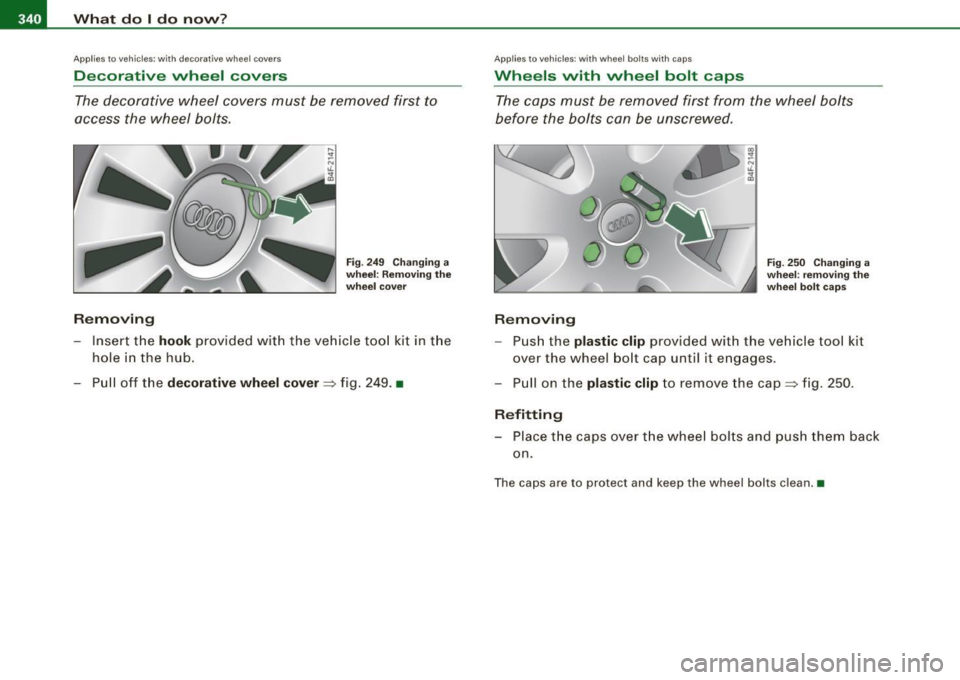
App lies to veh ic les : w ith deco rative whee l covers
Decorative wheel covers
The decorative wheel covers must be removed first to
access the wheel bolts.
Removing
Fig . 249 Changing a
wheel: Removing the
wheel cover
- Insert the hook provided with the vehicle tool kit in the
hole in t he hub.
- Pull off the
decorative wheel cover=> fig. 249. •
Applies to veh ic les: w ith whee l bolts w ith ca ps
Whee ls vvith wheel bolt caps
The caps must be removed first from the wheel bolts
before the bolts can be unscrewed .
Removing
Fig. 250 Changing a
wheel: removing the
wheel bolt caps
-Push the plastic clip prov ided w ith the vehicle tool kit
ov er the wheel bolt cap unt il it engages .
- Pull on t he
plastic clip to remove the cap=> fig. 250 .
Refitting
-Place the caps over the wheel bolts and push them back
on .
The caps are to pro tect and keep the wheel bolts clean. •