2008 AUDI S5 maintenance
[x] Cancel search: maintenancePage 229 of 294
Downloaded from www.Manualslib.com manuals search engine Checking and topping up fluids227
Controls
Safety
Driving tips
General maintenance
Self-help
Technical data
Brake fluidChecking brake fluid level
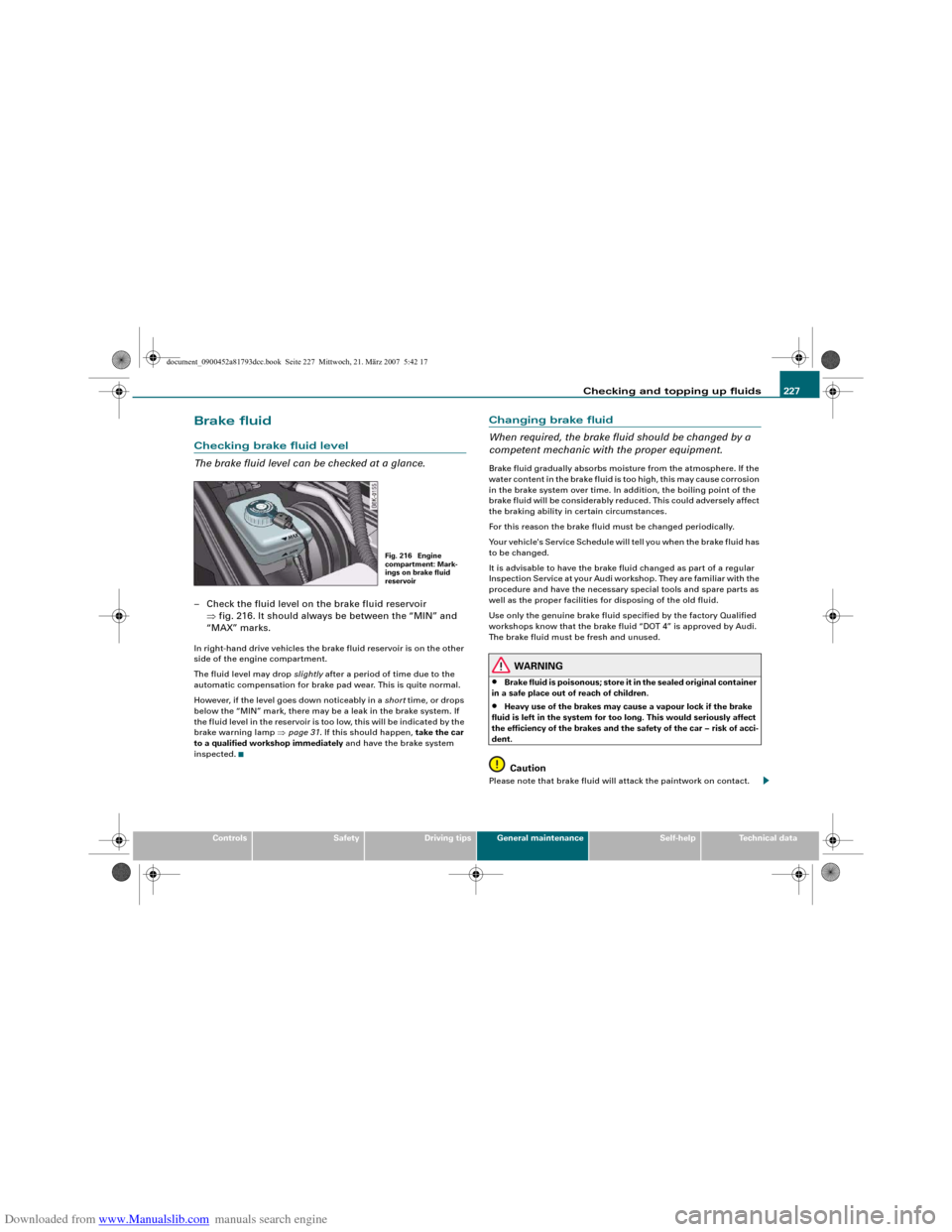
The brake fluid level can be checked at a glance.– Check the fluid level on the brake fluid reservoir
⇒fig. 216. It should always be between the “MIN” and
“MAX” marks.In right-hand drive vehicles the brake fluid reservoir is on the other
side of the engine compartment.
The fluid level may drop slightly after a period of time due to the
automatic compensation for brake pad wear. This is quite normal.
However, if the level goes down noticeably in a short time, or drops
below the “MIN” mark, there may be a leak in the brake system. If
the fluid level in the reservoir is too low, this will be indicated by the
brake warning lamp ⇒page 31. If this should happen, take the car
to a qualified workshop immediately and have the brake system
inspected.
Changing brake fluid
When required, the brake fluid should be changed by a
competent mechanic with the proper equipment.Brake fluid gradually absorbs moisture from the atmosphere. If the
water content in the brake fluid is too high, this may cause corrosion
in the brake system over time. In addition, the boiling point of the
brake fluid will be considerably reduced. This could adversely affect
the braking ability in certain circumstances.
For this reason the brake fluid must be changed periodically.
Your vehicle's Service Schedule will tell you when the brake fluid has
to be changed.
It is advisable to have the brake fluid changed as part of a regular
Inspection Service at your Audi workshop. They are familiar with the
procedure and have the necessary special tools and spare parts as
well as the proper facilities for disposing of the old fluid.
Use only the genuine brake fluid specified by the factory Qualified
workshops know that the brake fluid “DOT 4” is approved by Audi.
The brake fluid must be fresh and unused.
WARNING
•
Brake fluid is poisonous; store it in the sealed original container
in a safe place out of reach of children.
•
Heavy use of the brakes may cause a vapour lock if the brake
fluid is left in the system for too long. This would seriously affect
the efficiency of the brakes and the safety of the car – risk of acci-
dent.Caution
Please note that brake fluid will attack the paintwork on contact.
Fig. 216 Engine
compartment: Mark-
ings on brake fluid
reservoir
document_0900452a81793dcc.book Seite 227 Mittwoch, 21. März 2007 5:42 17
Page 230 of 294

Downloaded from www.Manualslib.com manuals search engine Checking and topping up fluids 228
For the sake of the environmentIf the fluid has to be drained out of the brake system, use an appro-
priate container to catch the used brake fluid and dispose of it in the
proper manner.BatteryGeneral notes
All work on batteries requires specialist knowledge.The battery is virtually maintenance-free. It is checked as part of the
Inspection Service.
We recommend that you replace a battery once it is older than 5
years.
When an airbag is triggered, the battery will, under certain circum-
stances, be disconnected from the on-board power supply for
safety reasons ⇒ in “General notes on airbag system” on
page 166.
Disconnecting the battery
If the battery is disconnected, some of the vehicle's functions will
become inoperative (e.g. electric windows). These functions will
require resetting after the battery is reconnected. For this reason,
the battery should only be disconnected from the vehicle's electrical
system when absolutely necessary.
If the vehicle is not used for long periods
If you do not drive your vehicle for a period of several days or weeks,
the power management will gradually shut off the on-board
systems one by one, or reduce the amount of current they are using.
This limits the amount of power consumed and helps to ensure reli-
able starting even after a long period ⇒page 192.Please note that certain convenience features, such as the Audi
advanced key*, the remote control key or the electrical seat adjust-
ment may not be available when you unlock the vehicle. These func-
tions will be restored when you switch on the ignition and start the
engine.
Winter conditions
At low temperatures the battery has to work very hard. It also
provides only a fraction of the starting power it has at normal
temperatures.
For this reason, we recommend having the battery checked and
charged if necessary before the start of winter ⇒page 230.
WARNING
•
All work on batteries requires specialist knowledge. For queries
regarding the vehicle battery please contact an Audi dealership or
other qualified workshop (risk of chemical burns / risk of explo-
sion).
•
The battery must not be opened. Do not attempt to make any
changes to the electrolyte level of the battery. Otherwise, there is
a risk that a mixture of oxygen and hydrogen gas can accumulate
and cause an explosion.Note
If the vehicle is to be left standing for a period of several weeks at
extremely low temperatures, the battery should be removed from
the vehicle. This ensures that it cannot “freeze up” and be
damaged.
document_0900452a81793dcc.book Seite 228 Mittwoch, 21. März 2007 5:42 17
Page 231 of 294
Downloaded from www.Manualslib.com manuals search engine Checking and topping up fluids229
Controls
Safety
Driving tips
General maintenance
Self-help
Technical data
Important safety warnings for handling a car battery
All work on batteries requires specialist knowledge.The vehicle battery is located under the floor panel in the luggage
compartment.
WARNING
Always be aware of the danger of injury and chemical burns as
well as the risk of accident or fire when working on the battery and
the electrical system.•
Wear safety glasses. Do not allow acid or lead particles to come
into contact with eyes, skin or clothing.
•
Battery acid is extremely corrosive. Wear protective gloves and
safety glasses. Do not tilt the battery - acid can leak out of the
vapour vent. If electrolyte should splash into the eyes rinse at once
for several minutes using clear water. Then seek medical care
immediately. Neutralize any acid splashes on the skin or clothing
with soap solution, and rinse off with plenty of water. If acid is
swallowed by mistake, consult a doctor immediately.
•
Keep open flames, sparks, uncovered lights and lit cigarettes
away from battery. Avoid sparks (including those from static charges) when handling cables and electrical equipment. Never
cross the battery poles. The resulting high-energy sparks can
cause injury.
•
A highly explosive mixture of gases is given off when the
battery is under charge. Only charge battery in a well ventilated
area.
•
Keep children away from the battery and battery acid.
•
Switch off all electrical equipment before starting any work on
the vehicle electrical system. Remove the ignition key. The minus
cable of the battery must be disconnected. When changing a light
bulb, it is sufficient to only turn off the light.
•
Before disconnecting the battery, turn off the anti-theft
system! Otherwise, the alarm will sound.
•
When disconnecting the battery from the vehicle's electrical
system, first disconnect the minus cable and then the plus cable.
•
Before reconnecting the battery, turn off all electrical equip-
ment. First connect the plus cable, then the minus cable. The
battery cables must not be connected to the wrong battery poles
- serious risk of cable fire.
•
Never charge a frozen or thawed out battery - risk of explosion
and chemical burns! A battery must be replaced once it has been
frozen. When it is discharged the battery can freeze at tempera-
tures around 0°C.
•
Make sure that the vapour hose is always attached to the
battery.
•
Never use a damaged battery - risk of explosion! Replace a
damaged battery immediately.Caution
•
Never disconnect the car's battery with the engine running or
with the ignition turned on, otherwise the electrical system or elec-
trical components will be damaged.
Wear safety glasses!
Battery acid is extremely corrosive. Wear protec-
tive gloves and safety glasses.
Keep open flames, sparks, uncovered lights and
lit cigarettes away from battery!
A highly explosive mixture of gases is given off
when the battery is under charge!
Keep children away from the battery and battery
acid.
WARNING (continued)
document_0900452a81793dcc.book Seite 229 Mittwoch, 21. März 2007 5:42 17
Page 233 of 294
Downloaded from www.Manualslib.com manuals search engine Checking and topping up fluids231
Controls
Safety
Driving tips
General maintenance
Self-help
Technical data
Replacing the battery
A replacement battery must have the same specifications
as the original equipment battery.Your vehicle is equipped with an intelligent power management
system to control the distribution of electrical energy ⇒page 192.
The power management function ensures that the battery is
charged much more efficiently than on vehicles without a power
management system. For this additional power to be available after
replacing the battery, we recommend that the replacement battery
used is of the same make and type as the original-equipment
battery. The battery must be encoded in the control unit for power
management. This has to be done by a qualified workshop.
A replacement battery must have the same capacity, voltage (12 V)
and current rating. It must also have the same dimensions as the
original, factory-fitted battery and have sealed caps. The battery
must comply with the standards TL 825 06 (dated December 1997 or
later) and VW 7 50 73 (August 2001 or later).
Caution
•
Make sure that the vent hose is always attached to the opening
on the side of the battery. Gases or battery acid can otherwise
escape and possibly cause damage.
•
The battery holder and clamps must always be correctly secured.
•
Before starting any work on the battery, always observe the
warnings listed under ⇒page 229, “Important safety warnings for
handling a car battery”.For the sake of the environment
Batteries contain toxic substances including sulphuric acid and
lead. They must be disposed of appropriately and must not be put
together with ordinary household waste. Make sure the battery
removed from the vehicle cannot tip over. Otherwise, sulphuric acid
could escape.
Windscreen washerPlain water on its own is not sufficient for the windscreen
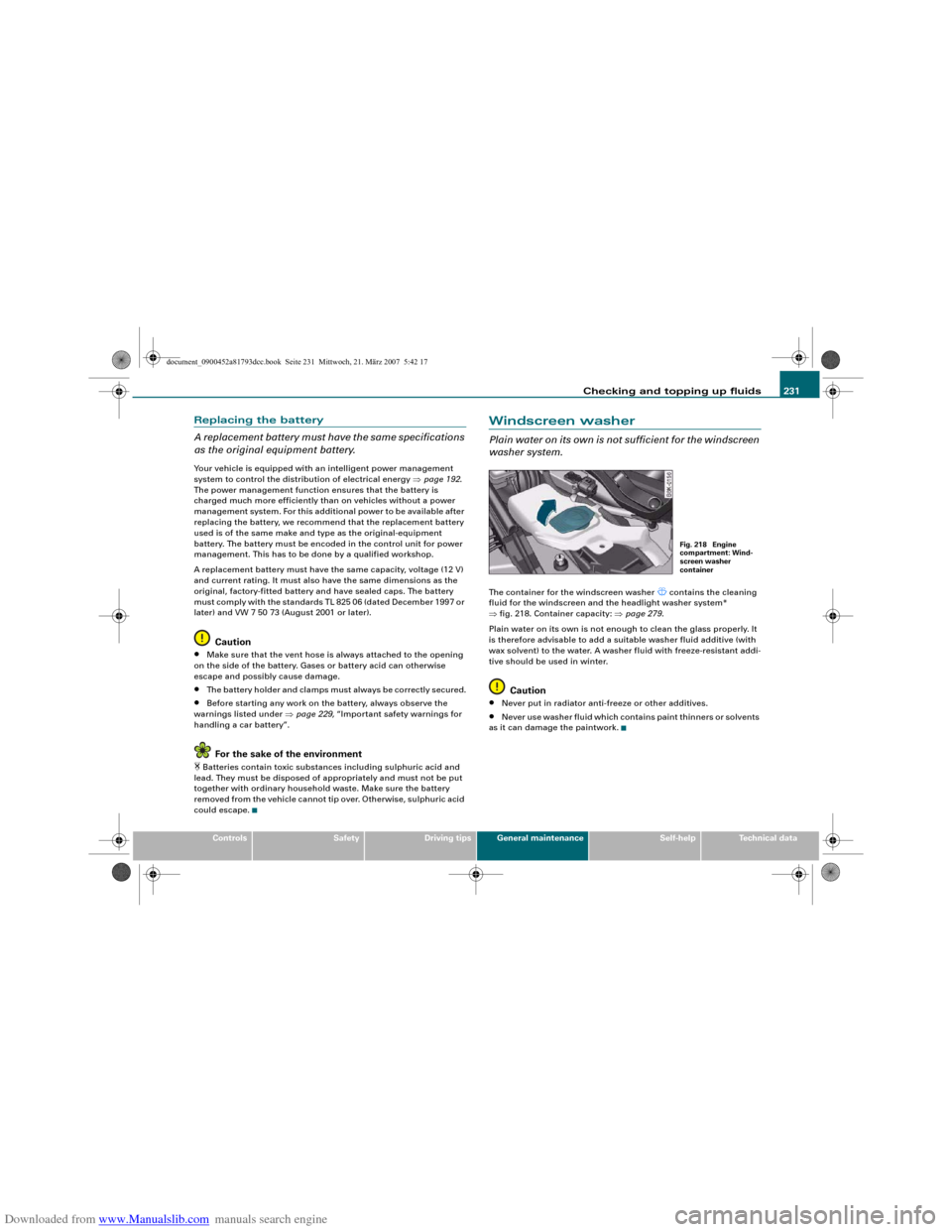
washer system.The container for the windscreen washer
contains the cleaning
fluid for the windscreen and the headlight washer system*
⇒fig. 218. Container capacity: ⇒page 279.
Plain water on its own is not enough to clean the glass properly. It
is therefore advisable to add a suitable washer fluid additive (with
wax solvent) to the water. A washer fluid with freeze-resistant addi-
tive should be used in winter.
Caution
•
Never put in radiator anti-freeze or other additives.
•
Never use washer fluid which contains paint thinners or solvents
as it can damage the paintwork.
Fig. 218 Engine
compartment: Wind-
screen washer
container
document_0900452a81793dcc.book Seite 231 Mittwoch, 21. März 2007 5:42 17
Page 235 of 294
Downloaded from www.Manualslib.com manuals search engine Wheels and tyres233
Controls
Safety
Driving tips
General maintenance
Self-help
Technical data
– The tyre pressures should only be checked when the
tyres are cold. The slightly raised pressures of warm tyres
must not be reduced.
– The pressures must be altered to suit major changes in
the load being carried.
– Avoid fast cornering and hard acceleration.
– Inspect the tyres for irregular wear from time to time.Tyre pressure and vehicle loading
The tyre pressure must be adjusted according to the load the vehicle
is carrying. We recommend adhering to the tyre pressure specifica-
tions for a maximum load. The tyre inflation pressures are listed on
a sticker on the end face of the driver's door ⇒page 232, fig. 219.
However, if you prefer an extra-smooth ride and the vehicle is not
fully loaded, you can select the tyre pressure for a normal load (no
more than three people travelling in the vehicle). However, should
you wish to drive with a full load you must increase the tyre pressure
to the specified maximum.
Under-inflation or over-inflation will reduce the life of the tyres
considerably and also impair the car's handling. Correct inflation
pressures are very important, especially at high speeds. The pres-
sures should therefore be checked at least once a month and before
starting a journey.
Do not forget the spare wheel* when checking the tyre pressures.
Keep the spare tyre inflated to the highest pressure required for the
road wheels.
Driving habits
Fast cornering, heavy acceleration and hard braking (squealing
tyres) all increase tyre wear.Wheel balancing
The wheels on new vehicles are balanced. However, various factors
encountered in normal driving can cause them to become unbal-
anced, which results in steering vibration.
Unbalanced wheels should be rebalanced, as they otherwise cause
excessive wear on steering, suspension and tyres. A wheel must
also be rebalanced when a new tyre is fitted or if a tyre is repaired.
Incorrect wheel alignment
Incorrect wheel alignment causes excessive tyre wear, impairing the
safety of the vehicle. If you notice excessive tyre wear, contact your
Audi dealer.
WARNING
•
Always adapt the tyre pressure accordingly when the vehicle
load changes.
•
Under-inflated tyres flex more and can overheat at continuous
high speeds. This can cause tread separation and tyre blow-out,
which could result in an accident.For the sake of the environment
Under-inflated tyres will increase the fuel consumption.
document_0900452a81793dcc.book Seite 233 Mittwoch, 21. März 2007 5:42 17
Page 237 of 294
Downloaded from www.Manualslib.com manuals search engine Wheels and tyres235
Controls
Safety
Driving tips
General maintenance
Self-help
Technical data
– Never use tyres whose actual size exceeds the dimen-
sions of the factory-approved makes of tyre.
– If you wish to fit the vehicle with non-standard rims or
tyres, it is advisable to consult an Audi dealer before
purchasing them.The tyres and wheel rims are an essential part of the vehicle's
design. The tyres and rims approved by Audi are specially matched
to the characteristics of the vehicle and make a major contribution
to good roadholding and safe handling ⇒.
The sizes of the rims and tyres approved for your vehicle are listed
in the vehicle's documents (e.g. EC Certificate of Conformity or COC
document
5)). The vehicle documents vary depending on the
country of residence.
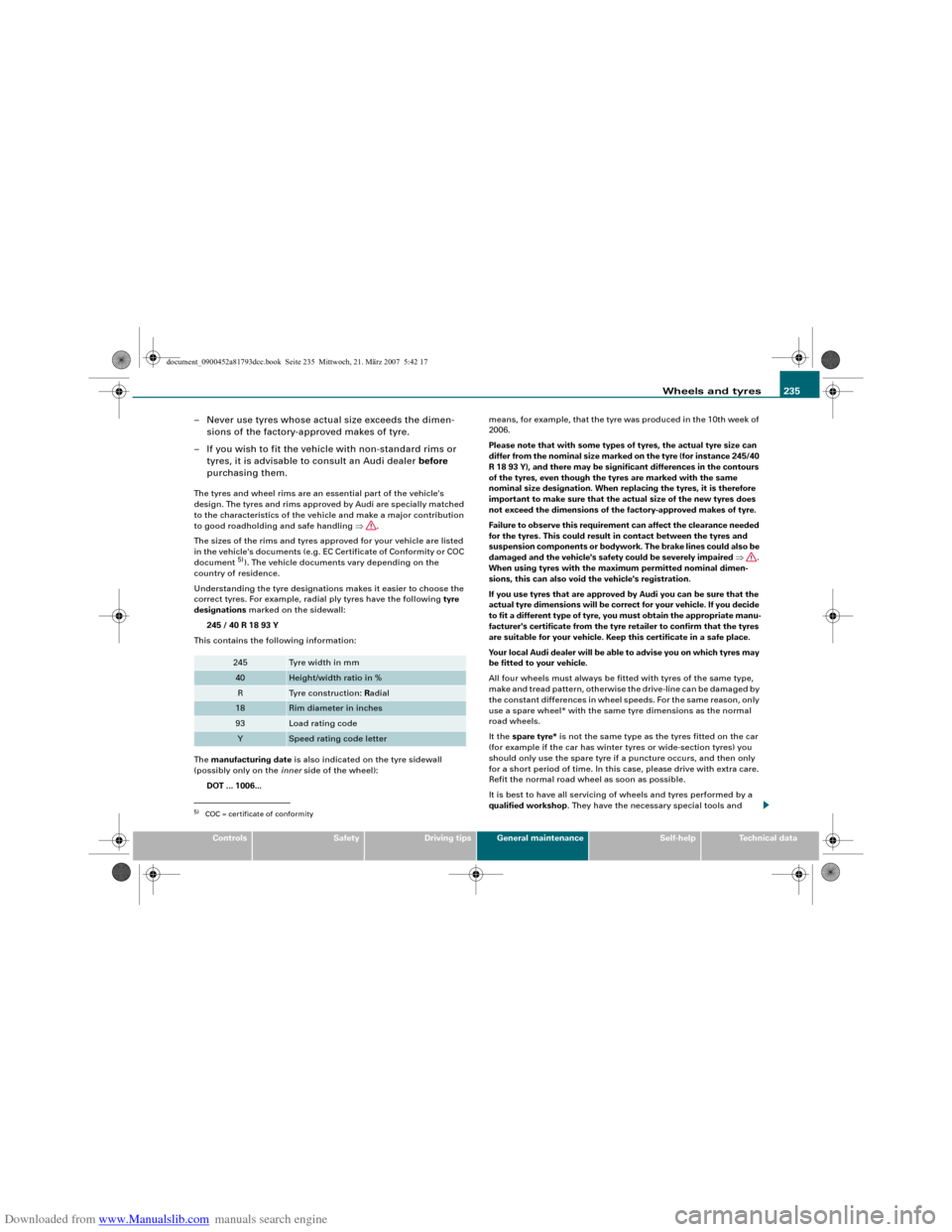
Understanding the tyre designations makes it easier to choose the
correct tyres. For example, radial ply tyres have the following tyre
designations marked on the sidewall:
245 / 40 R 18 93 Y
This contains the following information:
The manufacturing date is also indicated on the tyre sidewall
(possibly only on the inner side of the wheel):
DOT ... 1006...means, for example, that the tyre was produced in the 10th week of
2006.
Please note that with some types of tyres, the actual tyre size can
differ from the nominal size marked on the tyre (for instance 245/40
R 18 93 Y), and there may be significant differences in the contours
of the tyres, even though the tyres are marked with the same
nominal size designation. When replacing the tyres, it is therefore
important to make sure that the actual size of the new tyres does
not exceed the dimensions of the factory-approved makes of tyre.
Failure to observe this requirement can affect the clearance needed
for the tyres. This could result in contact between the tyres and
suspension components or bodywork. The brake lines could also be
damaged and the vehicle's safety could be severely impaired ⇒.
When using tyres with the maximum permitted nominal dimen-
sions, this can also void the vehicle's registration.
If you use tyres that are approved by Audi you can be sure that the
actual tyre dimensions will be correct for your vehicle. If you decide
to fit a different type of tyre, you must obtain the appropriate manu-
facturer's certificate from the tyre retailer to confirm that the tyres
are suitable for your vehicle. Keep this certificate in a safe place.
Your local Audi dealer will be able to advise you on which tyres may
be fitted to your vehicle.
All four wheels must always be fitted with tyres of the same type,
make and tread pattern, otherwise the drive-line can be damaged by
the constant differences in wheel speeds. For the same reason, only
use a spare wheel* with the same tyre dimensions as the normal
road wheels.
It the spare tyre* is not the same type as the tyres fitted on the car
(for example if the car has winter tyres or wide-section tyres) you
should only use the spare tyre if a puncture occurs, and then only
for a short period of time. In this case, please drive with extra care.
Refit the normal road wheel as soon as possible.
It is best to have all servicing of wheels and tyres performed by a
qualified workshop. They have the necessary special tools and
5)COC = certificate of conformity
245
Tyre width in mm
40
Height/width ratio in %
R
Tyre construction: Radial
18
Rim diameter in inches
93
Load rating code
Y
Speed rating code letter
document_0900452a81793dcc.book Seite 235 Mittwoch, 21. März 2007 5:42 17
Page 239 of 294
Downloaded from www.Manualslib.com manuals search engine Wheels and tyres237
Controls
Safety
Driving tips
General maintenance
Self-help
Technical data In winter road conditions winter tyres will considerably improve the
car's handling. Due to their type of construction (width, rubber
compound, tread pattern), summer tyres give less grip on ice and
snow. This applies particularly to vehicles equipped with wide
section tyres or high speed tyres (code letters H, V or Y on the side-
wall).
Only use winter tyres of the correct type approved for your vehicle.
The sizes of the winter tyres approved for your vehicle are listed in
the vehicle's documents (e.g. EC Certificate of Conformity or COC
document
6)). The vehicle documents vary depending on the
country of residence. Also refer to ⇒page 234.
Winter tyres are no longer fully effective when the tread is worn
down to a depth of 4 mm.
The performance of winter tyres is also severely impaired by ageing,
even if the tread is still much deeper than 4 mm.
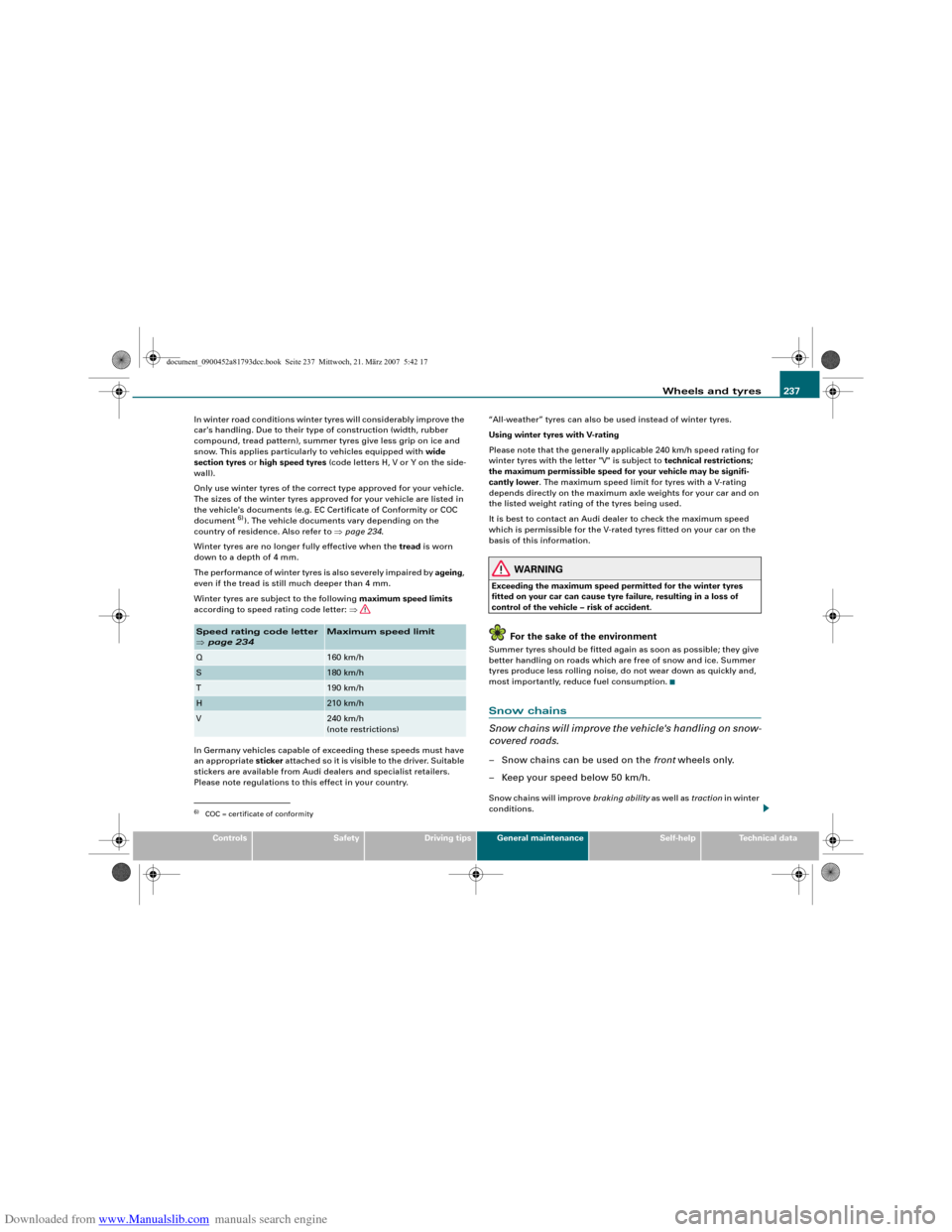
Winter tyres are subject to the following maximum speed limits
according to speed rating code letter: ⇒
In Germany vehicles capable of exceeding these speeds must have
an appropriate sticker attached so it is visible to the driver. Suitable
stickers are available from Audi dealers and specialist retailers.
Please note regulations to this effect in your country.“All-weather” tyres can also be used instead of winter tyres.
Using winter tyres with V-rating
Please note that the generally applicable 240 km/h speed rating for
winter tyres with the letter "V" is subject to technical restrictions;
the maximum permissible speed for your vehicle may be signifi-
cantly lower. The maximum speed limit for tyres with a V-rating
depends directly on the maximum axle weights for your car and on
the listed weight rating of the tyres being used.
It is best to contact an Audi dealer to check the maximum speed
which is permissible for the V-rated tyres fitted on your car on the
basis of this information.
WARNING
Exceeding the maximum speed permitted for the winter tyres
fitted on your car can cause tyre failure, resulting in a loss of
control of the vehicle – risk of accident.
For the sake of the environment
Summer tyres should be fitted again as soon as possible; they give
better handling on roads which are free of snow and ice. Summer
tyres produce less rolling noise, do not wear down as quickly and,
most importantly, reduce fuel consumption.Snow chains
Snow chains will improve the vehicle's handling on snow-
covered roads.– Snow chains can be used on the front wheels only.
– Keep your speed below 50 km/h.Snow chains will improve braking ability as well as traction in winter
conditions.
6)COC = certificate of conformitySpeed rating code letter
⇒page 234
Maximum speed limit
Q
160 km/h
S
180 km/h
T
190 km/h
H
210 km/h
V
240 km/h
(note restrictions)
document_0900452a81793dcc.book Seite 237 Mittwoch, 21. März 2007 5:42 17
Page 241 of 294
Downloaded from www.Manualslib.com manuals search engine Accessories and modifications to the vehicle239
Controls
Safety
Driving tips
General maintenance
Self-help
Technical data
Accessories and modifications to the vehicleAccessories and replacement partsAlways ask your dealer or specialist retailer for advice
before purchasing accessories and replacement parts.Your car is designed to offer a high standard of active and passive
safety. For this reason, we recommend that you ask an Audi dealer
for advice before fitting accessories or replacement parts. Audi
dealers have the latest information from the manufacturer and can
recommend accessories and replacement parts which are suitable
for your requirements. They can also answer any questions you
might have regarding official regulations.
We recommend you to use only Audi accessories and Audi Genuine
parts
®. Audi has tested these parts and accessories for suitability,
reliability and safety. Audi dealers have the necessary experience
and facilities to ensure that the parts are installed properly.
Although the market is constantly scrutinised, Audi cannot judge or
assume responsibility for the reliability, safety and suitability of
non-genuine products - even though in some instances, these parts
may have been approved by an officially recognised technical
testing authority or accompanied by an official approval certificate.
Any retro-fitted equipment which has a direct effect on the vehicle
and/or the way it is driven (e.g. cruise control system or electroni-
cally-controlled suspension) must be approved for use in your
vehicle and bear the e mark (the European Union's approval
symbol).
If any additional electrical components are fitted which do not serve
to control the vehicle itself (for instance a refrigerator box, laptop or
ventilator fan, etc.), these must bear the CE mark (manufacturer
conformity declaration in the European Union).
WARNING
Never attach accessories (such as cup holders or telephone
brackets) to the surfaces covering the airbag units or the areas
around the airbags: this could cause injury if the airbag is
triggered.ModificationsModifications must always be carried out according to
our specifications.Unauthorised modifications to the electronic components or soft-
ware in the vehicle may cause malfunctioning. Due to the way the
electronic components are linked together in networks, other
systems may be affected by the faults. This can seriously impair
safety, lead to excessive wear of components, and also invalidate
the type approval for your vehicle.
You will appreciate that your Audi dealer cannot be held liable for
any damage caused by modifications and/or work performed incor-
rectly.
We recommend that all work should be performed by an Audi work-
shop using Audi Genuine parts
®.
WARNING
Incorrectly performed modifications or other work on your vehicle
can lead to malfunctions and cause accidents.
document_0900452a81793dcc.book Seite 239 Mittwoch, 21. März 2007 5:42 17