2008 AUDI S4 brake
[x] Cancel search: brakePage 257 of 342

Checking and topping up fluids255
Controls
Safety
Driving tips
General maintenance
Self-help
Technical data
Working on components in the engine compartment
Extra caution is necessary when working on components
in the engine compartment.Always be aware of the danger of injury and scalding as well as the
risk of accident or fire when working in the engine compartment
(e.g. when checking and refilling fluids). Always observe the warn-
ings listed below and follow al l normal safety precautions. The
engine compartment of any motor vehicle is a potentially
hazardous area . ⇒ .
WARNING
•
Switch off the engine.
•
Remove the ignition key.
•
Apply the parking brake.
•
Put the gear lever in neutral or selector in P.
•
Wait for the engine to cool down.
•
Keep children away from engine compartment.
•
Never spill fluids on hot engine components. These fluids can
cause a fire (e.g. radiator anti-freeze).
•
Take care not to cause short circ uits in the electrical system,
especially when working on the battery.
•
Do not touch the radiator fan when the engine is hot. The fan
may start running suddenly.
•
Do not unscrew the cap on the ex pansion tank when the engine
is hot. The cooling system is under pressure.
•
Protect face, hands and arms by covering the cap with a large,
thick rag to protect against escaping coolant and steam.
•
If any tests have to be performed with the engine running,
there is an extra safety risk from the rotating parts, such as the
drive belts, alternator and radiator fan, etc., and from the high-
voltage ignition system.
•
Vehicles with automatic gearbox: Never open the throttle inad-
vertently (for instance by hand from the engine compartment) if a
gear is engaged while the vehicle is stationary with the engine
running. The vehicle could otherwise start moving immediately
and possibly cause an accident.
•
Observe the following a dditional warnings if work on the fuel
system or the electrical system is necessary:
−Always disconnect the battery.
− Do not smoke.
− Never work near naked flames.
− Always keep an approved fire extinguisher immediately
available.Caution
When topping up fluids make sure the correct fluid is put into the
correct filler opening. This can otherwise cause serious malfunc-
tions or engine damage.
For the sake of the environment
Inspect the ground un derneath your vehicle regularly so that any
leaks are detected at an early stag e. If you find oil spots or other
fluids, have your vehicle inspected by a qualified workshop.
Note
On right-hand drive vehicles* some of the containers / reservoirs
mentioned below are located on the other side of the engine
compartment.
WARNING (continued)
document_0900452a81b1b9de.book Seite 255 Donnerstag, 26. Juli 2007 9:16 09
--4 -
-T
-+
CD
+-
[I]
•
Page 258 of 342

Checking and topping up fluids
256Closing the bonnet– To close the bonnet, pull it down to overcome the spring
pressure.
– Then let it drop into the catches; do not press down ⇒ .
WARNING
•
For safety reasons the bonnet must always be completely
closed when the vehicl e is moving. After closing it always check
that it is properly secured. The bonnet must be flush with the adja-
cent body panels.
•
Should you notice that the bonne t is not safely secured when
the vehicle is moving, stop the ve hicle immediately and close the
bonnet properly, otherwise it could cause an accident.
Engine compartment layoutEngine compartment layout
Main components for checking and refillingFig. 252 Typical locations of fluid containers, engine oil dipstick and engine oil
filler cap
Jump-start terminal (+) under a cover . . . . . . . . . . . . .
Brake fluid reservoir (
) . . . . . . . . . . . . . . . . . . . . . . . .
Engine oil filler cap (
) . . . . . . . . . . . . . . . . . . . . . . . .
Engine oil dipstick* (orange) . . . . . . . . . . . . . . . . . . . . .
Radiator expansion tank () . . . . . . . . . . . . . . . . . . . . .
Jump-start terminal (-) with hexagon head . . . . . . . . .
Windscreen washer container (
) . . . . . . . . . . . . . . . .
Hydraulic fluid reservoir for power steering . . . . . . . .
A1
265, 294
A2
262
A3
259
A4
258
A5
261
A6
265, 294
A7
267
A8
225
document_0900452a81b1b9de.book Seite 256 Donnerstag, 26. Juli 2007 9:16 09
--4 -
-T
-+
•
+-
Page 264 of 342

Checking and topping up fluids
262
WARNING
•
The cooling system is under pr essure. Do not unscrew the cap
on the expansion tank when the engine is hot: you could be
scalded by escaping steam
•
The coolant and coolan t additive can be a health hazard. Store
the coolant additive in the original container in a safe place out of
reach of children – risk of poisoning.For the sake of the environment
Drained off coolant should not be used again. Drain off the used
coolant into a suitable container and dispose of it in the proper
manner (observe environmental regulations).Radiator fan
The radiator fan can start running spontaneously.The radiator fan is driven by the engine via a poly V-belt. The speed
of the fan is varied by a viscous clutch according to the temperature.
There is also an auxiliary electric fan, which cuts in automatically
whenever the temperature of the coolant and the engine compart-
ment rises above a certain level.
The auxiliary fan can continue to run for as long as 10 minutes after
stopping the engine – even after the ignition is switched off. It may
also start running suddenly ⇒ after a while if•
residual heat raises the coolant temperature, or
•
the hot engine compartment is ad ditionally heated up by the
sun.
WARNING
When working in the engine compa rtment be aware that the radi-
ator fan may start running suddenly – risk of injury.
Brake fluidChecking brake fluid level
The brake fluid level can be checked at a glance.– Check the fluid level on the brake fluid reservoir ⇒fig. 258. It should always be between the “MIN” and
“MAX” marks.In right-hand drive vehi cles the brake fluid reservoir is on the other
side of the engine compartment.
The fluid level may drop slightly after a period of time due to the
automatic compensation for brake pad wear. This is quite normal.
However, if the level goes down noticeably in a short time, or drops
below the “MIN” mark, there may be a leak in the brake system. If
the fluid level in the reservoir is too low, this will be indicated by the
brake warning lamp ⇒page 32 . If this should happen, take the car
to a qualified workshop immediately and have the brake system
inspected.
Fig. 258 Engine
compartment: Mark-
ings on brake fluid
reservoir
document_0900452a81b1b9de.book Seite 262 Donnerstag, 26. Juli 2007 9:16 09
--4 -
-T
•
-+ +-
•
. I
Page 265 of 342

Checking and topping up fluids263
Controls
Safety
Driving tips
General maintenance
Self-help
Technical data
Changing brake fluid
When required, the brake fluid should be changed by a
competent mechanic with the proper equipment.Brake fluid gradually absorbs moisture from the atmosphere. If the
water content in the brake fluid is too high, this may cause corrosion
in the brake system over time. In addition, the boiling point of the
brake fluid will be considerably reduced. This could adversely affect
the braking ability in certain circumstances.
For this reason the brake fluid must be changed periodically.
Your vehicle's Service Schedule will tell you when the brake fluid has
to be changed.
It is advisable to have the brake fluid changed as part of a regular
Inspection Service at your Audi workshop. They are familiar with the
procedure and have the necessary special tools and spare parts as
well as the proper facilities for disposing of the old fluid.
Use only the genuine brake fluid specified by the factory Qualified
workshops know that the brake fluid “DOT 4” is approved by Audi.
The brake fluid must be fresh and unused.
WARNING
•
Brake fluid is poisonous; store it in the sealed original container
in a safe place out of reach of children.
•
Heavy use of the brakes may caus e a vapour lock if the brake
fluid is left in the system for too long. This would seriously affect
the efficiency of the brakes and th e safety of the car – risk of acci-
dent.Caution
Please note that brake fluid will attack the paintwork on contact.
For the sake of the environment
If the fluid has to be drained out of the brake system, use an appro-
priate container to catch the used brake fluid and dispose of it in the
proper manner.BatteryGeneral notes
All work on batteries requires specialist knowledge.The battery is virtually maintenance-free. It is checked as part of the
Inspection Service.
We recommend that you replace a ba ttery once it is older than 5
years.
When an airbag is triggered, the battery will, under certain circum-
stances, be disconnected from the on-board power supply for
safety reasons ⇒ in “General notes on airbag system” on
page 201 .
Disconnecting the battery
If the battery is disconnected, some of the vehicle's functions will
become inoperative (e.g. electric windows). These functions will
require resetting after the battery is reconnected. For this reason,
the battery should only be disconnected from the vehicle's electrical
system when absolutely necessary.
If the vehicle is not used for long periods
If you do not drive your vehicle for a period of several days or weeks,
the power management will gr adually shut off the on-board
systems one by one, or reduce the amount of current they are using.
This limits the amount of power consumed and helps to ensure reli-
able starting even after a long period ⇒page 226 .
document_0900452a81b1b9de.book Seite 263 Donnerstag, 26. Juli 2007 9:16 09
--4 -
-T
•
-+ +-
CD
Page 273 of 342

Wheels and tyres271
Controls
Safety
Driving tips
General maintenance
Self-help
Technical data
– Never use tyres whose actual size exceeds the dimen-
sions of the factory-approved makes of tyre.
– If you wish to fit the vehicle with non-standard rims or tyres, it is advisable to consult an Audi dealer before
purchasing them.The tyres and wheel rims are an essential part of the vehicle's
design. The tyres and rims approved by Audi are specially matched
to the characteristics of the vehi cle and make a major contribution
to good roadholding and safe handling ⇒.
The sizes of the rims and tyres approved for your vehicle are listed
in the vehicle's documents (e.g. EC Certificate of Conformity or COC
document
3)). The vehicle documents vary depending on the
country of residence.
Understanding the tyre designations makes it easier to choose the
correct tyres. For example, radial ply tyres have the following tyre
designations marked on the sidewall:
225 / 50 R 17 94 Y
This contains the following information:
The manufacturing date is also indicated on the tyre sidewall
(possibly only on the inner side of the wheel):
DOT ... 1006... means, for example, that the tyre was produced in the 10th week of
2006.
Please note that with some types of tyres, the actual tyre size can
differ from the nominal size marked
on the tyre (for instance 225/50
R 17 94 Y), and there may be signific ant differences in the contours
of the tyres, even though the tyres are marked with the same
nominal size designation. When repl acing the tyres, it is therefore
important to make sure that the actual size of the new tyres does
not exceed the dimensions of the factory-approved makes of tyre.
Failure to observe this requirement can affect the clearance needed
for the tyres. This could result in contact between the tyres and
suspension components or bodywork. The brake lines could also be
damaged and the vehicle's safety could be severely impaired ⇒.
When using tyres with the ma ximum permitted nominal dimen-
sions, this can also void the vehicle's registration.
If you use tyres that are approved by Audi you can be sure that the
actual tyre dimensions will be corre ct for your vehicle. If you decide
to fit a different type of tyre, you must obtain the appropriate manu-
facturer's certificate from the tyre retailer to confirm that the tyres
are suitable for your vehicle. Keep this certificate in a safe place.
Your local Audi dealer will be able to advise you on which tyres may
be fitted to your vehicle.
On vehicles with four-wheel drive, all four tyres must always be
fitted with tyres of the same type, make and tread pattern, as other-
wise the driveline can be damaged by continuous variations in the
wheel speeds. For the same reason, only use a spare wheel* with
the same tyre dimensions as the normal road wheels.
It the spare tyre* is not the same type as the tyres fitted on the car
(for example if the car has winter tyres or wide-section tyres) you
should only use the spare tyre if a puncture occurs, and then only
for a short period of time. In this case, please drive with extra care.
Refit the normal road whee l as soon as possible.
It is best to have all servicing of wheels and tyres performed by a
qualified workshop . They have the necessary special tools and
3)COC = certificate of conformity
225
Tyre width in mm
50
Height/width ratio in %
R
Tyre construction: Radial
17
Rim diameter in inches
94
Load rating code
Y
Speed rating code letter
document_0900452a81b1b9de.book Seite 271 Donnerstag, 26. Juli 2007 9:16 09
--4 -
-T
-+ +-
Page 274 of 342

Wheels and tyres
272replacement parts, trained personnel and facilities for disposing of
the old tyres.
WARNING
•
It is very important to ensure that the tyres you have chosen
have adequate clearance. When selecting replacement tyres, do
not rely entirely on the nominal tyre size marked on the tyre; with
some makes of tyre the effective tyre size can differ significantly
from the nominal dimensions, even though the tyres have the
same size designation. Inadequate tyre clearance can result in
damage to the tyres or the vehicle, causing a serious safety risk. It
may also invalidate the vehicle' s type approval for use on public
roads.
•
Please ask your Audi dealer or qualified workshop whether run
flat tyres can be used on your ve hicle. Unauthorised use of these
tyres can invalidate the vehicle' s type approval for use on public
roads. Furthermore, this could cause damage to your vehicle and
possibly also result in an accident.
•
Avoid running the car on tyres that are more than 6 years old.
If you have no alternative, you should drive slowly and with extra
care at all times.For the sake of the environment
Old tyres must be disposed of according to the laws in the country
concerned.
Note
•
Never mount used tyres if you are not sure of their previous
history.
•
For technical reasons it is not normally possible to use wheel
rims from other vehicles. In some cases this also applies to rims
from other vehicles of the same model.
Wheel bolts
The wheel bolts are designed to suit the rims on your car.The wheel bolts are matched to the rims. When installing different
wheels (for instance wheels with winter tyres) it is important to use
the correct wheel bolts with the ri ght length and correctly shaped
bolt heads. This is essential for the secure fit of the wheels and for
the proper function of the brake system.
Audi dealers have full information on the technical requirements
when installing or changing tyres, rims or wheel trims.
The wheel bolts should be clean and turn easily.
A special adapter is required to turn the anti-theft wheel bolts*
⇒ page 292 .Winter tyres
Winter tyres will significantly improve the car's handling
in winter road conditions.–Use only radial ply winter tyres.
– Winter tyres must be fitted on all four wheels.
– Only use winter tyres of the correct type approved for your vehicle.
– Please note that the maximum permissible speed for winter tyres may be lower than for summer tyres.
– Also note that winter tyres are no longer effective when the tread is worn down.
– After fitting the wheels you must always check the tyre pressures. The correct tyre pressures are listed on the
sticker on the end face of the driver's door.
document_0900452a81b1b9de.book Seite 272 Donnerstag, 26. Juli 2007 9:16 09
--4 -
-T
•
-+ +-
[I)
•
Page 276 of 342

Wheels and tyres
274For technical reasons snow chains may only be used on tyres with
certain wheel rim/tyre combinations.
Only use snow chains with fine-pitch links. The links must not
protrude more than 13.5 mm from the tyres (including tensioner).
Remove the chains when roads are free of snow. Otherwise they will
impair handling, damage the tyres and wear out very quickly.
Four-wheel drive : where snow chains are compulsory on certain
roads, this normally also applies to cars with four-wheel drive. Snow
chains may only be fitted to the front wheels (also on vehicles with
four-wheel drive).Run flat tyresApplies to vehicles: with run flat tyresIntroduction
Run flat tyres allow you to co ntinue your journey in the
event of a loss of tyre pressure.Run flat tyres have reinforced sidewalls which support the tyre in
the event of a loss of pressure.
Run flat tyres must only be used on vehicles which were already
factory-fitted with these tyres and which also have a tyre pressure
monitoring system*.
Run flat tyres can be identified by the marking “RSC” (Runflat
System Component) on the sidewall. If you change the tyres on your vehicle from regular tyres to run flat
tyres or vice-versa, the control unit must be reprogrammed by an
Audi dealer or other qualified workshop.
What are the benefits of run flat tyres?
Run flat tyres ensure that you remain mobile, even in the event of a
loss of tyre pressure. In favourable conditions these tyres have an
operating range of
at least 30 km, however the vehicle must not be
driven faster than 80 km/h ⇒ in “Driving with run flat tyres” on
page 275 .
The tyre pressures are constantly checked by the tyre pressure
monitoring system. When the run flat system becomes active
(centre display), it is still the driver's responsibility to check the
tyre(s) affected and to decide whether it is possible to continue
driving. Also refer to ⇒page 275, “Driving with run flat tyres”.
When is it no longer possibl e to continue driving with
the help of the run flat tyres?
•
If the Electronic Stabilisation Program (ESP) is out of operation
or is triggered continuously.
•
If the tyre pressure monitoring system is out of operation.
•
If one of the tyres has been severely damaged in an accident, etc.
If a tyre has been badly damaged there is a risk that parts of the
tread can be thrown off and cause damage to the fuel lines, brake
pipes or fuel filler.
•
You must stop driving if severe vibrations occur, or if the wheel
starts overheating and gives off smoke.
•
You must also stop driving if damage to the tyres (e.g. tears in
the sidewalls) becomes apparent.
WARNING
Please ask your Audi dealer or qualified workshop whether run flat
tyres can be used on your vehicle. Unauthorised use of these tyres
can invalidate the vehi cle's type approval for use on public roads.
Rim size
Rim offset
Tyre size
7Jx16
39 mm
205/60
7Jx16
46 mm
225/55
7Jx17
46 mm
225/50
document_0900452a81b1b9de.book Seite 274 Donnerstag, 26. Juli 2007 9:16 09
--4 -
-T
-+
•
+-
~-
Page 288 of 342
Self-help
286The TMS can be used at outside temperatures down to – 20 °C.
WARNING
After repairing a tyre please note the following points:•
Do not drive faster than 80 km/h.
•
Avoid heavy acceleration, hard braking and fast cornering.
•
Vehicle handling could be impaired.
•
Tyres which have been sealed using the TMS are only suitable
for temporary use. Damaged tyres must be renewed.
•
The TMS must NOT be used,
− on cuts and punctures larger than 4 mm
− if the wheel rim has been damaged
− if you have been driving with very low pressure or a
completely flat tyre
•
Seek professional assistance if th e repair of a tyre puncture is
not possible with the sealing compound.
•
Do not allow the sealant to come into contact with your eyes,
skin or clothing.
•
If you do come into contact wi th the sealant immediately rinse
the eyes or skin affected with clean water.
•
Change clothing immediately if it becomes soiled with the tyre
sealant.
•
Make sure you do not breathe in the fumes!
•
If any of the tyre sealant is a ccidentally ingested, immediately
rinse the mouth thoroughly and drink lots of water.
•
Do not induce vomiting. Immediately contact a doctor!
•
If any allergic reactions should occur get medical help immedi-
ately.
•
Keep the sealant away from children.
For the sake of the environment
Used bottles of sealing compound can be returned to an Audi dealer
for disposal.
Note
•
If sealant should leak out, leave it to dry. When it has dried, you
can pull it off like a piece of foil.
•
Observe the expiry date stated on the sealing compound can.
Have the sealing compound exchanged by a qualified workshop.
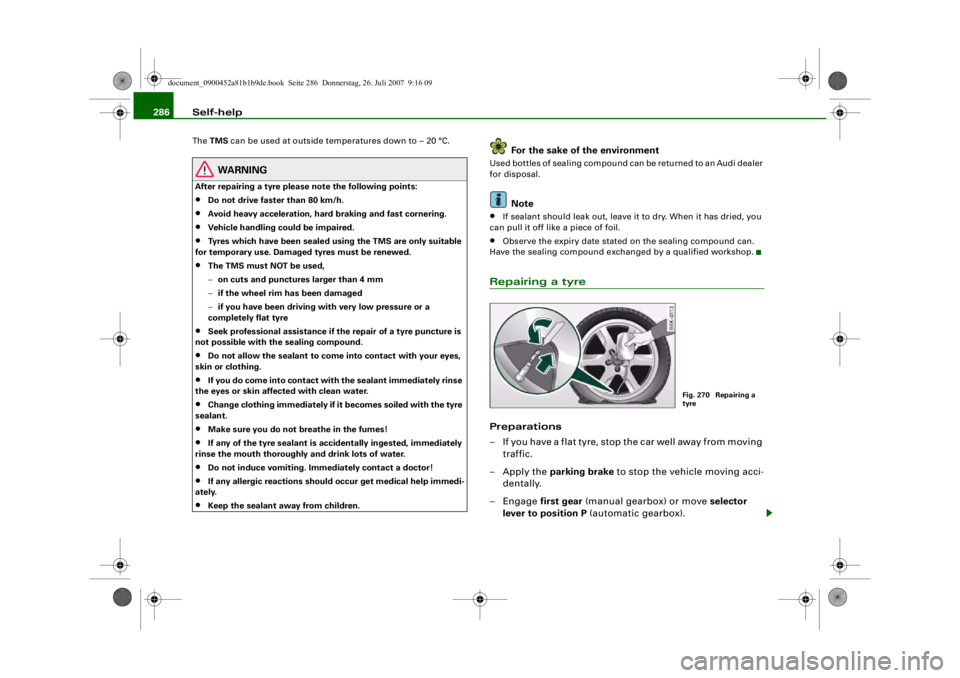
Repairing a tyrePreparations
– If you have a flat tyre, stop the car well away from moving traffic.
– Apply the parking brake to stop the vehicle moving acci-
dentally.
–Engage first gear (manual gearbox) or move selector
lever to position P (automatic gearbox).
Fig. 270 Repairing a
tyre
document_0900452a81b1b9de.book Seite 286 Donnerstag, 26. Juli 2007 9:16 09
--4 -
-T
[I]
•
-+ +-