2008 AUDI S4 brake
[x] Cancel search: brakePage 139 of 342

adaptive cruise control (ACC)137
Controls
Safety
Driving tips
General maintenance
Self-help
Technical data
•
The control lever has been pushed up / down to increase / reduce
the speed, but the resulting speed would be outside the range of 30
to 200 km/h.
ACC deactivation
The message ACC deactivation sometimes appears on vehicles with
a manual gearbox. If you press the clutch pedal for longer than
about 20 seconds, the adaptive crui se control will be automatically
deactivated and a warning tone will sound.
ACC not available
The text message ACC not available will appear if, for example, the
brakes are overheated. The adaptive cruise control will then tempo-
rarily not be available. This is indicated by a warning tone.
ACC not available!
The text message ACC not available! appears if a malfunction
should occur. The adaptive cruise control will then be switched off.
This is indicated by a warning tone. Have the system checked by a
qualified workshop.
ACC sensor blocked!
The text message ACC sensor blocked! appears if the ACC system
can no longer detect objects reli ably. The adaptive cruise control
will then be switched off. This is indicated by a warning tone.
The ACC sensor is obstructed by dirt or foreign objects (e.g. leaves
or snow). Clean the sensor to restore the function ⇒page 128,
fig. 136.
Engine speed !
On vehicles with manual gearbox, the text message Engine speed !
will appear if the driver does not change gear in time when the
adaptive cruise control accelerates or brakes the vehicle. The adap-
tive cruise control will automatically be deactivated if the engine
speed is not maintained within the permissible range. This is indi-
cated by a warning tone. ESP activation
The text message
ESP activation appears if the Electronic Stabilisa-
tion Programme (ESP) has intervened. In this case, the adaptive
cruise control will automatically be switched off. This is indicated by
a warning tone.
Speed (in km/h)
The target speed (in km/h) will appear in the display whenever it is
stored or changed ⇒page 131, “Setting the speed” and
⇒ page 131, “Setting a new speed”.
Speed range
The text message speed range appears if the current speed is too
low to set or to maintain the target speed.
To set a target speed, the speed of the vehicle must be at least
30 km/h. The cruise control system switches off if the speed falls
below 20 km/h.
If the speed exceeds 200 km/h (OVE RRIDE), the system will remain
active and will reduce the speed to 200 km/h once the driver stops
accelerating.
ACC functionality limited
The text message ACC functionality limited appears if the ACC
system does not detect any objects for an extended period. The
distance to vehicles in front is not being controlled while the
message is displayed. The ACC system is not deactivated, and so
extra care should be taken! The text message ACC functionality
limited can appear for the following reasons:
•
The ACC sensor is dirty. The ACC system is not responding or is
not responding correctly to the vehicles in front!
•
You may be driving on a country road with no traffic and no clear
roadside demarcation (e.g. safety barriers, traffic signs, trees). As
soon as the system detects a vehicle, distance control is resumed
and the text message disappears.
document_0900452a81b1b9de.book Seite 137 Donnerstag, 26. Juli 2007 9:16 09
--4 -
-T
-+ +-
Page 140 of 342
adaptive cruise control (ACC)
138The ACC sensor is located inside the trim grille (front right)
⇒ page 128, fig. 136. If the sensor is no longer functioning due to
dirt or obstruction in this area, it should be cleaned.
Parking brake !
The text message Parking brake ! appears if the parking brake is
operated. The adaptive cruise control will then be switched off. This
is indicated by a warning tone.
Gear lever position !
On vehicles with manual gearbox the text message Gear lever
position ! appears when no valid forward gear is selected, i.e.
reverse gear or 1st gear is engaged or the gear lever is in the neutral
position. Adaptive cruise control is not available when the lever is in
these positions.
Shift lever position!
On vehicles with automatic gearbox the text message Shift lever
position ! appears if the shift lever is moved to position N. Adaptive
cruise control is not available when the lever is in this position.
Applies to vehicles: with adaptive cruise controlDriver intervention prompt
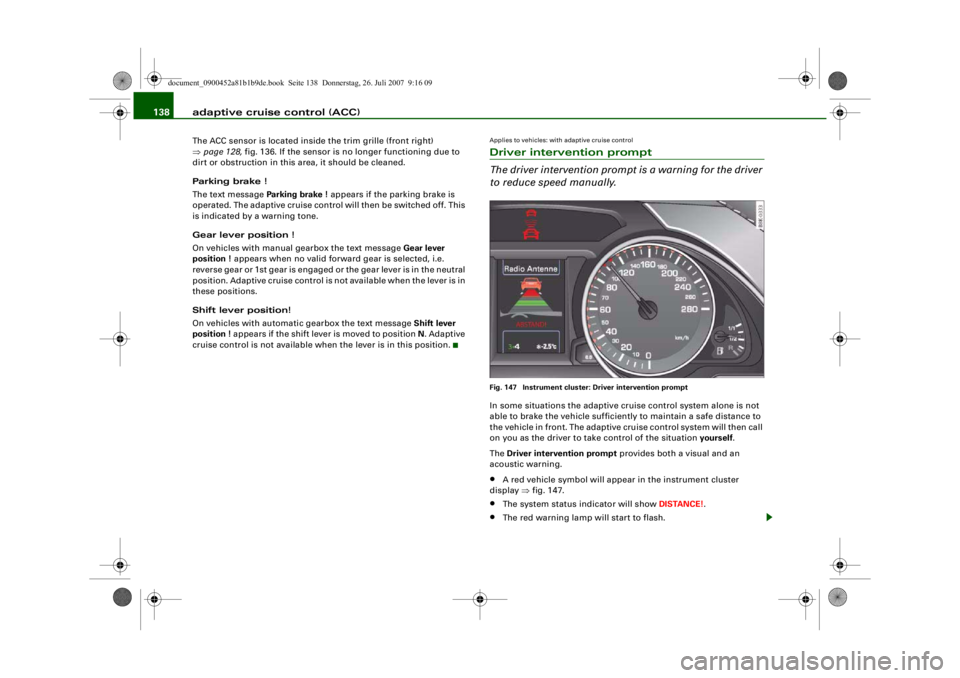
The driver intervention prompt is a warning for the driver
to reduce speed manually.Fig. 147 Instrument cluster: Driver intervention promptIn some situations the adaptive cruise control system alone is not
able to brake the vehicle sufficiently to maintain a safe distance to
the vehicle in front. The adaptive cruise control system will then call
on you as the driver to ta ke control of the situation yourself.
The Driver intervention prompt provides both a visual and an
acoustic warning.•
A red vehicle symbol will appear in the instrument cluster
display ⇒fig. 147.
•
The system status indicator will show DISTANCE!.
•
The red warning lamp will start to flash.
document_0900452a81b1b9de.book Seite 138 Donnerstag, 26. Juli 2007 9:16 09
--4 -
-T
-+
•
+-
Page 141 of 342

adaptive cruise control (ACC)139
Controls
Safety
Driving tips
General maintenance
Self-help
Technical data
•
An acoustic warning will also sound (unless it has been deacti-
vated in the sound syst em or MMI* settings).Note
•
Pressing the brake pedal will switch off the adaptive cruise
control system. The speed set at that point will, however, remain
stored until the adaptive cruise control is activated again.
•
To resume the programmed cruising speed, release the brake
pedal and pull the control lever towards you ⇒page 132,
“Switching off the system (with speed memory function) and reacti-
vating it”.
•
If you exceed the target speed by pressing the accelerator, the
driver intervention prompt will not be accompanied by a warning
tone. The indicator lamp shown in the display will also switch off
when the target speed is exceeded.
•
If the adaptive cruise control triggers a braking operation the
hydraulic brake system is under pressure. This is why brake pedal
travel will be shorter and the pedal will feel “harder”.
Applies to vehicles: with adaptive cruise controlSetting the warning tone volume and driving program
You can change the adaptive cruise control settings on
the sound system or MMI* to suit your individual driving
style.– Select: Function selector button > adaptive cruise
control .Setting the volume of the warning tone
If the adaptive cruise control syst em switches off (e.g. when the ESP
intervenes) or a driver intervention prompt appears, a warning tone
will sound.
You can set the volume of the warning tone to low, medium , or high .
The new volume will sound briefly after making any adjustment. If
you do not want a tone to sound, select off.
Adjusting the basic settings
You can set the distance (time interv al) you want the adaptive cruise
control system to keep to the vehicle in front by selecting distance
1 , distance 2 , distance 3 or distance 4 .
Fig. 148 Display: adap-
tive cruise control
CAR
document_0900452a81b1b9de.book Seite 139 Donnerstag, 26. Juli 2007 9:16 09
--4 -
-T
[I]
-+
•
+-
Page 143 of 342

adaptive cruise control (ACC)141
Controls
Safety
Driving tips
General maintenance
Self-help
Technical data
Driving into a bend
When you are driving into a bend
, the ACC system may react to a
vehicle travelling in the other lane and therefore brake the vehicle
⇒ page 140, fig. 149. You can override the braking effect by pressing
the accelerator.
Driving out of a bend
When you are driving out of a long bend, the ACC system may - in
the course of its calculation of th e lane ahead - react to a vehicle
travelling in the other lane and therefore brake the vehicle
⇒ page 140, fig. 150. You can override the braking effect by pressing
the accelerator.
Applies to vehicles: with adaptive cruise controlVehicles in front travelling out of lineVehicles in front which are not in line with your vehicle cannot be
detected by the ACC system until they are within the range of the
sensor.
Applies to vehicles: with adaptive cruise controlOther vehicles changing lanesVehicles which are very close to you when they move onto your lane
cannot be detected by the radar sensor until they move into its
range.Applies to vehicles: with adaptive cruise controlNot clearly discernible vehiclesVehicles that are not clearly discernible, e.g. a motorcycle travelling
in front of you and vehicles with a large amount of ground clearance
or protruding freight, are often identified late or may not be
detected at all.
Fig. 151 The vehicle in
front is outside the
range of the radar
sensor
Fig. 152 A vehicle is
changing lanesFig. 153 Motorcycle in
front
document_0900452a81b1b9de.book Seite 141 Donnerstag, 26. Juli 2007 9:16 09
--4 -
-T
•
-+
•
+-
•
Page 144 of 342
adaptive cruise control (ACC)
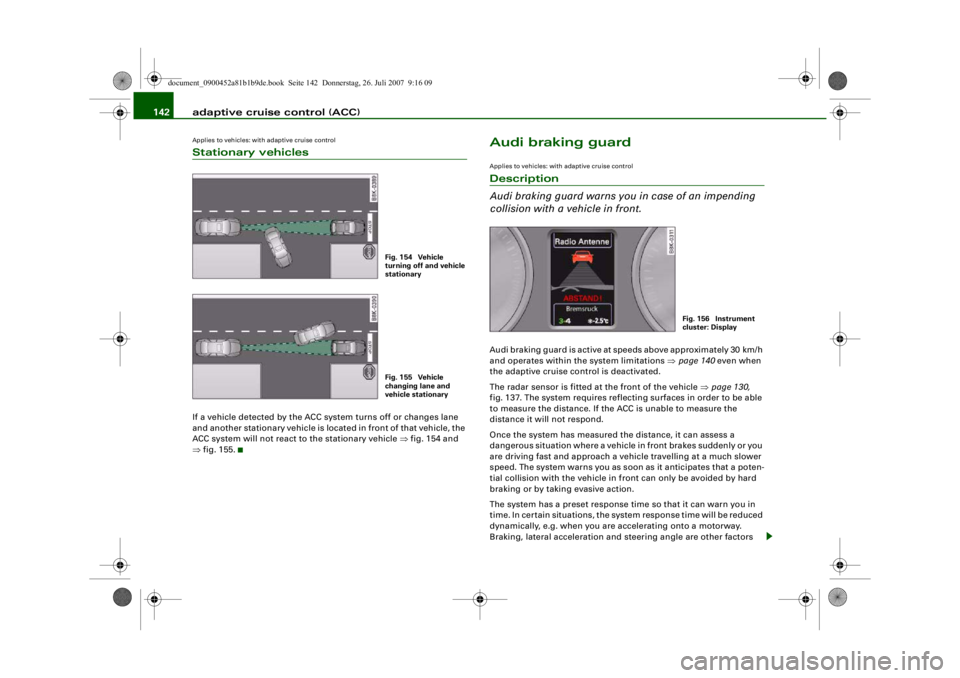
142Applies to vehicles: with adaptive cruise controlStationary vehiclesIf a vehicle detected by the ACC system turns off or changes lane
and another stationary vehicle is loca ted in front of that vehicle, the
ACC system will not react to the stationary vehicle ⇒fig. 154 and
⇒ fig. 155.
Audi braking guardApplies to vehicles: with adaptive cruise controlDescription
Audi braking guard warns you in case of an impending
collision with a vehicle in front.Audi braking guard is active at speeds above appr oximately 30 km/h
and operates within the system limitations ⇒ page 140 even when
the adaptive cruise control is deactivated.
The radar sensor is fitted at the front of the vehicle ⇒page 130,
fig. 137. The system requires reflecting surfaces in order to be able
to measure the distance. If the ACC is unable to measure the
distance it will not respond.
Once the system has measured the distance, it can assess a
dangerous situation where a vehicle in front brakes suddenly or you
are driving fast and approach a vehicle travelling at a much slower
speed. The system warns you as soon as it anticipates that a poten-
tial collision with the vehicle in front can only be avoided by hard
braking or by taking evasive action.
The system has a preset response time so that it can warn you in
time. In certain situations, the system response time will be reduced
dynamically, e.g. when you are accelerating onto a motorway.
Braking, lateral acceleration and steering angle are other factors
Fig. 154 Vehicle
turning off and vehicle
stationaryFig. 155 Vehicle
changing lane and
vehicle stationary
Fig. 156 Instrument
cluster: Display
document_0900452a81b1b9de.book Seite 142 Donnerstag, 26. Juli 2007 9:16 09
--4 -
-T
-+ +-
•
Page 145 of 342

adaptive cruise control (ACC)143
Controls
Safety
Driving tips
General maintenance
Self-help
Technical data
which can shorten the system response time. The warning will be
deactivated if you press the accelerator pedal right down in order to
overtake.
The system draws the driver's attention to two different hazardous
situations:
Distance !
A distance warning will be given if you travel too close to the vehicle
in front for longer than 5 seconds. For example, if the distance is
less than 9 m at 80 km/h, a message
will appear in the instrument
cluster display ⇒page 142, fig. 156.
If the vehicle in front were to brake hard, a collision would no longer
be avoidable, even if you reacted immediately. In this case, you
should leave more room between yo ur car and the vehicle in front.
Speed
If the vehicle in front of you is travelling in the same lane at a much
slower speed or if it brakes hard, the Audi braking guard will calcu-
late the time at which a collision can be avoided only by emergency
braking or evasive action. When the system warns you, it is possible
to avoid a potential collision with the vehicle in front by braking or
changing lane. There are two warning levels:
•
Early warning: A message will appear in the instrument cluster
display and you will also hear a warning tone.
•
Acute warning: The second (acute) warning will be triggered if
you do not react to the advance warning. There will automatically be
a short dab of the brakes to remind you to concentrate on the traffic.
If you brake hard, the brake assist system ⇒page 222 helps you to
achieve the optimum braking effect.
WARNING
Please always direct your full attention to the road, even when the
Audi braking guard is activated. It is always you who is responsible for determining your speed and for
keeping a safe distance to the
other vehicles on the road.
•
Always maintain the statutory mi nimum safety distance to the
vehicle in front (risk of accident).
•
Due to the system limi tations, the Audi braking guard will not
react in certain situations, fo r example when approaching a
stationary obstacle (such as the end of a traffic jam or a broken-
down vehicle).
•
Please note that the Audi braking guard is subject to limita-
tions in tight bends on account of the radar sensor's field of vision.
This means that obstacles may not be detected in certain situa-
tions.
•
The radar sensor's "field of vision" can be impaired by rain,
snow or a lot of water on the road. This results in vehicles not
being reliably recognised or, in some circumstances, not being
detected at all. Always keep the ro ad ahead within your field of
vision.
•
Reflecting objects, such as crash barriers or the entrance to a
tunnel, could impair the function of the radar sensor.
Applies to vehicles: with adaptive cruise controlStatus messages in the instrument cluster displaybraking guard brake jolt
This driver message appears when the brakes are dabbed due to an
acute warning.
braking guard off
This driver message appears when the system is switched off in the
MMI. The message also appears briefly after you begin driving if the
system is switched off.
WARNING (continued)
document_0900452a81b1b9de.book Seite 143 Donnerstag, 26. Juli 2007 9:16 09
--4 -
-T
-+ +-
•
Page 164 of 342

Automatic gearbox
162Automatic gearboxmultitronic
®, tiptronic (6-speed
gearbox)
Applies to vehicles: with multitronic® or tiptronicIntroductionApplies to vehicles with multitronic
® gearbox
The vehicle is equipped with an electronically controlled continu-
ously variable transmission (multitronic
®). Unlike conventional
automatics, the gear ratios are not shifted in fixed steps but contin-
uously variable. This gives smoother transmission and makes for
better fuel economy.
The gearbox selects the gear ratio and shifts up or down automati-
cally according to the gear change programmes stored in the
control unit ⇒page 166 .
If desired, you can also select the gears manually (tiptronic mode)
⇒ page 166 .
Please note that on ve hicles with a multitronic® gearbox, torque is
transmitted via a multi- plate clutch, and not via a torque converter
as on conventional automatics. This means that the car will not
“creep” as much as conventional automatics when the engine is
idling if you stop temporarily with the selector lever in position D, S
or R.
Applies to vehicles with tiptronic gearbox
The vehicle is equipped with an electronically controlled 6-speed
automatic gearbox. The gearbox changes up and down automati-
cally .
If desired, you can also select the gears manually (tiptronic mode)
⇒ page 166 .
Applies to vehicles: with multitronic® or tiptronicGeneral notes on using multitronic
®
The gears are changed automatically.Driving away from a standstill
– Press and hold the brake pedal.
– Press and hold the interlock button (the button in the
selector lever handle), move the selector lever to the
desired position, for instance D, and release the interlock
button.
– Wait for the gearbox to engage the gear (a slight move- ment can be felt).
– Release the brake and press the accelerator ⇒.
Stopping briefly
– Apply the foot brake to hold the vehicle when stationary (for instance at traffic lights).
Fig. 177 Detail of the
centre console:
Selector lever with
interlock button
document_0900452a81b1b9de.book Seite 162 Donnerstag, 26. Juli 2007 9:16 09
--4 -
-T
-+ +-
•
Page 165 of 342

Automatic gearbox163
Controls
Safety
Driving tips
General maintenance
Self-help
Technical data
– To prevent the vehicle from rolling away, apply the
parking brake before moving off on steep gradients
⇒ .
– As soon as you accelerate as normal, the parking brake will automatically be released and the vehicle will start
moving.
Pa rking the c ar
– Press and hold the brake pedal ⇒.
– Apply the parking brake.
– Press and hold the interlock button, move the selector lever to P and release the interlock button.The engine c an only be started when the selector lever is at P or N.
On level ground it is sufficient to move the selector lever to P. On a
gradient the parking brake should be applied first and the selector
lever should be moved to P. This reduces the load on the locking
mechanism and makes it easier to move the selector lever out of
position P.
Vehicles with multitronic® gearbox: Your vehicle is equipped with
the hill hold assist function which makes it easier to drive away on
a slope. The system is activated when you press and hold the brake
pedal for a few seconds . When you release the brake pedal the
braking force will be maintained for a moment in order to prevent
the vehicle rolling back when you drive away.
WARNING
•
Do not press the accelerator while selecting a gear with the
vehicle stationary and the engine running, as this could cause an
accident.
•
Please note that some power will still be transmitted when you
stop temporarily with the selector lever in position D, S or R. For this reason, to avoid ri
sking an accident, appl y the footbrake firmly
when stopping to prevent the vehicle rolling away.
•
Never move the selector lever to R or P when driving, as this
could cause an accident.
•
Vehicles with multitronic® gearbox: Please note that some
power will still be transmitted when you stop temporarily with the
selector lever in position D, S or R. For this reason, to avoid risking
an accident, apply the footbrake fi rmly when stopping to prevent
the vehicle rolling away.
Applies to vehicles: with multitronic® or tiptronicSelector lever positions
This section covers all the selector lever positions.The current selector lever position is shown in the instrument
cluster display.
P - Parking lock
This locks the driving wheels mechanically. The parking lock must
only be engaged when the vehicle is stationary ⇒.
The interlock button (the button in the selector lever handle) must
be pressed in and the brake pedal must be depressed before
WARNING (continued)
Fig. 178 Display:
Selector lever posi-
tions
document_0900452a81b1b9de.book Seite 163 Donnerstag, 26. Juli 2007 9:16 09
--4 -
-T
•
-+ +-