2008 AUDI A4 light
[x] Cancel search: lightPage 248 of 342
Care of vehicle and cleaning 246Plastic partsPlastic parts will come clean with regular washing. If this is not suffi-
cient, plastic parts should only be treated with a special solvent-free
plastic cleaning agent. Do not use paint cleaners, polishes or wax on
plastic parts.Paint damageMinor damage to the paint, such as scratches or stone chips, should
be touched up without delay before the metal starts to corrode. Suit-
able touch-up brushes or sprays for your car can be obtained from
an Audi dealer.
The number of the original paint finish on the vehicle is given on the
data sticker ⇒page 321.
If corrosion is already visible it must be thoroughly removed by a
qualified workshop.Windows
Clear vision is an essential safety factor.The windscreen must not be cleaned with insect remover or wax,
otherwise the windscreen wipers will not function properly
(juddering).
Traces of rubber, oil, grease or silicone can be removed with a
window cleaning solution or a silicone remover. Wax residue can
only be removed with a special cleaner. Your Audi dealer will be able
to provide you with more detailed information.
The windows should also be cleaned on the inside at regular inter-
vals.
Use a separate cloth or chamois to dry the windows. Cloths used for
waxing and polishing contain residues that will cause smears on the
glass.
WARNING
Do not use water-repellent coatings on the windscreen. In bad visi-
bility conditions such as light rain, low sun or when driving at
night these coatings can cause increased dazzle, which is a
serious safety hazard. Such coatings can also cause the wiper
blades to judder.
Caution
•
Remove snow and ice from windows and mirrors with a plastic
scraper only. To avoid scratches caused by dirt on the glass, the
scraper should only be pushed in one direction and not moved to
and fro.
•
The heating element for the rear window is located on the inner
side of the window. To avoid damaging the heating element, do not
put stickers on the inner side of the window.
•
Never use warm or hot water to remove snow and ice from
windows and mirrors. This could cause the glass to crack!
Rubber seals (weatherstrips)The weatherstrips will remain pliable and last longer if they are
occasionally treated with a suitable care product (for example sili-
cone spray). This will also prevent premature ageing and leaks. The
doors will be easier to open as well. If they are kept pliable, the door
seals will be less likely to freeze up in the winter.WheelsThe wheels require regular attention to preserve their appearance.
It is important to remove road salt and brake dust by washing the
wheels at regular intervals, otherwise the finish will be impaired.
document_0900452a81b1b9de.book Seite 246 Donnerstag, 26. Juli 2007 9:16 09
Page 249 of 342
Care of vehicle and cleaning247
Controls
Safety
Driving tips
General maintenance
Self-help
Technical data After washing, the wheels should only be cleaned with an "acid-
free" cleaning agent for alloy wheels. This is available from Audi
dealers and specialist retailers. Never leave the cleaning agent on
the rims for any longer than specified in the instructions before
rinsing it off. If the wheel cleaner fluid contains acid it can attack the
surfaces of the wheel bolts.
Car polish or other abrasive agents should not be used. If the
protective paint coating is damaged by stone chips etc., the
damaged area should be touched up immediately.
WARNING
Please note when cleaning the wheels that water, ice and road salt
can impair the effectiveness of the brakes – this can cause an
accident.Care of interiorSound system / MMI* display screen and MMI control console*The display screen can be cleaned with a soft cloth and a special
“LCD cleaner” (available from retailers of electrical goods). Moisten
the cloth with a small amount of the cleaning fluid.
Clean the MMI control console with a fine brush first to prevent any
dirt from getting in between the control buttons and the housing.
We then recommend wiping the MMI control console using a cloth
moistened with washing-up liquid and water.
Caution
To avoid scratching the screen, do not wipe the display with a dry
cloth.
•
To avoid any possibility of damage, do not let any liquid get
inside the control console.
Plastic parts and leatherettePlastic parts and leatherette can be cleaned with a damp cloth. If
this is not sufficient, plastic parts and leatherette should only be
treated with a special solvent-free plastic cleaner.Textile covers and trim partsTextile covers and trim parts (e.g. seats, door trim) should be
cleaned regularly with a vacuum cleaner. This will remove surface
dirt which could otherwise be rubbed into the textile material
during use. Do not use steam cleaners, as the steam could carry the
dirt deeper into the textile material.
Normal cleaning
We recommend that you use a soft sponge or lint-free, micro-fibre
cloth for normal cleaning. Only use brushes on floor coverings and
mats, as other textile surfaces could become damaged.
In the case of normal surface dirt you can use a foam cleaner. Use a
sponge to spread the foam on the textile surface and to work it into
the material lightly. However, make sure that the textile material
does not become soaking wet. Then dab off the foam with a dry and
absorbent cloth (e.g. a micro-fibre cloth) and vacuum off any
residue once the surface is completely dry.
Removal of stains
To treat stains caused by spilled drinks (coffee, fruit juice or similar)
make up a solution with a mild detergent for sensitive fabrics and
apply it with a sponge. If the stains are difficult to remove, a
washing paste can be applied directly onto the stain and worked
into the fabric. The surface will then have to be wiped with clear
document_0900452a81b1b9de.book Seite 247 Donnerstag, 26. Juli 2007 9:16 09
Page 250 of 342
Care of vehicle and cleaning 248water to remove any residue left by the paste. To do so, use a damp
cloth or sponge and then dab the stain with an absorbent cloth.
Treat chocolate or make-up stains with a washing paste and then
rinse off with water (using a damp sponge).
A spirit-based cleaner can be used to remove grease, oil, lipstick or
ball point pen. Then dab the dissolved grease or colour particles off
with an absorbent cloth or similar. You may also have to treat the
stain once more using washing paste and water.
If the covers or textile trim panels are badly soiled we recommend
that you have them cleaned by a professional cleaning company.
Note
Please make sure you close any velcro fasteners on your clothing, as
these could otherwise damage the upholstery.Applies to vehicles: with leather upholsteryNatural leather
Audi does everything possible to preserve the special
qualities of leather as a natural product.General notes
We have a wide selection of leathers. The main type used is nappa
in various forms, that is leather with a smooth surface in a selection
of colours.
The amount of dye used determines the appearance and properties
of leather. If the leather is left in a more natural state, it retains its
typical natural appearance and is pleasant and comfortable for the
seat occupants. Fine veins, healed scars, insect bites, wrinkles and
a subtle variation in shading remain visible; these are the character-
istic features of genuine natural leather.
Natural napped leather does not have a protective surface coating
of dye. It is therefore somewhat more prone to damage. You should bear this in mind if children or pets often travel in the car, or if there
are other factors that could lead to damage.
Types of leather with a coloured surface coating are likely to be
more resistant to damage. This has a great advantage for day-to-day
use. However, this means that the typical natural characteristics of
the surface are less apparent, though this does not affect quality.
Cleaning and care
Because of the natural properties of the specially selected hides
employed, the finished leather has a certain sensitivity to grease
and dirt, etc. so a degree of care is required in everyday use and
when looking after the leather. Dark clothing (especially if damp or
incorrectly dyed) may stain leather upholstery. Dust and grit in the
pores and seams can have an abrasive effect and damage the
surface of the leather. Therefore leather should be cleaned at
regular intervals, depending on the actual amount of use. When
they have been in use for a certain time, your car seats will acquire
a typical and distinctive patina. This is characteristic for real leather
upholstery, and is a sign of genuine quality.
To maintain the value of natural leather you should note the
following points:
Caution
•
Avoid exposing leather to direct sunlight for long periods, other-
wise it may tend to lose some of its colour. If the car is left for a
prolonged period in the bright sun, it is best to cover the leather.
•
Sharp-edged objects on clothing, such as belts, zip fasteners,
rivets or similar, can also leave permanent scratches and rough
marks on the surface of the leather.Note
•
Use a suitable impregnating cream with ultra-violet protection at
regular intervals and after cleaning. This cream will nourish and
moisturise the leather, keep it supple and able to breathe. In addi-
tion, it will also help to protect the surface of the leather.
document_0900452a81b1b9de.book Seite 248 Donnerstag, 26. Juli 2007 9:16 09
Page 252 of 342
Care of vehicle and cleaning 250Applies to vehicles: with Alcantara seat coversCleaning AlcantaraRemoving dust and dirt
– Moisten a cloth just a little and wipe down the seat
covers.
Removing stains
– Moisten a cloth with lukewarm water or diluted methyl-
ated spirits.
– Dab at the stain. Start at the outside and work inwards.
– Dry the area you have cleaned with a soft cloth.Do not use leather cleaning products on Alcantara seat covers.
You may use a suitable shampoo on dust and dirt.
Dust and grit in the pores and seams can have an abrasive effect
and damage the surface of the leather. If the car is left standing in
the sun for long periods, the leather should be protected against
direct sunlight to prevent it from fading. However, slight colour vari-
ations will arise in normal use.
Caution
•
Do not use solvents, wax polish, shoe cream, stain removers,
leather cleaning products or any similar products on Alcantara.
•
To avoid damage, stubborn stains should be removed by a qual-
ified workshop.
•
On no account use brushes, hard sponges or similar utensils.
Seat belts
Seat belts should be looked after properly to ensure that
they give the full protection.– Keep the seat belts clean.
– For cleaning, use a mild soap solution.
– Check the condition of the seat belts at regular intervals.Very dirty belts may not retract properly.
Make sure that the inertia reel seat belts are completely dry before
allowing them to retract.
Caution
•
Do not remove the seat belts from the vehicle to clean them.
•
Do not use chemical cleaning agents on the seat belts, as this
can damage the webbing. Ensure that the belts do not come into
contact with corrosive fluids.
•
If you find any damage to the belt webbing, belt fittings, the belt
retractor or the buckle, the belt in question must be replaced by a
qualified workshop.
document_0900452a81b1b9de.book Seite 250 Donnerstag, 26. Juli 2007 9:16 09
Page 253 of 342
Fuel and filling the tank251
Controls
Safety
Driving tips
General maintenance
Self-help
Technical data
Fuel and filling the tankPetrolApplies to vehicles: with petrol enginePetrol grade
The correct grade of petrol is listed inside the fuel tank
flap.The vehicle is equipped with a catalytic converter and must only be
run on unleaded petrol. Unleaded petrol must comply with the
European EN 228 standard. The petrol grades have different octane
ratings (RON). If, in exceptional circumstances, the correct octane
rating is not available, please note the following:•
For engines which require Premium unleaded petrol (95 RON)
according to ⇒page 323, “Performance, weights and dimensions”:
Regular unleaded fuel with 91 RON can also be used. This will,
however, result in a slight loss of power.
•
For engines which require Super Plus unleaded petrol (98 RON)
according to ⇒page 323, “Performance, weights and dimensions”:
Premium unleaded fuel with 95 RON can also be used. This can,
however, result in a slight loss of power under certain driving condi-
tions. – If premium unleaded petrol is not available, the engine can
be run on regular unleaded petrol with 91 RON as an emergency
measure. In this case only use moderate engine speeds and a light
throttle. Fill up with premium or Super Plus petrol as soon as
possible.Caution
•
Petrol complying with the EN 228 standard can contain small
quantities of ethanol. However, “bioethanol fuels”, which are
retailed under various different names such as E50 and E85, and
which contain a large proportion of ethanol, must not be put into
the vehicle, as this would damage the fuel system.
•
Even one tankful of leaded fuel would permanently impair the
efficiency of the catalytic converter.
•
High engine speed and full throttle can damage the engine when
using petrol with an octane rating lower than the correct grade for
the engine.
DieselApplies to vehicles: with diesel engineDiesel fuel
Please note the information on the inside of the fuel tank
flap.Diesel fuel must comply with the European EN 590 standard. It must
have a cetane number (CN) of at least 51. The cetane number indi-
cates the ignition quality of the diesel fuel.
Winter-grade diesel
Diesel fuel can thicken in winter. For this reason petrol stations in
some countries also offer winter diesel.
Caution
•
The vehicle is not designed for the use of biodiesel (FAME fuel).
The fuel system would be damaged if you used biodiesel.
•
Do not mix fuel additives (“thinners”, petrol or similar additives)
with the diesel fuel.
•
If poor-quality diesel fuel is used, it may be necessary to drain
the water separator on the fuel filter more frequently than is speci-
fied in the Service Schedule. We recommend having this done by a
specialist workshop. If water is allowed to collect in the filter, this
can cause engine performance problems.
document_0900452a81b1b9de.book Seite 251 Donnerstag, 26. Juli 2007 9:16 09
Page 256 of 342
Checking and topping up fluids 254Checking and topping up fluidsBonnetReleasing the bonnet
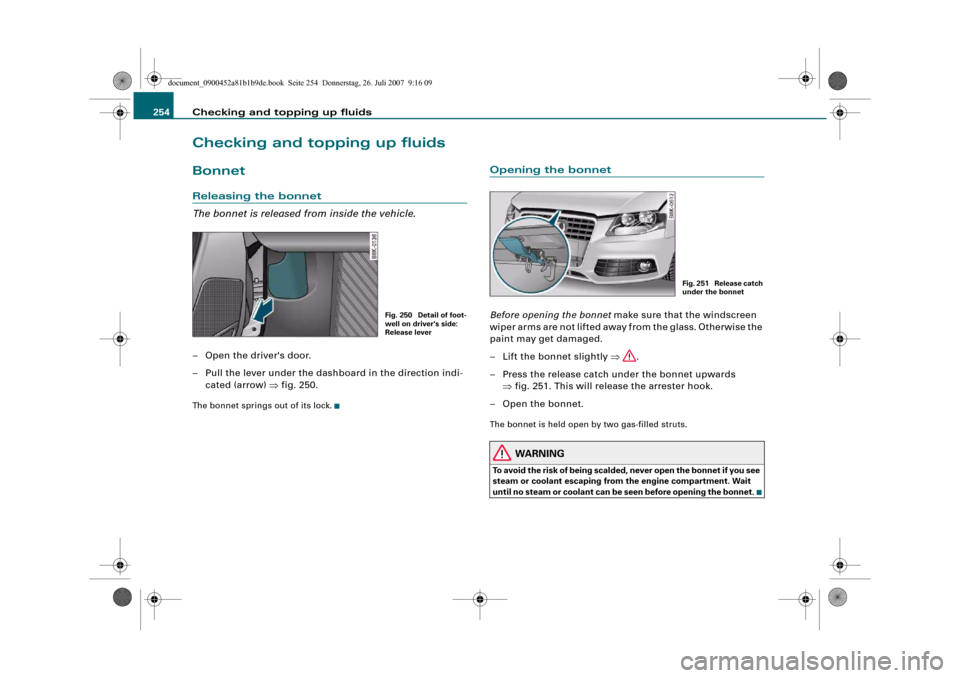
The bonnet is released from inside the vehicle.– Open the driver's door.
– Pull the lever under the dashboard in the direction indi-
cated (arrow) ⇒fig. 250.The bonnet springs out of its lock.
Opening the bonnetBefore opening the bonnet make sure that the windscreen
wiper arms are not lifted away from the glass. Otherwise the
paint may get damaged.
– Lift the bonnet slightly ⇒.
– Press the release catch under the bonnet upwards
⇒fig. 251. This will release the arrester hook.
– Open the bonnet.The bonnet is held open by two gas-filled struts.
WARNING
To avoid the risk of being scalded, never open the bonnet if you see
steam or coolant escaping from the engine compartment. Wait
until no steam or coolant can be seen before opening the bonnet.
Fig. 250 Detail of foot-
well on driver's side:
Release lever
Fig. 251 Release catch
under the bonnet
document_0900452a81b1b9de.book Seite 254 Donnerstag, 26. Juli 2007 9:16 09
Page 263 of 342
Checking and topping up fluids261
Controls
Safety
Driving tips
General maintenance
Self-help
Technical data
•
The coolant additive G12++ can be mixed only with additives
G12+ and G12.
Checking coolant level
The coolant level can be checked at a glance.– Switch off the ignition.
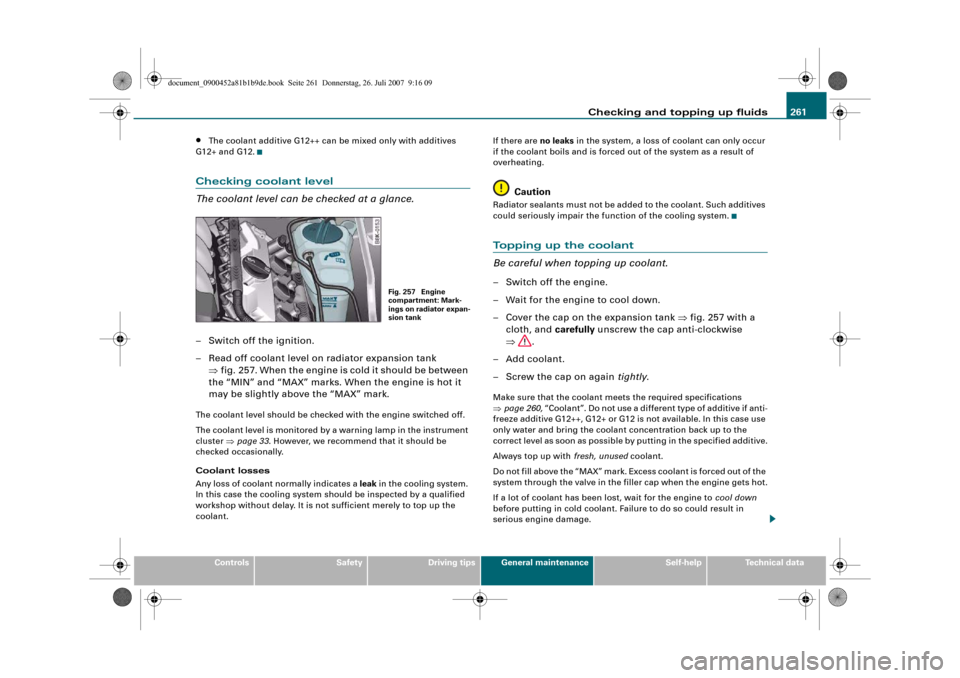
– Read off coolant level on radiator expansion tank
⇒fig. 257. When the engine is cold it should be between
the “MIN” and “MAX” marks. When the engine is hot it
may be slightly above the “MAX” mark.The coolant level should be checked with the engine switched off.
The coolant level is monitored by a warning lamp in the instrument
cluster ⇒page 33. However, we recommend that it should be
checked occasionally.
Coolant losses
Any loss of coolant normally indicates a leak in the cooling system.
In this case the cooling system should be inspected by a qualified
workshop without delay. It is not sufficient merely to top up the
coolant.If there are no leaks in the system, a loss of coolant can only occur
if the coolant boils and is forced out of the system as a result of
overheating.
Caution
Radiator sealants must not be added to the coolant. Such additives
could seriously impair the function of the cooling system.Topping up the coolant
Be careful when topping up coolant.– Switch off the engine.
– Wait for the engine to cool down.
– Cover the cap on the expansion tank ⇒fig. 257 with a
cloth, and carefully unscrew the cap anti-clockwise
⇒.
– Add coolant.
– Screw the cap on again tightly.Make sure that the coolant meets the required specifications
⇒page 260, “Coolant”. Do not use a different type of additive if anti-
freeze additive G12++, G12+ or G12 is not available. In this case use
only water and bring the coolant concentration back up to the
correct level as soon as possible by putting in the specified additive.
Always top up with fresh, unused coolant.
Do not fill above the “MAX” mark. Excess coolant is forced out of the
system through the valve in the filler cap when the engine gets hot.
If a lot of coolant has been lost, wait for the engine to cool down
before putting in cold coolant. Failure to do so could result in
serious engine damage.
Fig. 257 Engine
compartment: Mark-
ings on radiator expan-
sion tank
document_0900452a81b1b9de.book Seite 261 Donnerstag, 26. Juli 2007 9:16 09
Page 264 of 342
Checking and topping up fluids 262
WARNING
•
The cooling system is under pressure. Do not unscrew the cap
on the expansion tank when the engine is hot: you could be
scalded by escaping steam
•
The coolant and coolant additive can be a health hazard. Store
the coolant additive in the original container in a safe place out of
reach of children – risk of poisoning.For the sake of the environment
Drained off coolant should not be used again. Drain off the used
coolant into a suitable container and dispose of it in the proper
manner (observe environmental regulations).Radiator fan
The radiator fan can start running spontaneously.The radiator fan is driven by the engine via a poly V-belt. The speed
of the fan is varied by a viscous clutch according to the temperature.
There is also an auxiliary electric fan, which cuts in automatically
whenever the temperature of the coolant and the engine compart-
ment rises above a certain level.
The auxiliary fan can continue to run for as long as 10 minutes after
stopping the engine – even after the ignition is switched off. It may
also start running suddenly ⇒ after a while if•
residual heat raises the coolant temperature, or
•
the hot engine compartment is additionally heated up by the
sun.
WARNING
When working in the engine compartment be aware that the radi-
ator fan may start running suddenly – risk of injury.
Brake fluidChecking brake fluid level
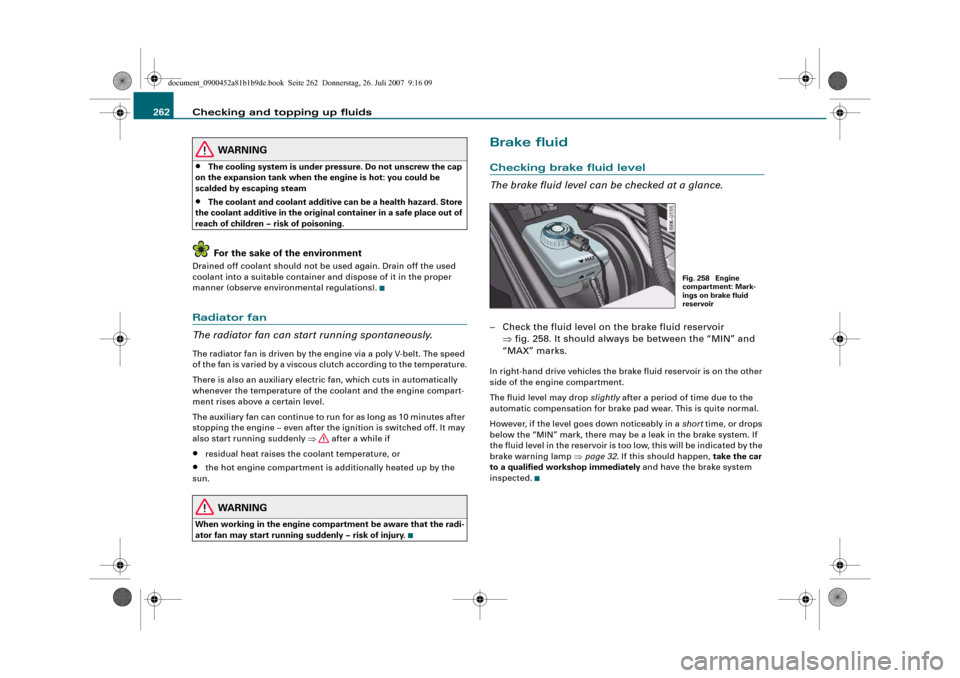
The brake fluid level can be checked at a glance.– Check the fluid level on the brake fluid reservoir
⇒fig. 258. It should always be between the “MIN” and
“MAX” marks.In right-hand drive vehicles the brake fluid reservoir is on the other
side of the engine compartment.
The fluid level may drop slightly after a period of time due to the
automatic compensation for brake pad wear. This is quite normal.
However, if the level goes down noticeably in a short time, or drops
below the “MIN” mark, there may be a leak in the brake system. If
the fluid level in the reservoir is too low, this will be indicated by the
brake warning lamp ⇒page 32. If this should happen, take the car
to a qualified workshop immediately and have the brake system
inspected.
Fig. 258 Engine
compartment: Mark-
ings on brake fluid
reservoir
document_0900452a81b1b9de.book Seite 262 Donnerstag, 26. Juli 2007 9:16 09