Page 48 of 79
Brake and shift pedal
lubricationLubricate the pivoting parts.
Recommended lubricant:
20W40 Type SG
Brake and Clutch Lever
GreasingGrease the pivoting parts.
MULTIPURPOSE Recommended Grease :
Center and sidestand
lubricationLubricate the pivoting and mating
joints.
Check to see that the center and
sidestand move up and down
smoothly.
Recommended lubricant:
If the center and/or sidestand does
not move smoothly, consult
aYAMAHA dealer.20W40 Type SG
PERIODIC MAINTENANCE AND MINOR REPAIR
6-22
WARNING
Page 49 of 79
CAUTION :
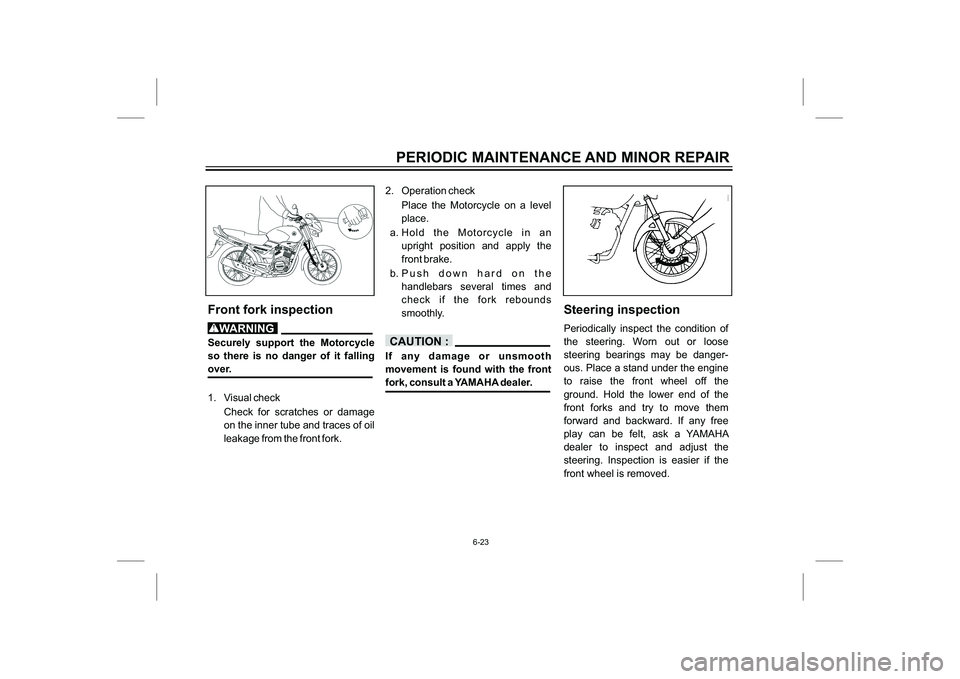
Front fork inspectionSecurely support the Motorcycle
so there is no danger of it falling
over.
1. Visual check
Check for scratches or damage
on the inner tube and traces of oil
leakage from the front fork.2. Operation check
Place the Motorcycle on a level
place.
a. Hold the Motorcycle in an
upright position and apply the
front brake.
b. Push down hard on the
handlebars several times and
check if the fork rebounds
smoothly.
If any damage or unsmooth
movement is found with the front
fork, consult a YAMAHA dealer.
Steering inspectionPeriodically inspect the condition of
the steering. Worn out or loose
steering bearings may be danger-
ous. Place a stand under the engine
to raise the front wheel off the
ground. Hold the lower end of the
front forks and try to move them
forward and backward. If any free
play can be felt, ask a YAMAHA
dealer to inspect and adjust the
steering. Inspection is easier if the
front wheel is removed.
PERIODIC MAINTENANCE AND MINOR REPAIR
6-23
WARNING
Page 50 of 79
Securely support the Motorcycle
so there is no danger of it falling
over.
Wheel bearingsIf there is play in the front or rear
wheel hub or if the wheel does not
turn smoothly, have a YAMAHA
dealer inspect the wheel bearings.
1. Maximum level mark
2. Minimum level markBattery1. Battery is located inside the
L.H. side panel (for removal &
installation of L.H. side panel
please refer page 6-5)
2. Open the lid.
3. Check the level of the battery
electrolyte and make sure that
the terminals are tight.
Top up with distilled water if the
electrolyte level is low.
PERIODIC MAINTENANCE AND MINOR REPAIR
6-24
WARNING
Page 51 of 79

When inspecting the battery, be
sure the breather hose is routed
correctly. If the breather hose is
positioned in such a way as to
cause battery electrolyte or gas to
exit onto the frame, structural and
cosmetic damage to the
Motorcycle can occur.
Battery electrolyte is poisonous
and dangerous, causing severe
burns, etc. It contains sulfuric
acid. Avoid contact with skin, eyes
or clothing.Antidote:
EXTERNAL: Flush with water.
INTERNAL: Drink large quantities
of water or milk. Follow with milk of
magnesia, beaten egg, or
vegetable oil. Call a physician
immediately. EYES: Flush with
water for 15 minutes and get
prompt medical attention.
Batteries produce explosive
gases. Keep sparks, flame,
cigarettes etc., away. Ventilate
when charging or using in an
enclosed space. Always shield
your eyes when working near
batteries. KEEP OUT OF REACH
OF CHILDREN.Replenishing the battery fluid
Normal tap water contains
minerals which are harmful to a
battery; therefore, refill only with
distilled water.
Take care not to spill battery fluid
on the chain. Battery fluid may
weaken the chain causing shorter
chain life and possibly result in an
accident A poorly maintained battery will
corrode and discharge quickly. The
battery fluid should be checked at
least once a month. The level should
be between the minimum level and
maximum level marks. Use only
distilled water if refilling is necessary.
PERIODIC MAINTENANCE AND MINOR REPAIR
6-25
ENSURE THAT BATTERY ELECTROLYTE LEVEL IS MAINTAINED BETWEEN
MAX . AND MIN. MARKS. IF REQUIRED, ADD DISTILLED WATER ONLY
CAUTION :
CAUTION :WARNING
Page 53 of 79
1. Screw (2 Nos.)
2. Bolt (1Headlight bulb replacementIf the headlight bulb burns out,
replace the bulb as follows:
1. Remove the two screws from the
Head Light.
2. Loosen bolt.
3. Remove head light bezel assy.
Forward.
No.)1. Bulb holder
3. Remove headlight bulb holder
from bezel
1. Bulb (Halogen)Keep flammable products and
your hands away from the bulb
while it is on, as it is hot. Do not
touch the bulb until it cools down.
4. Remove the defective bulb.
5. Put a new bulb into position and
secure it in place with the bulb
holder.
6. Install the Head Light Assy.
7. If the headlight beam adjustment
is necessary, ask a YAMAHA
dealer to make adjustment.
PERIODIC MAINTENANCE AND MINOR REPAIR
6-27
WARNING
1
Page 54 of 79
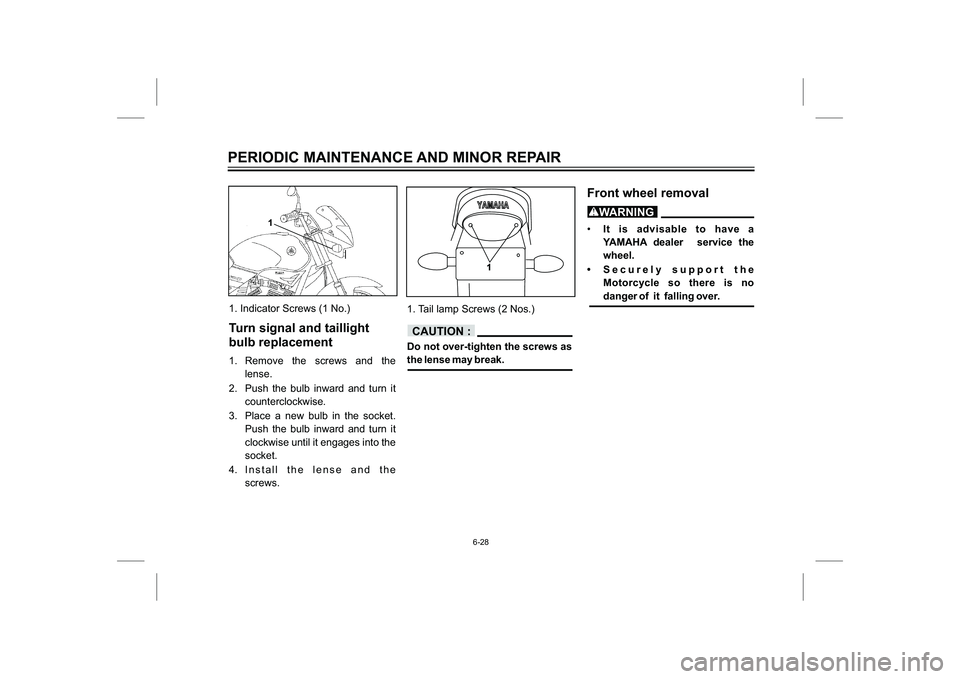
1. Indicator Screws (1 No.)Turn signal and taillight
bulb replacement1. Remove the screws and the
lense.
2. Push the bulb inward and turn it
counterclockwise.
3. Place a new bulb in the socket.
Push the bulb inward and turn it
clockwise until it engages into the
socket.
4. Install the lense and the
screws.1. Tail lamp Screws (2 Nos.)
Do not over-tighten the screws as
the lense may break.
Front wheel removalIt is advisable to have a
YAMAHA dealer service the
wheel.
Securely support the
Motorcycle so there is no
danger of it falling over.
PERIODIC MAINTENANCE AND MINOR REPAIR
6-28
WARNING
CAUTION :
Page 56 of 79
1. StopperFront wheel installationWhen installing the front wheel,
reverse the removal procedure.
Pay attention to the following points:
1. Make sure the slot in the brake
shoe plate fits over the stopper on
the front fork outer tube.
2. Make sure the axle nut is properly
torqued and a new cotter pin is
installed.Always use a new cotter pin.
Axle nut torque:
33 ft-lb (4.55 m-kg)
3. Adjust the free play in the brake
lever.PERIODIC MAINTENANCE AND MINOR REPAIR
6-30
WARNING
Rear wheel removalIt is advisable to service the
wheel by a YAMAHA dealer.
Securely support the
Motorcycle so there is no
danger of it falling over.
WARNING
Page 58 of 79

Rear wheel installation1. Install the rear wheel and the
axle.
2. Install the axle nut.
3. Insert the brake rod into the
brake cam lever and install the
brake free play adjusting nut.
4. Install the tension bar onto the
brake shoe plate and tighten the
tension bar nut to the specified
tightening torque.
5. Take the Motorcycle off the
centerstand.
6. Tighten the axle nut to the
specified tightening torque.
Then install a new cotter pin.
Specified torque:
Tension bar nut:
14 ft-lb (1.9 m kg)
Axle nut:
65 ft-lb (9.05 m kg)Always use a new cotter pin.
Check the operation of the brake
light after adjusting the rear brake. 7. Adjust the rear brake pedal free
play. (See page 6-17.)
TroubleshootingAlthough YAMAHA Motorcycles
receive a rigid inspection before
shipment from the factory, trouble
may occur during operation. Any
problem in the fuel, compression, or
ignition systems can cause poor
starting and loss of power. The
troubleshooting chart describes a
quick, easy procedure for making
checks. If your Motorcycle requires
any repair, bring it to a YAMAHA
dealer. The skilled technicians at a
YAMAHA dealership have the tools,
experience, and know-how to
properly service your Motorcycle.
Use only genuine YAMAHA parts
on your Motorcycle. Imitation
parts may look like YAMAHA
parts, but they are often inferior.
Consequently, they have a shorter
service life and can lead to
expensive repair bills.
PERIODIC MAINTENANCE AND MINOR REPAIR
6-32
WARNINGWARNING