Page 129 of 156

8-45
8
EBU24961Checking the wheel bearings The front and rear wheel bearings must be
checked at the intervals specified in the periodic
maintenance and lubrication chart. If there is play
in a wheel hub or if a wheel does not turn smoothly,
have a Yamaha dealer check the wheel bearings.EBU24980Lubricating the drive shaft universal
joint The drive shaft universal joint must be lubricated at
the intervals specified in the periodic maintenance
and lubrication chart.
EBU25021Checking the stabilizer bushes The stabilizer bushes must be checked for cracks
or damage at the intervals specified in the periodic
maintenance and lubrication chart.
Have a Yamaha dealer replace the stabilizer bush-
es if necessary.EBU25040Lubricating the upper and lower arm
pivots The upper and lower arm pivots must be lubricated
at the intervals specified in the periodic mainte-
nance and lubrication chart.EBU25050Lubricating the knuckle pivots The knuckle pivots must be lubricated at the inter-
vals specified in the periodic maintenance and lu-
brication chart.
Lubricate the pivoting points using a grease gun.Recommended lubricant:
Lithium-soap-based grease
Recommended lubricant:
Lithium-soap-based grease
U2C661E0.book Page 45 Thursday, March 16, 2006 10:45 AM
Page 132 of 156
8-48
8
EBU25322Replacing a fuse The main fuse and the fuse box are located under
the seat. (See page 4-18.)
If a fuse is blown, replace it as follows.
1. Turn the key to “OFF” and turn off all electrical
circuits.
CAUTION:ECB00640To prevent accidental short-circuiting, turn off
the main switch when checking or replacing afuse.
2. Remove the blown fuse, and then install a
new fuse of the specified amperage.
1. Main fuse
2. Spare main fuse
3. Headlight fuse
4. Ignition fuse
5. Auxiliary DC jack fuse
6. Four-wheel-drive motor fuse
7. Signaling system fuse
8. Backup fuse (for odometer and clock)
9. Spare fuse
Specified fuses:
Main fuse:
30.0 A
Headlight fuse:
15.0 A
Ignition fuse:
10.0 A
Four-wheel-drive motor fuse:
3.0 A
Signaling system fuse:
10.0 A
Auxiliary DC jack fuse:
10.0 A
Backup fuse:
10.0 A
U2C661E0.book Page 48 Thursday, March 16, 2006 10:45 AM
Page 136 of 156
8-52
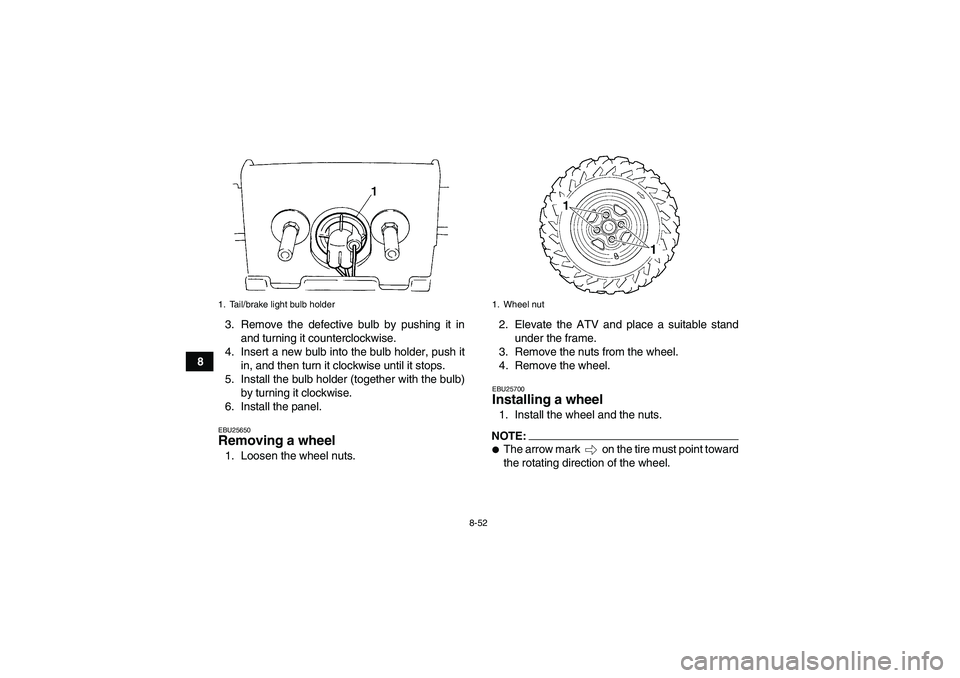
83. Remove the defective bulb by pushing it in
and turning it counterclockwise.
4. Insert a new bulb into the bulb holder, push it
in, and then turn it clockwise until it stops.
5. Install the bulb holder (together with the bulb)
by turning it clockwise.
6. Install the panel.
EBU25650Removing a wheel 1. Loosen the wheel nuts.2. Elevate the ATV and place a suitable stand
under the frame.
3. Remove the nuts from the wheel.
4. Remove the wheel.
EBU25700Installing a wheel 1. Install the wheel and the nuts.NOTE:�The arrow mark on the tire must point toward
the rotating direction of the wheel.
1. Tail/brake light bulb holder
1. Wheel nut
U2C661E0.book Page 52 Thursday, March 16, 2006 10:45 AM
Page 137 of 156
8-53
8
�Tapered nuts are used for both the front and rear
wheels. Install the nuts with their tapered side to-wards the wheel.
2. Lower the ATV to the ground.
3. Tighten the wheel nuts to the specified
torques.1. Arrow mark
1. Tapered nutTightening torques:
Front wheel nut:
55 Nm (5.5 m·kgf, 40 ft·lbf)
Rear wheel nut:
55 Nm (5.5 m·kgf, 40 ft·lbf)
U2C661E0.book Page 53 Thursday, March 16, 2006 10:45 AM
Page 141 of 156

9-1
9
EBU25860
CLEANING AND STORAGE
EBU25880Cleaning Frequent, thorough cleaning of your ATV will not
only enhance its appearance but will improve its
general performance and extend the useful life of
many components.
1. Before cleaning the ATV:
a. Block off the end of the exhaust pipe to
prevent water entry. A plastic bag and
strong rubber band may be used.
b. Make sure the spark plug and all filler caps
are properly installed.
2. If the engine case is excessively greasy, apply
degreaser with a paint brush. Do not apply de-
greaser to the wheel axles.
3. Rinse the dirt and degreaser off with a garden
hose. Use only enough pressure to do the job.CAUTION:ECB00710Excessive water pressure may cause water
seepage and deterioration of wheel bearings,
brakes, transmission seals and electrical de-
vices. Many expensive repair bills have result-ed from improper high-pressure detergent
applications such as those available in coin-
operated car washers.
4. Once most of the dirt has been hosed off,
wash all surfaces with warm water and mild,
detergent-type soap. An old toothbrush or bot-
tle brush is handy for hard-to-reach places.
5. Rinse the ATV off immediately with clean wa-
ter and dry all surfaces with a chamois, clean
towel or soft absorbing cloth.
6. Clean the seat with a vinyl upholstery cleaner
to keep the cover pliable and glossy.
7. Automotive type wax may be applied to all
painted and chrome plated surfaces. Avoid
combination cleaner-waxes. Many contain
abrasives which may mar the paint or protec-
tive finish. When finished cleaning, start the
engine and let it idle for several minutes.
U2C661E0.book Page 1 Thursday, March 16, 2006 10:45 AM
Page 143 of 156

9-3
9 c. Install the spark plug cap onto the spark
plug, and then place the spark plug on the
cylinder head so that the electrodes are
grounded. (This will limit sparking during
the next step.)
d. Turn the engine over several times with the
starter. (This will coat the cylinder wall with
oil.)
e. Remove the spark plug cap from the spark
plug, and then install the spark plug and
the spark plug cap.
6. Lubricate all control cables and the pivoting
points of all levers and pedals.
7. Check and, if necessary, correct the tire air
pressure, and then block up the ATV so that
all of its wheels are off the ground. Alternative-
ly, turn the wheels a little every month in order
to prevent the tires from becoming degraded
in one spot.
8. Cover the muffler outlet with a plastic bag to
prevent moisture from entering it.
9. Remove the battery and fully charge it. Store
it in a cool, dry place and charge it once a
month. Do not store the battery in an exces-
sively cold or warm place [less than 0 °C (30°F) or more than 30 °C (90 °F)]. For more in-
formation on storing the battery, see page
8-46.
NOTE:Make any necessary repairs before storing theATV.
U2C661E0.book Page 3 Thursday, March 16, 2006 10:45 AM
Page 144 of 156
10-1
10
EBU25960
SPECIFICATIONS
Dimensions:Overall length:
2085 mm (82.1 in)
Overall width:
1150 mm (45.3 in)
Overall height:
1210 mm (47.6 in)
Seat height:
880 mm (34.6 in)
Wheelbase:
1275 mm (50.2 in)
Ground clearance:
275 mm (10.8 in)
Minimum turning radius:
3200 mm (126 in)Weight:With oil and fuel:
290.0 kg (639 lb)Noise and vibration level:Noise level (77/311/EEC):
80.0 dB(A) (EUR)
Vibration on seat (EN1032, ISO5008):
Will not exceed 0.5 m/s² (EUR)
Vibration on handlebar (EN1032, ISO5008):
Will not exceed 2.8 m/s² (EUR)Engine:Engine type:
Liquid cooled 4-stroke, SOHCCylinder arrangement:
Forward-inclined single cylinder
Displacement:
660.0 cm³ (40.27 cu.in)
Bore × stroke:
100.0 × 84.0 mm (3.94 × 3.31 in)
Compression ratio:
9.10 :1
Starting system:
Electric and recoil starter
Lubrication system:
Wet sump
U2C661E0.book Page 1 Thursday, March 16, 2006 10:45 AM
Page 147 of 156
10-4
10
Rear:
33 kPa (4.8 psi) (0.33 kgf/cm²)
Front wheel:Wheel type:
Panel wheel
Rim size:
12 x 6.0ATRear wheel:Wheel type:
Panel wheel
Rim size:
12 x 7.5ATFront brake:Type:
Dual disc brake
Operation:
Right hand operation
Recommended fluid:
DOT 4Rear brake:Type:
Single disc brake
Operation:
Left hand and right foot operation
Recommended fluid:
DOT 4Front suspension:Type:
Double wishbone
Spring/shock absorber type:
Coil spring/oil damperWheel travel:
170 mm (6.7 in)
Rear suspension:Type:
Double wishbone
Spring/shock absorber type:
Coil spring/oil damper
Wheel travel:
225 mm (8.9 in)Electrical system:Ignition system:
DC. CDI
Charging system:
AC magnetoBattery:Model:
YTX20L-BS
Voltage, capacity:
12 V, 18.0 AhHeadlight:Bulb type:
Krypton bulbBulb voltage, wattage x quantity:Headlight:
12 V, 30 W/30.0 W × 2
Tail/brake light:
12 V, 5.0/21.0 W × 1
Neutral indicator light:
LED
Reverse indicator light:
LED
U2C661E0.book Page 4 Thursday, March 16, 2006 10:45 AM