2007 VOLVO S80 steering
[x] Cancel search: steeringPage 3 of 251
03 Your driving environment
Instruments and controls68
Ignition modes75
Seats77
Steering wheel82
Lighting84
Wipers and washers90
Power windows92
Mirrors94
Power moonroof96
HomeLink® Universal
Transceiver (option)98
Starting the engine
102
Transmission105
Brakes107
Parking brake110
04 Comfort and driving pleasure
Menus and messages114
Climate system118
Audio system125
Trip computer136
Compass137
Stability system139
Active chassis system-Four C141
Cruise control142
Adaptive Cruise Control-ACC144
Collision warning system (option)150
Park assist (option)153
Blind Spot Information System
(option)155
Passenger compartment
convenience158
Bluetooth hands-free (option)
162
05 During your trip
Driving recommendations170
Refueling174
Loading179
Towing a trailer182
Emergency towing185
4 Contents
06 Maintenance and specifications
Volvo maintenance 190
Maintaining your car191
Hood and engine compartment193
Engine oil194
Fluids196
Replacing bulbs198
Wiper blades and washer fluid205
Battery207
Fuses210
Wheels and tires216
Vehicle care236
Label information241
Specifications243
Volvo programs250
07 Index
Index252
5 Contents
This page left intentionally blank.
ProCarManuals.com
Page 11 of 251

The seat belt should always be worn during pregnancy. But it is crucial that it be worn in the correct way. The diagonal
section should wrap over the shoulder then be routed between the breasts and to the side of the belly. The lap section
should lay flat over the thighs and as low as possible under the belly. It must never be allowed to ride upward. Remove
all slack from the belt and ensure that it fits close to the body without any twists.
As a pregnancy progresses, pregnant drivers should adjust their seats and steering wheel such that they can easily
maintain control of the vehicle as they drive (which means they must be able to easily operate the foot pedals and
steering wheel). Within this context, they should strive to position the seat with as large a distance as possible between
their belly and the steering wheel.
Child seats
Please refer to page 32
for information on securing child seats with the seat belts.
17 01 Safety
Safety in the passenger compartment
Supplemental restraint system
Warning symbols in the instrument panel
As an enhancement to the three-point seat belts, your Volvo is equipped with a Supplemental Restraint System (SRS).
Volvo's SRS consists of seat belt tensioners, front airbags, side impact airbags, a front passenger occupant weight
sensor, and inflatable curtains. All of these systems are monitored by the SRS control module. An SRS warning light
in the instrument panel (see the illustration above) illuminates when the ignition is in modes I, II, or III, and will
normally go out after approximately 6 seconds if no faults are detected in the system.
Where applicable, a text message will also be displayed when the SRS warning light illuminates. If this warning
symbol is not functioning properly, the general warning symbol illuminates and a text message will be displayed. See
also pages 71and 72
for more information about indicator and warning symbols.
WARNING
ProCarManuals.com
Page 13 of 251

As the movement of the seats' occupants compresses the airbags, some of the gas is expelled at a controlled rate to
provide better cushioning. Both seat belt tensioners also deploy, minimizing seat belt slack. The entire process,
including inflation and deflation of the airbags, takes approximately one fifth of a second.
The location of the front airbags is indicated by "SRS AIRBAG" embossed on the steering wheel pad and above the
glove compartment, and by decals on both sun visors and on the front and far right side of the dash.
The driver's side front airbag is folded and located in the steering wheel hub.
The passenger's side front airbag is folded behind a panel located above the glove compartment.
WARNING
The airbags in the vehicle are designed to be a SUPPLEMENT to-not a replacement for-the three-point seat belts.
For maximum protection, wear seat belts at all times. Be aware that no system can prevent all possible injuries that
may occur in an accident.
Never drive a vehicle with a steering wheel-mounted airbag with your hands on the steering wheel pad/airbag
housing.
The front airbags are designed to help prevent serious injury. Deployment occurs very quickly and with
considerable force. During normal deployment and depending on variables such as seating position, one may
experience abrasions, bruises, swellings, or other injuries as a result from deployment of one or both of the airbags.
When installing any accessory equipment, make sure that the front airbag system is not damaged. Any interference
in the system could cause malfunction.
Front airbag deployment
The front airbags are designed to deploy during certain frontal or front -angular collisions, impacts, or decelerations,
depending on the crash severity, angle, speed
19 01 Safety
Safety in the passenger compartment
and object impacted. The airbags may also deploy in certain non-frontal collisions where rapid deceleration occurs.
The SRS sensors, which trigger the front airbags, are designed to react to both the impact of the collision and the
inertial forces generated by it, and to determine if the intensity of the collision is sufficient for the seat belt tensioners
and/or airbags to be deployed.
However, not all frontal collisions activate the front airbags.
ProCarManuals.com
Page 14 of 251

If the collision involves a nonrigid object (e.g., a snow drift or bush), or a rigid, fixed object at a low speed, the
front airbags will not necessarily deploy.
Front airbags do not normally deploy in a side impact collision, in a collision from the rear or in a rollover situation.
The amount of damage to the bodywork does not reliably indicate if the airbags should have deployed or not.
WARNING
Do not use child safety seats or child booster cushions/backrests in the front passenger's seat. We also recommend
that occupants under 4 feet 7 inches (140 cm) in height who have outgrown these devices sit in the rear seat with the
seat belt fastened
1.
Never drive with the airbags deployed. The fact that they hang out can impair the steering of your vehicle. Other
safety systems can also be damaged.
The smoke and dust formed when the airbags are deployed can cause skin and eye irritation in the event of
prolonged exposure.
1See also the Occupant Weight Sensor information on page 21.
Should you have questions about any component in the SRS system, please contact a trained and qualified Volvo
service technician or Volvo Customer Support:
In the USA
Volvo Cars of North America, LLC
Customer Care Center
P.O. Box 914 Rockleigh, New Jersey 07647-0914
1-800-458-1552
www.volvocars.us
In Canada
Volvo Cars of Canada Corp.
National Customer Service
175 Gordon Baker Road
North York, Ontario M2H 2N7
1-800-663-8255
www.volvocanada.com
NOTE
Deployment of front airbags occurs only one time during an accident. In a collision where deployment occurs, the
airbags and seat belt tensioners activate. Some noise occurs and a small amount of powder is released. The release of
the powder may appear as smoke-like matter. This is a normal characteristic and does not indicate fire.
Volvo's dual-threshold, dual-stage front airbags use special sensors that are integrated with the front seat belt
buckles. The point at which the airbag deploys is determined by whether or not the seat belt is being used, as well as
the severity of the collision.
Collisions can occur where only one of the airbags deploys. If the impact is less severe, but severe enough to
present a clear injury risk, the dual-stage airbags are triggered at 70% of their total capacity. If the impact is more
severe, the dual-stage airbags are triggered at full capacity.
20 01 Safety
Safety in the passenger compartment
ProCarManuals.com
Page 15 of 251

Airbag decals
WARNING
Children must never be allowed in the front passenger's seat. Volvo recommends that ALL occupants (adults and
children) shorter than 4 feet 7 inches (140 cm) be seated in the back seat of any vehicle with a passenger -side front
airbag. See page 31
for guidelines.
Occupants in the front passenger's seat must never sit on the edge of the seat, sit leaning toward the instrument
panel or otherwise sit out of position.
The occupant's back must be as upright as comfort allows and be against the seat back with the seat belt properly
fastened. Feet must be on the floor, e.g., not on the dash, seat or out of the window.
WARNING
No objects or accessory equipment, e.g. dashboard covers, may be placed on, attached to, or installed near the air
bag hatch (the area above the glove compartment) or the area affected by airbag deployment (see the illustration on
page 18
.
There should be no loose articles, e.g. coffee cups, on the floor, seat, or dashboard area.
Never try to open the airbag cover on the steering wheel or the passenger's side dashboard. This should only be
done by a trained and qualified Volvo service technician.
Failure to follow these instructions can result in injury to the vehicle occupants.
21 01 Safety
ProCarManuals.com
Page 59 of 251
2 0 0 7
VOLVO S80
66 03 Your driving environment
Instruments and controls 68
Ignition modes75
Seats77
Steering wheel82
Lighting84
Wipers and washers90
Power windows92
Mirrors94
Power moonroof96
HomeLink® Universal Transceiver (option)98
Starting the engine102
Transmission105
Brakes107
Parking brake110
67 03 Your driving environment
68 03 Your driving environment
Instruments and controls
Instrument overview
ProCarManuals.com
Page 74 of 251
1. The ignition must be in mode I or II.
2. Press the button to lower the rear head restraints for improved visibility.
NOTE
The head restraint must be returned to the upright position manually.
The outboard head restraints cannot be folded down on models that are not equipped with this button.
WARNING
For safety reasons, no one should be allowed to sit in the outboard rear seat positions if the head restraints are folded
down. If these positions are occupied, the head restraints should be in the upright (fixed) position.
82 03 Your driving environment
Steering wheel
Adjusting
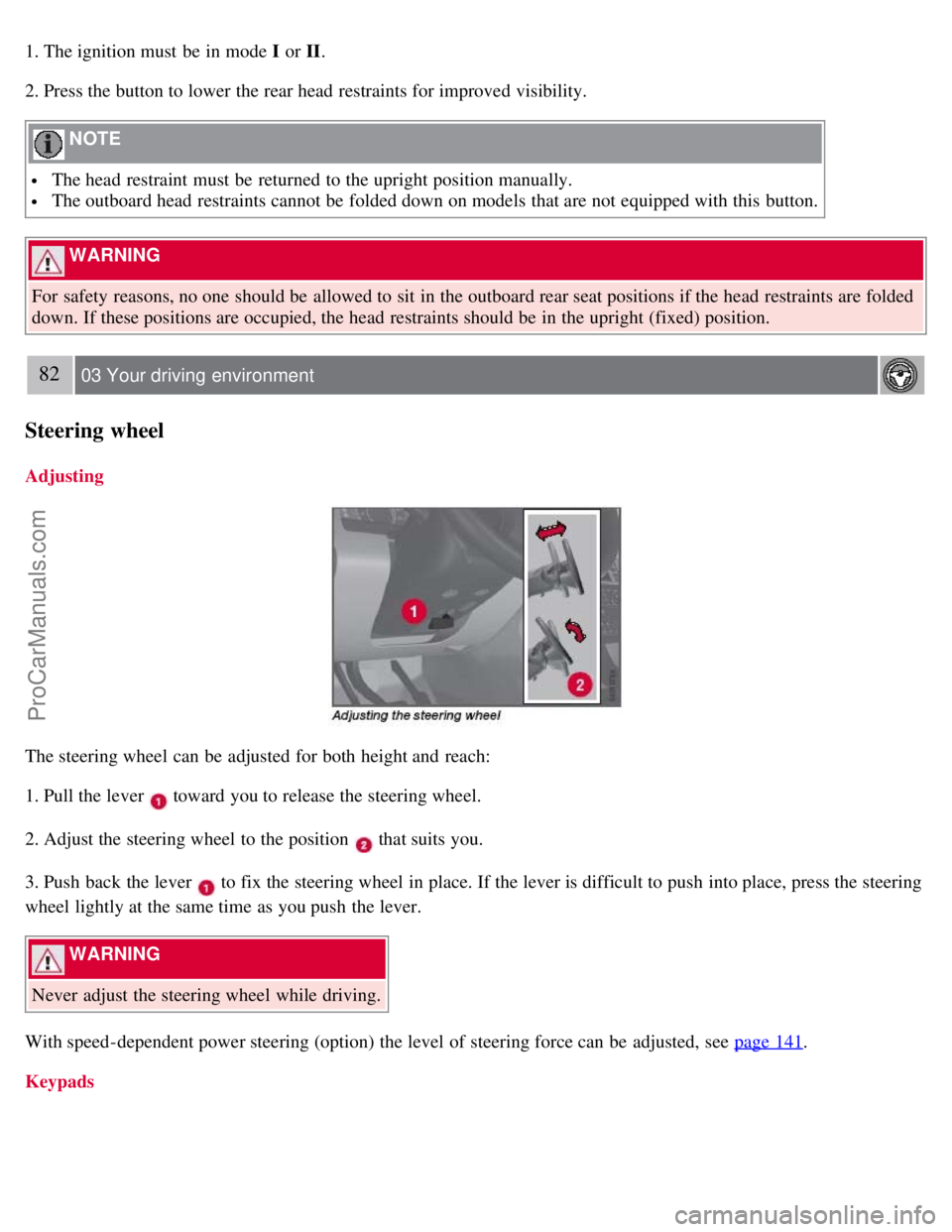
The steering wheel can be adjusted for both height and reach:
1. Pull the lever
toward you to release the steering wheel.
2. Adjust the steering wheel to the position
that suits you.
3. Push back the lever
to fix the steering wheel in place. If the lever is difficult to push into place, press the steering
wheel lightly at the same time as you push the lever.
WARNING
Never adjust the steering wheel while driving.
With speed-dependent power steering (option) the level of steering force can be adjusted, see page 141
.
Keypads
ProCarManuals.com
Page 75 of 251
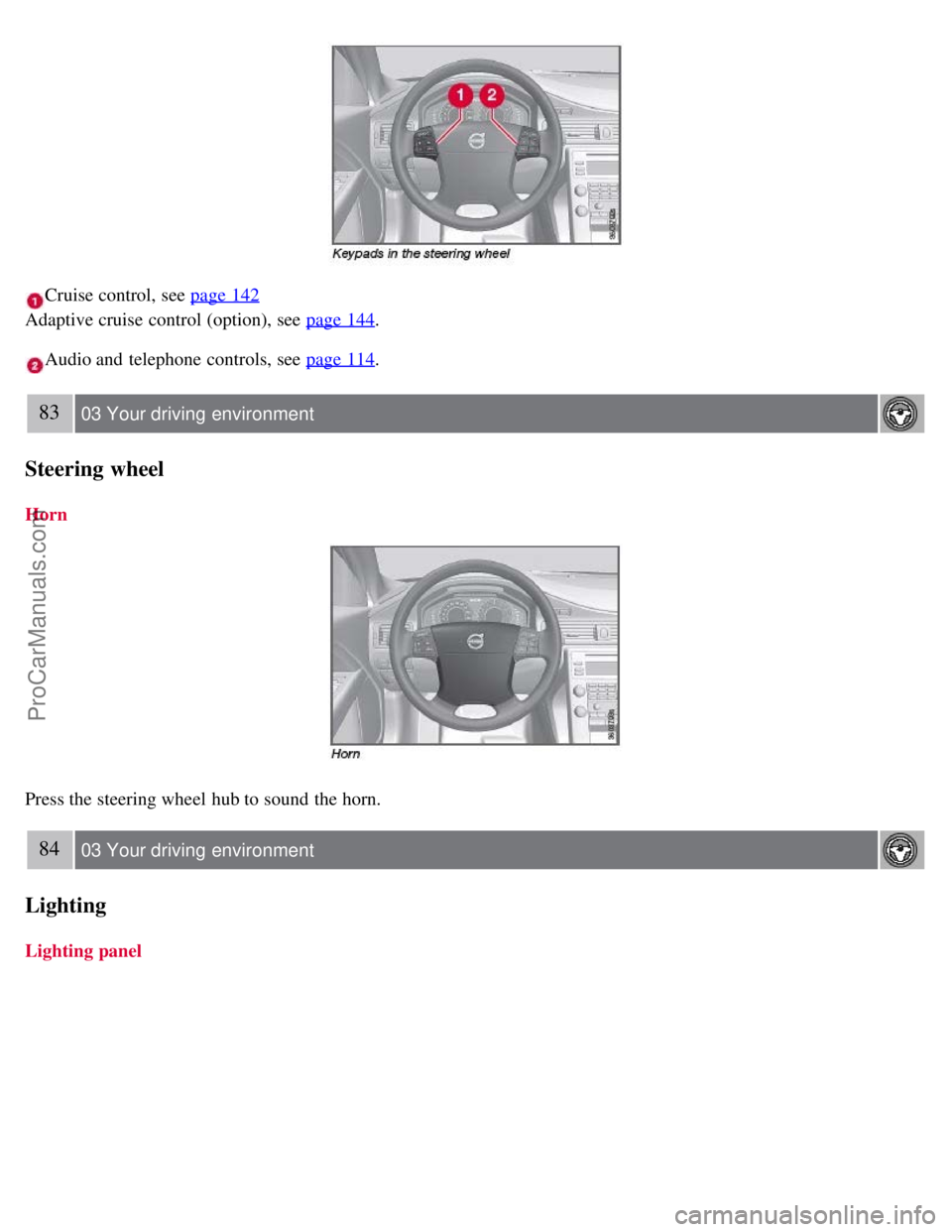
Cruise control, see page 142
Adaptive cruise control (option), see page 144
.
Audio and telephone controls, see page 114.
83 03 Your driving environment
Steering wheel
Horn
Press the steering wheel hub to sound the horn.
84 03 Your driving environment
Lighting
Lighting panel
ProCarManuals.com