Page 27 of 251
WARNING
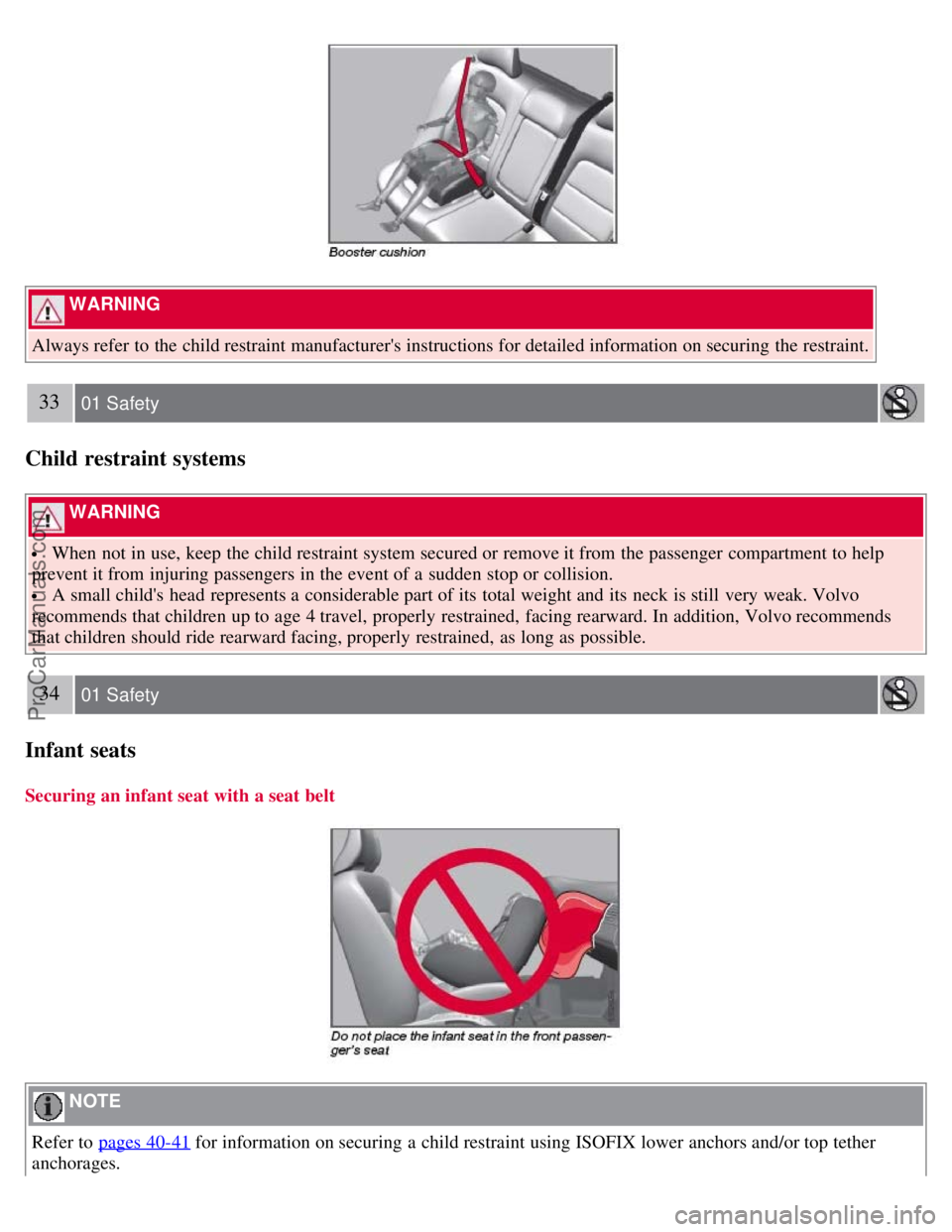
Always refer to the child restraint manufacturer's instructions for detailed information on securing the restraint.
33 01 Safety
Child restraint systems
WARNING
When not in use, keep the child restraint system secured or remove it from the passenger compartment to help
prevent it from injuring passengers in the event of a sudden stop or collision.
A small child's head represents a considerable part of its total weight and its neck is still very weak. Volvo
recommends that children up to age 4 travel, properly restrained, facing rearward. In addition, Volvo recommends
that children should ride rearward facing, properly restrained, as long as possible.
34 01 Safety
Infant seats
Securing an infant seat with a seat belt
NOTE
Refer to pages 40-41
for information on securing a child restraint using ISOFIX lower anchors and/or top tether
anchorages.
ProCarManuals.com
Page 28 of 251
1. Place the infant seat in the rear seat of the vehicle.
2. Attach the seat belt to the infant seat according to the manufacturer's instructions.
3. Fasten the seat belt by inserting the latch plate into the buckle (lock) until a distinct click is audible.
WARNING
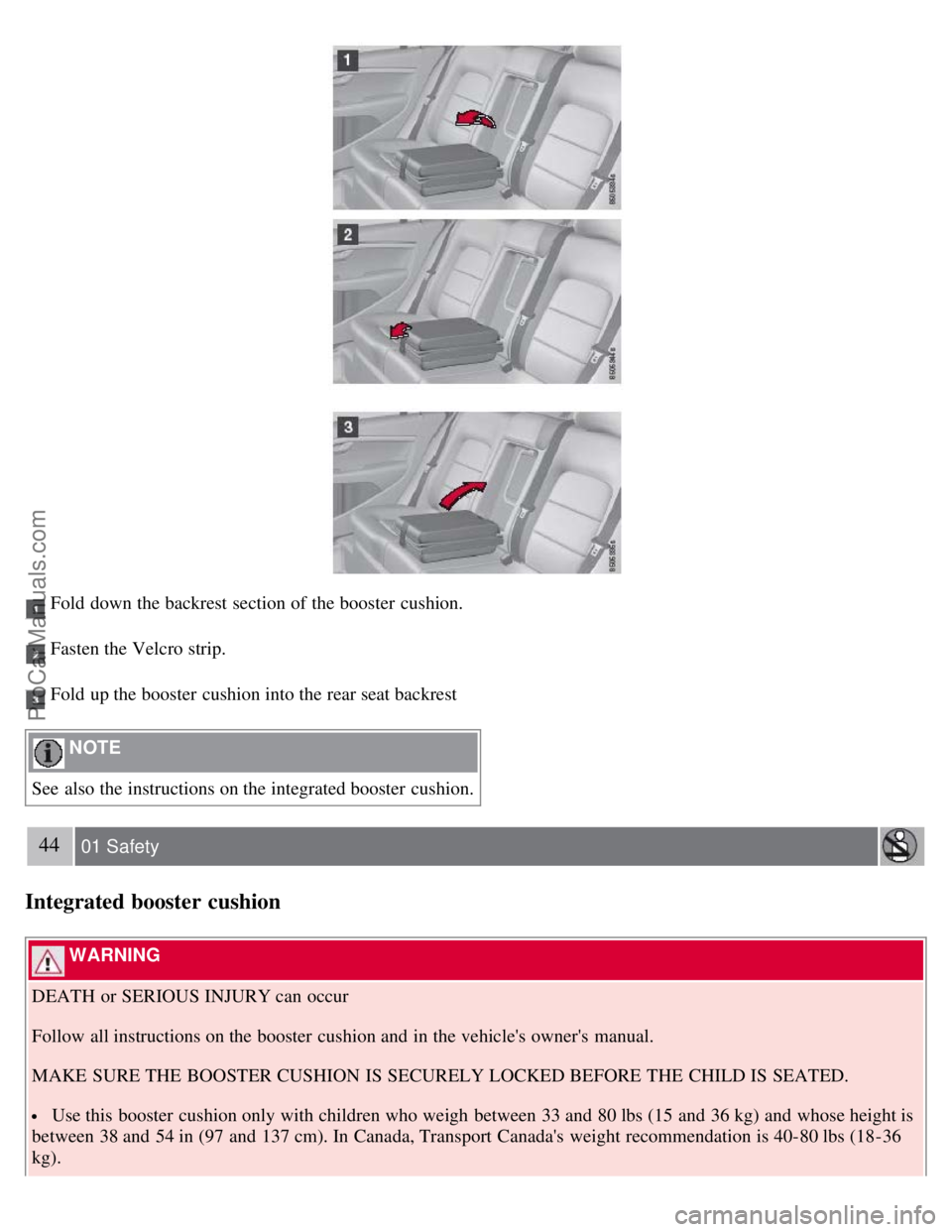
An infant seat must be in the rear-facing position only.
The infant seat should not be positioned behind the driver's seat unless there is adequate space for safe installation.
WARNING
A child seat should never be used in the front passenger seat of any vehicle with a front passenger airbag - not even
if the "Passenger airbag off" symbol near the rear-view mirror is illuminated (on vehicles equipped with Occupant
Weight Sensor). If the severity of an accident were to cause the airbag to inflate, this could lead to serious injury or
death to a child seated in this position.
35 01 Safety
Infant seats
ProCarManuals.com
Page 30 of 251
NOTE
Refer to pages 40-41
for information on securing a child restraint using ISOFIX lower anchors and/or top tether
anchorages.
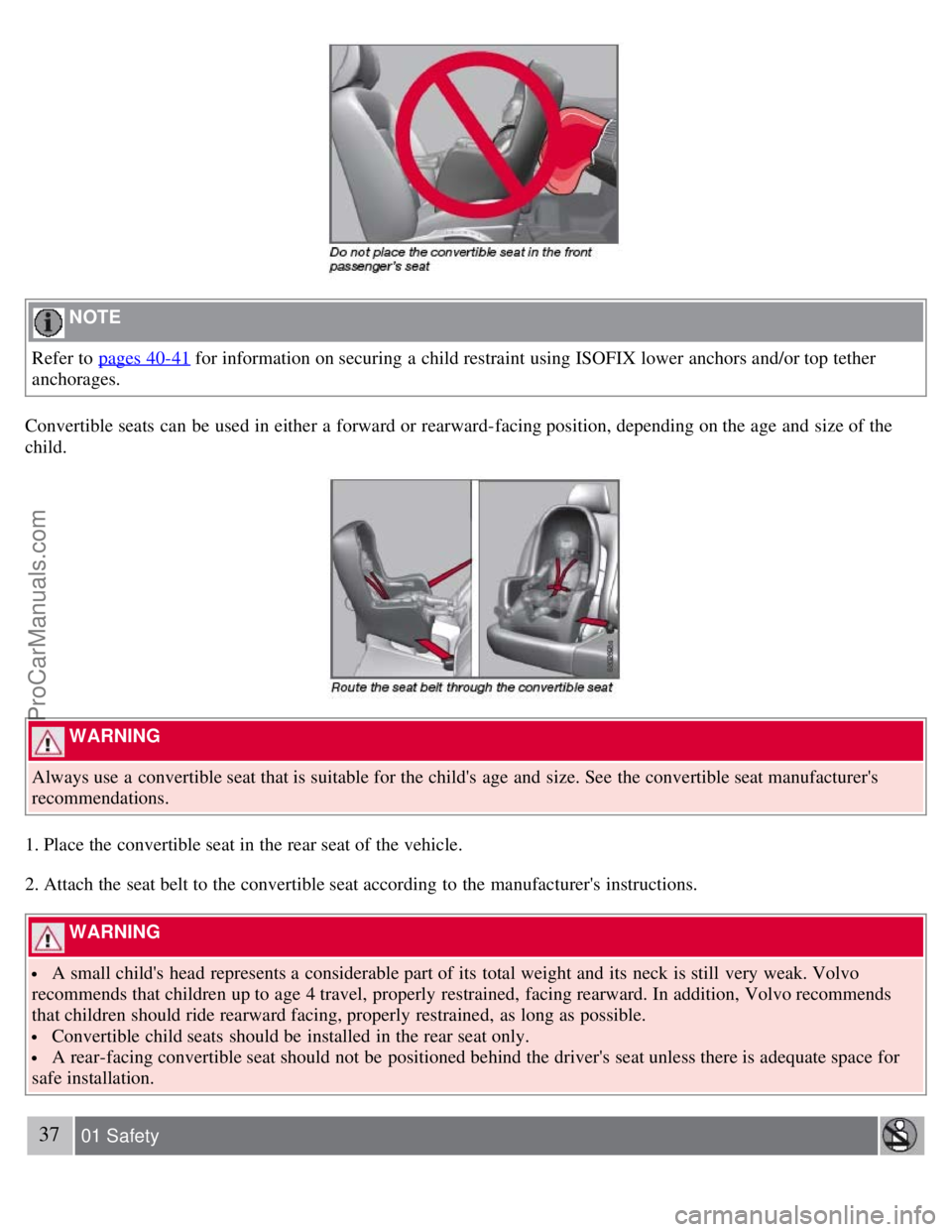
Convertible seats can be used in either a forward or rearward-facing position, depending on the age and size of the
child.
WARNING
Always use a convertible seat that is suitable for the child's age and size. See the convertible seat manufacturer's
recommendations.
1. Place the convertible seat in the rear seat of the vehicle.
2. Attach the seat belt to the convertible seat according to the manufacturer's instructions.
WARNING
A small child's head represents a considerable part of its total weight and its neck is still very weak. Volvo
recommends that children up to age 4 travel, properly restrained, facing rearward. In addition, Volvo recommends
that children should ride rearward facing, properly restrained, as long as possible.
Convertible child seats should be installed in the rear seat only.
A rear-facing convertible seat should not be positioned behind the driver's seat unless there is adequate space for
safe installation.
37 01 Safety
ProCarManuals.com
Page 32 of 251
WARNING
A child seat should never be used in the front passenger seat of any vehicle with a front passenger airbag - not even
if the "Passenger airbag off" symbol near the rear-view mirror is illuminated (on vehicles equipped with Occupant
Weight Sensor). If the severity of an accident were to cause the airbag to inflate, this could lead to serious injury or
death to a child seated in this position.
39 01 Safety
Booster cushions
Securing a booster cushion
1. Booster cushions are recommended for children who have outgrown convertible seats.
2. Place the booster cushion in the rear seat of the vehicle.
3. With the child properly seated on the booster cushion, attach the seat belt to or around the cushion according to the
manufacturer's instructions.
Fasten the seat belt by inserting the latch plate into the buckle (lock) until a distinct click is audible.
ProCarManuals.com
Page 36 of 251
Use this booster cushion only with children who weigh between 33 and 80 lbs (15 and 36 kg) and whose height is
between 38 and 54 in (97 and 137 cm). In Canada, Transport Canada's weight recommendation is 40-80 lbs (18-
36 kg).
The booster cushion is designed to raise the child higher, so that the shoulder strap crosses over the child's collarbone,
not over the child's neck. If using a booster cushion does not result in proper positioning of the shoulder strap, then the
child should be placed in a properly secured child restraint (see the information beginning on page 32
). The shoulder
belt must never be placed behind the child's back or under the arm.
1Canada only: This cushion may be referred to as a built- in booster cushion.
43 01 Safety
Integrated booster cushion
Using the integrated booster cushion
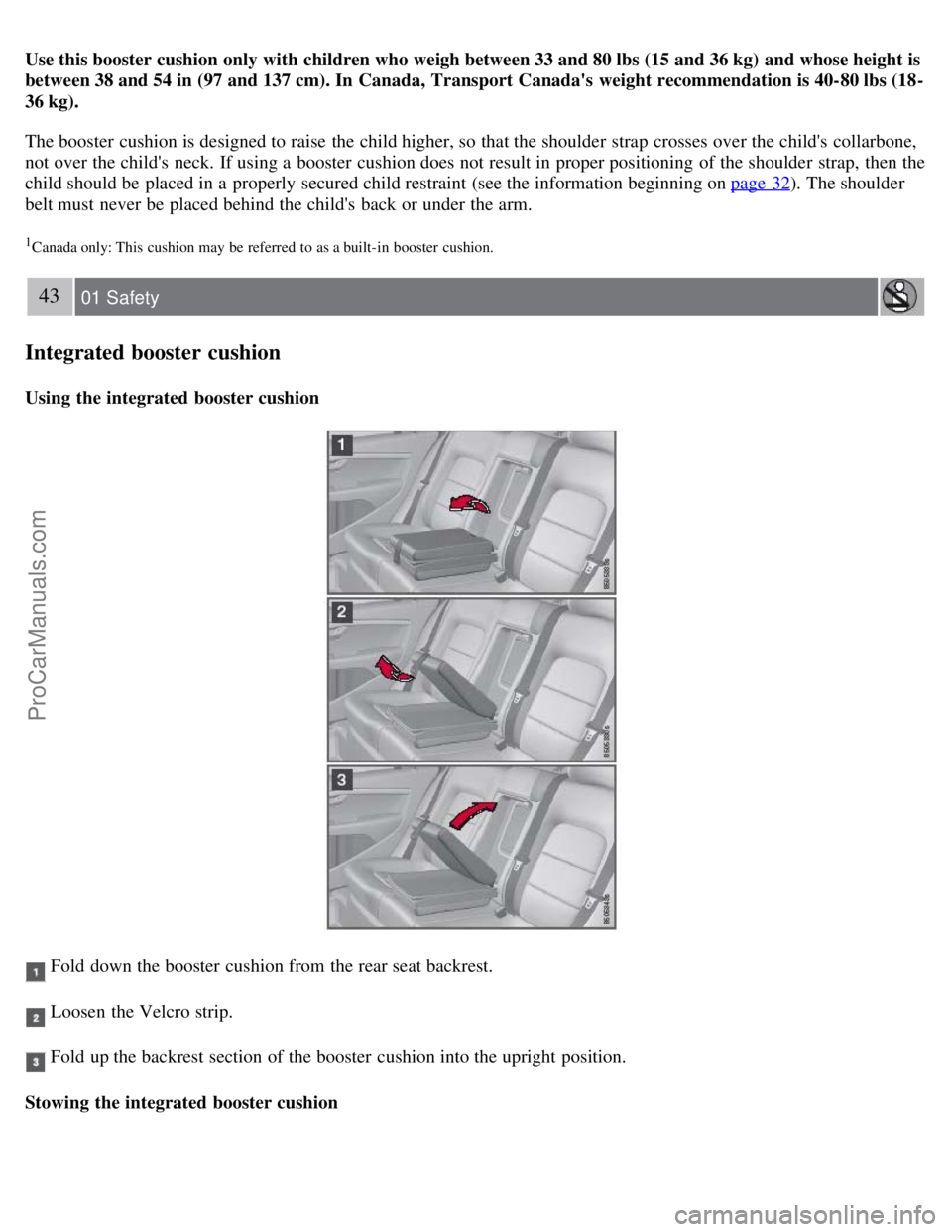
Fold down the booster cushion from the rear seat backrest.
Loosen the Velcro strip.
Fold up the backrest section of the booster cushion into the upright position.
Stowing the integrated booster cushion
ProCarManuals.com
Page 37 of 251
Fold down the backrest section of the booster cushion.
Fasten the Velcro strip.
Fold up the booster cushion into the rear seat backrest
NOTE
See also the instructions on the integrated booster cushion.
44 01 Safety
Integrated booster cushion
WARNING
DEATH or SERIOUS INJURY can occur
Follow all instructions on the booster cushion and in the vehicle's owner's manual.
MAKE SURE THE BOOSTER CUSHION IS SECURELY LOCKED BEFORE THE CHILD IS SEATED.
Use this booster cushion only with children who weigh between 33 and 80 lbs (15 and 36 kg) and whose height is
between 38 and 54 in (97 and 137 cm). In Canada, Transport Canada's weight recommendation is 40-80 lbs (18-36
kg).
ProCarManuals.com
Page 167 of 251
At highway driving speeds, fuel consumption will be lower with the air conditioning on and the windows closed
than with the air conditioning off and the windows open.
Using the onboard trip computer's fuel consumption modes can help you learn how to drive more economically.
Other factors that decrease gas mileage are:
Dirty air cleaner
Dirty engine oil and clogged oil filter
Dragging brakes
Incorrect front end alignment
Some of the above mentioned items and others are checked at the standard maintenance intervals.
WARNING
Driving with the trunk open : Driving with the trunk open could lead to poisonous exhaust gases entering the
passenger compartment. If the trunk must be kept open for any reason, proceed as follows:
Close the windows
Set the ventilation system control to air flow to floor, windshield and side windows and the blower control to its
highest setting.
Weight distribution affects handling
At the specified curb weight your vehicle has a tendency to understeer, which means that the steering wheel has to be
turned more than might seem appropriate for the curvature of a bend. This ensures good stability and reduces the risk
of rear wheel skid. Remember that these properties can alter with the vehicle load. The heavier the load in the cargo
area, the less the tendency to understeer.
Handling, roadholding
Vehicle load, tire design and inflation pressure all affect vehicle handling. Therefore, check that the tires are inflated to
the recommended pressure according to the vehicle load. See the "Tire pressure" section. Loads should be distributed
so that capacity weight
171 05 During your trip
Driving recommendations
or maximum permissible axle loads are not exceeded.
Driving through water
The vehicle can be driven through water up to a depth of approximately 9 in. (25 cm), at a maximum speed of 6 mph
(10 km/h).
Take particular care when driving through flowing water.
Clean the electrical connections for trailer wiring after driving in mud or water
When driving through water, maintain low speed and do not stop in the water.
WARNING
After driving through water, press lightly on the brake pedal to ensure that the brakes are functioning normally.
Water or mud can make the brake linings slippery, resulting in delayed braking effect.
ProCarManuals.com
Page 174 of 251

Refueling
or components, altering emission system components or location or removing components, and/or repeated use of
leaded fuel.
NOTE
Unleaded fuel is required for vehicles with three-way catalytic converters.
Heated oxygen sensors
The heated oxygen sensors monitor the oxygen content of the exhaust gases. Readings are fed into a control module
that continuously monitors engine functions and controls fuel injection. The ratio of fuel to air into the engine is
continuously adjusted for efficient combustion to help reduce harmful emissions.
179 05 During your trip
Loading
Introduction
The load carrying capacity of your vehicle is determined by factors such as the number of passengers, the amount of
cargo, the weight of any accessories that may be installed, etc.
NOTE
To increase loading space, the rear seat backrests can be folded down, see page 80
.
The trunk lid can be opened via the button located on the lighting panel, see page 60.
Load the cargo in the trunk against the backrest.
Load wide cargo in the trunk on both sides of the rear seat split.
Unstable loads can be secured to the load anchoring eyelets with straps or web lashings to help keep them from
shifting.
WARNING
The vehicle's driving characteristics may change depending on the weight and distribution of the load.
A 44-pound (20 kg) object produces a force of 2,200 pounds (1,000 kg) in a head-on collision at 30 mph (50
km/h).
Loading the cargo area
Stop the engine and apply the parking brake when loading or unloading long objects. The gear selector can be knocked
out of position by long loads, which could set the vehicle in motion. To increase loading space, the rear seat backrests
can be folded down, see page 80
.
WARNING
Stop the engine, put the gear selector in P , and apply the parking brake when loading or unloading long objects.
The rear seat should not be loaded to a level higher than 2 in. (5 cm) below the upper edge of the rear side
windows. Objects placed higher than this level could impede the function of the Volvo Inflatable Curtain.
ProCarManuals.com