2007 VOLVO S80 maintenance
[x] Cancel search: maintenancePage 1 of 251

2 0 0 7
VOLVO S80
VOLVO OWNER'S MANUAL S80
1
THANK YOU FOR CHOOSING VOLVO
Welcome to the world-wide family of Volvo owners. We trust that you will enjoy many
years of safe driving in your Volvo, an automobile designed with your safety and
comfort in mind. To help ensure your satisfaction with this vehicle, we encourage you to
familiarize yourself with the equipment descriptions, operating instructions and
maintenance requirements/recommendations in this manual. We also urge you and your
passengers to wear seat belts at all times in this (or any other) automobile. And, of
course, please do not operate a vehicle if you may be affected by alcohol, medication or
any impairment that could hinder your ability to drive.
Your Volvo is designed to meet all applicable safety and emission standards, as
evidenced by the certification labels attached to the driver's door opening and on the left
wheel housing in the engine compartment. For further information please contact your
retailer, or:
In the USA :
Volvo Cars of North America, LLC
Customer Care Center
P.O. Box 914 Rockleigh, New Jersey 07647-0914
ProCarManuals.com
Page 3 of 251
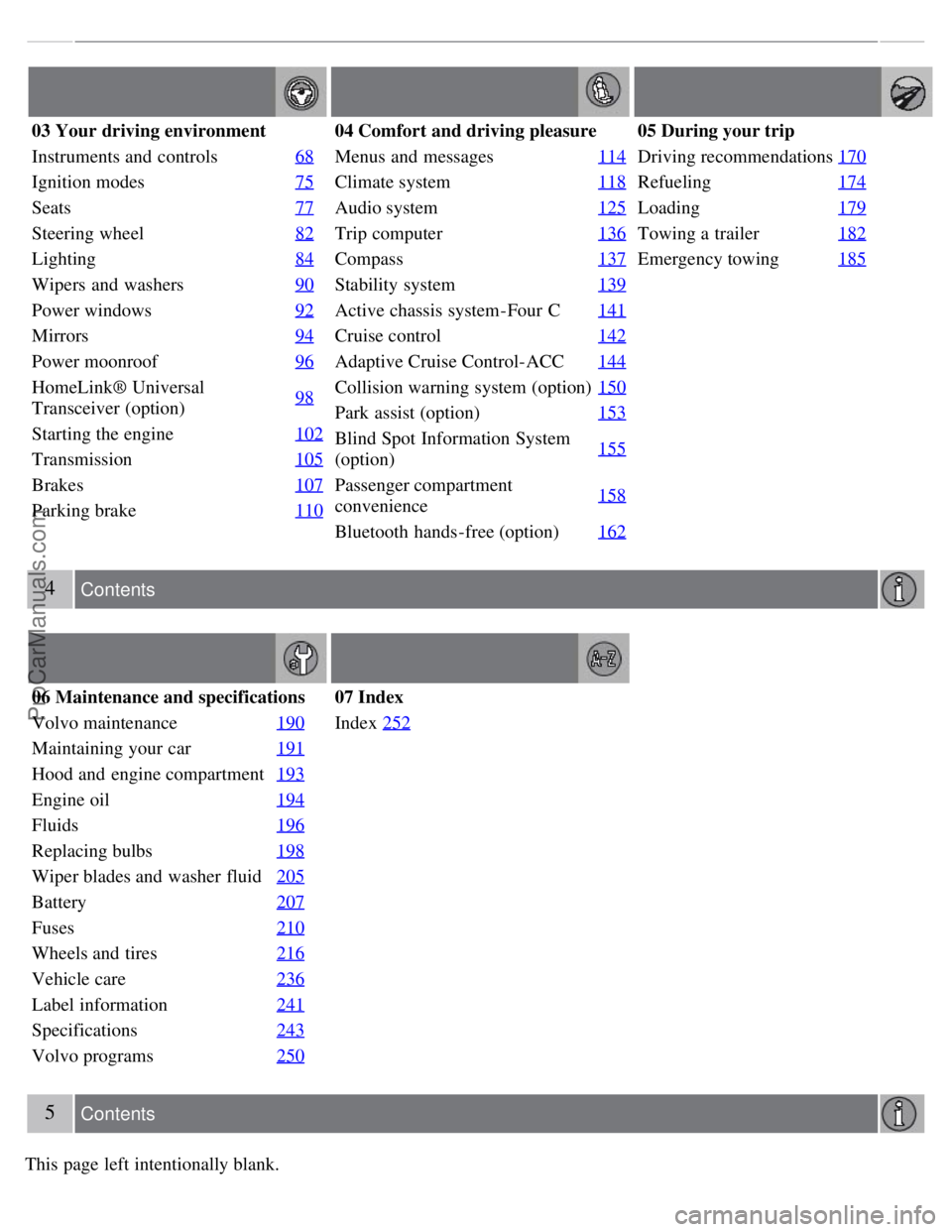
03 Your driving environment
Instruments and controls68
Ignition modes75
Seats77
Steering wheel82
Lighting84
Wipers and washers90
Power windows92
Mirrors94
Power moonroof96
HomeLink® Universal
Transceiver (option)98
Starting the engine
102
Transmission105
Brakes107
Parking brake110
04 Comfort and driving pleasure
Menus and messages114
Climate system118
Audio system125
Trip computer136
Compass137
Stability system139
Active chassis system-Four C141
Cruise control142
Adaptive Cruise Control-ACC144
Collision warning system (option)150
Park assist (option)153
Blind Spot Information System
(option)155
Passenger compartment
convenience158
Bluetooth hands-free (option)
162
05 During your trip
Driving recommendations170
Refueling174
Loading179
Towing a trailer182
Emergency towing185
4 Contents
06 Maintenance and specifications
Volvo maintenance 190
Maintaining your car191
Hood and engine compartment193
Engine oil194
Fluids196
Replacing bulbs198
Wiper blades and washer fluid205
Battery207
Fuses210
Wheels and tires216
Vehicle care236
Label information241
Specifications243
Volvo programs250
07 Index
Index252
5 Contents
This page left intentionally blank.
ProCarManuals.com
Page 6 of 251
harmful substances (CO, HC, NOx) from the exhaust pipe by approximately 95-99% and the search to eliminate the
remaining emissions continues. Volvo is the only automobile manufacturer to offer CFC-free retrofit kits for the air
conditioning system of all models as far back as the 1975 model 240. Advanced electronic engine controls and cleaner
fuels are bringing us closer to our goal. After Volvo vehicles and parts have fulfilled their use, recycling is the next
critical step in completing the life cycle. The metal content is about 75% of the total weight of a vehicle, which makes
the vehicle among the most recycled industrial products. In order to have efficient and well controlled recycling, all
Volvo variants have printed dismantling manuals, indicating the weight and material of individual components. For
Volvo, all homogeneous plastic parts weighing more than 3.4 oz. (100 grams) are marked with international symbols
that indicate how the component is to be sorted for recycling. In addition to continuous environmental refinement of
conventional gasoline-powered internal combustion engines, Volvo is actively looking at advanced technology
alternative-fuel vehicles.
When you drive a Volvo, you become our partner in the work to lessen the car's impact on the environment. To reduce
your vehicle's environmental impact, you can:
Maintain proper air pressure in your tires. Tests have shown decreased fuel economy with improperly inflated tires.
Follow the recommended maintenance schedule in your Warranty and Service Records Information booklet.
Drive at a constant speed whenever possible.
See a trained and qualified Volvo service technician as soon as possible for inspection if the check engine
(malfunction indicator) light illuminates, or stays on after the vehicle has started.
Properly dispose of any vehicle-related waste such as used motor oil, used batteries, brake pads, etc.
When cleaning your vehicle, please use genuine Volvo car care products. All Volvo car care products are
formulated to be environmentally friendly.
WARNING
PROPOSITION 65 WARNING!
Engine exhaust, some of its constituents, and certain vehicle components contain or emit chemicals known to the
state of California to cause cancer, and birth defects or other reproductive harm. In addition, certain fluids contained
in vehicles and certain products of component wear contain or emit chemicals known to the State of California to
cause cancer, and birth defects or other reproductive harm.
Contents | Top of Page
ProCarManuals.com
Page 10 of 251
Make sure that the shoulder belt is rolled up into its retractor and that the shoulder and lap belts are taut.
15 01 Safety
Safety in the passenger compartment
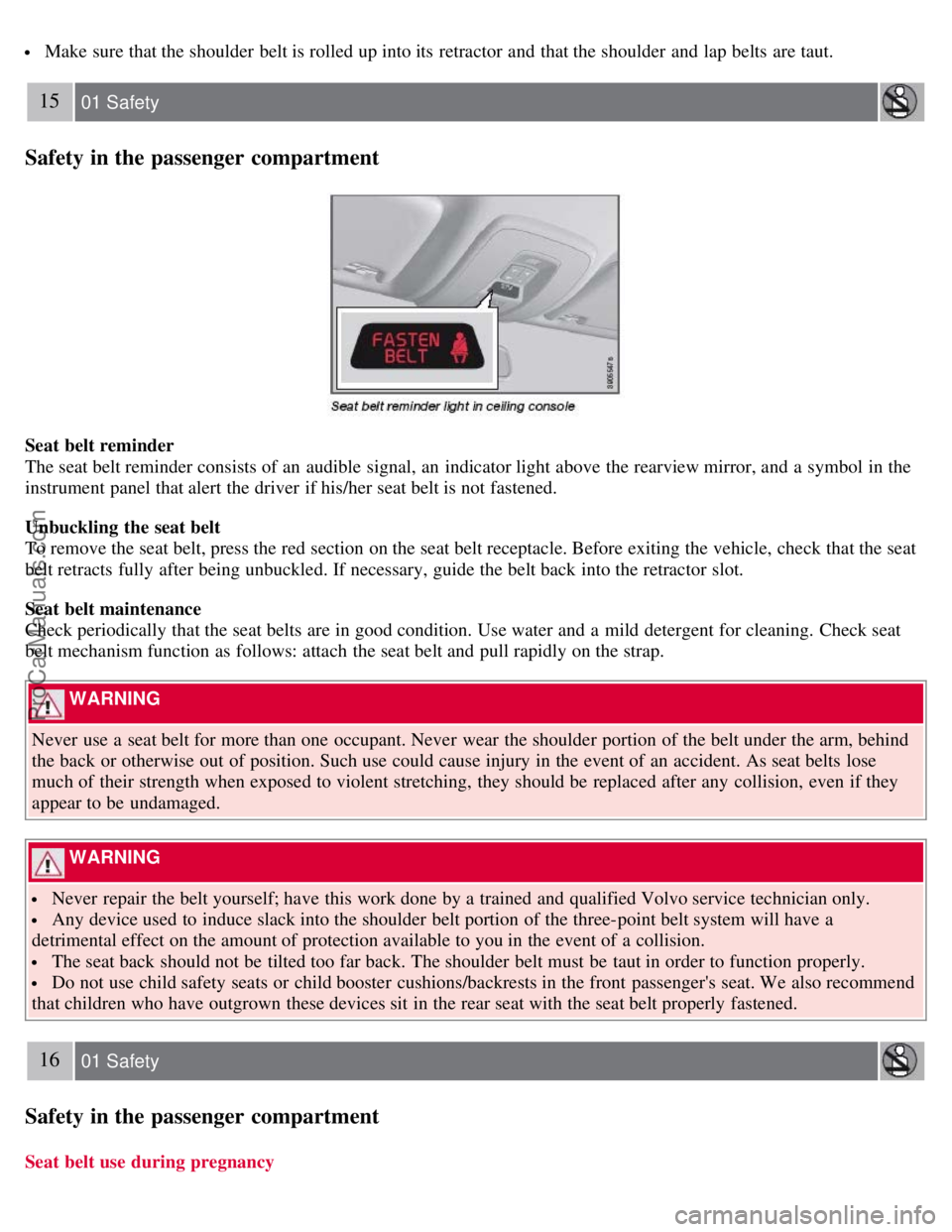
Seat belt reminder
The seat belt reminder consists of an audible signal, an indicator light above the rearview mirror, and a symbol in the
instrument panel that alert the driver if his/her seat belt is not fastened.
Unbuckling the seat belt
To remove the seat belt, press the red section on the seat belt receptacle. Before exiting the vehicle, check that the seat
belt retracts fully after being unbuckled. If necessary, guide the belt back into the retractor slot.
Seat belt maintenance
Check periodically that the seat belts are in good condition. Use water and a mild detergent for cleaning. Check seat
belt mechanism function as follows: attach the seat belt and pull rapidly on the strap.
WARNING
Never use a seat belt for more than one occupant. Never wear the shoulder portion of the belt under the arm, behind
the back or otherwise out of position. Such use could cause injury in the event of an accident. As seat belts lose
much of their strength when exposed to violent stretching, they should be replaced after any collision, even if they
appear to be undamaged.
WARNING
Never repair the belt yourself; have this work done by a trained and qualified Volvo service technician only.
Any device used to induce slack into the shoulder belt portion of the three-point belt system will have a
detrimental effect on the amount of protection available to you in the event of a collision.
The seat back should not be tilted too far back. The shoulder belt must be taut in order to function properly.
Do not use child safety seats or child booster cushions/backrests in the front passenger's seat. We also recommend
that children who have outgrown these devices sit in the rear seat with the seat belt properly fastened.
16 01 Safety
Safety in the passenger compartment
Seat belt use during pregnancy
ProCarManuals.com
Page 17 of 251
Never try to open, remove, or repair any components in the OWS system. This could result in system malfunction.
Maintenance or repairs should only be carried out by an a trained and qualified Volvo service technician.
The front passenger's seat should not be modified in any way. This could reduce pressure on the seat cushion,
which might interfere with the OWS system's function.
22 01 Safety
Safety in the passenger compartment
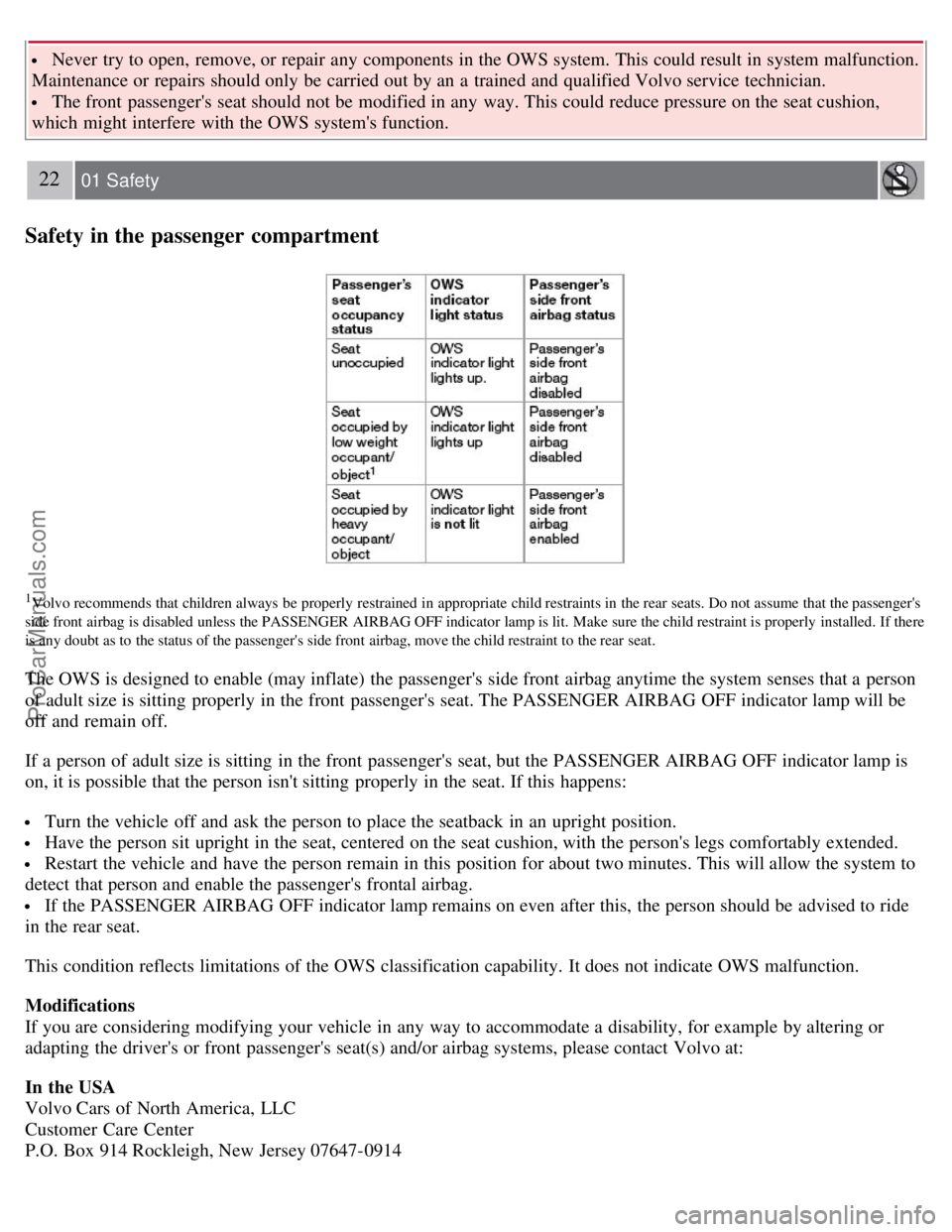
1Volvo recommends that children always be properly restrained in appropriate child restraints in the rear seats. Do not assume that the passenger's
side front airbag is disabled unless the PASSENGER AIRBAG OFF indicator lamp is lit. Make sure the child restraint is properly installed. If there
is any doubt as to the status of the passenger's side front airbag, move the child restraint to the rear seat.
The OWS is designed to enable (may inflate) the passenger's side front airbag anytime the system senses that a person
of adult size is sitting properly in the front passenger's seat. The PASSENGER AIRBAG OFF indicator lamp will be
off and remain off.
If a person of adult size is sitting in the front passenger's seat, but the PASSENGER AIRBAG OFF indicator lamp is
on, it is possible that the person isn't sitting properly in the seat. If this happens:
Turn the vehicle off and ask the person to place the seatback in an upright position.
Have the person sit upright in the seat, centered on the seat cushion, with the person's legs comfortably extended.
Restart the vehicle and have the person remain in this position for about two minutes. This will allow the system to
detect that person and enable the passenger's frontal airbag.
If the PASSENGER AIRBAG OFF indicator lamp remains on even after this, the person should be advised to ride
in the rear seat.
This condition reflects limitations of the OWS classification capability. It does not indicate OWS malfunction.
Modifications
If you are considering modifying your vehicle in any way to accommodate a disability, for example by altering or
adapting the driver's or front passenger's seat(s) and/or airbag systems, please contact Volvo at:
In the USA
Volvo Cars of North America, LLC
Customer Care Center
P.O. Box 914 Rockleigh, New Jersey 07647-0914
ProCarManuals.com
Page 113 of 251

Misting windows
Remove misting on the insides of the windows by primarily using the defroster function. To reduce the risk of misting,
clean the windows with a normal window cleaning agent.
Vents in the parcel shelf
NOTE
The air vents at the rear of the parcel shelf should never be obstructed.
Temporary shut-off of the air conditioning
The air conditioning is momentarily disengaged during full-throttle acceleration or when driving uphill with a trailer.
This may result in a temporary increase in cabin temperature.
Ice and snow
Always keep the air intake grille at the base of the windshield free of snow.
Climate system maintenance
Special tools and equipment are required to maintain and carry out repairs on the climate system. Work of this type
should only be done by a trained and qualified Volvo service technician.
Refrigerant
Volvo cares about the environment. The air conditioning system in your car contains a CFC-free refrigerant - R134a.
This substance will not deplete the ozone layer. The air conditioning system contains 1.59 lbs (720 g) of R134a. The
systems uses PAG oil.
Passenger compartment filter
Replace the cabin air filter with a new one at the recommended intervals. Please refer to your Warranty and Service
Records Information booklet, or consult a trained and qualified Volvo service technician for these intervals. The filter
should be replaced more often when driving under dirty and dusty conditions. The filter cannot be cleaned and
therefore should always be replaced with a new one.
119 04 Comfort and driving pleasure
Climate system
NOTE
There are different types of cabin air filters. Ensure that the correct type is installed.
Interior Air Quality System (IAQS)
A multifilter helps reduce gases and particles in the incoming air, thereby reducing the levels of odors and
contaminants entering the vehicle. The air quality sensor detects increased levels of contaminants in the outside air.
When the air quality sensor detects contaminated outside air, the air intake closes and the air inside the passenger
compartment is recirculated, i.e. no outside air enters the vehicle. The filter also cleans recirculated passenger
compartment air.
NOTE
Contact your Volvo retailer for IAQS air filter replacement intervals.
ProCarManuals.com
Page 141 of 251

Cruise control should not be used in heavy traffic or when driving on wet or slippery roads. Cruise control may not
maintain set speed on steep downgrades.
144 04 Comfort and driving pleasure
Adaptive Cruise Control-ACC
Introduction
Adaptive Cruise Control (ACC) is an optional system designed to assist the driver by maintaining a set speed or a set
distance to the vehicle ahead. It is primarily intended for use on long straight roads in steady traffic, such as on
highways and other main roads.
WARNING
Do not use the adaptive cruise control system in demanding driving conditions such as city traffic, winding roads,
at intersections, on slippery surfaces, in poor visibility, heavy rain, etc.
Maintenance of cruise control components must only be performed by an authorized Volvo workshop.
WARNING
Adaptive cruise control cannot cover all driving situations and traffic, weather and road conditions. The Function
section provides information about limitations that the driver must be aware of before using the adaptive cruise
control.
This system is designed to be a supplementary driving aid. It is not, however, intended to replace the driver's
attention and judgement. The driver is responsible for maintaining a safe distance and speed and must intervene if
adaptive cruise control does not maintain a suitable speed or suitable distance.
Function
Warning light, braking by driver required
Controls
Radar sensor in front grille
Adaptive cruise control consists of:
A cruise control system to maintain a set speed
A system to maintain a set distance to the vehicle ahead (expressed as a time interval. For example, you can choose
ProCarManuals.com
Page 147 of 251
150 04 Comfort and driving pleasure
Collision warning system (option)
Introduction
The Collision Warning with Brake Support, (CW) is designed to assist the driver by warning of collision risk. The
brake support helps reduce the collision speed.
WARNING
The collision warning system does not work in all driving situations and traffic, weather and road conditions.
The system does not react to slow moving or stationary vehicles, or vehicles that are not traveling in the same
direction as your vehicle.
Warnings are only provided when the risk of collision is high. The Function section provides information about
limitations that the driver must be aware of before use.
The collision warning system's brake support can only reduce the speed at which a collision occurs if the driver
applies the vehicle's brakes.
WARNING
Never wait for a collision warning. This system is designed to be a supplementary driving aid. It is not, however,
intended to replace the driver's attention and judgement. The driver is responsible for maintaining a safe distance and
speed, even when the collision warning system is in use.
Maintenance of the collision warning system components must only be performed by a trained and qualified
Volvo technician.
Function
ProCarManuals.com