Page 243 of 374

229
2. Slide the cross rails to the appropri-ate position for loading the luggages
and turn the side knobs clockwise to
tighten the cross rails securely.
There are cross rail stoppers on the roof
rails which help you prevent the cross
rails being touched with the tilted up moon
roof.
NOTICE
Do not remove the cross rail stop-
pers, or the moon roof may be dam-
aged when it is tilted.
3. In order to fix the cross rails to the appropriate length, turn the upper
knobs clockwise after tightening all
of the side knobs.
CAUTION
Make sure the cross rails are fixed
securely by pushing forward and rear-
ward them. Failure to do so may
cause an unexpected accident or se-
vere injury in the event of emergency
braking or a collision.
Follow the manufacturer ’s instructions and
precautions when installing the attach-
ments or their equivalent.
CAUTION
When you load cargo on the roof lug-
gage carrier, observe the following:
�Place the cargo so that its weight
is distributed evenly between the
front and rear axles.
�If loading long or wide cargo, never
exceed the vehicle overall length or
width. (See “Dimensions and
weights” on page 350 for informa-
tion on your vehicle overall length
and width.)
�Before driving, make sure the cargo
is securely fastened on the roof
luggage carrier.
�Loading cargo on the roof luggage
carrier will make the center of the
vehicle gravity higher. Avoid high
speeds, sudden starts, sharp turns,
sudden braking or abrupt maneu-
vers, otherwise it may result in loss
of control or vehicle rollover due to
failure to operate this vehicle cor-
rectly.
Page 302 of 374
288
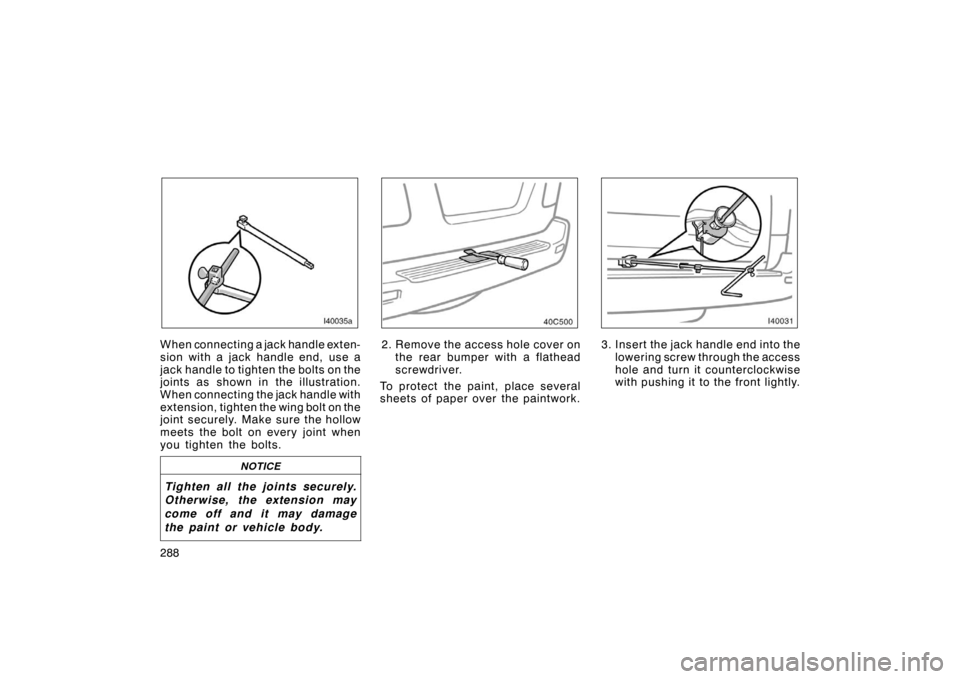
When connecting a jack handle exten-
sion with a jack handle end, use a
jack handle to tighten the bolts on the
joints as shown in the illustration.
When connecting the jack handle with
extension, tighten the wing bolt on the
joint securely. Make sure the hollow
meets the bolt on every joint when
you tighten the bolts.
NOTICE
Tighten all the joints securely.
Otherwise, the extension may
come off and it may damage
the paint or vehicle body.
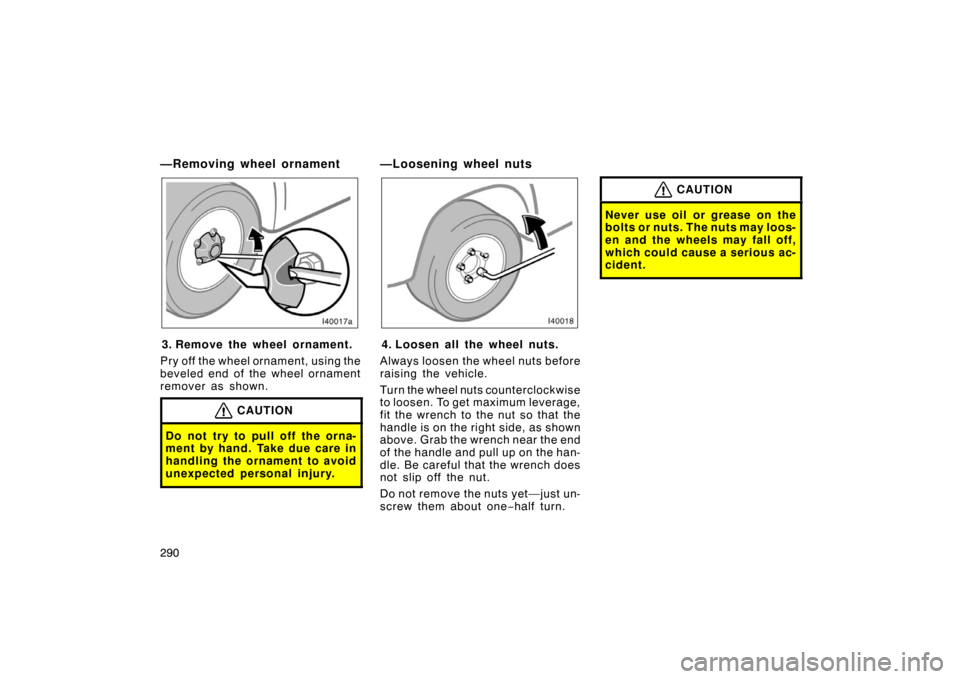
2. Remove the access hole cover on the rear bumper with a flathead
screwdriver.
To protect the paint, place several
sheets of paper over the paintwork.3. Insert the jack handle end into the lowering screw through the access
hole and turn it counterclockwise
with pushing it to the front lightly.
Page 304 of 374
290
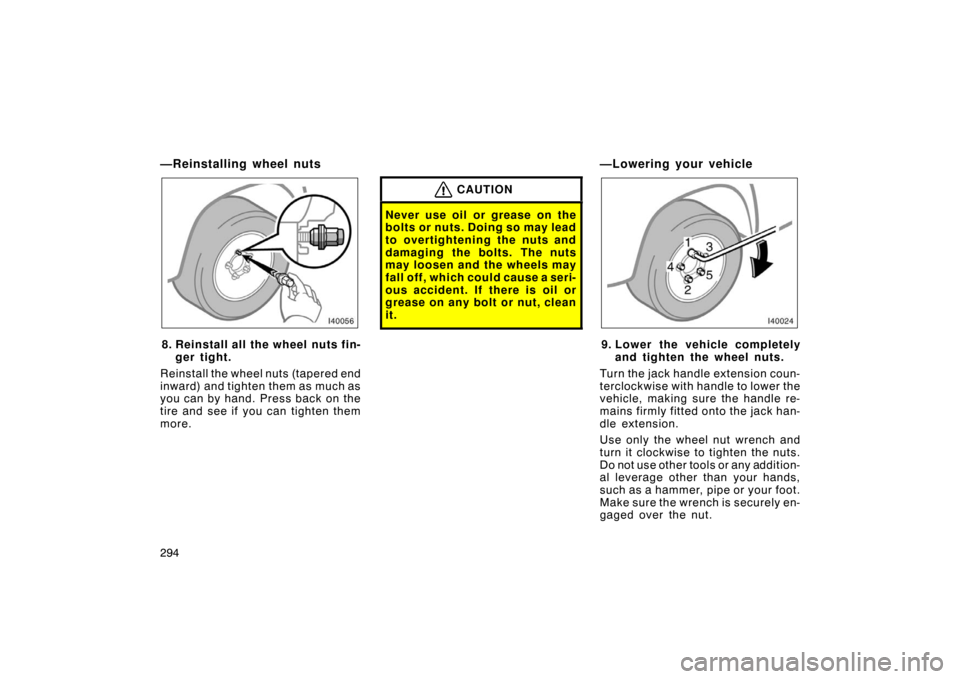
—Removing wheel ornament
3. Remove the wheel ornament.
Pry off the wheel ornament, using the
beveled end of the wheel ornament
remover as shown.
CAUTION
Do not try to pull off the orna-
ment by hand. Take due care in
handling the ornament to avoid
unexpected personal injury.
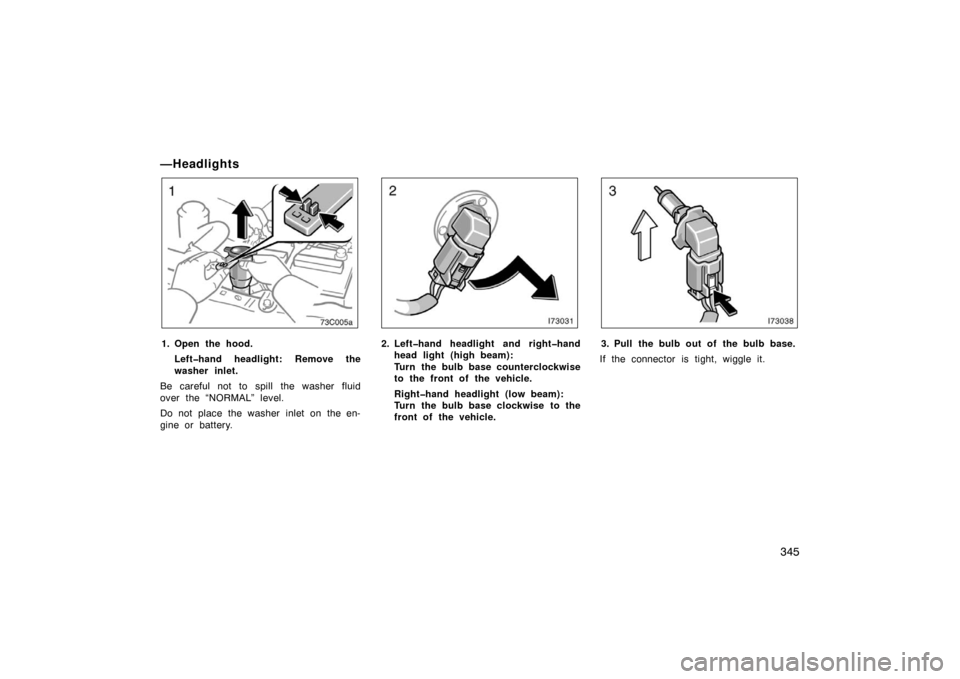
—Loosening wheel nuts
4. Loosen all the wheel nuts.
Always loosen the wheel nuts before
raising the vehicle.
Turn the wheel nuts counterclockwise
to loosen. To get maximum leverage,
fit the wrench to the nut so that the
handle is on the right side, as shown
above. Grab the wrench near the end
of the handle and pull up on the han-
dle. Be careful that the wrench does
not slip off the nut.
Do not remove the nuts yet—just un-
screw them about one −half turn.
CAUTION
Never use oil or grease on the
bolts or nuts. The nuts may loos-
en and the wheels may fall off,
which could cause a serious ac-
cident.
Page 307 of 374
293
To raise the vehicl
e, insert the jack
handle end into the joint of the jack
(it is a loose fit) and turn it clockwise
with the handle, making sure the han-
dle remains firmly fitted onto the jack
handle extension. As the jack touches
the vehicle and begins to lift, double −
check that it is properly positioned.
CAUTION
Never get under the vehicle when
the vehicle is supported by the
jack alone.
—Changing wheels
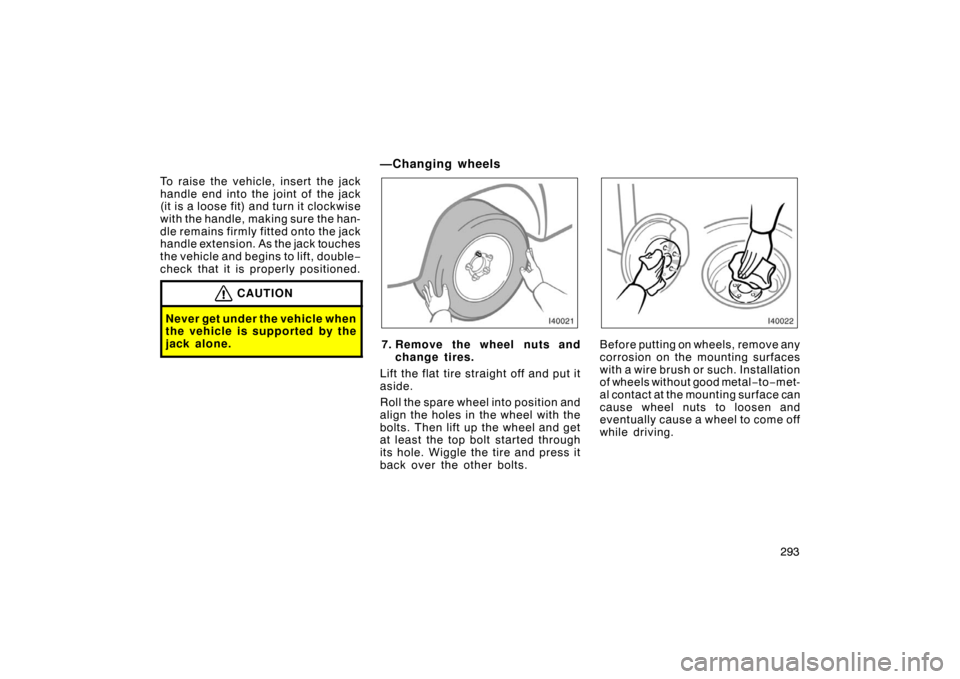
7. Remove the wheel nuts and change tires.
Lift the flat tire straight off and put it
aside.
Roll the spare wheel into position and
align the holes in the wheel with the
bolts. Then lift up the wheel and get
at least the top bolt started through
its hole. Wiggle the tire and press it
back over the other bolts.Before putting on wheels, remove any
corrosion on the mounting surfaces
with a wire brush or such. Installation
of wheels without good metal− to−met-
al contact at the mounting surface can
cause wheel nuts to loosen and
eventually cause a wheel to come off
while driving.
Page 308 of 374
294
—Reinstalling wheel nuts
8. Reinstall all the wheel nuts fin-ger tight.
Reinstall the wheel nuts (tapered end
inward) and tighten them as much as
you can by hand. Press back on the
tire and see if you can tighten them
more.
CAUTION
Never use oil or grease on the
bolts or nuts. Doing so may lead
to overtightening the nuts and
damaging the bolts. The nuts
may loosen and the wheels may
fall off, which could cause a seri-
ous accident. If there is oil or
grease on any bolt or nut, clean
it.
—Lowering your vehicle
9. Lower the vehicle completely and tighten the wheel nuts.
Turn the jack handle extension coun-
terclockwise with handle to lower the
vehicle, making sure the handle re-
mains firmly fitted onto the jack han-
dle extension.
Use only the wheel nut wrench and
turn it clockwise to tighten the nuts.
Do not use other tools or any addition-
al leverage other than your hands,
such as a hammer, pipe or your foot.
Make sure the wrench is securely en-
gaged over the nut.
Page 343 of 374
329
NOTICE
If you spill some of the fluid, be sure
to wipe it off to prevent it from dam-
aging the parts or paintwork.
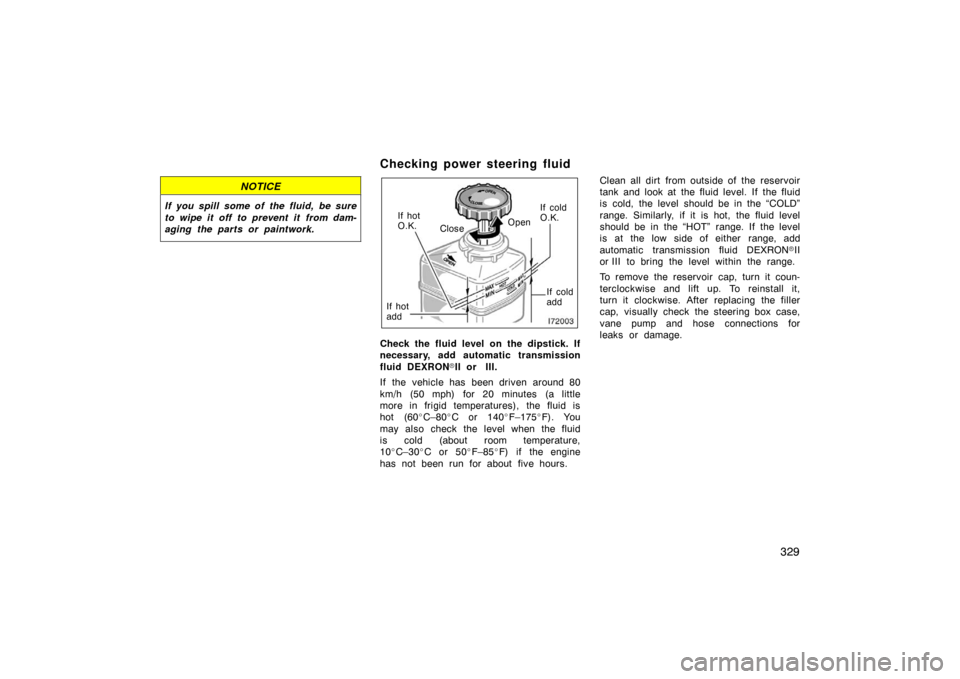
Checking power steering fluid
Open
Close If cold
O.K.
If cold
add
If hot
O.K.
If hot
add
Check the fluid level on the dipstick. If
necessary, add automatic transmission
fluid DEXRON \bII or III.
If the vehicle has been driven around 80
km/h (50 mph) for 20 minutes (a little
more in frigid temperatures), the fluid is
hot (60 �C–80 �C or 140 �F–175 �F). You
may also check the level when the fluid
is cold (about room temperature,
10 �C–30 �C or 50 �F–85 �F) if the engine
has not been run for about five hours. Clean all dirt from outside of the reservoir
tank and look at the fluid level. If the fluid
is cold, the level should be in the “COLD”
range. Similarly, if it is hot, the fluid level
should be in the “HOT” range. If the level
is at the low side of either range, add
automatic transmission fluid DEXRON
\bII
or III to bring the level within the range.
To remove the reservoir cap, turn it coun-
terclockwise and lift up. To reinstall it,
turn it clockwise. After replacing the filler
cap, visually check the steering box case,
vane pump and hose connections for
leaks or damage.
Page 359 of 374
345
—Headlights
73c005a
1. Open the hood.Lefthand headlight: Remove the
washer inlet.
Be careful not to spill the washer fluid
over the “NORMAL” level.
Do not place the washer inlet on the en-
gine or battery.2. Lefthand headlight and righthand head light (high beam):
Turn the bulb base counterclockwise
to the front of the vehicle.
Righthand headlight (low beam):
Turn the bulb base clockwise to the
front of the vehicle.3. Pull the bulb out of the bulb base.
If the connector is tight, wiggle it.
Page 360 of 374
346
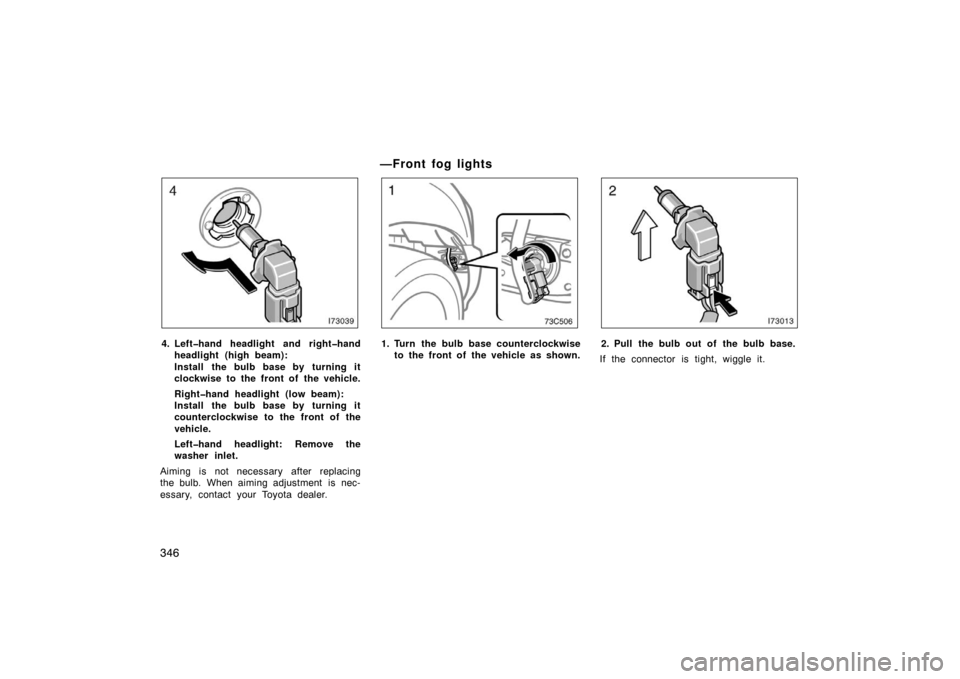
4. Lefthand headlight and righthandheadlight (high beam):
Install the bulb base by turning it
clockwise to the front of the vehicle.
Righthand headlight (low beam):
Install the bulb base by turning it
counterclockwise to the front of the
vehicle.
Lefthand headlight: Remove the
washer inlet.
Aiming is not necessary after replacing
the bulb. When aiming adjustment is nec-
essary, contact your Toyota dealer.
—Front fog lights
1. Turn the bulb base counterclockwise to the front of the vehicle as shown.2. Pull the bulb out of the bulb base.
If the connector is tight, wiggle it.