2007 SUBARU TRIBECA ESP
[x] Cancel search: ESPPage 220 of 377
Starting and operating 7-5
– CONTINUED –
State emission testing (U.S.
only)
At state inspection time, remember to
tell your inspection or service station
in advance not to place your SUBARU
AWD vehicle on a two-wheel dyna-
mometer. Otherwise, serious transmis-
sion damage will result.
Some states have started using dyna-
mometers in their state inspection pro-
grams in order to meet their obligation un-
der federal law to implement stricter vehi-
cle emission standards to reduce air pollu-
tion from vehicles. A dynamometer is a
treadmill or roller-like testing device that
allows your vehicle’s wheels to turn while
the vehicle remains in one place. Depend-
ing on the severity of a state’s air pollution
problems, the states must adopt either a
“basic” or “enhanced” vehicle emission in-
spection test. Normally, a portion of the
basic emission test consists of an emis-
sion inspector inserting an analyzer probe
into the exhaust pipe of an idling vehicle
for a short period of time. States with more
severe air pollution problems are required
to adopt an enhanced vehicle emission test. This test simulates actual driving
conditions on a dynamometer and permits
more accurate measurement of tailpipe
emitted pollution than the basic emission test.
The U.S. Environmental Protection Agen-
cy (EPA) and states using two-wheel dy-
namometers in their emission testing pro-
grams have
EXEMPTED SUBARU AWD
vehicles from the portion of the testing
program that involves a two-wheel dyna- mometer.
There are some states that use four-wheel
dynamometers in their testing programs.
When properly used, that equipment will
not damage an AWD SUBARU vehicle.
y
Make sure that the cap is tight-
ened until it clicks to prevent fuel
spillage in the event of an acci-
dent.
y Do not let fuel spill on the exterior
surfaces of the vehicle. Fuels may
cause paint damage, which is not
covered under the SUBARU Limit-
ed Warranty.
y Always use a genuine SUBARU
fuel filler cap. If you use the wrong
cap, it may not fit or have proper
venting, and your fuel tank and
emission control system might be
damaged.
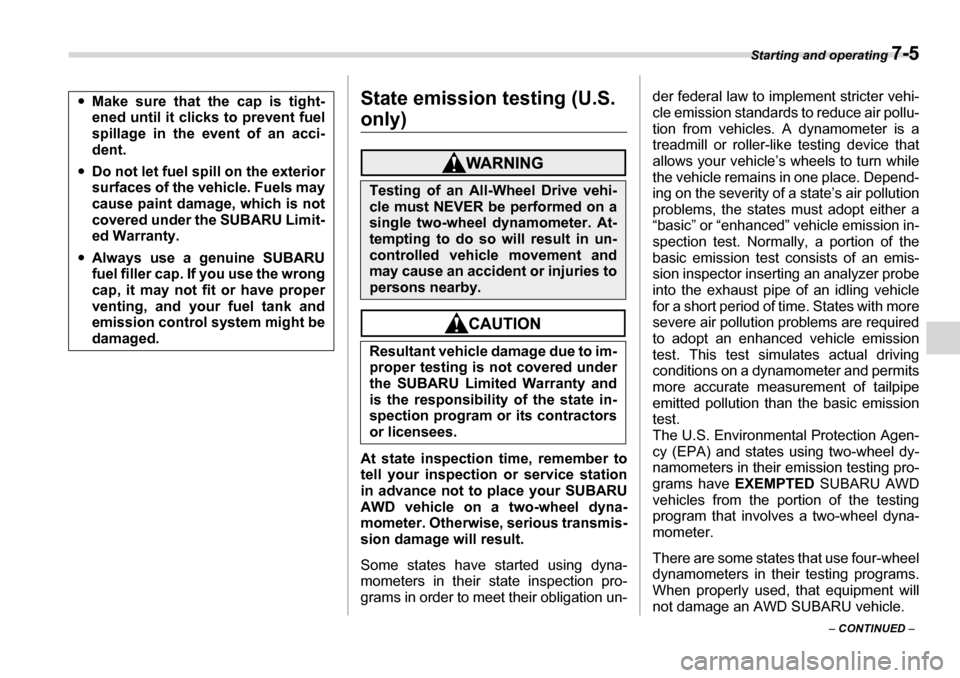
Testing of an All-Wheel Drive vehi-
cle must NEVER be performed on a
single two-wheel dynamometer. At-
tempting to do so will result in un-
controlled vehicle movement and
may cause an accident or injuries to
persons nearby.
Resultant vehicle damage due to im-
proper testing is not covered under
the SUBARU Limited Warranty and
is the responsibility of the state in-
spection program or its contractors
or licensees.
Page 227 of 377
7-12 Starting and operating
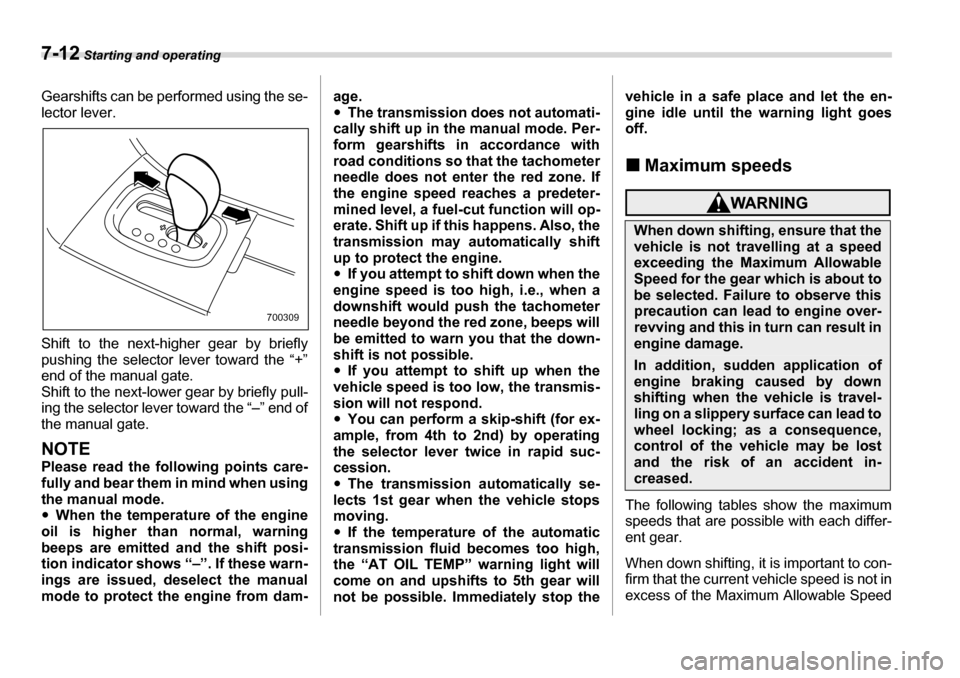
Gearshifts can be performed using the se-
lector lever.
Shift to the next-higher gear by briefly
pushing the selector lever toward the “+”
end of the manual gate.
Shift to the next-lower gear by briefly pull-
ing the selector lever toward the “–” end of
the manual gate.
NOTE
Please read the following points care-
fully and bear them in mind when usingthe manual mode. yWhen the temperature of the engine
oil is higher than normal, warning
beeps are emitted and the shift posi-
tion indicator shows “–”. If these warn-
ings are issued, deselect the manual
mode to protect the engine from dam- age. y
The transmission does not automati-
cally shift up in the manual mode. Per-
form gearshifts in accordance with
road conditions so that the tachometer
needle does not enter the red zone. If
the engine speed reaches a predeter-
mined level, a fuel-cut function will op-
erate. Shift up if this happens. Also, the
transmission may automatically shift
up to protect the engine. y If you attempt to shift down when the
engine speed is too high, i.e., when a
downshift would push the tachometer
needle beyond the red zone, beeps will
be emitted to warn you that the down-
shift is not possible. y If you attempt to shift up when the
vehicle speed is too low, the transmis-
sion will not respond. y You can perform a skip-shift (for ex-
ample, from 4th to 2nd) by operating
the selector lever twice in rapid suc-
cession. y The transmission automatically se-
lects 1st gear when the vehicle stops
moving. y If the temperature of the automatic
transmission fluid becomes too high,
the “AT OIL TEMP” warning light will
come on and upshifts to 5th gear will
not be possible. Immediately stop the vehicle in a safe place and let the en-
gine idle until the warning light goes off.
„ Maximum speeds
The following tables show the maximum
speeds that are possible with each differ- ent gear.
When down shifting, it is important to con-
firm that the current vehicle speed is not in
excess of the Maximum Allowable Speed
700309
When down shifting, ensure that the
vehicle is not travelling at a speed
exceeding the Maximum Allowable
Speed for the gear which is about to
be selected. Failure to observe this
precaution can lead to engine over-
revving and this in turn can result in
engine damage.
In addition, sudden application of
engine braking caused by down
shifting when the vehicle is travel-
ling on a slippery surface can lead to
wheel locking; as a consequence,
control of the vehicle may be lost
and the risk of an accident in-
creased.
Page 229 of 377
7-14 Starting and operating
When selected, the SPORT mode indica-
tor light on the instrument panel will turn
on.
To deselect SPORT mode, move the se-
lector lever to the “D” position or select
manual mode. To subsequently reselect
SPORT mode, move the selector lever to
the “D” position and from there to the man-
ual gate.
In this mode, the transmission shifts up at
higher vehicle speeds and shifts down
more responsively than in normal mode. „Shift lock release
Perform the following steps if the selector
lever does not move from the “P” position
even with the release button pressed, the
brake pedal depressed and the ignition
switch in the “ON” position:
To override the shift lock:
1. Set the parking brake and stop the en-
gine.
2. Take out the screwdriver from the tool
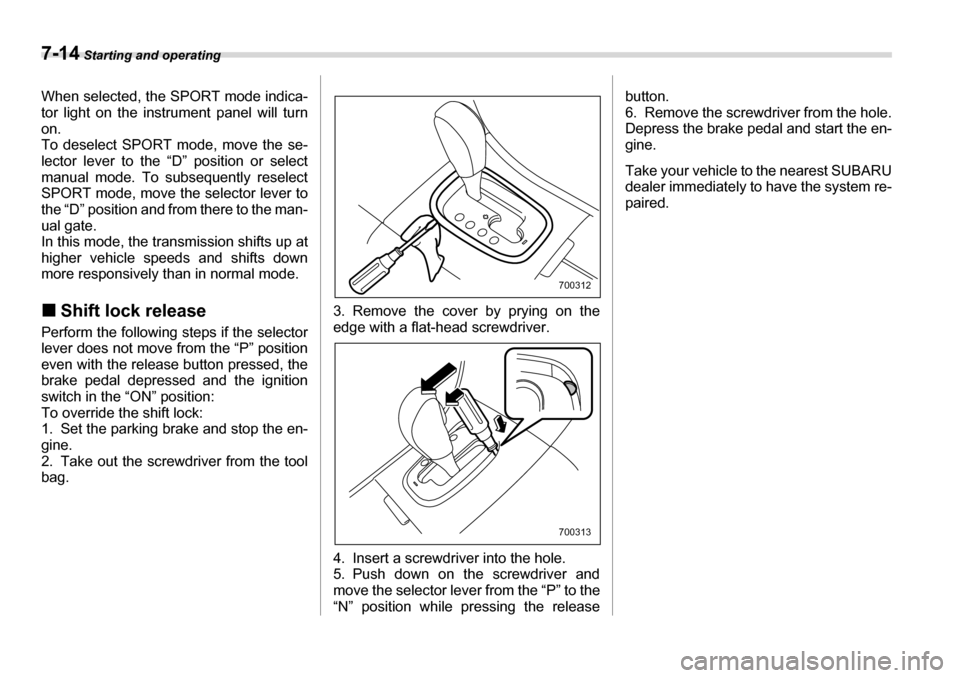
bag. 3. Remove the cover by prying on the
edge with a flat-head screwdriver.
4. Insert a screwdriver into the hole.
5. Push down on the screwdriver and
move the selector lever from the “P” to the
“N” position while pressing the release button.
6. Remove the screwdriver from the hole.
Depress the brake pedal and start the en-
gine.
Take your vehicle to the nearest SUBARU
dealer immediately to have the system re-
paired.
700312
700313
Page 235 of 377
7-20 Starting and operating
In the event of wheelspin and/or skidding
on a slippery road surface and/or during
cornering and/or an evasive maneuver,
the Vehicle Dynamics Control system ad-
justs the engine’s output and the wheels’
respective braking forces to help maintain
traction and directional control. yTraction Control Function
The traction control function is designed to
prevent spinning of the driving wheels on
slippery road surfaces, thereby helping to
maintain traction and directional control.
Activation of this function is shown by
steady illumination of the Vehicle Dynam-
ics Control operation indicator light. y Skid Suppression Function
The skid suppression function is designed
to help maintain directional stability by
suppressing the wheels’ tendency to slide
sideways during steering operations. Acti-
vation of this function is shown by flashing
of the Vehicle Dynamics Control operation
indicator light.
NOTE y Slight twitching of the brake pedal may be felt when the Vehicle Dynamics
Control system operates; a small de-
gree of vehicle or steering wheel shak-
ing may also be noticed in this situa-
tion. These are normal characteristics
of Vehicle Dynamics Control operation
and are no cause for alarm. y
When driving off immediately after
starting the engine, a short-lived oper-
ation noise may be noticed coming
from the engine compartment. This
noise is generated as a result of a
check being performed on the Vehicle
Dynamics Control system and is nor- mal.y Depending on the timing of activa-
tion of the brakes, certain situations
may occur just after driving off where
the brake pedal seems to exhibit a jolt-
ing motion. This too is a consequence
of the Vehicle Dynamics Control opera-
tional check and is normal.y In the circumstances listed in the fol-
lowing, the vehicle may be more unsta-
ble than it feels to the driver. The Vehi-
cle Dynamics Control System may
therefore operate. Such operation does
not indicate a system fault.
yon gravel-covered or rutted roads
y on unfinished roads
y when the vehicle is towing a trailer
y when the vehicle is fitted with
y
Activation of the Vehicle Dynam-
ics Control system is an indica-
tion that the road being travelled
on has a slippery surface; since
having Vehicle Dynamics Control
is no guarantee that full vehicle
control will be maintained at all
times and under all conditions, its
activation should be seen as a
sign that the speed of the vehicle
should be reduced considerably.
y Whenever suspension compo-
nents, steering components, or an
axle are removed from a vehicle
equipped with Vehicle Dynamics
Control, have an authorized
SUBARU dealer perform an in-
spection of that system.
y The following precautions should
be observed in order to ensure
that the Vehicle Dynamics Control
system is operating properly:
– All four wheels should be fitted
with tires of the same size, type,
and brand. Furthermore, the
amount of wear should be the
same for all four tires.
– Keep the tire pressure at theproper level as shown on the
vehicle placard attached to the
driver’s side door pillar.
Page 237 of 377
7-22 Starting and operating
ing that the Traction Control system is not
operating. It comes on in the event of a
malfunction in the system and is illuminat-
ed whenever the system is not operating. VVehicle Dynamics Control warning
The warning light comes on when the igni-
tion switch is turned to the “ON” position
and goes off several seconds after engine
startup. This lighting pattern indicates that
the Vehicle Dynamics Control system is
operating normally.
The following situations could indicate a
malfunction of the Vehicle Dynamics Con-
trol system; if any should occur, we rec-
ommend that you have an authorized
SUBARU dealer carry out an inspection of
the system at the first available opportuni-ty. y The warning light does not turn on when
the ignition key is turned to the ON posi- tion. y The warning light turns on while the ve-
hicle is being driven. y When a malfunction has occurred in the
Vehicle Dynamics Control electrical sys-
tem, only the warning light will turn on. In
such an event, the ABS will still be operat-
ing normally. y The warning light will also turn on when
a problem occurs with the ABS or Vehicle
Dynamics Control electronic control sys- tems.
Because the Vehicle Dynamics Control
system controls each brake through the
ABS, whenever the ABS stops operating
due to a malfunction in that electrical sys-
tem, the Vehicle Dynamics Control will
also become unable to control all four
brakes. Thus Vehicle Dynamics Control
system operation halts and the warning
light turns on. Although both the Vehicle
Dynamics Control system and the ABS
will be inoperable in this situation, it will
still be possible to stop the vehicle using
normal braking. The Vehicle Dynamics
Control system and the ABS do not ad-
versely affect operation of the vehicle in
any way when they are inoperable; how-
ever should such a situation occur, drive
with care and have an authorized
SUBARU dealer carry out an inspection of
those systems at the first available oppor-
tunity.
NOTE
When the warning light turns on and
off in the following way, it indicates
that the Vehicle Dynamics Control sys-
tem is operating normally. y
Although turning on after the engine
has been started, the warning light
quickly turns off and stays off. y The warning light turns on when the vehicle is being driven; it then turns off
and stays off. V
Traction Control system OFF indica- tor light
This light comes on to indicate that the
Traction Control system is in non-opera-
tion mode. This does not constitute failure
of the Vehicle Dynamics Control system.
NOTE y The indicator light may stay on for a
while after the engine has been started,
especially in cold weather. This occurs
because the engine has not yet
warmed up and is completely normal.
The light will turn off when the engine
has reached a suitable operating tem-
perature. y When an engine problem occurs and
the malfunction indicator lamp turns
on, the indicator light will also come
on.
The following two situations could indicate
malfunction of the Vehicle Dynamics Con-
trol system; if either should occur, have an
authorized SUBARU dealer carry out an
inspection of that system at the first avail-
able opportunity. y The indicator light does not turn on
when the ignition key is turned to the ON
position.
Page 240 of 377
Starting and operating 7-25
– CONTINUED –
NOTE
This device complies with Part 15 of
the FCC Rules and with RSS-210 of In-
dustry Canada. Operation is subject to
the following two conditions: (1) This
device may not cause harmful interfer-
ence, and (2) this device must accept
any interference received, including in-
terference that may cause undesired
operation.
Changes or modifications not express-
ly approved by the party responsible
for compliance could void the user’s
authority to operate the equipment.
Parking your vehicleIf this light still comes on while driv-
ing after adjusting the tire pressure,
a tire may have significant damage
and a fast leak that causes the tire to
lose air rapidly. If you have a flat tire,
replace it with a spare tire as soon
as possible. When a spare tire is
mounted or a wheel rim is replaced
without the original pressure sen-
sor/transmitter being transferred,
the low tire pressure warning light
will flash. This indicates the TPMS is unable to monitor all four road
wheels. Contact your SUBARU deal-
er as soon as possible for tire and
sensor replacement and/or system resetting.
Do not inject any tire liquid or aero-
sol tire sealant into the tires, as this
may cause a malfunction of the tire
pressure sensors. If the light flash-
es, promptly contact a SUBARU
dealer to have the system inspect-
ed.
Do not place metal film or any metal
parts under the driver’s seat. This
may cause poor reception of the sig-
nals from the tire pressure sensors,
and the tire pressure monitoring
system will not function properly.
yNever leave unattended children
or pets in the vehicle. They could
accidentally injure themselves or
others through inadvertent opera-
tion of the vehicle. Also, on hot or
sunny days, the temperature in a
closed vehicle could quickly be-
come high enough to cause se-
vere or possibly fatal injuries to them.
yDo not park the vehicle over flam-
mable materials such as dry
grass, waste paper or rags, as
they may burn easily if they come
near hot engine or exhaust sys-
tem parts.
yBe sure to stop the engine if you
take a nap in the vehicle. If engine
exhaust gas enters the passenger
compartment, occupants in the
vehicle could die from carbon
monoxide (CO) contained in the
exhaust gas.
Page 251 of 377
8-6 Driving tips
Your B9 TRIBECA is classified as a utility
vehicle. Utility vehicles feature a higher
ground clearance which enables them to
be used for wide applications including
off-road driving, but a higher center of
gravity in relation to the tread width as
compared with ordinary passenger cars
makes vehicles of this type more likely to
roll over. In reality, utility vehicles have a
significantly higher rollover rate than other
types of vehicles. The high ground clear-
ance of this vehicle is a real advantage,
giving you a better view of the road and al-
lowing you to anticipate problems earlier.
However, remember that your utility vehi-
cle is not designed for high-speed corner-
ing comparable to ordinary passenger
cars and that your vehicle could roll over if you make a sharp turn at high speed. If
you do take your SUBARU off-road, cer-
tain common sense precautions such as
the following should be taken: y
Make certain that you and all of your
passengers are wearing seatbelts. y Carry some emergency equipment,
such as a towing rope or chain, a shovel,
wheel blocks, first aid kit and cell phone or
citizens band radio. y Drive carefully. Do not take unneces-
sary risks by driving in dangerous areas or
over rough terrain. y Slow down and employ extra caution at
all times. When driving off-road, you will
not have the benefit of marked traffic
lanes, banked curves, traffic signs and the
like. y Do not drive across steep slopes. In-
stead, drive either straight up or straight
down the slopes. A vehicle can much
more easily tip over sideways than it can
end over end. Avoid driving straight up or
down slopes that are too steep. y Avoid sharp turning maneuvers, espe-
cially at higher speeds. y Do not grip the inside or spokes of the
steering wheel. A bad bump could jerk the
wheel and injure your hands. Instead drive
with your fingers and thumbs on the out-
side of the rim.y If driving through water, such as when crossing shallow streams, first check the
depth of the water and the bottom of the
stream bed for firmness and ensure that
the bed of the stream is flat. Drive slowly
and completely through the stream. The
water should be shallow enough that it
does not reach the vehicle’s undercar-
riage. Water entering the engine air intake
or the exhaust pipe or water splashing
onto electrical parts may damage your ve-
hicle and may cause it to stall. Never at-
tempt to drive through rushing water; re-
gardless of its depth, it can wash away the
ground from under your tires, resulting in
possible loss of traction and even vehiclerollover. y
Always check your brakes for effective-
ness immediately after driving in sand,
mud or water. Do this by driving slowly
and stepping on the brake pedal. Repeat
that process several times to dry out the
brake discs and brake pads.y Do not drive or park over or near flam-
mable materials such as dry grass or fall-
en leaves, as they may burn easily. Theexhaust system is very hot while the en-
gine is running and right after engine
stops. This could create a fire hazard.y After driving through tall grass, mud,
rocks, sand, rivers, etc., check that there
is no grass, bush, paper, rags, stones,
sand, etc. adhering to or trapped on the
y Whenever strong crosswinds are
present, slow down sufficiently to
maintain control of your vehicle.
Remember that your vehicle, with
its higher profile and center of
gravity, is more likely to be affect-
ed by crosswinds than ordinary
passenger cars.
yAlways use the utmost care in
driving – overconfidence because
you are driving an All-Wheel Drive
vehicle could easily lead to a seri-
ous accident.
Page 254 of 377
Driving tips 8-9
– CONTINUED –
If there is caked snow or ice, remove it,
being careful not to damage the disc
brakes and brake hoses and ABS har-ness. T
Refueling in cold weather
To help prevent moisture from forming in
the fuel system and the risk of its freezing,
use of an antifreeze additive in the fuel
tank is recommended during cold weath- er.
Use only additives that are specifically de-
signed for this purpose. When an anti-
freeze additive is used, its effect lasts
longer if the tank is refilled whenever the
fuel level reaches half empty.
If your SUBARU is not going to be used for
an extended period, it is best to have the
fuel tank filled to capacity. „ Driving on snowy and icy
roads
To prevent skidding and slipping, avoid
sudden braking, abrupt acceleration, high-
speed driving, and sharp turning when
driving on snowy or icy roads.
Always maintain ample distance between
your vehicle and the vehicle ahead of you
to avoid the need for sudden braking.
To supplement the foot brake, use the en-
gine brake effectively to control the vehi-
cle speed. (Shift into a lower gear when necessary.)
Avoid shifting down abruptly. Such behav-
ior can cause the wheels to lock, possibly
leading to loss of vehicle control.
An anti-lock brake system (ABS) enhanc-
es your vehicle’s braking performance on
snowy and icy roads. Refer to the “ABS
(Anti-lock Brake System)” and “Vehicle
Dynamics Control system” section in
chapter 7 for information on braking on
slippery surfaces. T
Wiper operation when snowing
Before driving in cold weather, make sure
the wiper blades are not frozen to the
windshield or rear window. If the wiper
blades are frozen to the windshield or rear
window, use the defroster with the airflow
control button in the “ ” position and
the temperature control dial set for maxi-
mum warmth until the wiper blades are
completely thawed out. If your vehicle is
equipped with a wiper deicer, it is helpful
to thaw the windshield wiper blades. To
thaw out the rear wiper blade, use the rear
window defogger.
When driving in snow, if frozen snow
starts to stick on the surface of the wind-
shield despite wiper operation, use the de-
froster with the airflow control button in
“ ” and the temperature control dial
set for maximum warmth. After the wind-
shield gets warmed enough to melt the
frozen snow on it, wash it away using the
windshield washer.
Snow stuck on the wiper arm prevents the
wiper from working effectively. If snow is
stuck on the wiper arm, pull off the road to
a safe place, then remove it. If you stop
the vehicle at road side, use the hazard
warning flasher to alert other drivers.
We recommend use of non-freezing type
Do not use the cruise control on
slippery roads such as snowy or icy
roads. This may cause loss of vehi-
cle control.
Avoid prolonged continuous driving
in snowstorms. Snow will enter the
engine’s intake system and may
hinder the air flow, which could re-
sult in engine shutdown or even
breakdown.