2007 SUBARU TRIBECA brake light
[x] Cancel search: brake lightPage 206 of 377
Interior equipment 6-9
– CONTINUED –
Electrical power (12V DC) from the battery
is available at any of the outlets when the
ignition switch is either in the “ACC” or
“ON” position.
You can use an in-car use electrical appli-
ance by connecting it to an outlet.
When both outlets are used at the same
time, the total power consumption of the
electric appliances must be 120W or less.
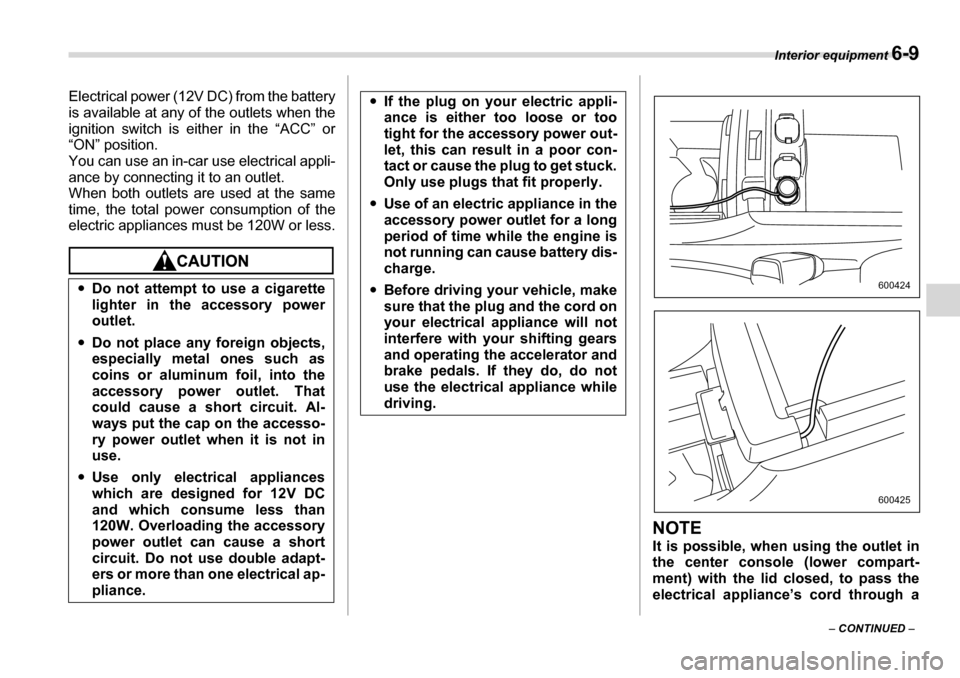
NOTE
It is possible, when using the outlet in
the center console (lower compart-
ment) with the lid closed, to pass the
electrical appliance’s cord through a
y
Do not attempt to use a cigarette
lighter in the accessory power
outlet.
y Do not place any foreign objects,
especially metal ones such as
coins or aluminum foil, into the
accessory power outlet. That
could cause a short circuit. Al-
ways put the cap on the accesso-
ry power outlet when it is not in
use.
y Use only electrical appliances
which are designed for 12V DC
and which consume less than
120W. Overloading the accessory
power outlet can cause a short
circuit. Do not use double adapt-
ers or more than one electrical ap-
pliance.
yIf the plug on your electric appli-
ance is either too loose or too
tight for the accessory power out-
let, this can result in a poor con-
tact or cause the plug to get stuck.
Only use plugs that fit properly.
y Use of an electric appliance in the
accessory power outlet for a long
period of time while the engine is
not running can cause battery dis-
charge.
y Before driving your vehicle, make
sure that the plug and the cord on
your electrical appliance will not
interfere with your shifting gears
and operating the accelerator and
brake pedals. If they do, do not
use the electrical appliance while
driving.
600424
600425
Page 216 of 377
7
Starting and operating
Fuel ...................................................................... 7-2 Fuel requirements .................................................. 7-2
Fuel filler lid and cap .............................................. 7-3
State emission testing (U.S. only) .................... 7-5
Preparing to drive .............................................. 7-6
Starting the engine ............................................. 7-7
Stopping the engine ........................................... 7-8
Automatic transmission .................................... 7-8 Selector lever .......................................................... 7-9
Selector lever reverse inhibiting function ............ 7-10
Selection of manual mode ..................................... 7-11
Maximum speeds .................................................... 7-12
Driving tips .............................................................. 7-13
SPORT mode ........................................................... 7-13
Shift lock release .................................................... 7-14
Power steering ................................................... 7-15
Braking ................................................................ 7-15 Braking tips ............................................................. 7-15
Brake system .......................................................... 7-15
Disc brake pad wear warning indicators .............. 7-16
ABS (Anti-lock Brake System) .......................... 7-16 ABS system self-check .......................................... 7-17
ABS warning light ................................................... 7-17
Electronic Brake Force Distribution (EBD) system .............................................................. 7-18Steps to take if EBD system fails .......................... 7-18
Vehicle Dynamics Control system ................... 7-19 Vehicle Dynamics Control system monitor .......... 7-21 Traction Control system OFF switch .................... 7-23
Tire pressure monitoring system (TPMS) ........ 7-24
Parking your vehicle .......................................... 7-25
Cruise control ..................................................... 7-27 To set cruise control .............................................. 7-27
To temporarily cancel the cruise control ............. 7-28
To turn off the cruise control ................................. 7-28
To change the cruising speed ............................... 7-28
Cruise control indicator light ................................. 7-29
Cruise control set indicator light .......................... 7-30
Page 221 of 377
7-6 Starting and operating
Under no circumstances should the rear
wheels be jacked off the ground, nor
should the driveshaft be disconnected for
state emission testing. The EPA has issued regulations for in-
specting the On-Board Diagnostic (OBD)
system as part of the state emissions in-
spection. The OBD system is designed to
detect engine and transmission problems
that might cause vehicle emissions to ex-
ceed allowable limits. These inspections
apply to all 1996 model year and newer
passenger cars and light trucks. Over 30
states plus the District of Columbia have
implemented the OBD system inspection. yThe inspection of the OBD system con-
sists of a visual operational check of the “ CHECK ENGINE ” warning light/malfunc-
tion indicator lamp (MIL) and an examina-
tion of the OBD system with an electronic
scan tool while the engine is running. y A vehicle passes
the OBD system in-
spection if proper the “ CHECK ENGINE”
warning light/MIL illumination is observed,
there is no stored diagnostic trouble
codes, and the OBD system readiness
monitors are complete. y A vehicle fails
the OBD inspection if the
“ CHECK ENGINE ” warning light/MIL is
not properly operating or there is one or
more diagnostic trouble codes stored in vehicle’s computer with the “
CHECK EN-
GINE ” warning light/MIL illuminated.
y A state emission inspection may reject
(not pass or fail) a vehicle if the number of
OBD system readiness monitors “ Not
Ready ” is greater than one. Under this
condition, the vehicle operator should be
instructed to drive his/her vehicle for a few
days to set the monitors and return for an
emission re-inspection. y Owners of rejected or failing vehicles
should contact their SUBARU Dealer for service.
Preparing to drive
You should perform the following checks
and adjustments every day before you
start driving.
1. Check that all windows, mirrors, and
lights are clean and unobstructed.
2. Check the appearance and condition of
the tires. Also check tires for proper infla-
tion.
3. Look under the vehicle for any sign of
leaks.
4. Check that the hood and rear gate are
fully closed.
5. Check the adjustment of the seat.
6. Check the adjustment of the inside and outside mirrors.
7. Fasten your seatbelt. Check that your
passengers have fastened their seatbelts.
8. Check the operation of the warning and
indicator lights when the ignition switch is
turned to the “ON” position.
9. Check the gauges, indicator and warn-
ing lights after starting the engine.
NOTE
Engine oil, engine coolant, brake fluid,
washer fluid and other fluid levels
should be checked daily, weekly or at
fuel stops.
Page 222 of 377
Starting and operating 7-7
Starting the engine
1. Apply the parking brake.
2. Turn off unnecessary lights and acces- sories.
3. Shift the selector lever to the “P” or “N”
position (preferably “P” position). The
starter will only operate when the select
lever is at the “P” or “N” position.
4. Turn the ignition switch to the “ON” po-
sition and check the operation of the warn-
ing and indicator lights. Refer to the
“Warning and indicator lights” section
(chapter 3).
5. Turn the ignition switch to the “START”position without depressing the accelera-
tor pedal. Release the key immediately af- ter the engine has started.
If the engine does not start, try the follow-
ing.
1) Turn the ignition switch to the “OFF”
position and wait for at least 10 sec-
onds. After checking that the parking
brake is firmly set, turn the ignition
switch to the “START” position while de-
pressing the accelerator pedal slightly(approximately a quarter of the full
stroke). Release the accelerator pedal
as soon as the engine starts.
2) If this fails to start the engine, turn the
ignition switch back to the “OFF” posi-
tion and wait for at least 10 seconds.
Then fully depress the accelerator ped-
al and turn the ignition switch to the
“START” position. If the engine starts,
quickly release the accelerator pedal.
3) If this fails to start the engine, turn the
ignition switch again to the “OFF” posi-
tion. After waiting for 10 seconds or
longer, turn the ignition switch to the
“START” position without depressing
the accelerator pedal.
4) If the engine still refuses to start, con-
tact your nearest SUBARU dealer for
assistance.
6. Confirm that all warning and indicator
lights have gone out after the engine has
started. The fuel injection system auto-
matically lowers the idle speed as the en- gine warms up.
While the engine is warming up, make
sure that the selector lever is at the “P” or
“N” position and that the parking brake is
applied.
y
Do not operate the starter motor
continuously for more than ten
seconds. If the engine fails to start
after operating the starter for five
to ten seconds, wait for ten sec-
onds or more before trying again.
y If you restart the engine while the
vehicle is moving, shift the selec-
tor lever into the “N” position. Do
not attempt to place the selector
lever of a moving vehicle into the “P” position.
Page 224 of 377
Starting and operating 7-9
– CONTINUED –
the transmission to shift at the most
appropriate times for the current con-
dition of your vehicle. Optimized shift-
ing will be restored as the vehicle con-
tinues to be driven for a while. „
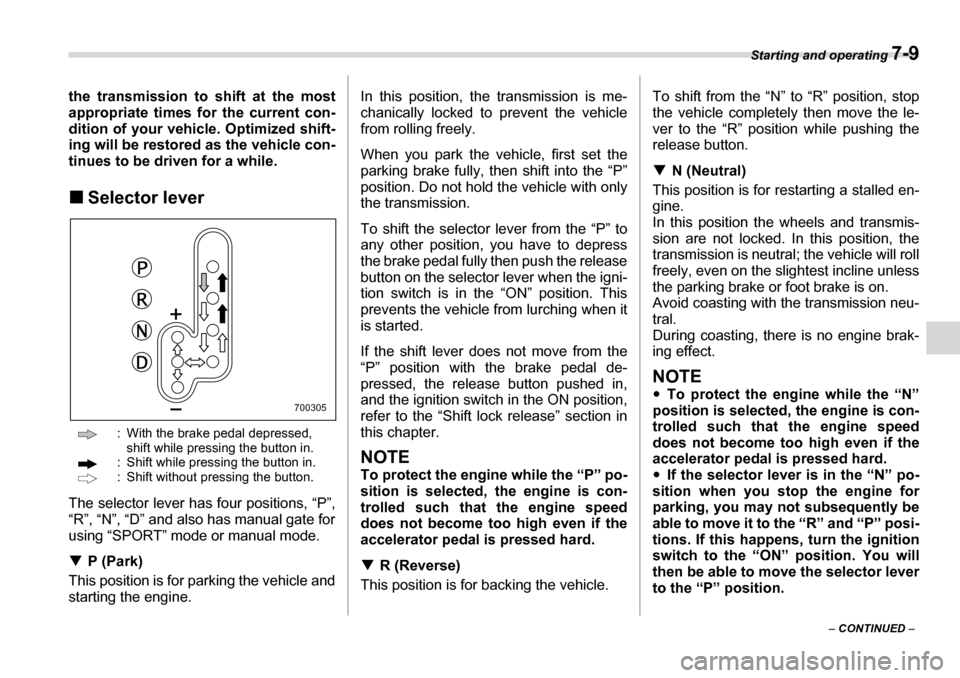
Selector lever
: With the brake pedal depressed, shift while pressing the button in.
: Shift while pressing the button in.
: Shift without pressing the button.
The selector lever has four positions, “P”,
“R”, “N”, “D” and also has manual gate for
using “SPORT” mode or manual mode. T P (Park)
This position is for parking the vehicle and
starting the engine. In this position, the transmission is me-
chanically locked to prevent the vehicle
from rolling freely.
When you park the vehicle, first set the
parking brake fully, then shift into the “P”
position. Do not hold the vehicle with onlythe transmission.
To shift the selector lever from the “P” to
any other position, you have to depress
the brake pedal fully then push the release
button on the selector lever when the igni-
tion switch is in the “ON” position. This
prevents the vehicle from lurching when it
is started.
If the shift lever does not move from the
“P” position with the brake pedal de-
pressed, the release button pushed in,
and the ignition switch in the ON position,
refer to the “Shift lock release” section in
this chapter.
NOTE
To protect the engine while the “P” po-
sition is selected, the engine is con-
trolled such that the engine speed
does not become too high even if the
accelerator pedal is pressed hard. T
R (Reverse)
This position is for backing the vehicle. To shift from the “N” to “R” position, stop
the vehicle completely then move the le-
ver to the “R” position while pushing the
release button. T
N (Neutral)
This position is for restarting a stalled en-
gine.
In this position the wheels and transmis-
sion are not locked. In this position, the
transmission is neutral; the vehicle will roll
freely, even on the slightest incline unless
the parking brake or foot brake is on.
Avoid coasting with the transmission neu-tral.
During coasting, there is no engine brak-
ing effect.
NOTE y To protect the engine while the “N”
position is selected, the engine is con-
trolled such that the engine speed
does not become too high even if the
accelerator pedal is pressed hard.y If the selector lever is in the “N” po-
sition when you stop the engine for
parking, you may not subsequently be
able to move it to the “R” and “P” posi-
tions. If this happens, turn the ignition
switch to the “ON” position. You will
then be able to move the selector lever
to the “P” position.
700305
Page 228 of 377
Starting and operating 7-13
– CONTINUED –
of the gear which is about to be selected.
Never exceed posted speed limits.
NOTE y In order to prevent over-revving dur-
ing acceleration of the vehicle, the
transmission will automatically shift to
the next highest gear if the Maximum
Allowable Speed for the current gear is
exceeded.y Similarly, in order to prevent over-
revving during deceleration of the vehi-
cle, the transmission will remain in the
current gear if the speed of the vehicle
is in excess of the Maximum Allowable
Speed for the gear to which the selec-
tor lever has been moved. „ Driving tips
y On a road surface where there is a risk
of wheelspin (for example, a snow- or
gravel-covered road), you can pull away
from a standstill safely and easily by first selecting the 2nd gear of the manual mode. y
Always apply the foot or parking brake
when the vehicle is stopped in the “D” or
“R” position. y Always set the parking brake when
parking your vehicle. Do not hold the vehi-
cle with only the transmission. y Do not keep the vehicle in a stationary
position on an uphill grade by using the
“D” position. Use the brake instead. y The engine may, on rare occasions,
knock when the vehicle rapidly acceler-
ates or rapidly pulls away from a standstill.
This phenomenon does not indicate a
problem. y A slight reduction in output torque may
occur before the engine warms up. „
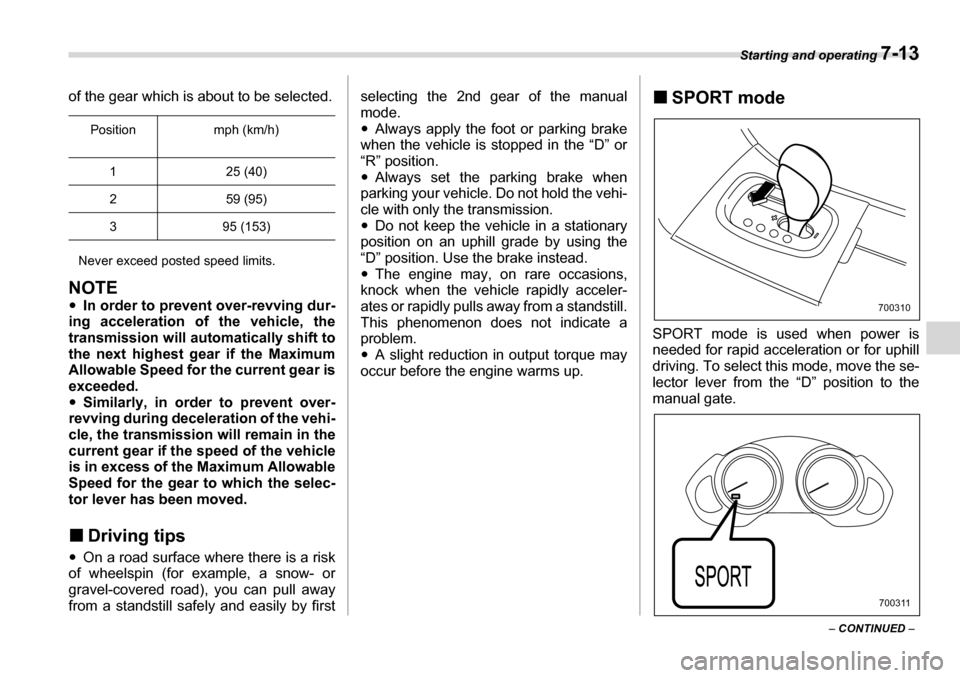
SPORT mode
SPORT mode is used when power is
needed for rapid acceleration or for uphill
driving. To select this mode, move the se-
lector lever from the “D” position to the
manual gate.
Position mph (km/h)
1 25 (40)
2 59 (95)
3 95 (153)
700310
700311
Page 229 of 377
7-14 Starting and operating
When selected, the SPORT mode indica-
tor light on the instrument panel will turn
on.
To deselect SPORT mode, move the se-
lector lever to the “D” position or select
manual mode. To subsequently reselect
SPORT mode, move the selector lever to
the “D” position and from there to the man-
ual gate.
In this mode, the transmission shifts up at
higher vehicle speeds and shifts down
more responsively than in normal mode. „Shift lock release
Perform the following steps if the selector
lever does not move from the “P” position
even with the release button pressed, the
brake pedal depressed and the ignition
switch in the “ON” position:
To override the shift lock:
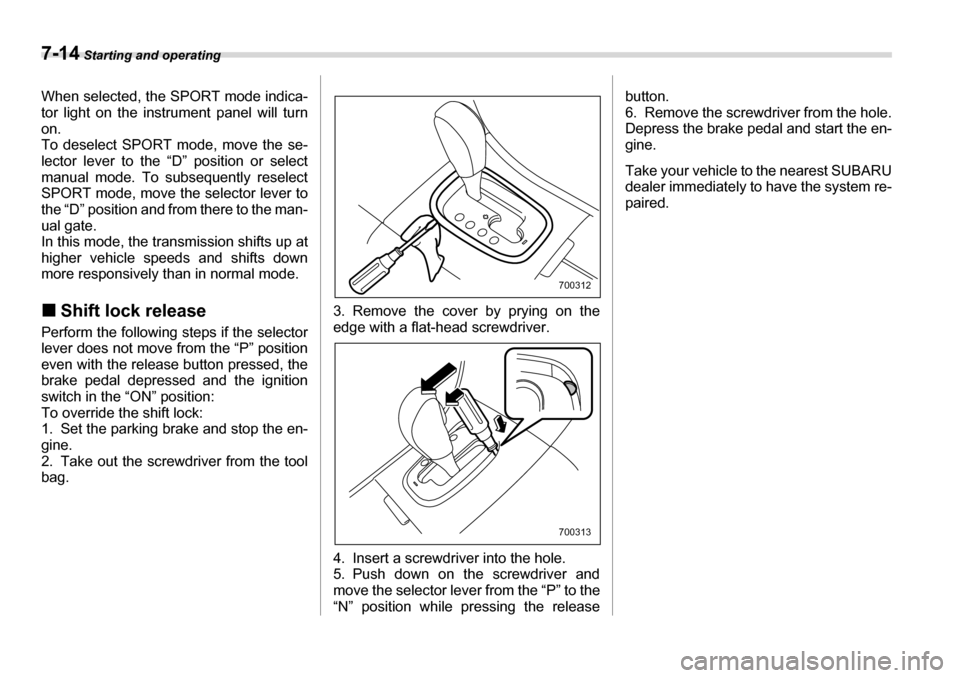
1. Set the parking brake and stop the en-
gine.
2. Take out the screwdriver from the tool
bag. 3. Remove the cover by prying on the
edge with a flat-head screwdriver.
4. Insert a screwdriver into the hole.
5. Push down on the screwdriver and
move the selector lever from the “P” to the
“N” position while pressing the release button.
6. Remove the screwdriver from the hole.
Depress the brake pedal and start the en-
gine.
Take your vehicle to the nearest SUBARU
dealer immediately to have the system re-
paired.
700312
700313
Page 230 of 377
Starting and operating 7-15
– CONTINUED –
Power steering
The power steering system operates only
when the engine is running.
If you lose power steering assist because
the engine stops or the system fails to
function, you can steer but it will take
much more effort.
NOTE
Right after the engine has been started
and before it has warmed up, you may
hear a noise coming from areas adja-
cent to the power steering pump whichis located at the right-front area of the
engine compartment. This noise is nor-
mal. It does not indicate power steering
system trouble.
Braking „Braking tips
TWhen the brakes get wet
When driving in rain or after washing the
vehicle, the brakes may get wet. As a re-
sult, brake stopping distance will be long-
er. To dry the brakes, drive the vehicle at
a safe speed while lightly depressing the
brake pedal to heat up the brakes. T Use of engine braking
Remember to make use of engine braking
in addition to foot braking. When descend-
ing a grade, if only the foot brake is used,
the brakes may start working improperly
because of brake fluid overheating,
caused by overheated brake pads. To
help prevent this, shift into a lower gear to
get stronger engine braking. T Braking when a tire is punctured
Do not depress the brake pedal suddenly when a tire is punctured. This could cause
a loss of control of the vehicle. Keep driv-
ing straight ahead while gradually reduc-
ing speed. Then slowly pull off the road to
a safe place. „
Brake system
T Two separate circuits
Your vehicle has a dual circuit brake sys-
tem. Each circuit works diagonally across
the vehicle. If one circuit of the brake sys-
tem should fail, the other half of the sys-
tem still works. If one circuit fails, the
brake pedal will go down much closer to
the floor than usual and you will need to
press it down much harder. And a much
longer distance will be needed to stop the vehicle. T Brake booster
The brake booster uses engine manifold
vacuum to assist braking force. If engine
manifold vacuum becomes insufficient,
such as when driving in a high-altitude
place, a vacuum pump assures a suffi-
cient vacuum to operate the brake boost-
er. Do not turn off the engine while driving
because that will turn off the brake boost-
er, resulting in poor braking power.
The brakes will continue to work even
when the brake booster completely stops
Do not hold the steering wheel at the
fully locked position left or right for
more than five seconds. This may
damage the power steering pump.
Never rest your foot on the brake
pedal while driving. This can cause
dangerous overheating of the
brakes and needless wear on the
brake pads and linings.