2007 SUBARU TRIBECA brake light
[x] Cancel search: brake lightPage 318 of 377
Maintenance and service 11 - 2 1
Brake booster
If the brake booster does not operate as
described in the following, have it checked
by your SUBARU dealer.
1. With the engine off, depress the brake
pedal several times, applying the same
pedal force each time. The distance the
pedal travels should not vary.
2. With the brake pedal depressed, start
the engine. The pedal should move slight-
ly down to the floor.
3. With the brake pedal depressed, stop
the engine and keep the pedal depressed
for 30 seconds. The pedal height should
not change.
4. Start the engine again and run for ap-
proximately one minute then turn it off.
Depress the brake pedal several times to
check the brake booster. The brake boost-
er operates properly if the pedal stroke de-
creases with each depression.Brake pedal
Check the brake pedal free play and re-
serve distance according to the mainte-
nance schedule in the “Warranty and
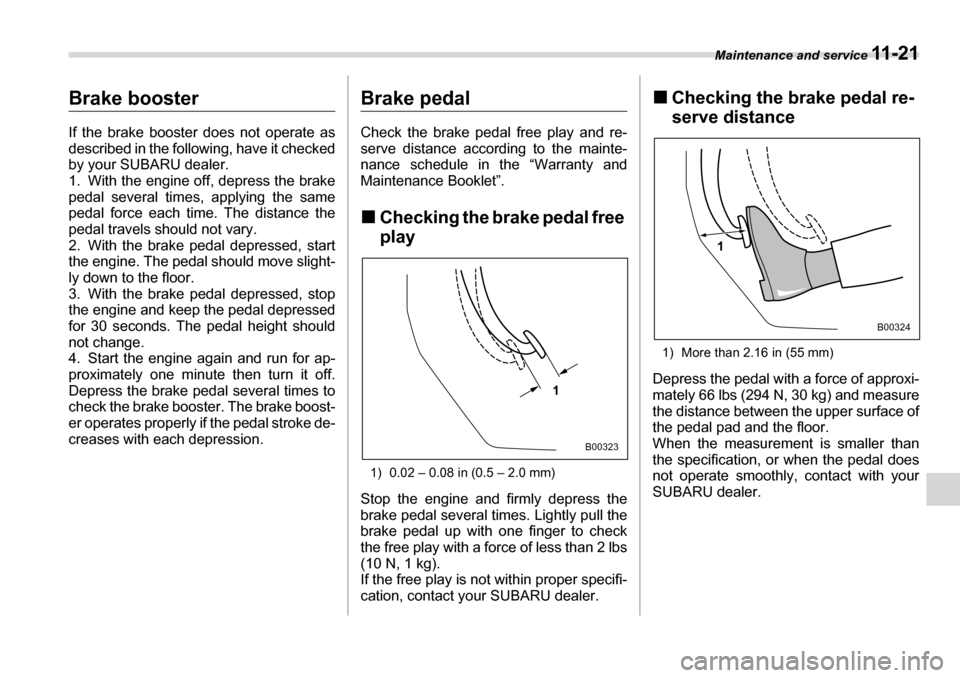
Maintenance Booklet”. „Checking the brake pedal free play
1) 0.02 – 0.08 in (0.5 – 2.0 mm)
Stop the engine and firmly depress the
brake pedal several times. Lightly pull the
brake pedal up with one finger to check
the free play with a force of less than 2 lbs
(10 N, 1 kg).
If the free play is not within proper specifi-
cation, contact your SUBARU dealer. „
Checking the brake pedal re-
serve distance
1) More than 2.16 in (55 mm)
Depress the pedal with a force of approxi-
mately 66 lbs (294 N, 30 kg) and measure
the distance between the upper surface of
the pedal pad and the floor.
When the measurement is smaller than
the specification, or when the pedal does
not operate smoothly, contact with your
SUBARU dealer.
1
B00323
1
B00324
Page 319 of 377
11 - 2 2 Maintenance and service
Replacement of brake pad
and lining
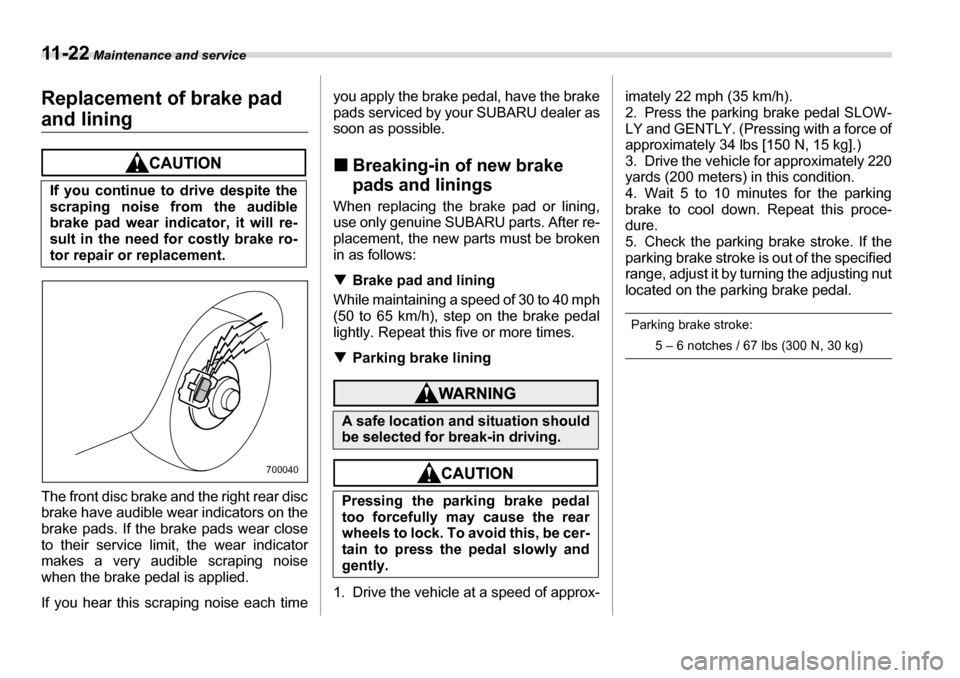
The front disc brake and the right rear disc
brake have audible wear indicators on the
brake pads. If the brake pads wear close
to their service limit, the wear indicator
makes a very audible scraping noise
when the brake pedal is applied.
If you hear this scraping noise each time you apply the brake pedal, have the brake
pads serviced by your SUBARU dealer as
soon as possible. „
Breaking-in of new brake
pads and linings
When replacing the brake pad or lining,
use only genuine SUBARU parts. After re-
placement, the new parts must be broken
in as follows: T Brake pad and lining
While maintaining a speed of 30 to 40 mph
(50 to 65 km/h), step on the brake pedal
lightly. Repeat this five or more times. T Parking brake lining
1. Drive the vehicle at a speed of approx- imately 22 mph (35 km/h).
2. Press the parking brake pedal SLOW-
LY and GENTLY. (Pressing with a force of
approximately 34 lbs [150 N, 15 kg].)
3. Drive the vehicle for approximately 220
yards (200 meters) in this condition.
4. Wait 5 to 10 minutes for the parking
brake to cool down. Repeat this proce- dure.
5. Check the parking brake stroke. If the
parking brake stroke is out of the specified
range, adjust it by turning the adjusting nut
located on the parking brake pedal.
Parking brake stroke:
5 – 6 notches / 67 lbs (300 N, 30 kg)
If you continue to drive despite the
scraping noise from the audible
brake pad wear indicator, it will re-
sult in the need for costly brake ro-
tor repair or replacement.
700040
A safe location and situation should
be selected for break-in driving.
Pressing the parking brake pedal
too forcefully may cause the rear
wheels to lock. To avoid this, be cer-
tain to press the pedal slowly and
gently.
Page 320 of 377
Maintenance and service 11 - 2 3
– CONTINUED –
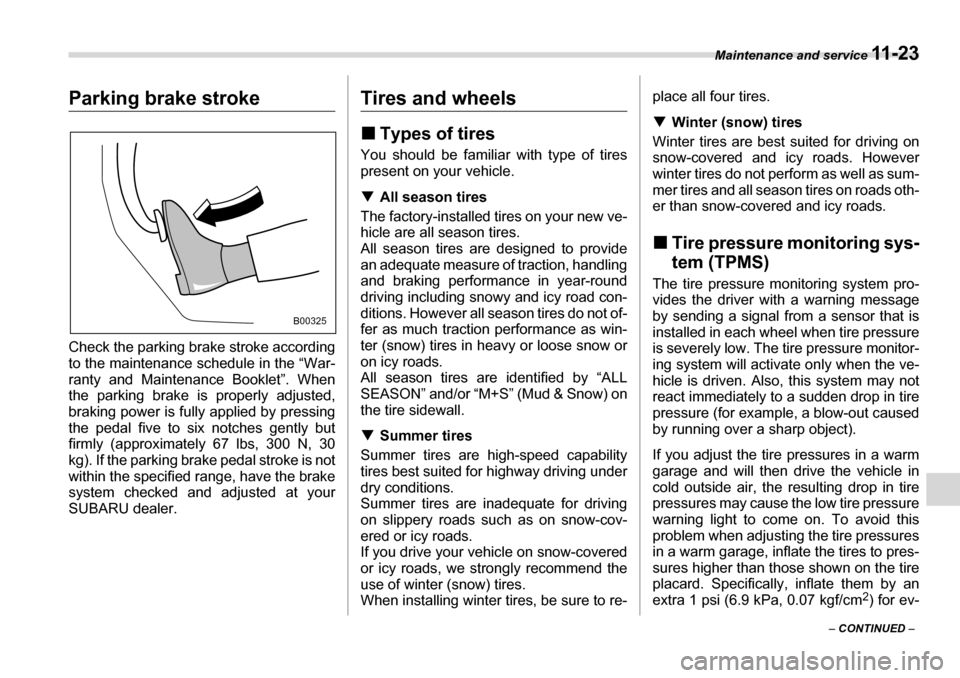
Parking brake stroke
Check the parking brake stroke according
to the maintenance schedule in the “War-
ranty and Maintenance Booklet”. When
the parking brake is properly adjusted,
braking power is fully applied by pressing
the pedal five to six notches gently but
firmly (approximately 67 lbs, 300 N, 30
kg). If the parking brake pedal stroke is not
within the specified range, have the brake
system checked and adjusted at your
SUBARU dealer.Tires and wheels „Types of tires
You should be familiar with type of tires
present on your vehicle. T All season tires
The factory-installed tires on your new ve-
hicle are all season tires.
All season tires are designed to provide
an adequate measure of traction, handling
and braking performance in year-round
driving including snowy and icy road con-
ditions. However all season tires do not of-
fer as much traction performance as win-
ter (snow) tires in heavy or loose snow or
on icy roads.
All season tires are identified by “ALL
SEASON” and/or “M+S” (Mud & Snow) on
the tire sidewall. T Summer tires
Summer tires are high-speed capability
tires best suited for highway driving under
dry conditions.
Summer tires are inadequate for driving
on slippery roads such as on snow-cov-
ered or icy roads.
If you drive your vehicle on snow-covered
or icy roads, we strongly recommend the
use of winter (snow) tires.
When installing winter tires, be sure to re- place all four tires. T
Winter (snow) tires
Winter tires are best suited for driving on
snow-covered and icy roads. However
winter tires do not perform as well as sum-
mer tires and all season tires on roads oth-
er than snow-covered and icy roads. „ Tire pressure monitoring sys- tem (TPMS)
The tire pressure monitoring system pro-
vides the driver with a warning message
by sending a signal from a sensor that is
installed in each wheel when tire pressure
is severely low. The tire pressure monitor-
ing system will activate only when the ve-
hicle is driven. Also, this system may not
react immediately to a sudden drop in tire
pressure (for example, a blow-out caused
by running over a sharp object).
If you adjust the tire pressures in a warm
garage and will then drive the vehicle in
cold outside air, the resulting drop in tire
pressures may cause the low tire pressure
warning light to come on. To avoid this
problem when adjusting the tire pressures
in a warm garage, inflate the tires to pres-
sures higher than those shown on the tire
placard. Specifically, inflate them by an
extra 1 psi (6.9 kPa, 0.07 kgf/cm 2
) for ev-
B00325
Page 321 of 377
11 - 2 4 Maintenance and service
ery difference of 10 °F (5.6 °C) between the
temperature in the garage and the tem-
perature outside. By way of example, the
following table shows the required tire
pressures that correspond to various out-
side temperatures when the temperature
in the garage is 60 °F (15.6 °C).
Standard tire pressures:
Front: 33 psi (230 kPa, 2.3 kgf/cm 2
)
Rear: 32 psi (220 kPa, 2.2 kgf/cm 2
)
Garage temperature: 60 °F (15.6 °C)
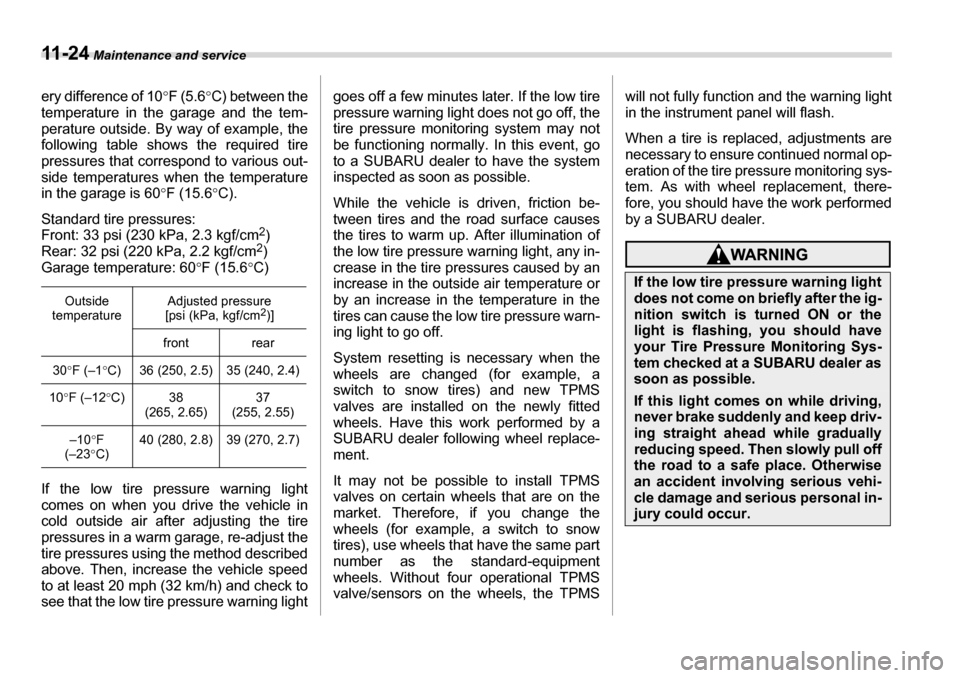
If the low tire pressure warning light
comes on when you drive the vehicle in
cold outside air after adjusting the tire
pressures in a warm garage, re-adjust the
tire pressures using the method described
above. Then, increase the vehicle speed
to at least 20 mph (32 km/h) and check to
see that the low tire pressure warning light goes off a few minutes later. If the low tire
pressure warning light does not go off, the
tire pressure monitoring system may not
be functioning normally. In this event, go
to a SUBARU dealer to have the system
inspected as soon as possible.
While the vehicle is driven, friction be-
tween tires and the road surface causes
the tires to warm up. After illumination of
the low tire pressure warning light, any in-
crease in the tire pressures caused by an
increase in the outside air temperature or
by an increase in the temperature in the
tires can cause the low tire pressure warn-
ing light to go off.
System resetting is necessary when the
wheels are changed (for example, a
switch to snow tires) and new TPMS
valves are installed on the newly fitted
wheels. Have this work performed by a
SUBARU dealer following wheel replace- ment.
It may not be possible to install TPMS
valves on certain wheels that are on the
market. Therefore, if you change the
wheels (for example, a switch to snow
tires), use wheels that have the same part
number as the standard-equipment
wheels. Without four operational TPMS
valve/sensors on the wheels, the TPMS
will not fully function and the warning light
in the instrument panel will flash.
When a tire is replaced, adjustments are
necessary to ensure continued normal op- eration of the tire pressure monitoring sys-
tem. As with wheel replacement, there-
fore, you should have the work performed
by a SUBARU dealer.
Outside
temperature Adjusted pressure
[psi (kPa, kgf/cm 2
)]
front rear
30 °F (–1 °C) 36 (250, 2.5) 35 (240, 2.4)
10 °F (–12 °C) 38
(265, 2.65) 37
(255, 2.55)
–10 °F
(–23 °C) 40 (280, 2.8) 39 (270, 2.7)
If the low tire pressure warning light
does not come on briefly after the ig-
nition switch is turned ON or the
light is flashing, you should have
your Tire Pressure Monitoring Sys-
tem checked at a SUBARU dealer as
soon as possible.
If this light comes on while driving,
never brake suddenly and keep driv-
ing straight ahead while gradually
reducing speed. Then slowly pull off
the road to a safe place. Otherwise
an accident involving serious vehi-
cle damage and serious personal in-
jury could occur.
Page 337 of 377
11 - 4 0 Maintenance and service
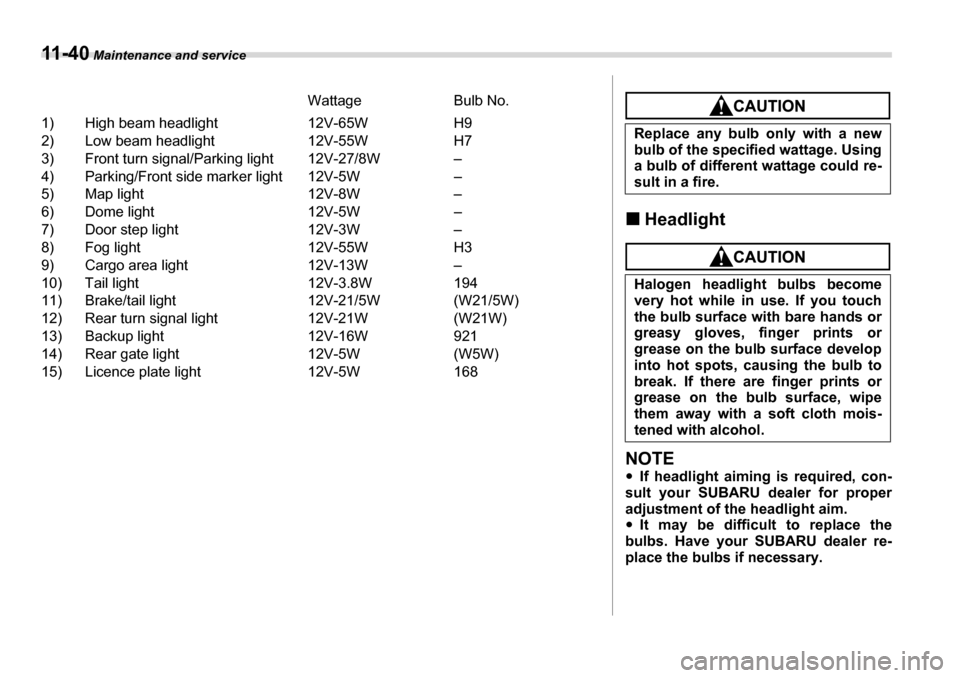
Wattage Bulb No.
1) High beam headlight 12V-65W H9
2) Low beam headlight 12V-55W H7
3) Front turn signal/Parking light 12V-27/8W –
4) Parking/Front side marker light 12V-5W –
5) Map light 12V-8W –
6) Dome light 12V-5W –
7) Door step light 12V-3W –
8) Fog light 12V-55W H3
9) Cargo area light 12V-13W –
10) Tail light 12V-3.8W 194
11) Brake/tail light 12V-21/5W (W21/5W)
12) Rear turn signal light 12V-21W (W21W)
13) Backup light 12V-16W 921
14) Rear gate light 12V-5W (W5W)
15) Licence plate light 12V-5W 168
„ Headlight
NOTE yIf headlight aiming is required, con-
sult your SUBARU dealer for proper
adjustment of the headlight aim. y It may be difficult to replace the
bulbs. Have your SUBARU dealer re-
place the bulbs if necessary. Replace any bulb only with a new
bulb of the specified wattage. Using
a bulb of different wattage could re-
sult in a fire.
Halogen headlight bulbs become
very hot while in use. If you touch
the bulb surface with bare hands or
greasy gloves, finger prints or
grease on the bulb surface develop
into hot spots, causing the bulb to
break. If there are finger prints or
grease on the bulb surface, wipe
them away with a soft cloth mois-
tened with alcohol.
Page 340 of 377
Maintenance and service 11 - 4 3
– CONTINUED –
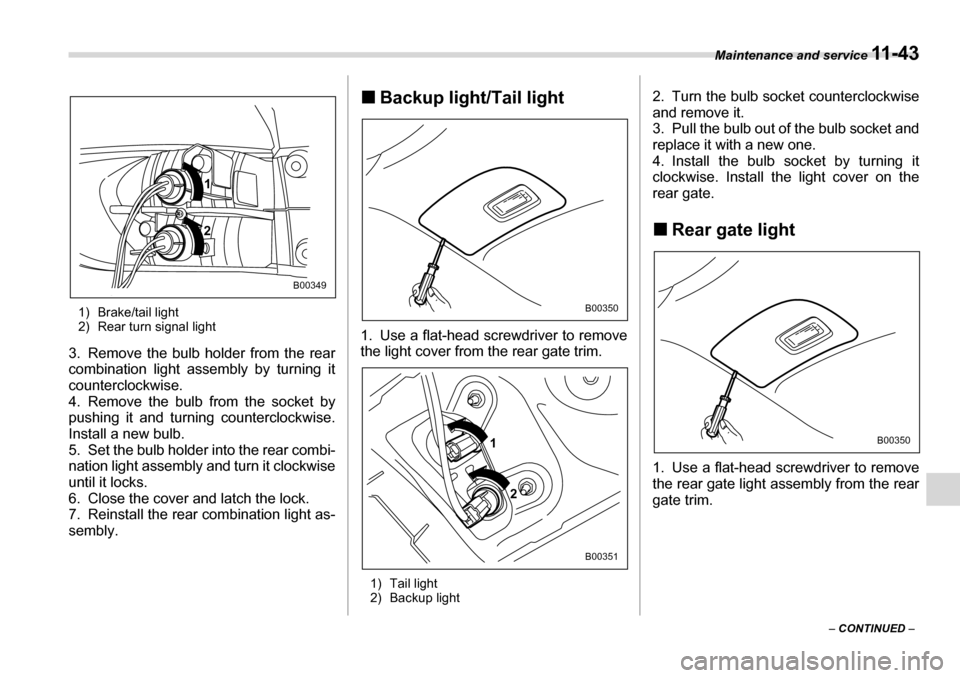
1) Brake/tail light
2) Rear turn signal light
3. Remove the bulb holder from the rear
combination light assembly by turning it
counterclockwise.
4. Remove the bulb from the socket by
pushing it and turning counterclockwise.
Install a new bulb.
5. Set the bulb holder into the rear combi-
nation light assembly and turn it clockwise
until it locks.
6. Close the cover and latch the lock.
7. Reinstall the rear combination light as-
sembly. „
Backup light/Tail light
1. Use a flat-head screwdriver to remove
the light cover from the rear gate trim. 1) Tail light
2) Backup light 2. Turn the bulb socket counterclockwise
and remove it.
3. Pull the bulb out of the bulb socket and
replace it with a new one.
4. Install the bulb socket by turning it
clockwise. Install the light cover on the
rear gate. „
Rear gate light
1. Use a flat-head screwdriver to remove
the rear gate light assembly from the rear
gate trim.
1
2
B00349
B00350
1
2
B00351
B00350
Page 351 of 377
12-8 Specifications
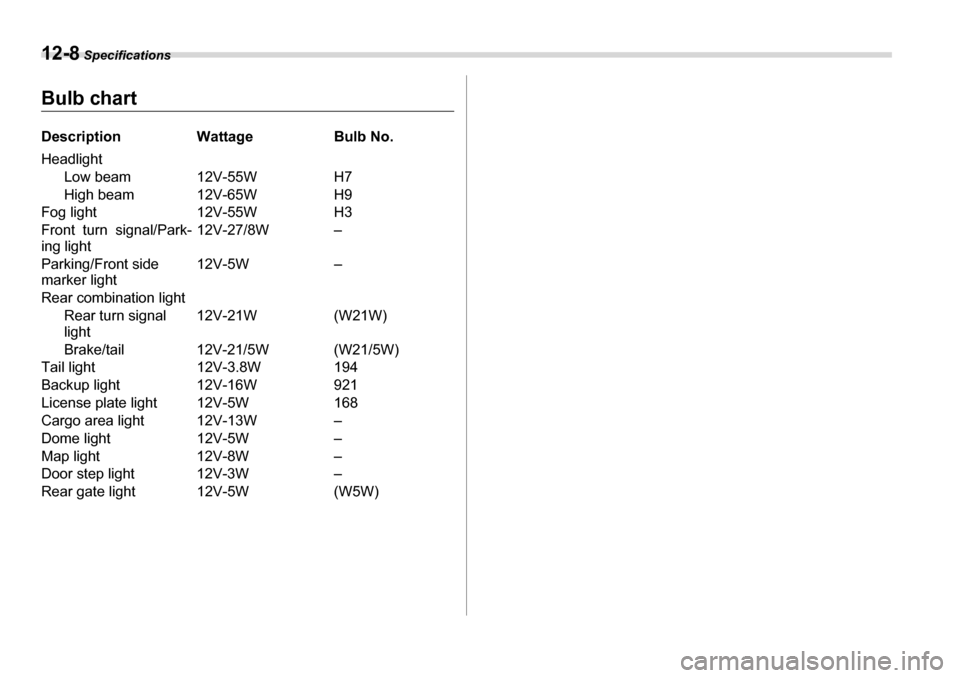
Bulb chart
Description Wattage Bulb No.
Headlight
Low beam 12V-55W H7
High beam 12V-65W H9
Fog light 12V-55W H3
Front turn signal/Park-
ing light 12V-27/8W –
Parking/Front side marker light 12V-5W –
Rear combination light Rear turn signal
light 12V-21W (W21W)
Brake/tail 12V-21/5W (W21/5W)
Tail light 12V-3.8W 194
Backup light 12V-16W 921
License plate light 12V-5W 168
Cargo area light 12V-13W –
Dome light 12V-5W –
Map light 12V-8W –
Door step light 12V-3W –
Rear gate light 12V-5W (W5W)
Page 369 of 377
14-2 Index
A
ABS (Anti-lock Brake System) .......................................... 7-16 Warning light ....................................................... 3-15, 7-17
Accessories .................................................................... 11-38
Accessory power outlet ...................................................... 6-8
Active head restraint ........................................................... 1-5
Air cleaner element ........................................................ 11-13
Air filtration system ........................................................... 4-11
Air flow ............................................................................... 4-2
Alarm system .................................................................... 2-14
All-Wheel Drive warning light ........................................... 3-17
Aluminum wheels ........................................................... 11-29
Antenna system ................................................................. 5-2
Anti-lock Brake System (ABS) .......................................... 7-16
Arming the system ............................................................ 2-15
Armrest ............................................................................. 1-11
AT OIL TEMPerature warning light .................................. 3-13
Audio control buttons ....................................................... 5-22
Audio set ............................................................................ 5-3
Auto-dimming mirror/compass ......................................... 3-34
Automatic climate control system ....................................... 4-5
Automatic transmission ...................................................... 7-8 Capacities .................................................................... 12-3
Fluid ........................................................................... 11-15
Manual mode ............................................................... 7-11
Selector lever ................................................................. 7-9
Shift lock release ......................................................... 7-14
Temperature warning light (AT OIL TEMP) ................. 3-13
Automatic/Emergency Locking Retractor (A/ELR) ........... 1-16 B
Battery ............................................................................ 11-35 Jump starting ............................................................... 9-11
Replacement (Remote keyless entry system) ............. 2-10
Brake
Booster ...................................................................... 11-21
Fluid ........................................................................... 11-20
Pad and lining ............................................................ 11-22
Pedal .......................................................................... 11-21
Brake pedal
Free play .................................................................... 11-21
Reserve distance ....................................................... 11-21
Brake system .................................................................... 7-15
Warning light ................................................................ 3-16
Braking ............................................................................. 7-15 Breaking-in of new brake pads and linings ................ 11-22
Tips .............................................................................. 7-15
Bulb Chart ............................................................................ 12-8
Replacing ................................................................... 11-39
C
Capacities ......................................................................... 12-3
Cargo area Light ............................................................................... 6-2
Tie-down hooks ........................................................... 6-12
Catalytic converter .............................................................. 8-3
Center Console .......................................................................... 6-5
Ventilators ...................................................................... 4-4
Changing
Flat tire ........................................................................... 9-7
Oil and oil filter ............................................................. 11-7
Charge warning light ......................................................... 3-13