2007 SUBARU OUTBACK towing
[x] Cancel search: towingPage 356 of 442
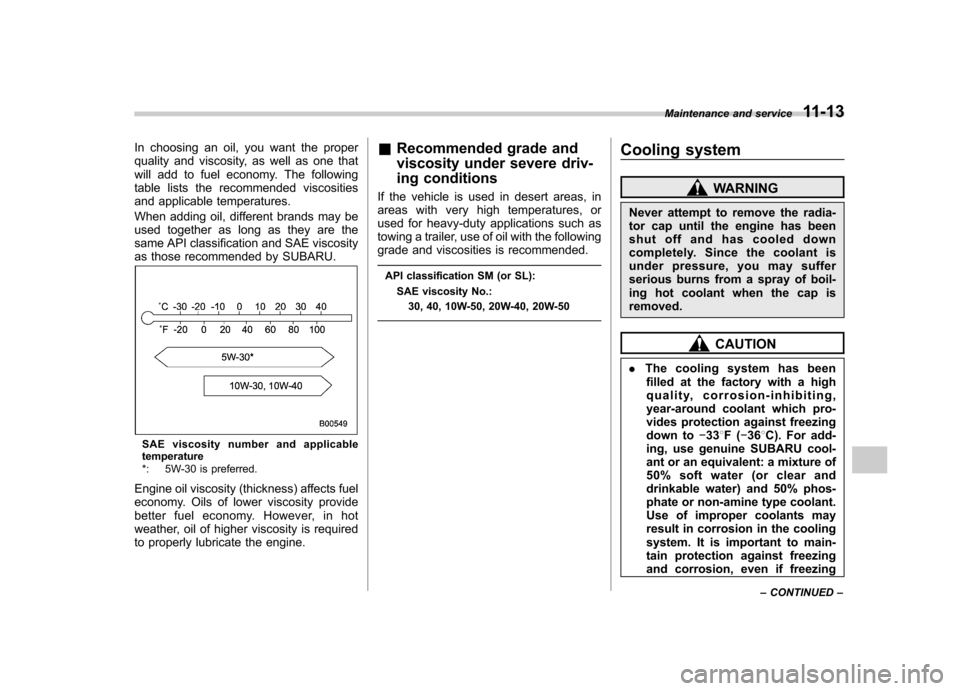
In choosing an oil, you want the proper
quality and viscosity, as well as one that
will add to fuel economy. The following
table lists the recommended viscosities
and applicable temperatures.
When adding oil, different brands may be
used together as long as they are the
same API classification and SAE viscosity
as those recommended by SUBARU.
SAE viscosity number and applicable
temperature
*: 5W-30 is preferred.
Engine oil viscosity (thickness) affects fuel
economy. Oils of lower viscosity provide
better fuel economy. However, in hot
weather, oil of higher viscosity is required
to properly lubricate the engine. &
Recommended grade and
viscosity under severe driv-
ing conditions
If the vehicle is used in desert areas, in
areas with very high temperatures, or
used for heavy-duty applications such as
towing a trailer, use of oil with the following
grade and viscosities is recommended.
API classification SM (or SL): SAE viscosity No.: 30, 40, 10W-50, 20W-40, 20W-50 Cooling system
WARNING
Never attempt to remove the radia-
tor cap until the engine has been
shut off and has cooled down
completely. Since the coolant is
under pressure, you may suffer
serious burns from a spray of boil-
ing hot coolant when the cap isremoved.
CAUTION
. The cooling system has been
filled at the factory with a high
quality, corrosion-inhibiting,
year-around coolant which pro-
vides protection against freezing
down to 33 8F( 36 8C). For add-
ing, use genuine SUBARU cool-
ant or an equivalent: a mixture of
50% soft water (or clear and
drinkable water) and 50% phos-
phate or non-amine type coolant.
Use of improper coolants may
result in corrosion in the cooling
system. It is important to main-
tain protection against freezing
and corrosion, even if freezing Maintenance and service
11-13
– CONTINUED –
Page 408 of 442

&Tires
Tire size P205/55R16 89H P225/60R16 97H P205/50R17 88V 215/45ZR17 P225/55R17 95V 215/45R18 89Y
Wheel size 16 66.5JJ 1767JJ 18 67JJ
Pressure Front 32 psi (220 kPa,
2.2 kgf/cm
2) 32 psi (220 kPa,
2.2 kgf/cm2) 33 psi (230 kPa,
2.3 kgf/cm2) 35 psi (240 kPa,
2.4 kgf/cm2) 32 psi (220 kPa,
2.2 kgf/cm2) 33 psi (230 kPa,
2.3 kgf/cm2)
Rear 30 psi (210 kPa,
2.1 kgf/cm
2) 30 psi (210 kPa,
2.1 kgf/cm2) 32 psi (220 kPa,
2.2 kgf/cm2) 33 psi (230 kPa,
2.3 kgf/cm2) 30 psi (210 kPa,
2.1 kgf/cm2) 32 psi (220 kPa,
2.2 kgf/cm2)
Rear at trailer towing –
32 psi (220 kPa,
2.2 kgf/cm
2) –
32 psi (220 kPa,
2.2 kgf/cm2) –
Temporary
spare tire Size T135/80R16 T155/70D17 T135/80R16 T135/70D17 T155/70D17 T155/70D17 Pressure
60 psi (420 kPa, 4.2 kgf/cm
2)
& Wheel alignment
Item Legacy OUTBACK
Sedan Station wagon Sedan Station wagon
Toe Front 0 in (0 mm)
Rear 0 in (0 mm)
Camber Front 0815 ’ 0840 ’
Rear 0840 ’ 0830 ’
0810 ’Specifications
12-5
Page 420 of 442

&Recommended tire inflation pressure
! Recommended cold tire inflation pressure
Recommended cold tire inflation pressure for your vehicle ’s tires is as follows,
Tire size P205/55R16
89H P225/60R16
97H P205/50R17
88V 215/45ZR17 P225/55R17
95V 215/45R18
89Y
Wheel size 16 66.5JJ 17 67JJ 18 67JJ
Pressure Front 32 psi
(220 kPa,
2.2 kgf/cm
2) 32 psi
(220 kPa,
2.2 kgf/cm2) 33 psi
(230 kPa,
2.3 kgf/cm2) 35 psi
(240 kPa,
2.4 kgf/cm2) 32 psi
(220 kPa,
2.2 kgf/cm2) 33 psi
(230 kPa,
2.3 kgf/cm2)
Rear 30 psi
(210 kPa,
2.1 kgf/cm
2) 30 psi
(210 kPa,
2.1 kgf/cm2) 32 psi
(220 kPa,
2.2 kgf/cm2) 33 psi
(230 kPa,
2.3 kgf/cm2) 30 psi
(210 kPa,
2.1 kgf/cm2) 32 psi
(220 kPa,
2.2 kgf/cm2)
Rear at trailertowing –
32 psi
(220 kPa,
2.2 kgf/cm
2) –
32 psi
(220 kPa,
2.2 kgf/cm2) –
Temporary
spare tire Size T135/80R16 T155/70D17 T135/80R16 T135/70D17 T155/70D17 T155/70D17
Pressure
60 psi (420 kPa, 4.2 kgf/cm
2)
Consumer information and Reporting safety defects
13-5
– CONTINUED –
Page 423 of 442
13-8Consumer information and Reporting safety defects
specification for the wheel nuts can be found “Flat tires ”section in chapter 9.
& Vehicle load limit –how to
determine
The load capacity of your vehicle is
determined by weight, not by avail-
able cargo space. The load limit of
your vehicle is shown on the vehicle
placard attached to the driver ’s side
B-pillar. Locate the statement “The
combined weight of occupants and
cargo should never exceed XXX kg or
XXX lbs ”on your vehicle ’s placard.
The vehicle placard also shows seat-
ing capacity of your vehicle.
The total load capacity includes the
total weight of driver and all passen-
gers and their belongings, any cargo,
any optional equipment such as a
trailer hitch, roof rack or bike carrier,
etc., and the tongue load of a trailer.
Therefore cargo capacity can be
calculated by the following method.
Cargo capacity = Load limit (total
weight of occupants + total weight of
optional equipment + tongue load of a
trailer (if applicable)) For towing capacity information and
weight limits, refer to
“Trailer towing ”
section in chapter 8. ! Calculating total and load ca-
pacities varying seating con-
figurations
Calculate the available load capacity
as shown in the following examples:
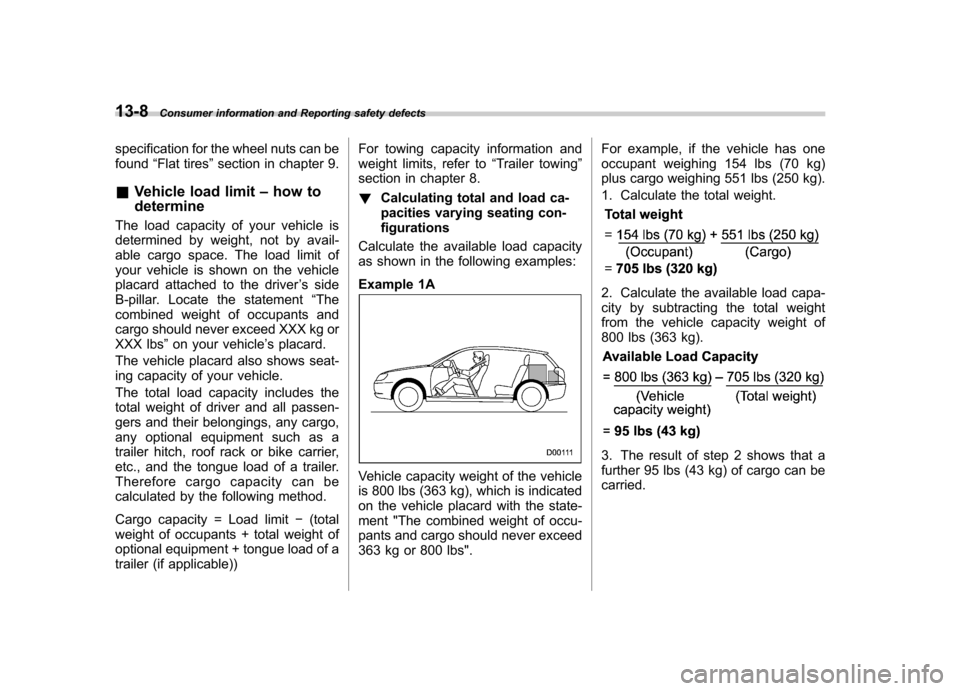
Example 1A
Vehicle capacity weight of the vehicle
is 800 lbs (363 kg), which is indicated
on the vehicle placard with the state-
ment "The combined weight of occu-
pants and cargo should never exceed
363 kg or 800 lbs". For example, if the vehicle has one
occupant weighing 154 lbs (70 kg)
plus cargo weighing 551 lbs (250 kg).
1. Calculate the total weight.
2. Calculate the available load capa-
city by subtracting the total weight
from the vehicle capacity weight of
800 lbs (363 kg).
3. The result of step 2 shows that a
further 95 lbs (43 kg) of cargo can be
carried.
Page 426 of 442

suspension, axles and other parts of
the body.
Therefore, this means that the vehicle
cannot necessarily be loaded up to
the tire’s maximum load rating on the
tire sidewall. & Adverse safety conse-
quences of overloading on
handling and stopping and
on tires
Overloading could affect vehicle
handling, stopping distance, vehicle
and tire as shown in the following.
This could lead to an accident and
possibly result in severe personal
injury. . Vehicle stability will deteriorate.
. Heavy and/or high-mounted loads
could increase the risk of rollover. . Stopping distance will increase.
. Brakes could overheat and fail.
. Suspension, bearings, axles and
other parts of the body could break or
experience accelerated wear that will
shorten vehicle life. . Tires could fail.
. Tread separation could occur.
. Tire could separate from its rim. &
Steps for Determining Cor-
rect Load Limit
1. Locate the statement “The com-
bined weight of occupants and cargo
should never exceed XXX pounds ”on
your vehicle ’s placard.
2. Determine the combined weight of
the driver and passengers that will be
riding in your vehicle.
3. Subtract the combined weight of
the driver and passengers from XXX
kilograms or XXX pounds.
4. The resulting figure equals the
available amount of cargo and lug-
gage load capacity. For example, ifthe “XXX ”amount equals 1,400 lbs
(635kg). and there will be five- 150 lbs
(68 kg) passengers in your vehicle,
the amount of available cargo and
luggage load capacity is 650 lbs. (1,400 750 (5 6150) = 650 lbs.)
5. Determine the combined weight of
luggage and cargo being loaded on
the vehicle. That weight may not
safely exceed the available cargo
and luggage load capacity calculated
in Step 4.
6. If your vehicle will be towing a trailer, load from your trailer will be
transferred to your vehicle. Consult
this manual to determine how this
reduces the available cargo and
luggage load capacity of your vehicle.
Consumer information and Reporting safety defects
13-11
Page 437 of 442

14-8Index
Seatbelts .................................................................. 1-13
Security ID plate .......................................................... 2-3
Selector lever .................................................... 7-19, 7-25
Position indicator ........................................... 3-32, 3-33
Shift lock release ............................................... 7-23, 7-30
Shift-up indicator light ................................................. 3-32
Shock sensors ........................................................... 2-19
Shopping bag hook .................................................... 6-11
SI-DRIVE mode ......................................................... 7-31
Snow tires ................................................................. 8-10
Snowy and icy roads .................................................... 8-9
Sounding a panic alarm .............................................. 2-10
Spark plugs .............................................................. 11-20
Specifications ............................................................ 12-2
Speedometer ....................................................... 3-6, 3-18
SRS
Curtain airbag ........................................................ 1-55
Frontal airbag ........................................................ 1-45
Side airbag ........................................................... 1-55
SRS airbag (Supplemental Restraint System airbag) ... 4, 1-40
SRS airbag system
Monitors. ............................................................... 1-61
Servicing ............................................................... 1-63
SRS airbag system warning light ................................. 3-24
Starting the engine ....................................................... 7-9
State emission testing (U.S. only) .................................. 7-7
Steering wheel
Power ................................................................... 7-33
Tilt ....................................................................... 3-51
Stopping the engine ................................................... 7-11
Storage compartment ................................................... 6-4 Stowage boxes
.......................................................... 6-15
Sun shade ......................................................... 2-28, 2-29
Sun visors .................................................................. 6-3
Supplemental Restraint System airbag (SRS) ................ 1-40
Synthetic leather upholstery ......................................... 10-5
T
Tachometer ......................................................... 3-6, 3-20
Temperature gauge ...................................... 3-7, 3-11, 3-21
Temperature warning light (AT OIL TEMP) ..................... 3-26
Temporary spare tire .................................................... 9-2
Tie-down hooks .......................................................... 9-13
Tilt steering wheel. ...................................................... 3-51
Tire
Chains .................................................................. 8-12
Inspection ............................................................ 11-36
Pressures and wear .............................................. 11-36
Replacement. ....................................................... 11-40
Rotation .............................................................. 11-39
Tire pressure monitoring system (TPMS) ....................... 7-43
Tires ......................................................................... 12-5
Types .................................................................. 11-34
Tires and wheels ...................................................... 11-34
Top tether anchorages ................................................ 1-37
Towing ...................................................................... 9-13
All wheels on the ground ......................................... 9-16
Flat-bed truck ......................................................... 9-16
Tie-down hooks ...................................................... 9-13
Weight .................................................................. 8-22
Trailer
Hitch ..................................................................... 8-19
Page 438 of 442

Hitches................................................................. 8-25
Towing .................................................................. 8-21
Towing tips ............................................................ 8-27
Trip meter ................................................................. 3-19
Trunk lid ................................................................... 2-22
Release handle ..................................................... 2-23
Trunk light ................................................................ 11-58
Turn signal Indicator lights ....................................................... 3-33
Lever .................................................................... 3-41
U
Under-floor storage compartment ................................. 6-16
V
Valet mode ................................................................ 2-17
Vanity mirror ................................................................ 6-4
Vehicle Capacity weight ..................................................... 8-14
Identification ......................................................... 12-11
Symbols .................................................................... 3
Vehicle Dynamics Control OFF indicator light .................................................. 3-30
OFF switch ........................................................... 7-42
Operation indicator light .......................................... 3-30
System ................................................................. 7-38
Warning light ......................................................... 3-30
Ventilator .................................................................... 4-2
W
Warning and indicator lights ........................................ 3-22 Warning lights
ABS...................................................................... 3-28
All-Wheel Drive ...................................................... 3-30
Anti-lock Brake System ........................................... 3-28
AT OIL TEMPerature ............................................... 3-26
Brake system ......................................................... 3-28
Charge .................................................................. 3-26
CHECK ENGINE .................................................... 3-25
Door open ............................................................. 3-29
Low fuel ................................................. 3-7, 3-21, 3-29
Oil pressure ........................................................... 3-26
Seatbelt. ................................................................ 3-22
SRS airbag system ................................................. 3-24
Vehicle Dynamics Control ................................ 3-30, 7-40
Warranties ..................................................................... 1
Warranties and maintenance ........................................ 8-21
Washing .................................................................... 10-2
Waxing and polishing .................................................. 10-3
Wear indicators ........................................................ 11-38
Wheel Alignment .............................................................. 12-5
Balance ............................................................... 11-38
Replacement. ....................................................... 11-40
Windows ................................................................... 2-20
Windshield Washer fluid. ........................................................ 11-41
Wiper and washer switches ..................................... 3-44
Wiper blades ........................................................ 11-43
Wiper deicer .......................................................... 3-46
Winter driving .............................................................. 8-8
Wiper and washer ...................................................... 3-43 Index
14-9
Page 441 of 442

GAS STATION REFERENCE
& Fuel:
! 2.5-liter non-turbo models
Use only unleaded gasoline with an octane rating of 87 AKI or
higher. ! 2.5-liter turbo models
Use premium unleaded gasoline with an octane rating of 91 AKI
or higher. For temporary purposes if premium unleaded
gasoline is not available, you may use regular unleaded
gasoline with an octane rating of 87 AKI or higher. For optimum
engine performance and driveability, it is required that you use
premium grade unleaded gasoline. ! 3.0-liter models
Use unleaded gasoline with an octane rating of 91 AKI or
higher. Regular unleaded gasoline with an octane rating of 87
AKI or higher may be used. However for optimum engine
performance and driveability, it is recommended that you use
91 AKI or higher grade unleaded gasoline. You may experience
reduced output, poor accelerator response, and reduced fuel
economy when using gasoline with an octane rating lower than
91 AKI, depending on your driving habits and conditions. If you
experience any of these conditions while using a lower octane
rated fuel, you may want to return to using 91 AKI octane rated
fuel as soon as possible. Additionally, if your vehicle knocks
heavily or persistently, or if you are driving with heavy loads
such as when towing a trailer, the use of 91 AKI or higher grade
unleaded gasoline is required. &
Fuel octane rating
This octane rating is the average of the Research Octane and
Motor Octane numbers and is commonly referred to as the Anti
Knock Index (AKI). Refer to “Fuel ”section in this manual.
& Fuel capacity:
16.9 US gal (64 liters, 14.1 Imp gal) & Engine oil:
Use only API classification SM with the words “ENERGY
CONSERVING ”and the ILSAC certification mark (starburst
mark) displayed on the container.& Engine oil capacity:
2.5-liter models: 4.2 US qt (4.0 liters, 3.5 Imp qt)
3.0-liter models: 5.8 US qt (5.5 liters, 4.8 Imp qt)