2007 SUBARU FORESTER spark
[x] Cancel search: sparkPage 202 of 356
7-4 Starting and operating
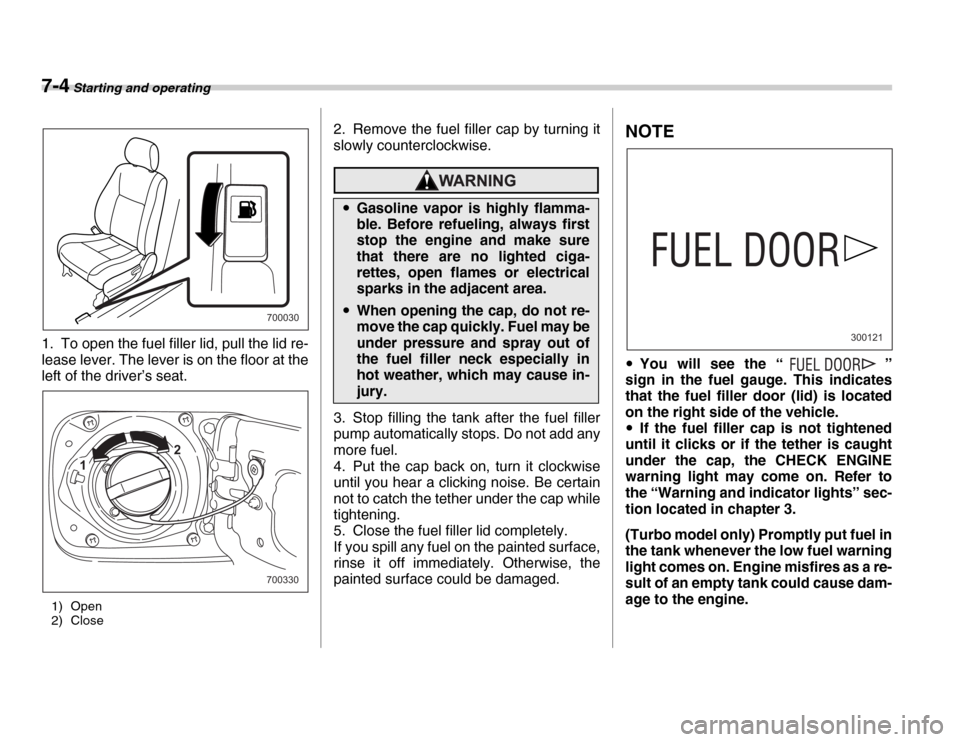
1. To open the fuel filler lid, pull the lid re-
lease lever. The lever is on the floor at the
left of the driver’s seat.1) Open
2) Close 2. Remove the fuel filler cap by turning it
slowly counterclockwise.
3. Stop filling the tank after the fuel filler
pump automatically stops. Do not add any
more fuel.
4. Put the cap back on, turn it clockwise
until you hear a clicking noise. Be certain
not to catch the tether under the cap while
tightening.
5. Close the fuel filler lid completely.
If you spill any fuel on the painted surface,
rinse it off immediately. Otherwise, the
painted surface could be damaged.
NOTE y
You will see the “ ”
sign in the fuel gauge. This indicates
that the fuel filler door (lid) is located
on the right side of the vehicle. y If the fuel filler cap is not tightened
until it clicks or if the tether is caught
under the cap, the CHECK ENGINE
warning light may come on. Refer to
the “Warning and indicator lights” sec-
tion located in chapter 3.
(Turbo model only) Promptly put fuel in
the tank whenever the low fuel warning
light comes on. Engine misfires as a re-
sult of an empty tank could cause dam-
age to the engine.
700030
1 2
700330
y
Gasoline vapor is highly flamma-
ble. Before refueling, always first
stop the engine and make sure
that there are no lighted ciga-
rettes, open flames or electrical
sparks in the adjacent area.
yWhen opening the cap, do not re-
move the cap quickly. Fuel may be
under pressure and spray out of
the fuel filler neck especially in
hot weather, which may cause in-
jury.
300121
Page 257 of 356

In case of emergency 9-7
– CONTINUED –
14.Store the flat tire in the spare tire com-
partment.
Put the spacer and tighten the attaching
bolt firmly.
Also store the jack and wheel nut wrench
in their storage locations.
Jump starting
When your vehicle does not start due to a
run down (discharged) battery, the vehicle
may be jump started by connecting your
battery to another battery (called the
booster battery) with jumper cables.
Never place a tire or tire changing
tools in the passenger compartment
after changing wheels. In a sudden
stop or collisions, loose equipment
could strike occupants and cause
injury. Store the tire and all tools in
the proper place.
900012
y
Battery fluid is SULFURIC ACID.
Do not let it come in contact with
the eyes, skin, clothing or the ve-
hicle.
If battery fluid gets on you, thor-
oughly flush the exposed area
with water immediately. Get medi-
cal help if the fluid has entered
your eyes.
If battery fluid is accidentally
swallowed, immediately drink a
large amount of milk or water, and
obtain immediate medical help.
Keep everyone including children
away from the battery.
yThe gas generated by a battery ex-
plodes if a flame or spark is
brought near it. Do not smoke or
light a match while jump starting.
yNever attempt jump starting if the
discharged battery is frozen. It
could cause the battery to burst or
explode.
yWhenever working on or around a
battery, always wear suitable eye
protectors, and remove metal ob-
jects such as rings, bands or oth-
er metal jewelry.
yBe sure the jumper cables and
clamps on them do not have loose
or missing insulation.
Do not jump start unless cables in
suitable condition are available.
yA running engine can be danger-
ous. Keep your fingers, hands,
clothing, hair and tools away from
the cooling fan, belts and any oth-
er moving engine parts. Remov-
ing rings, watches and ties is ad-
visable.
yJump starting is dangerous if it is
done incorrectly. If you are unsure
about the proper procedure for
jump starting, consult a compe-
tent mechanic.
Page 273 of 356

11
Maintenance and service
Maintenance schedule ....................................... 11-3
Maintenance precautions .................................. 11-3Before checking or servicing in the engine compartment ........................................................ 11-4
When you do checking or servicing in the
engine compartment while the engine is
running .................................................................. 11-4
Engine hood ....................................................... 11-4
Engine compartment overview ......................... 11-6 Non-turbo models ................................................... 11-6
Turbo models .......................................................... 11-7
Engine oil ............................................................ 11-8 Checking the oil level ............................................. 11-8
Changing the oil and oil filter ................................ 11-8
Recommended grade and viscosity ..................... 11-10
Recommended grade and viscosity under severe driving conditions .................................... 11-11
Synthetic oil ............................................................ 11-11
Cooling system .................................................. 11-11 Cooling fan, hose and connections ...................... 11-12
Engine coolant ........................................................ 11-12
Air cleaner element ............................................ 11-15 Replacing the air cleaner element ......................... 11-15
Spark plugs ......................................................... 11-17 Recommended spark plugs ................................... 11-17
Drive belts ........................................................... 11-18
Manual transmission oil .................................... 11-18 Checking the oil level ............................................. 11-18 Recommended grade and viscosity ..................... 11-19
Automatic transmission fluid ............................ 11-20 Checking the fluid level .......................................... 11-20
Recommended fluid ............................................... 11-21
Front differential gear oil (AT vehicles) ............ 11-21 Checking the oil level ............................................. 11-21
Recommended grade and viscosity ..................... 11-22
Rear differential gear oil .................................... 11-22 Checking the gear oil level .................................... 11-22
Recommended grade and viscosity ..................... 11-23
Power steering fluid ........................................... 11-23 Checking the fluid level .......................................... 11-23
Recommended fluid ............................................... 11-24
Brake fluid ........................................................... 11-25 Checking the fluid level .......................................... 11-25
Recommended brake fluid ..................................... 11-25
Clutch fluid (MT vehicles) .................................. 11-26 Checking the fluid level .......................................... 11-26
Recommended clutch fluid .................................... 11-26
Brake booster ..................................................... 11-27
Brake pedal ......................................................... 11-27 Checking the brake pedal free play ...................... 11-27
Checking the brake pedal reserve distance ......... 11-27
Clutch pedal (MT vehicles) ................................ 11-28 Checking the clutch function ................................ 11-28
Checking the clutch pedal free play ..................... 11-28
Hill holder (MT vehicles – if equipped) ............. 11-28
Page 289 of 356

Maintenance and service 11 - 17
3. Clean the inside of the air cleaner cov-
er and case with a damp cloth and install
a new air cleaner element.
4. To install the air cleaner case cover, in-
sert the two projections on the air cleaner
case cover into the slits on the air cleaner
case and then snap the two clamps on the
air cleaner case cover.Spark plugs
It may be difficult to replace the spark
plugs. It is recommended that you have
the spark plugs replaced by your
SUBARU dealer.
The spark plugs should be replaced ac-
cording to the maintenance schedule in
the “Warranty and Maintenance Booklet”.„
Recommended spark plugs
Non-turbo models:
FR5AP-11 (NGK)
Turbo models:
ILFR6B (NGK)
B00026
y When disconnecting the spark
plug cables, always grasp the
spark plug cap, not the cables.
y Make sure the cables are replaced
in the correct order.
B00027
Page 312 of 356
11 - 4 0 Maintenance and service
ber is not retained properly, the wiper may
scratch the rear window glass.
8. Install the wiper blade assembly to the
wiper arm. Make sure that it locks in place.
9. Lower the wiper arm.Battery
yBefore beginning work on or near
any battery, be sure to extinguish
all cigarettes, matches, and light-
ers. Never expose a battery to an
open flame or electric sparks. Bat-
teries give off a gas which is high-
ly flammable and explosive.
yFor safety, in case an explosion
does occur, wear eye protection
or shield your eyes when working
near any battery. Never lean over
a battery.
yDo not let battery fluid contact
eyes, skin, fabrics, or paint be-
cause battery fluid is a corrosive
acid. If battery fluid gets on your
skin or in your eyes, immediately
flush the area with water thor-
oughly. Seek medical help imme-
diately if acid has entered the
eyes.
If battery fluid is accidentally
swallowed, immediately drink a
large amount of milk or water, and
seek medical attention immediate-
ly.
yTo lessen the risk of sparks, re-
move rings, metal watchbands,
and other metal jewelry. Never al-
low metal tools to contact the pos-
itive battery terminal and anything
connected to it WHILE you are at
the same time in contact with any
other metallic portion of the vehi-
cle because a short circuit will re-
sult.
yKeep everyone including children
away from the battery.
yCharge the battery in a well-venti-
lated area.
yBattery posts, terminals and relat-
ed accessories contain lead and
lead compounds, chemicals
known to the State of California to
cause cancer and reproductive
harm. Batteries also contain other
chemicals known to the State of
California to cause cancer. Wash
hands after handling.
Never use more than 10 amperes
when charging the battery because
it will shorten battery life.
Page 325 of 356

Specifications 12-3
–
CONTINUED –
„ Engine
„ Electrical system
Engine modelEJ253 (2.5-liter, SOHC, non-turbo)EJ255 (2.5-liter, DOHC, turbo)
Engine typeHorizontally opposed, liquid cooled 4 cylinder, 4-stroke gasoline engine
Displacement cc (cu-in)2,457 (150)
Bore u Stroke in (mm)3.92 u 3.11 (99.5 u 79.0)
Compression ratio10.0 : 18.4 : 1
Firing order1 – 3 – 2 – 4
Battery type and capacity (5HR)Manual transmission12V-48AH (55D23L)
Automatic transmission12V-52AH (75D23L)
Alternator2.5-liter turbo models12V-110A
2.5-liter non-turbo models12V-90A
Spark plugs2.5-liter non-turbo modelsFR5AP-11 (NGK)
2.5-liter turbo modelsILFR6B (NGK)
Page 352 of 356

14-6 Index
ReplacingAir cleaner element .................................................... 11-15
Battery (remote keyless entry) ....................................... 2-8
Bulbs ......................................................................... 11-44
Transmitters ................................................................... 2-9
Rocking the vehicle .......................................................... 8-11
Roof rail and crossbar ...................................................... 8-13 S
Safety
Precautions when driving .................................................. 4
Symbol .............................................................................. 2
Warnings ........................................................................... 2
Seat height adjustment (drivers seat) ................................. 1-4
Seatbelt .................................................................................. 4
Extender ...................................................................... 1-20
Maintenance ................................................................ 1-19
Pretensioners .............................................................. 1-21
Safety tips .................................................................... 1-10
Warning light and chime ....................................... 1-12, 3-9
Seatbelts .......................................................................... 1-10
Seats Fabric .......................................................................... 10-4
Heater ............................................................................ 1-7
Selector lever (AT vehicles) ............................................. 7-11
Self-leveling rear suspension ........................................... 7-25
Shift lock release .............................................................. 7-14
Shift position indicator ...................................................... 3-15
Shopping bag hook .......................................................... 6-14
Snow tires ........................................................................ 8-10
Snowy and icy roads .......................................................... 8-9
Spark plugs .................................................................... 11-17 Specifications ................................................................... 12-2
Speedometer ...................................................................... 3-6 SRS
Airbag system warning light ......................................... 3-10
Frontal airbag ............................................................... 1-40
Side airbag ................................................................... 1-52
SRS airbag (Supplemental Restraint System airbag) ... 4, 1-36
Steering wheel Power ........................................................................... 7-15
Tilt wheel ...................................................................... 3-28
Storage compartments ....................................................... 6-4
Sun visors ........................................................................... 6-3
Supplemental Restraint System airbag ............................ 1-36
Synthetic leather upholstery ............................................. 10-5 T
Tachometer ........................................................................ 3-7
Temperature gauge ............................................................ 3-8
Temperature warning (AT OIL TEMP) .............................. 3-12
Tie-down hooks ................................................................ 9-11
Tilt steering wheel ............................................................. 3-28
Tire Chains .......................................................................... 8-10
Inspection .................................................................. 11-30
Pressures and wear ................................................... 11-31
Replacement .............................................................. 11-34
Rotation ..................................................................... 11-34
Types ......................................................................... 11-30
Top tether anchorages ..................................................... 1-34
Towing .............................................................................. 9-10
All wheels on the ground ............................................. 9-12
Flat-bed truck ............................................................... 9-12