2007 SUBARU FORESTER LOW GEAR
[x] Cancel search: LOW GEARPage 189 of 356
Interior equipment 6-9
– CONTINUED –
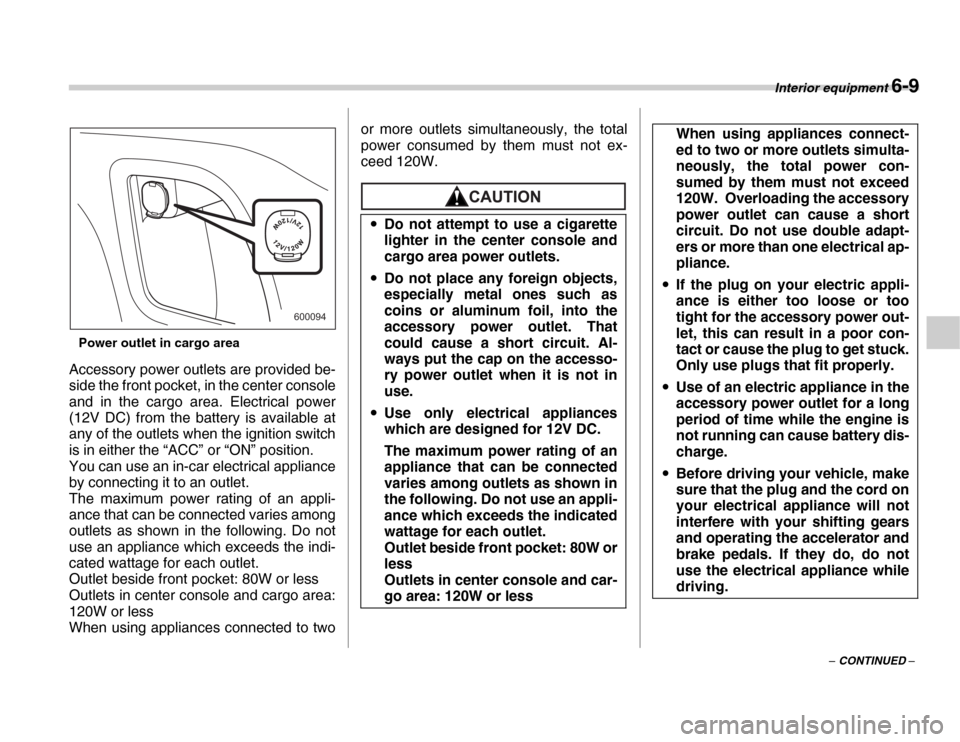
Power outlet in cargo area
Accessory power outlets are provided be-
side the front pocket, in the center console
and in the cargo area. Electrical power
(12V DC) from the battery is available at
any of the outlets when the ignition switch
is in either the “ACC” or “ON” position.
You can use an in-car electrical appliance
by connecting it to an outlet.
The maximum power rating of an appli-
ance that can be connected varies among
outlets as shown in the following. Do not
use an appliance which exceeds the indi-
cated wattage for each outlet.
Outlet beside front pocket: 80W or less
Outlets in center console and cargo area:
120W or less
When using appliances connected to two or more outlets simultaneously, the total
power consumed by them must not ex-
ceed 120W.
600094
y
Do not attempt to use a cigarette
lighter in the center console and
cargo area power outlets.
y Do not place any foreign objects,
especially metal ones such as
coins or aluminum foil, into the
accessory power outlet. That
could cause a short circuit. Al-
ways put the cap on the accesso-
ry power outlet when it is not in
use.
y Use only electrical appliances
which are designed for 12V DC.
The maximum power rating of an
appliance that can be connected
varies among outlets as shown in
the following. Do not use an appli-
ance which exceeds the indicated
wattage for each outlet.
Outlet beside front pocket: 80W or
less
Outlets in center console and car-
go area: 120W or less
When using appliances connect-
ed to two or more outlets simulta-
neously, the total power con-
sumed by them must not exceed
120W. Overloading the accessory
power outlet can cause a short
circuit. Do not use double adapt-
ers or more than one electrical ap-
pliance.
y If the plug on your electric appli-
ance is either too loose or too
tight for the accessory power out-
let, this can result in a poor con-
tact or cause the plug to get stuck.
Only use plugs that fit properly.
y Use of an electric appliance in the
accessory power outlet for a long
period of time while the engine is
not running can cause battery dis-
charge.
y Before driving your vehicle, make
sure that the plug and the cord on
your electrical appliance will not
interfere with your shifting gears
and operating the accelerator and
brake pedals. If they do, do not
use the electrical appliance while
driving.
Page 207 of 356
Starting and operating 7-9
– CONTINUED –
Manual transmission
The manual transmission is a fully syn-
chromeshed, 5-forward-speed and 1-re-
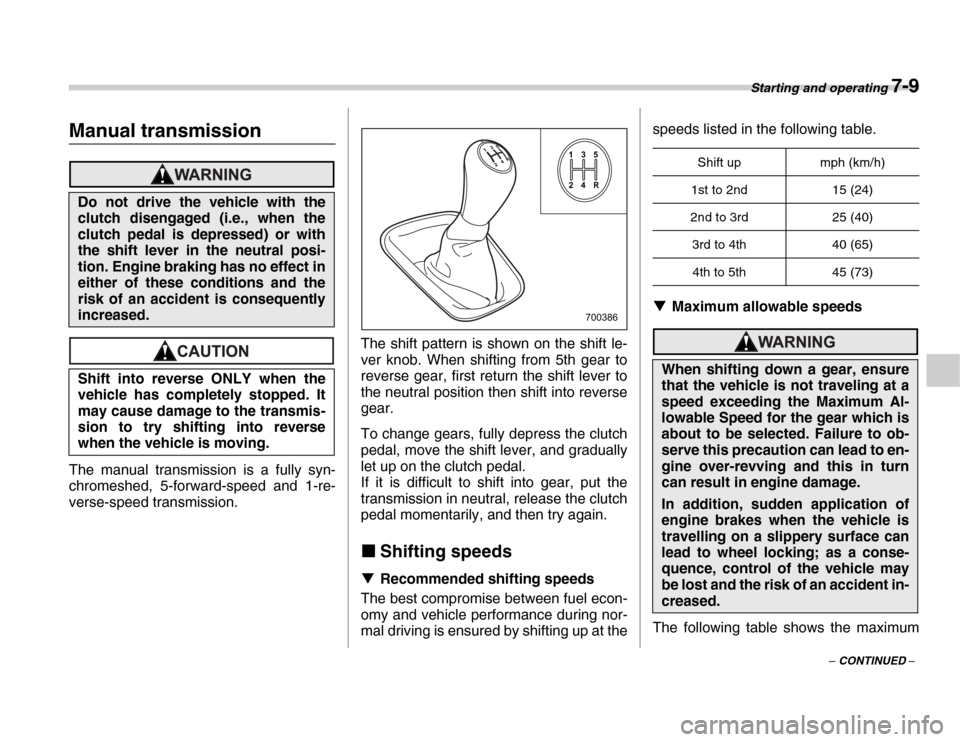
verse-speed transmission.The shift pattern is shown on the shift le-
ver knob. When shifting from 5th gear to
reverse gear, first return the shift lever to
the neutral position then shift into reverse
gear.
To change gears, fully depress the clutch
pedal, move the shift lever, and gradually
let up on the clutch pedal.
If it is difficult to shift into gear, put the
transmission in neutral, release the clutch
pedal momentarily, and then try again.
„ Shifting speeds
T Recommended shifting speeds
The best compromise between fuel econ-
omy and vehicle performance during nor-
mal driving is ensured by shifting up at the speeds listed in the following table. T
Maximum allowable speeds
The following table shows the maximum
Do not drive the vehicle with the
clutch disengaged (i.e., when the
clutch pedal is depressed) or with
the shift lever in the neutral posi-
tion. Engine braking has no effect in
either of these conditions and the
risk of an accident is consequently
increased.
Shift into reverse ONLY when the
vehicle has completely stopped. It
may cause damage to the transmis-
sion to try shifting into reverse
when the vehicle is moving.
700386
531
R42 Shift up mph (km/h)
1st to 2nd 15 (24)
2nd to 3rd 25 (40) 3rd to 4th 40 (65)
4th to 5th 45 (73)
When shifting down a gear, ensure
that the vehicle is not traveling at a
speed exceeding the Maximum Al-
lowable Speed for the gear which is
about to be selected. Failure to ob-
serve this precaution can lead to en-
gine over-revving and this in turn
can result in engine damage.
In addition, sudden application of
engine brakes when the vehicle is
travelling on a slippery surface can
lead to wheel locking; as a conse-
quence, control of the vehicle may
be lost and the risk of an accident in-
creased.
Page 208 of 356
7-10 Starting and operating
speeds that are possible with each differ-
ent gear.
Never exceed the speed limit below for
each gear position except for brief accel-
eration in an emergency. The tachome-
ter’s needle will enter the red area if these
speeds are exceeded. Failure to observe
this precaution can lead to excessive en-
gine wear and poor fuel economy.mph (km/h)
„ Driving tips
Do not drive with your foot resting on the
clutch pedal and do not use the clutch to
hold your vehicle at a standstill on an up-
grade. Either of those actions may cause
clutch damage.
Do not drive with your hand resting on the
shift lever. This may cause wear on the
transmission components.
When it is necessary to reduce vehicle
speed due to slow traffic, turning corners, or driving up steep hills, downshift to a
lower gear before the engine starts to la- bor.
On steep downgrades, downshift the
transmission to 4th, 3rd or 2nd gear as
necessary; this helps to maintain a safe
speed and to extend brake pad life.
In this way, the engine provides a braking
effect. Remember, if you “ride” (over use)
the brakes while descending a hill, they
may overheat and not work properly.Automatic transmission
The automatic transmission is electroni-
cally controlled and provides 4 forward
speeds and 1 reverse speed.
Non-turbo
models Turbo models
1st 30 (49) 28 (46)
2nd 51 (82) 52 (83)
3rd 73 (117) 73 (118)
Do not shift from the “P” or “N” po-
sition into the “D”, “3”, “2”, “1” or
“R” position while depressing the
accelerator pedal. This may cause
the vehicle to jump forward or back-
ward. y Shift into the “P” or “R” position
only after the vehicle is complete-
ly stopped. Shifting while the ve-
hicle is moving may cause dam-
age to the transmission.
y Do not race the engine for more
than five seconds in any position
except the “N” or “P” position
when the brake is set or when
chocks are used in the wheels.
This may cause the automatic
transmission fluid to overheat.
Page 209 of 356
Starting and operating 7-11
– CONTINUED –
NOTE
y When the engine coolant tempera-
ture is still low, your vehicle’s automat-
ic transmission will up-shift at higher
engine speeds than when the coolant
temperature is sufficiently high in or-
der to shorten the warm-up time and
improve driveability. The gearshift tim-
ing will automatically shift to the nor-
mal timing after the engine has warmed up. y Immediately after ATF (automatic
transmission fluid) is replaced, you
may feel that the automatic transmis-
sion operation is somewhat unusual.
This results from invalidation of data
the on-board computer has collected
and stored in memory to allow the
transmission to shift at the most ap-
propriate times for the current condi-
tion of your vehicle. Optimized shifting will be restored as the vehicle contin-
ues to be driven for a while.
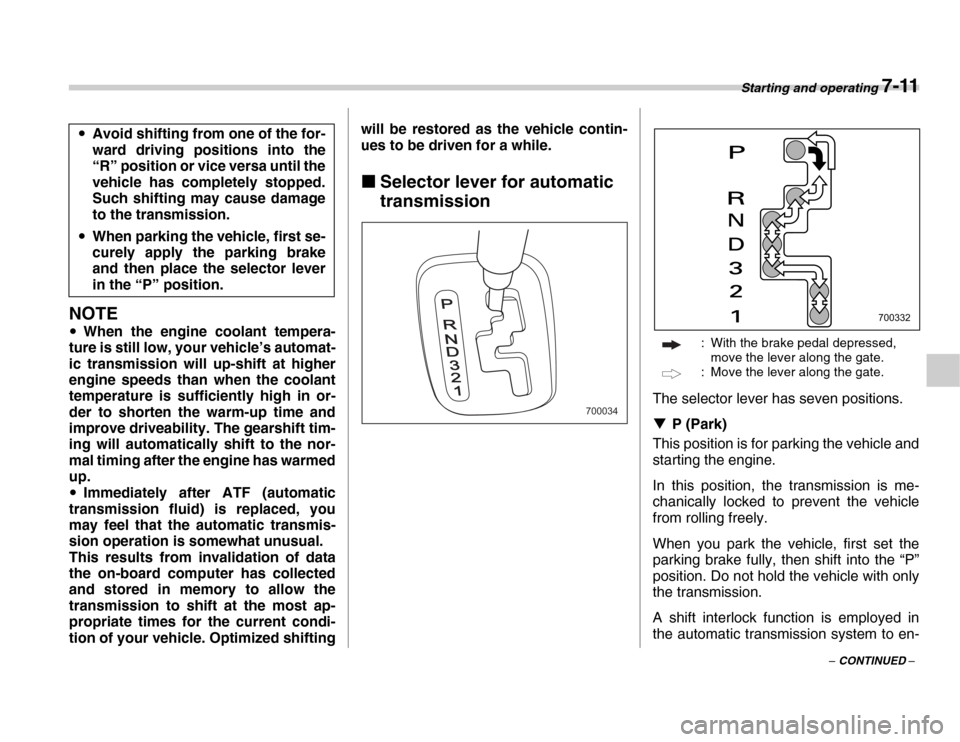
„ Selector lever for automatic
transmission
: With the brake pedal depressed, move the lever along the gate.
: Move the lever along the gate.
The selector lever has seven positions. T P (Park)
This position is for parking the vehicle and
starting the engine.
In this position, the transmission is me-
chanically locked to prevent the vehicle
from rolling freely.
When you park the vehicle, first set the
parking brake fully, then shift into the “P”
position. Do not hold the vehicle with only
the transmission.
A shift interlock function is employed in
the automatic transmission system to en-
y
Avoid shifting from one of the for-
ward driving positions into the
“R” position or vice versa until the
vehicle has completely stopped.
Such shifting may cause damage
to the transmission.
y When parking the vehicle, first se-
curely apply the parking brake
and then place the selector lever
in the “P” position.PP
R
N
D
3
2
1
700034
700332
Page 210 of 356
7-12 Starting and operating
sure safe starting of the vehicle.
To shift the selector lever from the “P” to
the any other position, you have to de-
press the brake pedal fully when the igni-
tion switch is in the “ON” position. This
prevents the vehicle from lurching when it
is started.
If the shift lever does not move from the
“P” position with the brake pedal de-
pressed, refer to the “Shift lock release”
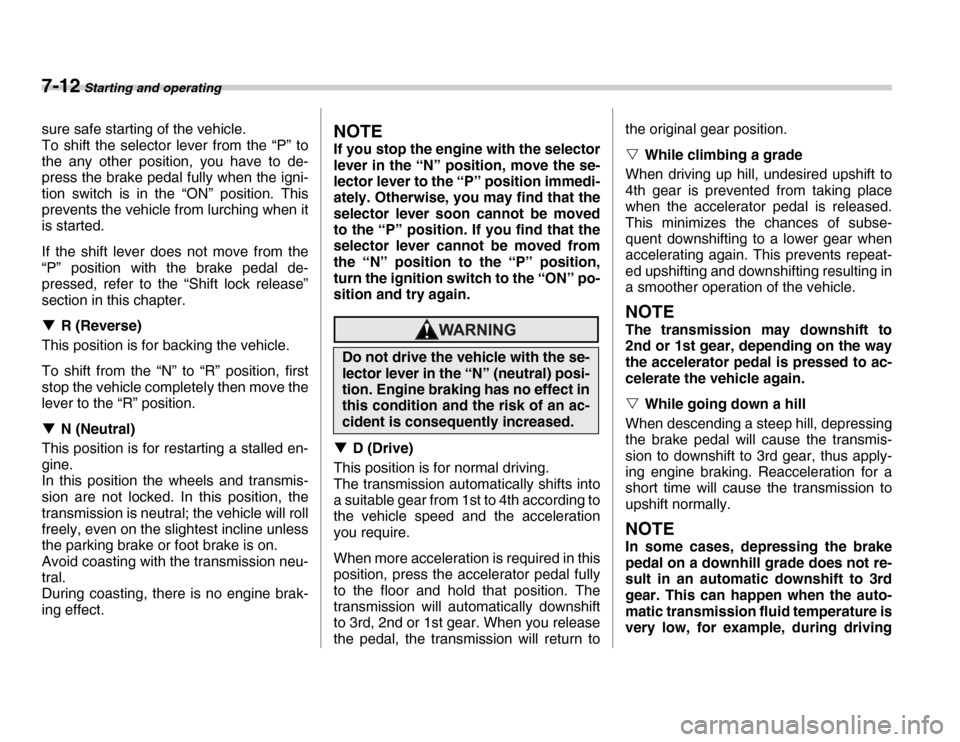
section in this chapter. TR (Reverse)
This position is for backing the vehicle.
To shift from the “N” to “R” position, first
stop the vehicle completely then move the
lever to the “R” position. T N (Neutral)
This position is for restarting a stalled en-
gine.
In this position the wheels and transmis-
sion are not locked. In this position, the
transmission is neutral; the vehicle will roll
freely, even on the slightest incline unless
the parking brake or foot brake is on.
Avoid coasting with the transmission neu-
tral.
During coasting, there is no engine brak-
ing effect.NOTE
If you stop the engine with the selector
lever in the “N” position, move the se-
lector lever to the “P” position immedi-
ately. Otherwise, you may find that the
selector lever soon cannot be moved
to the “P” position. If you find that the
selector lever cannot be moved from
the “N” position to the “P” position,
turn the ignition switch to the “ON” po-
sition and try again.
T D (Drive)
This position is for normal driving.
The transmission automatically shifts into
a suitable gear from 1st to 4th according to
the vehicle speed and the acceleration
you require.
When more acceleration is required in this
position, press the accelerator pedal fully
to the floor and hold that position. The
transmission will automatically downshift
to 3rd, 2nd or 1st gear. When you release
the pedal, the transmission will return to the original gear position. V
While climbing a grade
When driving up hill, undesired upshift to
4th gear is prevented from taking place
when the accelerator pedal is released.
This minimizes the chances of subse-
quent downshifting to a lower gear when
accelerating again. This prevents repeat-
ed upshifting and downshifting resulting in
a smoother operation of the vehicle.
NOTE
The transmission may downshift to
2nd or 1st gear, depending on the way
the accelerator pedal is pressed to ac-
celerate the vehicle again. V While going down a hill
When descending a steep hill, depressing
the brake pedal will cause the transmis-
sion to downshift to 3rd gear, thus apply-
ing engine braking. Reacceleration for a
short time will cause the transmission to
upshift normally.
NOTE
In some cases, depressing the brake
pedal on a downhill grade does not re-
sult in an automatic downshift to 3rd
gear. This can happen when the auto-
matic transmission fluid temperature is
very low, for example, during driving
Do not drive the vehicle with the se-
lector lever in the “N” (neutral) posi-
tion. Engine braking has no effect in
this condition and the risk of an ac-
cident is consequently increased.
Page 211 of 356
Starting and operating 7-13
– CONTINUED –
shortly after the vehicle has been
parked for an extended period of time.
When the ATF temperature has risen to
a certain level, automatic downshift
normally takes place. In the meantime,
downshift manually for engine braking
as required.
Also, downshifting when braking
downhill will not occur at speeds
above approximately 48 mph (78 km/h). T
3 (Third)
This position is for using engine braking
when going down a hill or for climbing a
grade.
The transmission automatically shifts into
a suitable gear from 1st to 3rd according
to the vehicle speed and the acceleration
you require.
When more acceleration is required in this
position, press the accelerator pedal fully
to the floor and hold that position. The
transmission will automatically downshift
to 2nd or 1st gear. When you release the
pedal, the transmission will return to the
original gear position. T 2 (Second)
This position is for using engine braking
when going down a hill or for climbing a
steep grade.
In this position, the transmission holds in the 2nd gear.
Use this position when starting off from a
standstill on slippery road surfaces such
as mud or snow. It will ensure greater trac-
tion. T
1 (First)
This position is for driving up or down very
steep grades, or driving through mud or
sand, or on slippery surfaces. In this posi-
tion, the transmission holds in the 1st
gear. T Maximum speeds
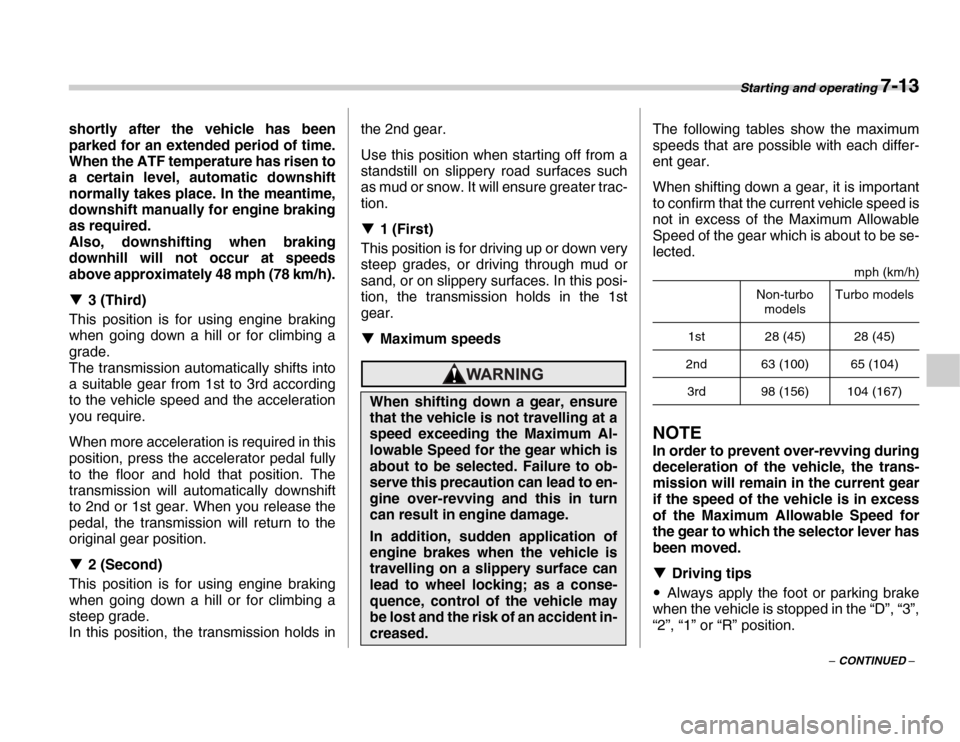
The following tables show the maximum
speeds that are possible with each differ-
ent gear.
When shifting down a gear, it is important
to confirm that the current vehicle speed is
not in excess of the Maximum Allowable
Speed of the gear which is about to be se-
lected.
mph (km/h)
NOTE
In order to prevent over-revving during
deceleration of the vehicle, the trans-
mission will remain in the current gear
if the speed of the vehicle is in excess
of the Maximum Allowable Speed for
the gear to which the selector lever has
been moved. T Driving tips
y Always apply the foot or parking brake
when the vehicle is stopped in the “D”, “3”,
“2”, “1” or “R” position.
When shifting down a gear, ensure
that the vehicle is not travelling at a
speed exceeding the Maximum Al-
lowable Speed for the gear which is
about to be selected. Failure to ob-
serve this precaution can lead to en-
gine over-revving and this in turn
can result in engine damage.
In addition, sudden application of
engine brakes when the vehicle is
travelling on a slippery surface can
lead to wheel locking; as a conse-
quence, control of the vehicle may
be lost and the risk of an accident in-
creased.
Non-turbo models Turbo models
1st 28 (45) 28 (45)
2nd 63 (100) 65 (104) 3rd 98 (156) 104 (167)
Page 213 of 356
Starting and operating 7-15
– CONTINUED –
Rear viscous limited slip dif-
ferential (LSD) (if equipped)
The LSD provides optimum distribution of
power according to the difference in revo-
lutions between the right and left rear
wheels that may be caused by certain
driving conditions, thereby improving driv-
ing stability on snow-covered, muddy or
other slippery roads.
Power steering
The power steering system operates only
when the engine is running.
If you lose power steering assist because
the engine stops or the system fails to
function, you can steer but it will take
much more effort.
NOTE
Right after the engine has been started
and before it has warmed up, you may
hear a noise coming from areas adja-
cent to the power steering pump which
is located at the right-front area of the
engine compartment. This noise is nor-
mal. It does not indicate power steering
system trouble.
Braking „
Braking tips
TWhen the brakes get wet
When driving in rain or after washing the
vehicle, the brakes may get wet. As a re-
sult, brake stopping distance will be long-
er. To dry the brakes, drive the vehicle at
a safe speed while lightly depressing the
brake pedal to heat up the brakes. T Use of engine braking
Remember to make use of engine braking
in addition to foot braking. When descend-
ing a grade, if only the foot brake is used,
the brakes may start working improperly
because of brake fluid overheating,
caused by overheated brake pads. To
help prevent this, shift into a lower gear to
get stronger engine braking. T Braking when a tire is punctured
Do not depress the brake pedal suddenly
y
Never start the engine while a tire
on one side is jacked up, as the
vehicle may move.
y If one rear tire is spinning in mud,
avoid continued spinning at high
speed as this could adversely af-
fect the LSD.
y If a different size rear tire is tem-
porarily used (as in an emergen-
cy), it will adversely affect the
LSD. Always replace it with a reg-
ular size tire as soon as possible.
Do not hold the steering wheel at the
fully locked position left or right for
more than five seconds. This may
damage the power steering pump.
Never rest your foot on the brake
pedal while driving. This can cause
dangerous overheating of the
brakes and needless wear on the
brake pads and linings.
Page 226 of 356
8-2 Driving tips
Driving tipsNew vehicle break-in driving
– the first 1,000 miles (1,600
km)
The performance and long life of your ve-
hicle are dependent on how you handle
and care for your vehicle while it is new.
Follow these instructions during the first
1,000 miles (1,600 km):yDo not race the engine. And do not al-
low engine speed to exceed 4,000 rpm ex-
cept in an emergency. y Do not drive at one constant engine or
vehicle speed for a long time, either fast or
slow.y Avoid starting suddenly and rapid accel-
eration, except in an emergency. y Avoid hard braking, except in an emer-
gency.
The same break-in procedures should be
applied to an overhauled engine, newly
mounted engine or when brake pads or
brake linings are replaced with new ones.
Fuel economy hints
The following suggestions will help to
save your fuel. y Select the proper gear position for the
speed and road conditions. y Avoid sudden acceleration or decelera-
tion. Always accelerate gently until you
reach the desired speed. Then try to main-
tain that speed for as long as possible. y Do not pump the accelerator and avoid
racing the engine. y Avoid unnecessary engine idling.
y Keep the engine properly tuned.
y Keep the tires inflated to the correct
pressure shown on the tire placard, which
is located under the door latch on the driv-
er’s side. Low pressure will increase tire
wear and fuel consumption. y Use the air conditioner only when nec-
essary. y Keep the front and rear wheels in prop-
er alignment.y Avoid carrying unnecessary cargo. Engine exhaust gas (Carbon
monoxide)
y
Never inhale engine exhaust gas.
Engine exhaust gas contains car-
bon monoxide, a colorless and
odorless gas which is dangerous,
or even lethal, if inhaled.
yAlways properly maintain the en-
gine exhaust system to prevent
engine exhaust gas from entering
the vehicle.
yNever run the engine in a closed
space, such as a garage, except
for the brief time needed to drive
the vehicle in or out of it.
yAvoid remaining in a parked vehi-
cle for a lengthy time while the en-
gine is running. If that is unavoid-
able, then use the ventilation fan
to force fresh air into the vehicle.
yAlways keep the front ventilator
inlet grille free from snow, leaves
or other obstructions to ensure
that the ventilation system always
works properly.