2007 SUBARU FORESTER engine
[x] Cancel search: enginePage 211 of 356
Starting and operating 7-13
– CONTINUED –
shortly after the vehicle has been
parked for an extended period of time.
When the ATF temperature has risen to
a certain level, automatic downshift
normally takes place. In the meantime,
downshift manually for engine braking
as required.
Also, downshifting when braking
downhill will not occur at speeds
above approximately 48 mph (78 km/h). T
3 (Third)
This position is for using engine braking
when going down a hill or for climbing a
grade.
The transmission automatically shifts into
a suitable gear from 1st to 3rd according
to the vehicle speed and the acceleration
you require.
When more acceleration is required in this
position, press the accelerator pedal fully
to the floor and hold that position. The
transmission will automatically downshift
to 2nd or 1st gear. When you release the
pedal, the transmission will return to the
original gear position. T 2 (Second)
This position is for using engine braking
when going down a hill or for climbing a
steep grade.
In this position, the transmission holds in the 2nd gear.
Use this position when starting off from a
standstill on slippery road surfaces such
as mud or snow. It will ensure greater trac-
tion. T
1 (First)
This position is for driving up or down very
steep grades, or driving through mud or
sand, or on slippery surfaces. In this posi-
tion, the transmission holds in the 1st
gear. T Maximum speeds
The following tables show the maximum
speeds that are possible with each differ-
ent gear.
When shifting down a gear, it is important
to confirm that the current vehicle speed is
not in excess of the Maximum Allowable
Speed of the gear which is about to be se-
lected.
mph (km/h)
NOTE
In order to prevent over-revving during
deceleration of the vehicle, the trans-
mission will remain in the current gear
if the speed of the vehicle is in excess
of the Maximum Allowable Speed for
the gear to which the selector lever has
been moved. T Driving tips
y Always apply the foot or parking brake
when the vehicle is stopped in the “D”, “3”,
“2”, “1” or “R” position.
When shifting down a gear, ensure
that the vehicle is not travelling at a
speed exceeding the Maximum Al-
lowable Speed for the gear which is
about to be selected. Failure to ob-
serve this precaution can lead to en-
gine over-revving and this in turn
can result in engine damage.
In addition, sudden application of
engine brakes when the vehicle is
travelling on a slippery surface can
lead to wheel locking; as a conse-
quence, control of the vehicle may
be lost and the risk of an accident in-
creased.
Non-turbo models Turbo models
1st 28 (45) 28 (45)
2nd 63 (100) 65 (104) 3rd 98 (156) 104 (167)
Page 213 of 356
Starting and operating 7-15
– CONTINUED –
Rear viscous limited slip dif-
ferential (LSD) (if equipped)
The LSD provides optimum distribution of
power according to the difference in revo-
lutions between the right and left rear
wheels that may be caused by certain
driving conditions, thereby improving driv-
ing stability on snow-covered, muddy or
other slippery roads.
Power steering
The power steering system operates only
when the engine is running.
If you lose power steering assist because
the engine stops or the system fails to
function, you can steer but it will take
much more effort.
NOTE
Right after the engine has been started
and before it has warmed up, you may
hear a noise coming from areas adja-
cent to the power steering pump which
is located at the right-front area of the
engine compartment. This noise is nor-
mal. It does not indicate power steering
system trouble.
Braking „
Braking tips
TWhen the brakes get wet
When driving in rain or after washing the
vehicle, the brakes may get wet. As a re-
sult, brake stopping distance will be long-
er. To dry the brakes, drive the vehicle at
a safe speed while lightly depressing the
brake pedal to heat up the brakes. T Use of engine braking
Remember to make use of engine braking
in addition to foot braking. When descend-
ing a grade, if only the foot brake is used,
the brakes may start working improperly
because of brake fluid overheating,
caused by overheated brake pads. To
help prevent this, shift into a lower gear to
get stronger engine braking. T Braking when a tire is punctured
Do not depress the brake pedal suddenly
y
Never start the engine while a tire
on one side is jacked up, as the
vehicle may move.
y If one rear tire is spinning in mud,
avoid continued spinning at high
speed as this could adversely af-
fect the LSD.
y If a different size rear tire is tem-
porarily used (as in an emergen-
cy), it will adversely affect the
LSD. Always replace it with a reg-
ular size tire as soon as possible.
Do not hold the steering wheel at the
fully locked position left or right for
more than five seconds. This may
damage the power steering pump.
Never rest your foot on the brake
pedal while driving. This can cause
dangerous overheating of the
brakes and needless wear on the
brake pads and linings.
Page 214 of 356
7-16 Starting and operating
when a tire is punctured. This could cause
a loss of control of the vehicle. Keep driv-
ing straight ahead while gradually reduc-
ing speed. Then slowly pull off the road to
a safe place. „Brake system
T Two separate circuits
Your vehicle has two separate circuit
brake systems. Each circuit works diago-
nally across the vehicle. If one circuit of
the brake system should fail, the other half
of the system still works. If one circuit fails,
the brake pedal will go down much closer
to the floor than usual and you will need to
press it down much harder. And a much
longer distance will be needed to stop the
vehicle. T Brake booster
The brake booster uses engine manifold
vacuum to assist braking force. Do not
turn off the engine while driving because
that will turn off the brake booster, result-
ing in poor braking power.
The brakes will continue to work even
when the brake booster completely stops
functioning. If this happens, however, you
will have to push the pedal much harder
than normal and the braking distance will
increase. „
Disc brake pad wear warning
indicators
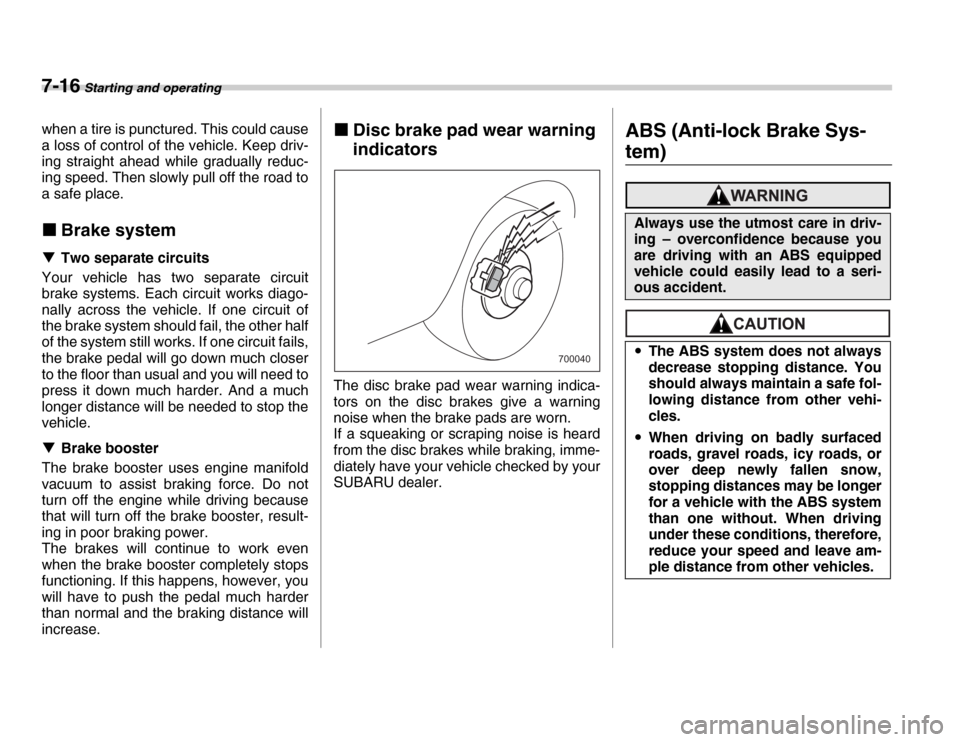
The disc brake pad wear warning indica-
tors on the disc brakes give a warning
noise when the brake pads are worn.
If a squeaking or scraping noise is heard
from the disc brakes while braking, imme-
diately have your vehicle checked by your
SUBARU dealer. ABS (Anti-lock Brake Sys-
tem)
700040
Always use the utmost care in driv-
ing – overconfidence because you
are driving with an ABS equipped
vehicle could easily lead to a seri-
ous accident. y
The ABS system does not always
decrease stopping distance. You
should always maintain a safe fol-
lowing distance from other vehi-
cles.
y When driving on badly surfaced
roads, gravel roads, icy roads, or
over deep newly fallen snow,
stopping distances may be longer
for a vehicle with the ABS system
than one without. When driving
under these conditions, therefore,
reduce your speed and leave am-
ple distance from other vehicles.
Page 215 of 356
Starting and operating 7-17
– CONTINUED –
The ABS system prevents the lock-up of
wheels which may occur during sudden
braking or braking on slippery road surfac-
es. This helps prevent the loss of steering
control and directional stability caused by
wheel lock-up.
When the ABS system is operating, you
may hear a chattering noise or feel a slight
vibration in the brake pedal. This is normal
when the ABS operates.
The ABS system will not operate when the
vehicle speed is below approximately 6
mph (10 km/h). „
ABS system self-check
You may feel a slight shock in the brake
pedal and hear the operating sound of
ABS from the engine compartment just af-
ter the vehicle is started. This is caused by
an automatic functional test of the ABS
system being carried out and does not in-
dicate any abnormal condition. „
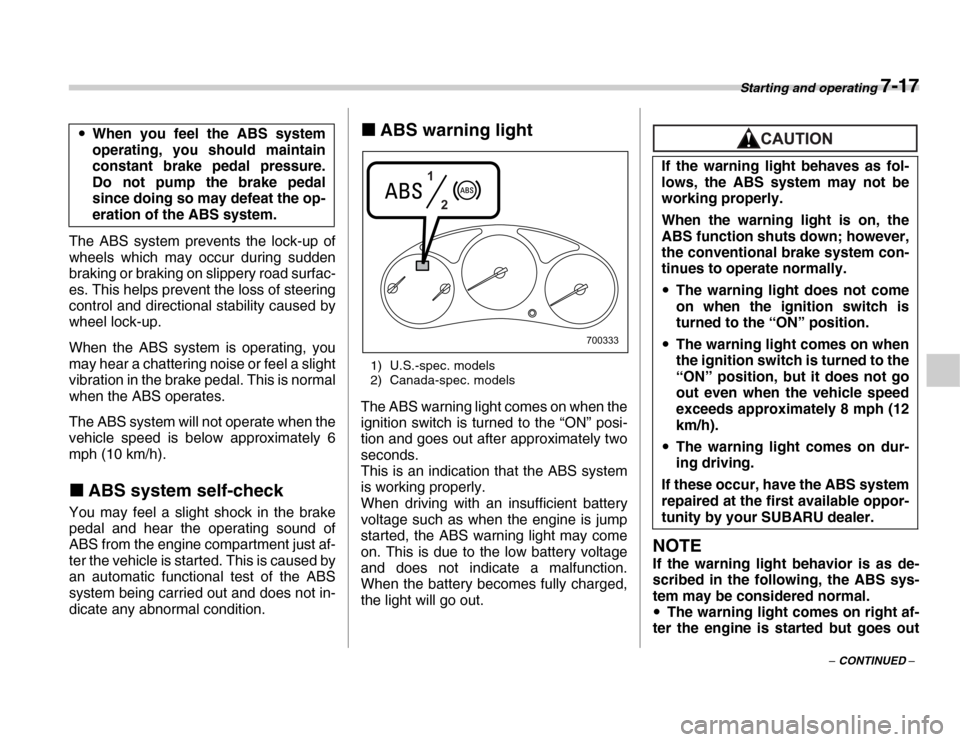
ABS warning light
1) U.S.-spec. models
2) Canada-spec. models
The ABS warning light comes on when the
ignition switch is turned to the “ON” posi-
tion and goes out after approximately two
seconds.
This is an indication that the ABS system
is working properly.
When driving with an insufficient battery
voltage such as when the engine is jump
started, the ABS warning light may come
on. This is due to the low battery voltage
and does not indicate a malfunction.
When the battery becomes fully charged,
the light will go out.
NOTE
If the warning light behavior is as de-
scribed in the following, the ABS sys-
tem may be considered normal. y The warning light comes on right af-
ter the engine is started but goes out
y
When you feel the ABS system
operating, you should maintain
constant brake pedal pressure.
Do not pump the brake pedal
since doing so may defeat the op-
eration of the ABS system.
1
2
700333 If the warning light behaves as fol-
lows, the ABS system may not be
working properly.
When the warning light is on, the
ABS function shuts down; however,
the conventional brake system con-
tinues to operate normally. y
The warning light does not come
on when the ignition switch is
turned to the “ON” position.
y The warning light comes on when
the ignition switch is turned to the
“ON” position, but it does not go
out even when the vehicle speed
exceeds approximately 8 mph (12
km/h).
y The warning light comes on dur-
ing driving.
If these occur, have the ABS system
repaired at the first available oppor-
tunity by your SUBARU dealer.
Page 216 of 356
7-18 Starting and operating
immediately, remaining off. yThe warning light remains on after
the engine has been started, but it goes
out when the vehicle speed reaches
approximately 8 mph (12 km/h). y The warning light comes on during
driving, but it goes out immediately
and remains off. Electronic Brake Force Dis-
tribution (EBD) system
The EBD system maximizes the effective-
ness of the brakes by allowing the rear
brakes to supply a greater proportion of
the braking force. It functions by adjusting
the distribution of braking force to the rear
wheels in accordance with the vehicle’s
loading condition and speed.
The EBD system is an integral part of the
ABS system and uses some of the ABS
system’s components to perform its func-
tion of optimizing the distribution of brak-
ing force. If any of the ABS components
used by the EBD function fails, the EBD
system also stops working.
When the EBD system is operating, you
may hear a chattering noise or feel a slight
vibration in the brake pedal. This is normal
and does not indicate a malfunction.„
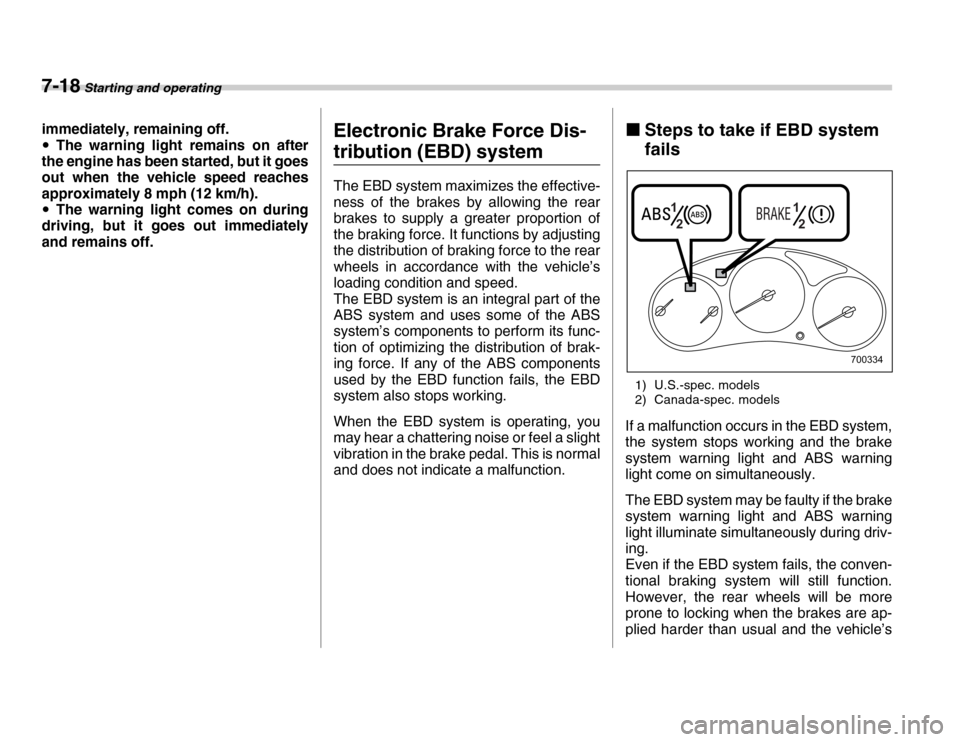
Steps to take if EBD system
fails
1) U.S.-spec. models
2) Canada-spec. models
If a malfunction occurs in the EBD system,
the system stops working and the brake
system warning light and ABS warning
light come on simultaneously.
The EBD system may be faulty if the brake
system warning light and ABS warning
light illuminate simultaneously during driv-
ing.
Even if the EBD system fails, the conven-
tional braking system will still function.
However, the rear wheels will be more
prone to locking when the brakes are ap-
plied harder than usual and the vehicle’s
1 2 1
2
700334
Page 217 of 356
Starting and operating 7-19
– CONTINUED –
motion may therefore become somewhat
harder to control.
If the brake system warning light and ABS
warning light illuminate simultaneously,
take the following steps:
1. Stop the vehicle in the nearest safe, flat
place.
2. Shut down the engine, then restart it.
3. Release the parking brake. If both
warning lights go out, the EBD system
may be faulty.
Drive carefully to the nearest SUBARU
dealer and have the system inspected.
4. If both warning lights come on again
and stay illuminated after the engine has
been restarted, shut down the engine
again, apply the parking brake, and check
the brake fluid level.
5. If the brake fluid level is not below the
“MIN” mark, the EBD system may be
faulty. Drive carefully to the nearest
SUBARU dealer and have the system in-
spected.
6. If the brake fluid level is below the
“MIN” mark, DO NOT drive the vehicle. In-
stead, have the vehicle towed to the near-
est SUBARU dealer for repair.
Parking your vehicle
y
Driving with the brake system
warning light on is dangerous.
This indicates your brake system
may not be working properly. If
the light remains on, have the
brakes inspected by a SUBARU
dealer immediately.
yIf at all in doubt about whether the
brakes are operating properly, do
not drive the vehicle. Have your
vehicle towed to the nearest SUB-
ARU dealer for repair.
yNever leave unattended children
or pets in the vehicle. They could
accidentally injure themselves or
others through inadvertent opera-
tion of the vehicle. Also, on hot or
sunny days, the temperature in a
closed vehicle could quickly be-
come high enough to cause se-
vere or possibly fatal injuries to
people.
yDo not park the vehicle over flam-
mable materials such as dry
grass, waste paper or rags, as
they may burn easily if they come
near hot engine or exhaust sys-
tem parts.
yBe sure to stop the engine if you
take a nap in the vehicle. If engine
exhaust gas enters the passenger
compartment, occupants in the
vehicle could die from carbon
monoxide (CO) contained in the
exhaust gas.
Page 218 of 356
7-20 Starting and operating
„Parking brake
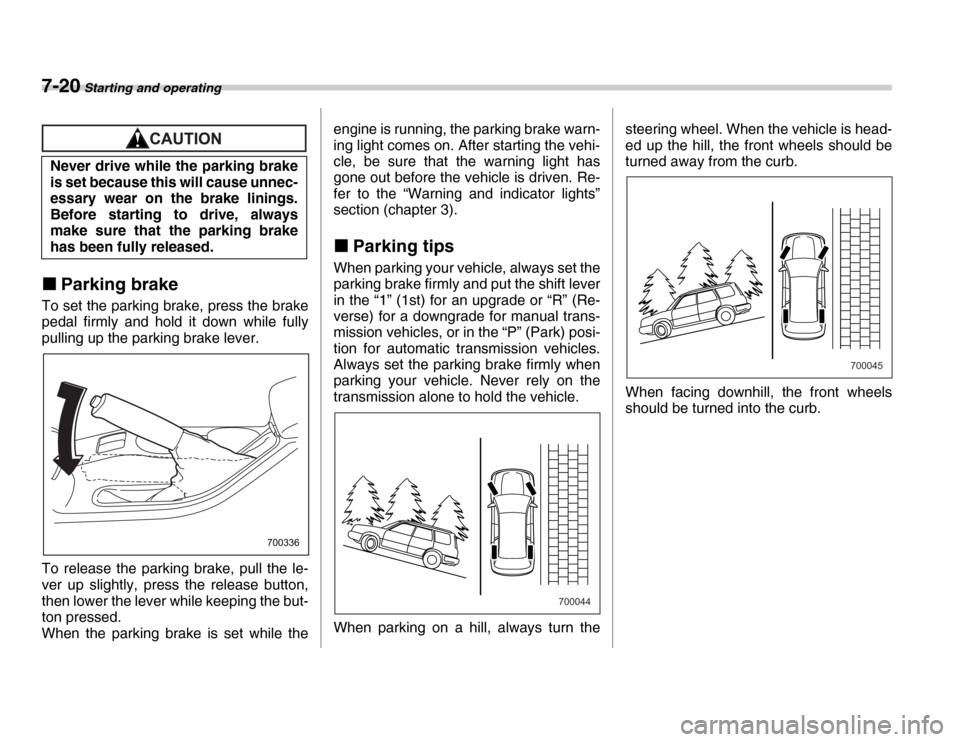
To set the parking brake, press the brake
pedal firmly and hold it down while fully
pulling up the parking brake lever.
To release the parking brake, pull the le-
ver up slightly, press the release button,
then lower the lever while keeping the but-
ton pressed.
When the parking brake is set while the engine is running, the parking brake warn-
ing light comes on. After starting the vehi-
cle, be sure that the warning light has
gone out before the vehicle is driven. Re-
fer to the “Warning and indicator lights”
section (chapter 3).
„ Parking tips
When parking your vehicle, always set the
parking brake firmly and put the shift lever
in the “1” (1st) for an upgrade or “R” (Re-
verse) for a downgrade for manual trans-
mission vehicles, or in the “P” (Park) posi-
tion for automatic transmission vehicles.
Always set the parking brake firmly when
parking your vehicle. Never rely on the
transmission alone to hold the vehicle.
When parking on a hill, always turn the steering wheel. When the vehicle is head-
ed up the hill, the front wheels should be
turned away from the curb.
When facing downhill, the front wheels
should be turned into the curb.
Never drive while the parking brake
is set because this will cause unnec-
essary wear on the brake linings.
Before starting to drive, always
make sure that the parking brake
has been fully released.
700336
700044
700045
Page 225 of 356

8
Driving tips
New vehicle break-in driving – the first 1,000 miles (1,600 km) .................................... 8-2
Fuel economy hints ........................................... 8-2
Engine exhaust gas (Carbon monoxide) ........ 8-2
Catalytic converter ............................................. 8-3
Periodic inspections .......................................... 8-4
Driving in foreign countries .............................. 8-4
Driving tips for AWD vehicles ........................... 8-5
Off road driving .................................................. 8-6
Winter driving ..................................................... 8-7 Operation during cold weather .............................. 8-7
Driving on snowy and icy roads ............................ 8-9
Corrosion protection .............................................. 8-10
Snow tires ............................................................... 8-10
Tire chains ............................................................... 8-10
Rocking the vehicle ................................................ 8-11
Loading your vehicle ......................................... 8-11 Vehicle capacity weight ......................................... 8-12
GVWR and GAWR (Gross Vehicle Weight Rating and Gross Axle Weight Rating) ........................... 8-12
Roof rail and crossbar (if equipped) ..................... 8-13
Trailer hitch (if equipped) .................................. 8-16 Connecting a trailer ................................................ 8-16
When you do not tow a trailer ............................... 8-17
Trailer towing ...................................................... 8-18 Warranties and maintenance ................................. 8-18
Maximum load limits .............................................. 8-18 Trailer hitches ......................................................... 8-21
Connecting a trailer ................................................ 8-22
Trailer towing tips ................................................... 8-23