2007 SUBARU FORESTER tow bar
[x] Cancel search: tow barPage 229 of 356

Driving tips 8-5
Driving tips for AWD vehicles
All-Wheel Drive distributes the engine
power to all four wheels. AWD vehiclesprovide better traction when driving on
slippery, wet or snow-covered roads and
when moving out of mud, dirt and sand. By
shifting power between the front and rear
wheels, SUBARU AWD can also provide
added traction during acceleration and
added engine braking force during decel-
eration.
Therefore, your SUBARU AWD vehicle
may handle differently than an ordinary
two wheel drive vehicle and it contains
some features unique to AWD. For safety
purposes as well as to avoid damaging
the AWD system, you should keep the fol-
lowing tips in mind: y
An AWD vehicle is better able to climb
steeper roads under snowy or slippery
conditions than a two wheel drive vehicle.
There is little difference in handling, how-
ever, during extremely sharp turns or sud-
den braking. Therefore, when driving
down a slope or turning corners, be sure
to reduce your speed and maintain an am-
ple distance from other vehicles. y When replacing a tire, make sure you
use only the same size, construction,
brand, and load range as the original tires
listed on the tire placard. Using other sizes
or construction may result in severe me-
chanical damage to the drive train of your
vehicle and may affect ride, handling, braking, speedometer/odometer calibra-
tion, and clearance between the body and
tires. It also may be dangerous and lead to
loss of vehicle control. y
Always check the cold tire pressure be-
fore starting to drive. The recommended
tire pressure is provided on the tire plac-
ard, which is located under the door latch
on the driver’s side. y Tire chains should always be placed on
the front wheels only. y There are some precautions that you
must observe when towing your vehicle.
For detail information, see the “Towing”
section in chapter 9.
y Always maintain a safe driving
speed according to the road and
weather conditions in order to
avoid having an accident on a
sharp turn, during sudden braking
or under other similar conditions.
yAlways use the utmost care in
driving – overconfidence because
you are driving an All-Wheel Drive
vehicle could easily lead to a seri-
ous accident.
800004
Page 230 of 356

8-6 Driving tips
Off road driving
Because of the AWD feature and higher
ground clearance, your SUBARU can be
driven on ordinary roads or off-road. But
please keep in mind that an AWD SUBA-
RU is a passenger car and is neither a
conventional off-road vehicle nor an all-
terrain vehicle. If you do take your SUBA-
RU off-road, certain common sense pre-
cautions such as the following should be
taken: yMake certain that you and all of your
passengers are wearing seatbelts. y Carry some emergency equipment,
such as a towing rope or chain, a shovel,
wheel blocks, first aid kit and cell phone or citizens band radio. y
Drive carefully. Do not take unneces-
sary risks by driving in dangerous areas or
over rough terrain. y Slow down and employ extra caution at
all times. When driving off-road, you will
not have the benefit of marked traffic
lanes, banked curves, traffic signs and the
like. y Do not drive across steep slopes. In-
stead, drive either straight up or straight
down the slopes. A vehicle can much
more easily tip over sideways than it can
end over end. Avoid driving straight up or
down slopes that are too steep. y Avoid sharp turning maneuvers, espe-
cially at higher speeds. y Do not grip the inside or spokes of the
steering wheel. A bad bump could jerk the
wheel and injure your hands. Instead drive
with your fingers and thumbs on the out-
side of the rim. y If driving through water, such as when
crossing shallow streams, first check the
depth of the water and the bottom of the
stream bed for firmness and ensure that
the bed of the stream is flat. Drive slowly
and completely through the stream. The
water should be shallow enough that it
does not reach the vehicle’s undercar-
riage. Water entering the engine air intake
or the exhaust pipe or water splashing onto electrical parts may damage your ve-
hicle and may cause it to stall. Never at-
tempt to drive through rushing water; re-
gardless of its depth, it can wash away the
ground from under your tires, resulting in
possible loss of traction and even vehicle
rollover. y
Always check your brakes for effective-
ness immediately after driving in sand,
mud or water. Do this by driving slowly
and stepping on the brake pedal. Repeat
that process several times to dry out the
brake discs and brake pads. y Do not drive or park over or near flam-
mable materials such as dry grass or fall-
en leaves, as they may burn easily. The
exhaust system is very hot while the en-
gine is running and right after the engine
stops. This could create a fire hazard. y After driving through tall grass, mud,
rocks, sand, rivers, etc., check that there
is no grass, bush, paper, rags, stones,
sand, etc. adhering to or trapped on the
underbody. Clear off any such matter from
the underbody. If the vehicle is used with
these materials trapped or adhering to the
underbody, a mechanical breakdown or
fire could occur. y Secure all cargo carried inside the vehi-
cle and make certain that it is not piled
higher than the seatbacks. During sudden
stops or jolts, unsecured cargo could be
y Always maintain a safe driving
speed according to the road and
weather conditions in order to
avoid having an accident on a
sharp turn, during sudden braking
or under other similar conditions.
yAlways use the utmost care in
driving – overconfidence because
you are driving an All-Wheel Drive
vehicle could easily lead to a seri-
ous accident.
Page 239 of 356
Driving tips 8-15
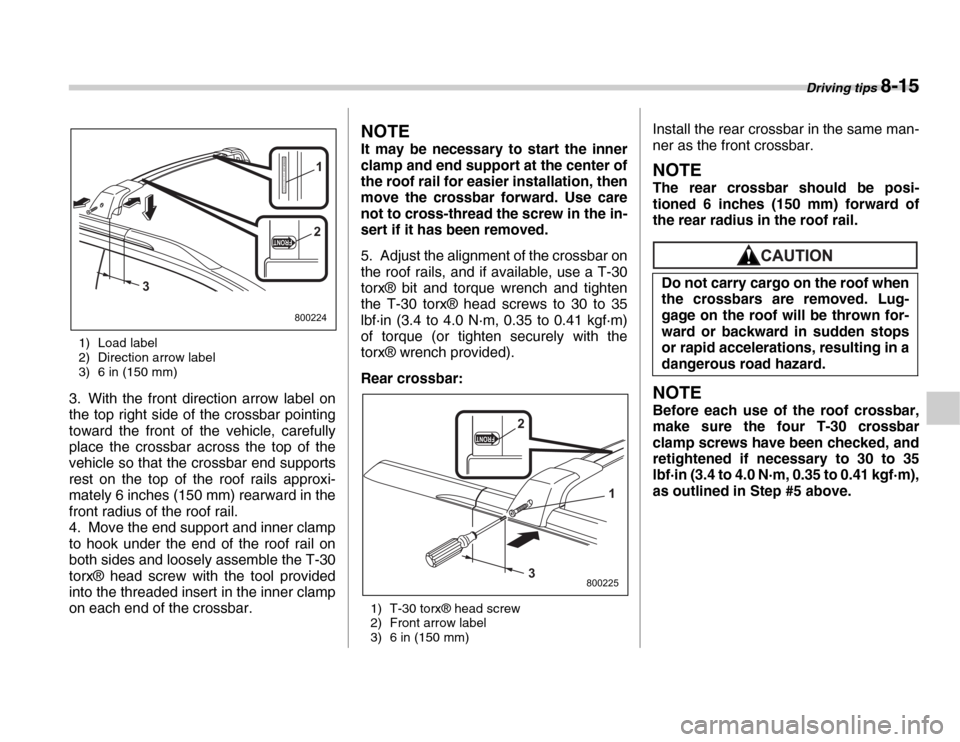
1) Load label
2) Direction arrow label
3) 6 in (150 mm)
3. With the front direction arrow label on
the top right side of the crossbar pointing
toward the front of the vehicle, carefully
place the crossbar across the top of the
vehicle so that the crossbar end supports
rest on the top of the roof rails approxi-
mately 6 inches (150 mm) rearward in the
front radius of the roof rail.
4. Move the end support and inner clamp
to hook under the end of the roof rail on
both sides and loosely assemble the T-30
torx® head screw with the tool provided
into the threaded insert in the inner clamp
on each end of the crossbar.
NOTE
It may be necessary to start the inner
clamp and end support at the center of
the roof rail for easier installation, then
move the crossbar forward. Use care
not to cross-thread the screw in the in-
sert if it has been removed.
5. Adjust the alignment of the crossbar on
the roof rails, and if available, use a T-30
torx® bit and torque wrench and tighten
the T-30 torx® head screws to 30 to 35
lbf·in (3.4 to 4.0 N·m, 0.35 to 0.41 kgf·m)
of torque (or tighten securely with the
torx® wrench provided).
Rear crossbar:
1) T-30 torx® head screw
2) Front arrow label
3) 6 in (150 mm) Install the rear crossbar in the same man-
ner as the front crossbar.
NOTE
The rear crossbar should be posi-
tioned 6 inches (150 mm) forward of
the rear radius in the roof rail.
NOTE
Before each use of the roof crossbar,
make sure the four T-30 crossbar
clamp screws have been checked, and
retightened if necessary to 30 to 35
lbf
Page 242 of 356

8-18 Driving tips
Trailer towing
Your vehicle is designed and intended to
be used primarily as a passenger-carrying
vehicle. Towing a trailer puts additional
loads on your vehicle’s engine, drivetrain,
brakes, tires and suspension and has an
adverse effect on fuel economy.
If you do decide to tow a trailer, your safe-
ty and satisfaction depend upon proper
use of correct equipment and cautious op-
eration of your vehicle. Seek the advice of
your SUBARU dealer to assist you in pur-
chasing a hitch and other necessary tow-
ing equipment appropriate for your vehi-
cle. In addition, be sure to follow the in-
structions on correct installation and use
provided by the trailer and other towing
equipment manufacturers.
SUBARU assumes no responsibility for in-
juries or vehicle damage that result from
trailer towing equipment, or from any er-
rors or omissions in the instructions ac-
companying such equipment or for your
failure to follow the proper instructions. „Warranties and maintenance
SUBARU warranties do not apply to vehi-
cle damage or malfunction caused by trail-
er towing. If you use your vehicle to tow a
trailer, more frequent maintenance will be required due to the additional load. (Refer
to “Maintenance schedule under severe
driving conditions” in the “Warranty and
Maintenance Booklet”.)
Under no circumstances should a trailer
be towed with a new vehicle or a vehicle
with any new powertrain component (en-
gine, transmission, differential, wheel
bearings, etc.) for the first 1,000 miles
(1,600 km) of driving.
„ Maximum load limits
TTotal trailer weight
Total trailer weight
The total trailer weight (trailer weight plus
its cargo load) must never exceed the
maximum weight shown in the following
table.
Never exceed the maximum load
limits explained in the following. Ex-
ceeding the maximum load limits
could cause personal injury and/or
vehicle damage. y Adequate size trailer brakes are
required when the trailer and its
cargo exceed 1,000 lbs (453 kg)
total weight.
yBefore towing a trailer, check the
trailer total weight, GVW, GAWs
and tongue load. Make sure the
load and its distribution in your
vehicle and trailer are acceptable.
800211
Page 245 of 356
Driving tips 8-21
– CONTINUED –
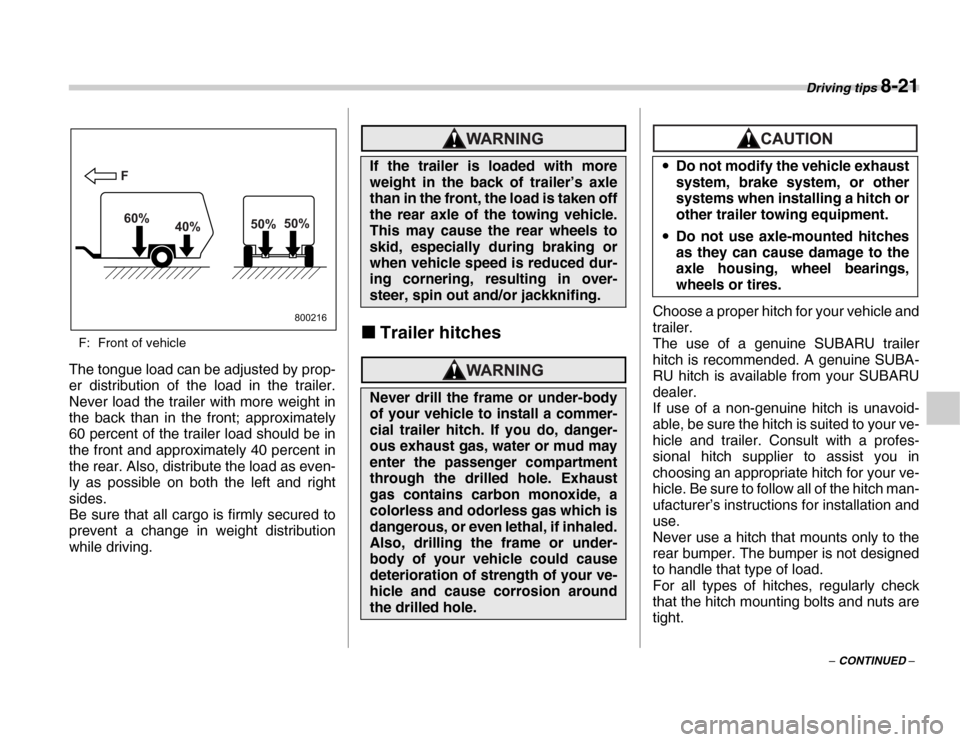
F: Front of vehicle
The tongue load can be adjusted by prop-
er distribution of the load in the trailer.
Never load the trailer with more weight in
the back than in the front; approximately
60 percent of the trailer load should be in
the front and approximately 40 percent in
the rear. Also, distribute the load as even-
ly as possible on both the left and right
sides.
Be sure that all cargo is firmly secured to
prevent a change in weight distribution
while driving.
„ Trailer hitches
Choose a proper hitch for your vehicle and
trailer.
The use of a genuine SUBARU trailer
hitch is recommended. A genuine SUBA-
RU hitch is available from your SUBARU
dealer.
If use of a non-genuine hitch is unavoid-
able, be sure the hitch is suited to your ve-
hicle and trailer. Consult with a profes-
sional hitch supplier to assist you in
choosing an appropriate hitch for your ve-
hicle. Be sure to follow all of the hitch man-
ufacturer’s instructions for installation and
use.
Never use a hitch that mounts only to the
rear bumper. The bumper is not designed
to handle that type of load.
For all types of hitches, regularly check
that the hitch mounting bolts and nuts are
tight.
F
60% 40% 50%
50%
800216
If the trailer is loaded with more
weight in the back of trailer’s axle
than in the front, the load is taken off
the rear axle of the towing vehicle.
This may cause the rear wheels to
skid, especially during braking or
when vehicle speed is reduced dur-
ing cornering, resulting in over-
steer, spin out and/or jackknifing.
Never drill the frame or under-body
of your vehicle to install a commer-
cial trailer hitch. If you do, danger-
ous exhaust gas, water or mud may
enter the passenger compartment
through the drilled hole. Exhaust
gas contains carbon monoxide, a
colorless and odorless gas which is
dangerous, or even lethal, if inhaled.
Also, drilling the frame or under-
body of your vehicle could cause
deterioration of strength of your ve-
hicle and cause corrosion around
the drilled hole.
y
Do not modify the vehicle exhaust
system, brake system, or other
systems when installing a hitch or
other trailer towing equipment.
y Do not use axle-mounted hitches
as they can cause damage to the
axle housing, wheel bearings,
wheels or tires.
Page 246 of 356

8-22 Driving tips
„Connecting a trailer
T Trailer brakes
If your trailer’s total weight (trailer weight
plus its cargo weight) exceeds 1,000 lbs
(453 kg), the trailer is required to be
equipped with its own brake system. Elec-
tric brakes or surge brakes are recom-
mended, and must be installed properly.
Check that your trailer’s brakes conform
with Federal, state/province and/or other
applicable regulations. Your SUBARU’s
brake system is not designed to be tapped
into the trailer’s hydraulic brake system.
Please ask your SUBARU dealer and pro-
fessional trailer supplier for more informa-
tion about the trailer’s brake system. T
Trailer safety chains
In case the trailer hitch connector or hitch
ball should break or become disconnect-
ed, the trailer could get loose and create a
traffic safety hazard.
For safety, always connect the towing ve-
hicle and trailer with trailer safety chains.
Pass the chains crossing each other un-
der the trailer tongue to prevent the trailer
from dropping onto the ground in case the
trailer tongue should disconnect from the
hitch ball. Allow sufficient slack in the
chains taking tight-turn situations into ac-
count; however, be careful not to let them
drag on the ground.
For more information about the safety
chain connection, refer to the instructions
for your hitch and trailer. T
Side mirrors
After hitching a trailer to your vehicle,
check that the standard side mirrors pro-
vide a good rearward field of view without
significant blind spots. If significant blind
spots occur with the vehicle’s standard
side mirrors, use towing mirrors that con-
form with Federal, state/province and/or
other applicable regulations. T Trailer lights
yAdequate size trailer brakes are
required when the trailer and its
cargo exceed 1,000 lbs (453 kg)
total weight.
yDo not directly connect your trail-
er’s hydraulic brake system to the
hydraulic brake system in your
vehicle. Direct connection would
cause the vehicle’s brake perfor-
mance to deteriorate and could
lead to an accident.
Always use safety chains between
your vehicle and the trailer. Towing
a trailer without safety chains could
create a traffic safety hazard if the
trailer separates from the hitch due
to coupling damage or hitch ball
damage.
Direct splicing or other improper
connection of trailer lights may
damage your vehicle’s electrical
system and cause a malfunction of
your vehicle’s lighting system.
800007
Page 247 of 356

Driving tips 8-23
– CONTINUED –
Connection of trailer lights to your vehi-
cle’s electrical system requires modifica-
tions to the vehicle’s lighting circuit to in-
crease its capacity and accommodate wir-
ing changes. To ensure the trailer lights
are connected properly, please consult
your SUBARU dealer. Check for proper
operation of the turn signals, the brake
lights and parking lights each time you
hitch up. T
Tires
Make sure that all the tires on your vehicle
are properly inflated to the pressure spec-
ified on the tire placard located on the driv-
er’s side center pillar.
Trailer tire condition, size, load rating and
proper inflation pressure should be in ac-
cordance with the trailer manufacturer’s
specifications. „
Trailer towing tips
TBefore starting out on a trip
y Check that the vehicle and vehicle-to-
hitch mounting are in good condition. If
any problems are apparent, do not tow the
trailer. y Check that the vehicle sits horizontally
with the trailer attached. If the vehicle is
tipped sharply up at the front and down at
the rear, check the total trailer weight,
GVW, GAWs and tongue load again, then
confirm that the load and its distribution
are acceptable. y Check that the tire pressures are cor-
rect. y Check that the vehicle and trailer are connected properly. Confirm that
– the trailer tongue is connected prop-
erly to the hitch ball.
– the trailer lights connector is connect-
ed properly and trailer’s brake lights illu-
minate when the vehicle’s brake pedal
is pressed, and that the trailer’s turn sig-
nal lights flash when the vehicle’s turn
signal lever is operated.
– the safety chains are connected prop-
erly.
– all cargo in the trailer is secured safe-
ty in position.
– the side mirrors provide a good rear-
ward field of view without a significant
blind spot.
y Sufficient time should be taken to learn
the “feel” of the vehicle/trailer combination
before starting out on a trip. In an area free
of traffic, practice turning, stopping and
backing up. T Driving with a trailer
y You should allow for considerably more
stopping distance when towing a trailer.
Avoid sudden braking because it may re-
sult in skidding or jackknifing and loss of
control. y Avoid abrupt starts and sudden acceler-
ations. If your vehicle has a manual trans-
mission, always start out in first gear and
release the clutch at moderate engine rev-
Never tow a trailer when the tempo-
rary spare tire is used. The tempo-
rary spare tire is not designed to
sustain the towing load. Use of the
temporary spare tire when towing
can result in failure of the spare tire
and/or less stability of the vehicle.
y Never exceed 45 mph (72 km/h)
when towing a trailer in hilly coun-
try on hot days.
y When towing a trailer, steering,
stability, stopping distance and
braking performance will be dif-
ferent from normal operation. For
safety’s sake, you should employ
extra caution when towing a trail-
er and you should never speed.
You should also keep the follow-
ing tips in mind:
Page 248 of 356

8-24 Driving tips
olution. yAvoid uneven steering, sharp turns and
rapid lane changes. y Slow down before turning. Make a long-
er than normal turning radius because the
trailer wheels will be closer than the vehi-
cle wheels to the inside of the turn. In a
tight turn, the trailer could hit your vehicle. y Crosswinds will adversely affect the
handling of your vehicle and trailer, caus-
ing sway. Crosswinds can be due to
weather conditions or the passing of large
trucks or buses. If swaying occurs, firmly
grip the steering wheel and slow down im-
mediately but gradually. y When passing other vehicles, consider-
able distance is required because of the
added weight and length caused by at-
taching the trailer to your vehicle. 1) Left turn
2) Right turn
y Backing up with a trailer is difficult and
takes practice. When backing up with a
trailer, never accelerate or steer rapidly.
When turning back, grip the bottom of the
steering wheel with one hand and turn it to
the left for a left turn, and turn it to the right
for a right turn.y If the ABS warning light illuminates
while the vehicle is in motion, stop towing
the trailer and have repairs performed im-
mediately by the nearest SUBARU dealer. T Driving on grades
y Before going down a steep hill, slow
down and shift into lower gear (if neces-
sary, use 1st gear) in order to utilize the
engine braking effect and prevent over- heating of your vehicle’s brakes. Do not
make sudden downshifts. y
When driving uphill in hot weather, the
air conditioner may turn off automatically
to protect the engine from overheating. y When driving uphill in hot weather, pay
attention to the water temperature gauge
pointer (for all vehicles) and AT OIL TEMP
warning light (for AT vehicles) since the
engine and transmission are relatively
prone to overheating under these condi-
tions. If the water temperature gauge
pointer approaches the OVERHEAT zone
or the AT OIL TEMP warning light illumi-
nates, immediately switch off the air con-
ditioner and stop the vehicle at the nearest
safe place. Refer to the “Engine overheat-
ing” section in chapter 9, and “Warning
and indicator lights” section in chapter 3. y If your vehicle has an automatic trans-
mission, avoid using the accelerator pedal
to stay stationary on an uphill slope in-
stead of using the parking brake or foot
brake. That may cause the transmission
fluid to overheat. y If your vehicle has an automatic trans-
mission, place the selector lever as fol-
lows:
Uphill slopes: “D” position
Downhill slopes: A low-speed gear posi-
tion to use engine braking
1 2
800231