2007 SKODA SUPERB lights
[x] Cancel search: lightsPage 39 of 259

Unlocking and locking
38
•unlocking boot lid,
•Opening and closing window.
The transmitter with the battery is housed in the handle of the master key. The
receiver is located in the interior of th e car. The operating range of the remote
control is 10 metres but this range can be reduced if the batteries are weak.
The master key has a fold-open key bit whic h can be used for unlocking and locking
the car manually and also for starting the engine.
If a lost key is replaced or if the rece iver unit has been repaired or a new unit
installed, it is then necessary for a Škoda Service Partner to initialise the system.
Only after this is it possible to again use the remote control.
Note
•The remote control is automatically deac tivated when the ignition is switched
on.
•The operation of the remote control may temporarily be affected by interfer-
ence from transmitters close to the car and which operate in the same frequency
range (e.g. mobile phone, TV transmitter).
•The battery must be replaced, ideally by a Škoda Service Partner, if the central
locking or anti-theft alarm system does re act to the remote control at less than 3
metres away.
Unlocking and locking car
Unlocking the vehicle
– Press button ⇒fig. 27 for about 1 second.
Locking the vehicle
– Press button for about 1 second.
Boot lid remote release
– Press button for about 1 second.
Deactivating safe securing system
– Press button twice in 2 seconds. Further information ⇒page 34.
The turn signal lights flash twice as confirmation that the vehicle has been
unlocked. If you unlock the car with button but do not open a door or the boot
lid within the next 30 seconds, the car lo cks again automatically. This function is
intended to prevent the car being unlocked unintentionally.
The safe securing system along with the anti-theft alarm system* are, however,
deactivated during these 30 seconds.
If the single door opening function has been activated on your car, you unlock
only the driver door by pressing butto n once and the complete vehicle by
pressing the button twice ⇒page 33.
In addition, when the car is unlocked, the power seats and exterior mirrors move
into the position assigned to this key. The stored setting of driver seat and exterior
mirrors is retrieved automatically.
When the vehicle is unlocked or locked, the interior lights in the door contact are
automatically switched on or off.
The turn signal lights flash once to co nfirm that the vehicle has been correctly
locked. If the turn signal lights do not fl ash, check the doors, bonnet and boot lid
again to ensure that they are closed. If th e doors, the bonnet or the boot lid remain
open when the anti-theft alarm system is activated, the turn signal lights do not
flash until after they have been closed.
B1Z-0042HB1Z-0042HFig. 27 Key: Assignment
of buttons
AA
AB
AC
AB
AA
AA
NKO B5 20.book Page 38 Friday, March 2, 2007 1:46 PM
Page 47 of 259

Lights and Visibility
46
Lights and Visibility
Lights
Switching lights on and off
Switching on side lights
– Turn the light switch ⇒fig. 34 into position
.
Switching on the low beam and main beam
– Turn the light switch into position .
– Press the main beam lever forward in order to switch on the main beam ⇒page 49, fig. 39.
Switching off all lights
– Turn the light switch into position O.
Low beam comes on only if the ignition is switched on. The low beam is switched
off automatically when the engine is star ted and after switching the ignition off;
only the side lights come on. On models fitted with
right-hand steering* the position of certain switches differs
from that shown in ⇒fig. 34 . The symbols which mark the switch positions are
identical, however.
In certain countries, the low beam is on a reduced brightness as well as the side
lights, when the ignition is switched on.
WARNING
Never drive with side lights on - risk of accident! The side lights are not
bright enough to light up the road sufficiently in front of you or to be seen by
other oncoming traffic. In this case, always switch on the low beam when it
is dark or if visibility is reduced.
Note
•An audible warning will sound if you withdraw the ignition key and open the
driver's door when the vehicle lights are still on.
•The acoustic warning signal is switched off over the door contact when the
driver's door is closed (ignition off). The vehicle can be parked with the side lights
on.
•If you park the car for a lengthy period, we recommend switching off all lights,
or leaving only the side lights switched on.
•The switching on of the described lights should only be undertaken in accord-
ance with the legal requirements.
•In the event of cool or humid weather conditions, the headligh ts can be misted
up from inside.
−The temperature difference between interior and external area of the head-
light lenses is decisive.
− When the driving lights are switched on, the light outlet surfaces are free
from mist after a short period. The headli ght lenses can possibly mist up at the
border areas.
− It also concerns reverse light and turn signal lights.
B1Z-0042HB1Z-0042HFi g. 3 4 D ash pan el: Lig ht
switch
NKO B5 20.book Page 46 Friday, March 2, 2007 1:46 PM
Page 48 of 259

Lights and Visibility47
Using the systemSafetyDriving TipsGeneral MaintenanceBreakdown assistanceTechnical Data
−
This mist has no influence on th e life of the lighting system.
Fog lights
Switching on the fog lights
– First of all turn the light switch into position
or ⇒ fig. 35 .
– Pull the light switch into position .
The rear fog light warning light ⇒ page 25 lights up in the instrument cluster
when the fog light is switched off.
Rear fog light
Switching on the rear fog light
– First of all turn the light switch into position
or ⇒ fig. 35 .
– Pull the light switch into position .
The rear fog light warning light ⇒ page 25 lights up in the instrument cluster
when the fog light is switched off.
Only the rear fog light of the trailer lights up automatically when you are towing a
trailer using a factory-fitted towing device which is fitted with the rear fog light .
Caution
The rear fog light should only be switched on if visibility is particularly poor
(conform with any varying legal provisions) to avoid dazzling vehicles behind your
vehicle.
Instrument lighting
You can adjust the brightness of the instrument lighting.
– Switch on the light.
– Turn the control dial ⇒fig. 36 to the desired intensity of the instru-
ment lighting.
Fig. 35 Dash panel: Light
switch
A1
A2
Fig. 36 Dash panel:
Instrument lighting
NKO B5 20.book Page 47 Friday, March 2, 2007 1:46 PM
Page 49 of 259
Lights and Visibility
48
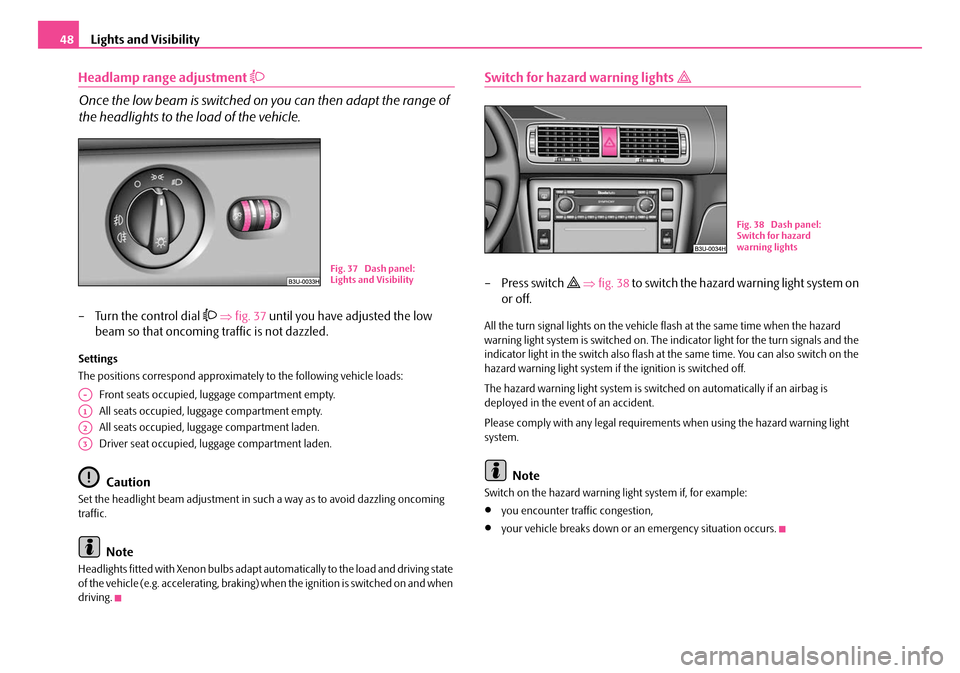
Headlamp range adjustment
Once the low beam is switched on you can then adapt the range of
the headlights to the load of the vehicle.
– Turn the control dial ⇒ fig. 37 until you have adjusted the low
beam so that oncoming traffic is not dazzled.
Settings
The positions correspond approximately to the following vehicle loads:
Front seats occupied, lu ggage compartment empty.
All seats occupied, luggage compartment empty.
All seats occupied, luggage compartment laden.
Driver seat occupied, luggage compartment laden.
Caution
Set the headlight beam adjustment in su ch a way as to avoid dazzling oncoming
traffic.
Note
Headlights fitted with Xenon bulbs adapt au tomatically to the load and driving state
of the vehicle (e.g. accelerating, braking) wh e n th e i g n i t i o n i s s w i t c h e d o n a n d w h e n
driving.
Switch for hazard warning lights
–Press switch ⇒ fig. 38 to switch the hazard warning light system on
or off.
All the turn signal lights on the vehicle flash at the same time when the hazard
warning light system is switched on. The indicator light for the turn signals and the
indicator light in the switch also flash at the same time. You can also switch on the
hazard warning light system if the ignition is switched off.
The hazard warning light system is switch ed on automatically if an airbag is
deployed in the event of an accident.
Please comply with any legal requirements when using the hazard warning light
system.
Note
Switch on the hazard warning light system if, for example:
•you encounter traffic congestion,
•your vehicle breaks down or an emergency situation occurs.
Fig. 37 Dash panel:
Lights and Visibility
A-
A1
A2
A3
Fig. 38 Dash panel:
Switch for hazard
warning lights
NKO B5 20.book Page 48 Friday, March 2, 2007 1:46 PM
Page 50 of 259

Lights and Visibility49
Using the systemSafetyDriving TipsGeneral MaintenanceBreakdown assistanceTechnical Data
The turn signal and main beam lever
The parking lights and headlight flas her are also switched on and off
using the turn signal and main beam lever.
The turn signal and main beam lever perform the following functions:
Right
and left turn signal light
– Push the lever upwards or downwards ⇒fig. 39 .
– Turn signal for changing lanes - in or der to only flash briefly, move the
lever up or down to the pressure po int and hold it in this position.
Main beam
– Switch on the low beam.
– Push the lever forwards.
– Pull the lever back into the initial position in order to switch the main beam off again.
Headlight flasher
– Pull on the lever of the steering wheel (sprung position) - the main beam and warning light in the instrument cluster come on. Parking light
– Switch off the ignition.
– Push the lever up or down - the right-hand or left-hand parking light
is switched on.
Notes on light and indicator functions
•The turn signal system only operates when the ignition is switched on. The
corresponding indicator light or in the instrument cluster also flashes.
•The turn signal is automatically cancelled after negotiating a curve.
•The side light and rear light on the appropriate side of the vehicle are switched
on when the parking light is selected. The parking light function only operates if
the ignition is switched off.
•An acoustic warning signal will sound when the driver's door is opened if the
lever is not in the middle position after removing the ignition key. The acoustic
warning signal will stop just as soon as the driver's door is closed.
Caution
Use main beam or the headlight flasher only if this does not risk dazzling other road
users.
Note
Use only in accordance with the legal requirements the described lighting and
signal systems.
Coming Home Function
This function makes it possible to switch on low or main beam for a short
time after leaving the car, e.g. to illuminate the path to your front door,
etc.
Selecting function
– Switch off the light.
Fig. 39 Turn signal and
main beam lever
NKO B5 20.book Page 49 Friday, March 2, 2007 1:46 PM
Page 51 of 259

Lights and Visibility
50
– Switch off the ignition.
– Flash one time with the headlights.
– Open the door, the low beam lights up.
If you shift the lever into the main be am position, the main beam lights up.
If the door remains open, the ligh t remains on for about 3 minutes.
If the door is closed, the light remains on for about 30 seconds.
Interior lighting
Front interior lighting and storage compartment on front
passenger side
Door contact setting
– Position the switch ⇒ fig. 40 into middle position
.
Switching the interior light on
– Press the switch on the symbol
. Switching the interior light off
– Press the switch on the symbol O.
Front reading lights
– Press on one of the switches
⇒fig. 40 in order to switch the right
or left reading light on or off.
Lighting of storage compartme nt on the front passenger side
– Open the flap of the storage compartment on the front passenger side, the lighting of the storage compartment switches on automati-
cally and switches off when the flap is closed.
If the interior lighting is fitted with a dela yed-off control*, the lighting of the interior
of the car remains on for a few seconds after the doors are closed.
The interior light comes on as soon as yo u unlock the car or open a door or when
the ignition key has been removed. The light goes out again about 30 seconds after
all the doors have been closed. The interior lighting is switched off when you lock
the car or switch the ignition on. This on ly applies when the switch for the corre-
sponding interior lights is standing n the door contact setting.
The interior lighting goes off after about 60 minutes when a door has been left open
in order to avoid discharging the battery of the vehicle.
Two LEDs are integrated in the interior li ghting, which illuminates the shift lever and
the middle of the dash panel. They are switched on automatically when switching
on the parking light.
In addition, the lighting of the door handle is switched on after the ignition is
switched on when the side lights are switched on.
B1Z-0042HB1Z-0042H
Fig. 40 Detail of the
headliner: front interior
lighting
AA
AA
AA
AB
NKO B5 20.book Page 50 Friday, March 2, 2007 1:46 PM
Page 52 of 259

Lights and Visibility51
Using the systemSafetyDriving TipsGeneral MaintenanceBreakdown assistanceTechnical Data
Rear interior lighting
The lights with interior monitoring sensors ⇒fig. 41 are actuated by moving the
switch to the symbol , O or to the middle position .
The lights without interior monitoring sensors ⇒fig. 42 are actuated by pressing
the glass on the symbol
O or by switching to the middle position .
The functions are the same as for the inte rior lighting at the front of the car
⇒ page 50.
Luggage compartment light
The light is located at the top side of the luggage compartment.
The lighting ⇒fig. 43 comes on automatically when the boot lid is opened. The
luggage compartment lighting will switch off again automatically if the boot lid
remains open for more than about 60 minutes.
Entry lighting
The light is located in th e door trim panel below.
The light beam is directed towards the entry area of the corresponding door.
The light switches on when the door is opened and switches off again when the
door is closed.
If the doors remain open, the lighting go es out automatically after about 60 minutes
provided the ignition is not switched on.
Fig. 41 The roof light at
the rear with interior
monitoring sensors
B1Z-0042HB1Z-0042H
Fig. 42 The interior light
at the rear without inte-
rior monitoring sensors
Fig. 43 Luggage
compartment: Lighting
NKO B5 20.book Page 51 Friday, March 2, 2007 1:46 PM
Page 53 of 259

Lights and Visibility
52
Visibility
Windscreen heater*
– Press switch ⇒fig. 44 to switch on the windscreen heater.
The windscreen heater operates only if the ignition is switched on. An indicator light
in the switch is illuminated when the rear window heater is switched on.
The windscreen heater switches off automatically after 4 minutes.
For the sake of the environment
You should switch off the rear window heater as soon as the rear window is clear.
The reduced current consumption will have a favourable effect on fuel economy
⇒ page 166.
Rear window heater
– Press switch ⇒fig. 45 to switch on the rear window heater.
The rear window heater operates only if the ignition is switched on. An indicator
light in the switch is illuminated when the rear window heater is switched on.
The rear wind ow heater switches off automatically after a few minutes.
For the sake of the environment
You should switch off the rear window heater as soon as the rear window is clear.
The reduced current consumption will have a favourable effect on fuel economy
⇒ page 166.
Fig. 44 Switch for wind-
screen heater
Fig. 45 Switch for rear
window heater
NKO B5 20.book Page 52 Friday, March 2, 2007 1:46 PM