2007 SKODA SUPERB lights
[x] Cancel search: lightsPage 156 of 259

Intelligent Technology155
Using the systemSafetyDriving TipsGeneral MaintenanceBreakdown assistanceTechnical Data
Driving Tips
Intelligent Technology
Electronic stability programme (ESP)*
General
General
The ESP aids you maintain control of your vehicle in situations in borderline driving
situations such as when negotiating a curve too fast. The risk of skidding is reduced
and your car thus offers greater driving stability depending on the conditions of the
road surface. This occurs at all speeds.
The following systems are integrated into the electronic stability programme:
•Electronic Differential Lock (EDL),
•Traction control system (TCS),
•Antilock brake system ABS,
•Brake Assist. Operating principle
The ESP switches on automatically when the engine is started and then conducts a
self-test. The ESP control unit processes data from the individual systems. It also
processes additional measurement data which are supplied by highly sensitive
sensors: the rotational velocity of the vehi
cle about its vertical axis, the lateral accel-
eration of the vehicle, the brakin g pressure and the steering angle.
The direction which the driver wishes to ta ke is determined based on the steering
angle and the speed of the vehicle and is constantly compared with the actual
behaviour of the vehicle. If differences exis t, such as the car beginning to skid, the
ESP will automatically brake the appropriate wheel.
The car is stabilised again by the forces which take effect when the wheel is braked.
Intervention into the brake system takes place primarily on the outer front wheel of
a vehicle which tends to oversteer (tendency for the rear of the vehicle to break
away) while occurs this is on the inner re ar wheel of a vehicle which tends to under-
steer (tendency to shift out of the curve). This braking control cycle is accompanied
by noises.
The ESP operates in combination with the ABS ⇒page 159, “Antilock brake system
(ABS)”. If there is a fault in the ABS system, the ESP also does not operate.
The ESP warning light ⇒page 28 lights up in the instrument cluster when there is a
fault on the ESP.
Switching off
You can switch the ESP off and on again as you wish, by pressing the button
⇒ fig. 163 . The ESP warning light ⇒page 28 lights up in the instrument cluster
when the ESP is switched off.
The ESP should normally always be switched on. It may be good practice to switch
the system off only in particular exceptional situations if you desire wheel slip.
Examples:
•when driving with snow chains,
B1Z-0042HB1Z-0042HFig. 163 ESP switch
NKO B5 20.book Page 155 Friday, March 2, 2007 1:46 PM
Page 157 of 259

Intelligent Technology
156
•when driving in deep snow or on a loose surface,
•when it is necessary to rock a ca r free when it has become stuck.
then you should switch on the ESP again.
WARNING
It is also not possible for the ESP to overcome the physical limits of the
vehicle. Even if a vehicle fitted with ESP you should still always adapt your
style of driving to the condition of the road surface and the traffic situation.
This particularly applies when driving on slippery and wet roads. The
increased safety offered must not tempt you to take greater risks than other-
wise - risk of an accident!
Note
•All four wheels must be fitted with the same tyres in order to achieve problem-
free operation of the ESP. Differing rolling circumferences of the tyres can lead to an
undesirable reduction in the engine output.
•Changes to vehicle (e.g. on engine, on the brakes, on chassis or other assign-
ment of tyres and wheels) can influence the function of the ESP ⇒page 205.
Traction control system (TCS)*
The traction control system prevents the driven wheels from spinning
when accelerating.
General
The TCS makes it much easier, and sometimes at all possible, to start off, accelerate
and climb a steep hill when the conditions of the road surface are unfavourable.
Operating principle
The TCS switches on automatically when th e engine is started and then conducts a
self-test. The system monitors the speeds of the driven wheels with the aid of the
ABS sensors. If the wheels ar e spinning, the force transmitted to the road surface is
automatically adapted by reducing the engi ne speed. This occurs at all speeds.
The TCS operates in combination with the ABS ⇒page 159, “Antilock brake system
(ABS)”. The TCS will not function if a fault exists in the ABS system.
The TCS warning light ⇒page 28 lights up in the instrument cluster when there is a
fault on the TCS.
Switching off
You can switch the TCS off and on again as you wish by pressing the button
⇒ fig. 164 . The TCS warning light ⇒page 28 lights up in the instrument cluster
when the TCS is switched off.
B1Z-0042HB1Z-0042HFig. 164 TCS switch
NKO B5 20.book Page 156 Friday, March 2, 2007 1:46 PM
Page 165 of 259

Driving and the Environment
164
The fuel consumption can naturally also be influenced by factors which are beyond
the driver's control. It is, for example, no rmal for the fuel consumption to increase
in winter and under worsened conditions such as poor road conditions, towing a
trailer, etc.
The technical requirements for low fuel usage and economic efficiency of the
vehicle have already been bu ilt into the vehicle at the works. Special attention has
been given to minimisi ng negative effects on the envi ronment. It is necessary to
take note of the guidelines given in this chapter in order to make best use of these
characteristics and to maintain their effectiveness.
Looking ahead when driving
A vehicle's highest fuel consumption occurs it accelerates.
Avoid accelerating and braking unnecessarily. If you drive with forsight you will not
need to brake so often and will also then not have to accelerate so much. Let your
vehicle coast to a stop, for example, if this is possible, when you see that the next
set of traffic lights is at red.
Shifting gears and saving energy
Shifting up early saves on fuel.
Manual gearbox
– Drive no more than about one length of your vehicle in first gear. Always shift up into the next higher gear at approx. 2 000 to 2 500 revs.
Automatic gearbox
– Depress the accelerator pedal slowly. Do not depress it beyond the
kickdown position, however.
An effective way of achieving good fuel economy is to shift up early. You will
consume more fuel if you drive at unnecess arily high revolutions in any given gear.
The ⇒fig. 166 shows the ratio of fuel consumption to the speed of your vehicle in
the relevant gears. Fuel cons umption in 1st gear is the highest, while that in 5th or
the 6th gear is the lowest.
Only depress the accelerator pedal slowly if your vehicle is fitted with an automatic
gearbox in order to automatically select an economic driving programme. You will
achieve good fuel economy by shifting up early and shifting down late. This applies
in particular if you make use of the ma nual mode (Tiptronic) for shifting gears.
Note
Also use the information supplied by the multi-functional indicator ⇒page 15.
Fig. 166 Fuel consump-
tion in litres/100 km. and
speed in km/h.
NKO B5 20.book Page 164 Friday, March 2, 2007 1:46 PM
Page 166 of 259
Driving and the Environment165
Using the systemSafetyDriving TipsGeneral MaintenanceBreakdown assistanceTechnical Data
Avoiding full throttle
Driving more slowly means saving fuel.
Sensitive use of the accelerator will not only significantly reduce fuel consumption
but also positively influence environmental pollution and wear of your vehicle.
You should avoid fully exploiting the top speed of your vehicle wherever possible.
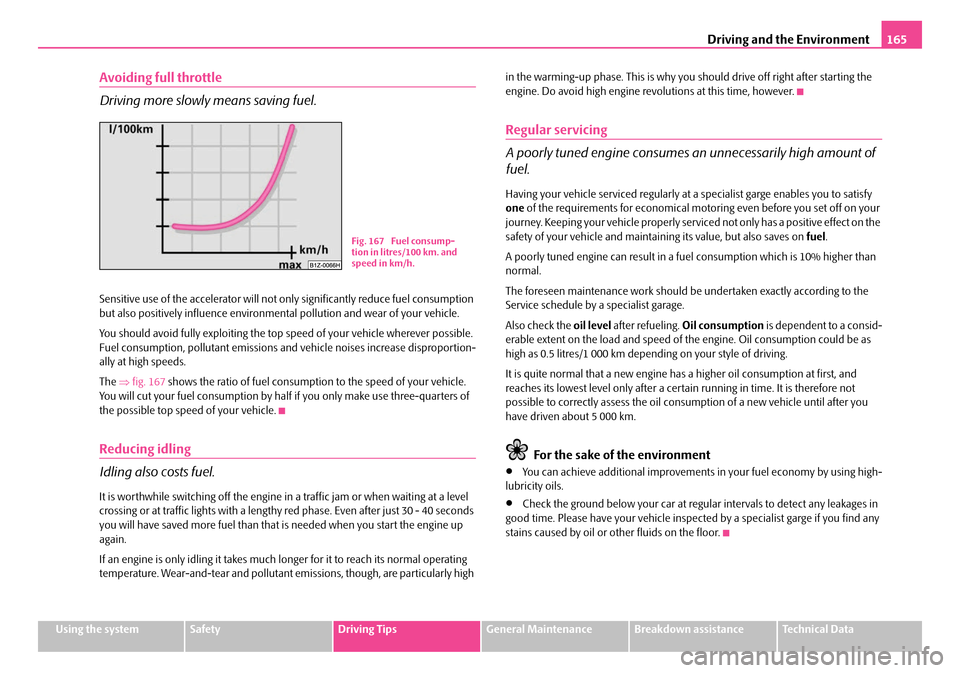
Fuel consumption, pollutant emissions and vehicle noises increase disproportion-
ally at high speeds.
The ⇒fig. 167 shows the ratio of fuel consumptio n to the speed of your vehicle.
You will cut your fuel consumption by half if you only make use three-quarters of
the possible top speed of your vehicle.
Reducing idling
Idling also costs fuel.
It is worthwhile switching off the engine in a traffic jam or when waiting at a level
crossing or at traffic lights with a length y red phase. Even after just 30 - 40 seconds
you will have saved more fuel than that is needed when you start the engine up
again.
If an engine is only idling it takes much longer for it to reach its normal operating
temperature. Wear-and-tear and pollutant em issions, though, are particularly high in the warming-up phase. This is why you should drive off right after starting the
engine. Do avoid high engine re
volutions at this time, however.
Regular servicing
A poorly tuned engine consumes an unnecessarily high amount of
fuel.
Having your vehicle serviced regularly at a specialist garge enables you to satisfy
one of the requirements for economical motoring even before you set off on your
journey. Keeping your vehicle properly serviced not only has a positive effect on the
safety of your vehicle and maintaining its value, but also saves on fuel.
A poorly tuned engine can result in a fu el consumption which is 10% higher than
normal.
The foreseen maintenance work should be undertaken exactly according to the
Service schedule by a specialist garage.
Also check the oil level after refueling. Oil consumption is dependent to a consid-
erable extent on the load and speed of the engine. Oil consumption could be as
high as 0.5 litres/1 000 km depending on your style of driving.
It is quite normal that a new engine ha s a higher oil consumption at first, and
reaches its lowest level only after a certain running in time. It is therefore not
possible to correctly assess the oil cons umption of a new vehicle until after you
have driven about 5 000 km.
For the sake of the environment
•You can achieve additional improvements in your fuel economy by using high-
lubricity oils.
•Check the ground below your car at regula r intervals to detect any leakages in
good time. Please have your vehicle inspected by a specialist garge if you find any
stains caused by oil or other fluids on the floor.
Fig. 167 Fuel consump-
tion in litres/100 km. and
speed in km/h.
NKO B5 20.book Page 165 Friday, March 2, 2007 1:46 PM
Page 169 of 259
Driving and the Environment
168
Unleaded petrol
A vehicle fitted with a petrol engine must always be refuelled with unleaded petrol
⇒ page 163. The automobile associations can provide you with information
regarding the locations of filling stations which offer unleaded petrol.
Headlight
The low beam of your headlights is set asymmetrically. It illuminates the side of the
road on which you are driving to a greater extent. If you drive abroad on the other
side of the road, you will dazzle oncoming traffic.
It is necessary in order to avoid dazzling oncoming traffic to stick a sticker over a
certain part of the headlights.
Headlight stickers can be obtained as a spare part from the Skoda Service Partners.
Headlights with Xenon lamps are designed for driving in countries with traffic on
the right or on the left. Have this do ne always at a Škoda Service Partner.
Note
You can obtain further information regardin g masking over or converting the head-
lights from your Škoda Service Partner.
Avoiding damage to your vehicle
When driving on poor roads and lanes or when driving over kerbstones, steep
ramps etc., you must pay particular attent ion to ensuring that any low-slung parts
of the vehicle, such as spoiler and ex haust, do not touch the ground and get
damaged.
This particularly applies to models with a lowered suspension (sport suspension)
and also when your vehicle is fully laden.
NKO B5 20.book Page 168 Friday, March 2, 2007 1:46 PM
Page 171 of 259

Towing a trailer
170
should be attached to folding arms. Adjust the mirrors so that they provide you with
an adequate field of view to the rear.
Headlights
Before starting off with a hitched trailer, also check the setting of the headlights.
Alter the setting as necessary with the aid of the headlight beam adjuster
⇒ page 48.
Detachable ball head
The ball rod is detachable on vehicles wh ich feature a factory-fitted towing device.
It is stowed together with separate fitting instructions in the spare wheel well in the
luggage compartment of the vehicle.
Further information on the towing device ⇒page 171.
Note
•We recommend that you also have yo ur vehicle inspected between service
intervals if you tow a trailer frequently.
•The handbrake on the towing vehicle must be put on when coupling and
decoupling the trailer.
Driving Tips
Particular caution is required when towing a trailer.
– Do not, as far as possible, drive with your vehicle unladen and the
trailer laden.
– Do not make full use of the legal maximum speeds. This applies in
particular to downhill sections.
– Apply the brakes in good time.
– Keep a check on the coolant temper ature gauge if the outside temper-
ature is high.
Distribution of weight
The distribution of the weight is very poor if your vehicle is unladen and the trailer
is laden. Maintain a particularly low speed if you cannot avoid driving with this
combination.
Driving speed
Do not drive faster than 80 km/h for safety reasons. This also applies for countries
in which higher speeds are allowed.
The fact that the driving stability of the vehicle + trailer combination reduces with
increasing speed means that the legally allowed speed should not be used when
there are unfavourable road, weather or wind conditions, particularly near accident
black spots.
You must always reduce your speed immedi ately as soon as you detect even just
the slightest swaying of the trailer. On no account attempt to stop the trailer from
“swaying” by accelerating.
Apply the brakes in good time! If the trailer is fitted with a trailer brake, apply the
brakes gently at first and then brake firmly. This will avoid brake jolts resulting from
the trailer wheels locking. Shift down gears in good time before negotiating a down-
hill section to allow the engine to also act as a brake.
Engine overheating
Please keep a check on the coolant temperature gauge if you have to negotiate a
lengthy slope in a low gear at a high engi ne speed when the outside temperature is
very high ⇒page 12.
If the needle of the coolant temperature gauge moves into the right-hand area or
even the red area of the scale, reduce yo ur speed immediately. Stop and switch off
the engine if the warning light
in the instrument cluste r begins flashing. Wait a
few minutes and check the level of coolant in the coolant expansion bottle
⇒ page 190, “Inspecting the coolant level”.
Please refer to the following guidelines ⇒page 26, “Coolant temperature, Coolant
quantity ”.
The coolant temperature can be reduced by switching on the heating.
Any increase in the cooling effect of the coolant fan through shifting down a gear
and increasing the engine speed is not possible since the fan speed is independent
NKO B5 20.book Page 170 Friday, March 2, 2007 1:46 PM
Page 177 of 259

Taking care of your vehicle and cleaning the vehicle
176
Plastic parts
External plastic parts are cleaned by normal washing. Plastic parts and synthetic
leather can also be treated with special solvent-free plastic cleaning agents if a
damp cloth is not sufficient. Paint care pr oducts are not suitable for plastic parts.
Caution
Solvent-free cleaners attack the material and can damage it.
Windows
Only use a plastic ice scraper for removing snow and ice from the windows and
mirrors. You should not move the ice scraper forward and backward but in one
direction on the window which you are clea ning in order to avoid any damage to
the surface of the glass.
You can best remove residues of rubber, oil, grease, wax or silicone by using a
special window cleaner or a special silicone remover.
You should also clean the windows regularly from the inside.
Do not use window leathers which you have used to polish the vehicle body to dry
off the windows. Residues of preservati ves in the window leather can dirty the
window and reduce visibility.
Do not affix any stickers over the inside of the rear window to avoid damage to the
heating elements of the rear window heater .
We recommend using a preservative from Škoda genuine accessories offered by
your Škoda dealer.
Caution
Never remove snow or ice from the glass parts with warm or hot water - risk of
formation of cracks in the glass!
The headlight lenses
Please do not use any aggres sive cleaning or chemical solvent pr oducts - risk of
damage to the plastic lenses Please use soap and clean warm water.
Caution
Never wipe the headlights dry and do not use any sharp objects for cleaning the
plastic lenses, this may result in damage to the protective paintwork and conse-
quently in formation of cracks on the head light lenses, e.g through effect of chem-
ical products.
Door and window seals
The rubber seals on the doors, boot lid, bonnet and windows remain supple and
last longer if you treat them from time to time with a rubber care product (e.g. with
a spray with silicone-free oil). You also avoid premature wear of the seals and
prevent leakages in this way. It is also easier to open the doors. Rubber seals which
are well cared for also do not stick together in cold winter weather.
Locks
We recommend that you use the spray from Škoda original accessories with
regreasing and anticorrosive effect for de-icing locks.
Note
When washing your vehicle, ensure that as little water as possible gets into the
locks.
NKO B5 20.book Page 176 Friday, March 2, 2007 1:46 PM
Page 198 of 259

Inspecting and Replenishing197
Using the systemSafetyDriving TipsGeneral MaintenanceBreakdown assistanceTechnical Data
We recommend having the ve
hicle checked by a specialist garage to ensure full
functionality of all electrical systems.
Replacing the battery
You should only replace a battery with a new battery of the same capacity, voltage
(12 V), amperage and of the same size. Specialist garages have a range of suitable
batteries available.
We recommend that you only have an old battery disposed of by a specialist garage
since it does require special disposal.
For the sake of the environment
Batteries contain poisonous substances such as sulphuric acid and lead. They must
be disposed of in accordance with loca l environmental protection regulations and
on no account as domestic waste.
Windshield washer system
The windshield washer reservoir contains the cleaning fluid for the windscreen and
for the headlamp cleaning system*. The rese rvoir is located in the front left of the
engine compartment ⇒fig. 182 .
The reservoir has a capacity of 4 liters.
Clear water is not sufficient to intensivel y clean the windscreen and headlights. We
therefore recommend using clean washing water together with the screen cleaner
from Škoda genuine accessories (in winter additionally with antifreeze) which is
capable of removing stubborn dirt. Follow the instructions for use on the packaging
when using screen cleaning products.
You should always add antifreeze to the cleaning water in winter even if your
vehicle is fitted with heated windscreen washer nozzles*.
It is also possible in exceptional cases to use methylated spirits when no screen
cleaner with antifreeze is available. The concentration of methylated spirits must
not be more than 15 %. Please note, however, that the antifreeze protection at this
concentration is only adequate down to -5°C.
WARNING
Read and observe the warning notes ⇒page 185, “Working in the engine
compartment” before working in the engine compartment.
OperationOperating measure
Electrical power window (operational
faults)⇒ page 42
Enter radio code numbersee Radio Operating Instruc-
tions
Set hours⇒page 13
Data in the multi-functional indicator are
deleted.⇒page 15
B1Z-0042HB1Z-0042H
Fig. 182 Engine
compartment: Wind-
shield washer fluid reser-
voir
NKO B5 20.book Page 197 Friday, March 2, 2007 1:46 PM