2007 SKODA FABIA maintenance
[x] Cancel search: maintenancePage 56 of 242

Lights and Visibility55
Using the systemSafetyDriving TipsGeneral MaintenanceBreakdown assistanceTechnical Data
Adjusting the left-hand exterior mirror*
– Turn the rotary knob to position . The movement of the mirror surface
is identical to the movement of the rotary knob.
Adjusting the right-hand exterior mirror*
– Turn the rotary knob to position . The movement of the mirror
surface is identical to the movement of the rotary knob.
The vehicle can also be equi pped with a second rear mirror*, which is attached above the inner main rear mirror. The second rear mirror* enables an extensive look into the area of the rear seats, e.g. to check on the seated passengers. You can adjust it in the horizontal as well as vertical direction regardless of the inner main rear mirror.
The exterior mirror heat er only operates when the engine is running.
WARNING
•Convex (curved outward) or a spherical exterior mirrors increase the vision field. They do, however, make objects appear smaller in the mirror. These mirrors are only of limited use, therefore, for estimating distances to the following vehicles.
•Use whenever possible the interior rear mirror, for estimating the distances to the following vehicles.
Note
•Do not touch the surfaces of the exterior mirrors if the exterior mirror heater is switched on.
•You can set the exterior mirrors by hand, if the power setting function fails at any time, by pressing on the edge of the mirror surface.
•Contact your specialist garage if a fault exists with the power setting of the exte-rior mirrors.
NKO A05F 20 MR08.book Page 55 Thursday, April 19, 2007 11:34 AM
Page 58 of 242

Seats and Stowage57
Using the systemSafetyDriving TipsGeneral MaintenanceBreakdown assistanceTechnical Data
Adjusting height of seat*
– Lift the seat if required by pulling or pumping lever upwards.
– Lower the seat if required by pushing or pumping lever down-
wards.
Adjust the angle of the seat backrest
– Relieve any pressure on the backrest (do not lean on it) and turn the
handwheel to adjust the angle of the backrest.
The driver's seat should be adjusted in such a way that the pedals can be pressed to the floor with slightly bent legs.
The backrest on the driver's seat should be adjusted in such a way that the upper point of the steering wheel can be easi ly reached with slightly bent arms.
WARNING
•Only adjust the driver seat when the vehicle is stationary - risk of injury!
•Take care when adjusting the seat! Adjusting the seat without care can lead to bruises or injuries.
•The backrests must not be angled too far back when driving otherwise this will affect proper operation of the seat belts and of the airbag system - risk of injury!
Head restraints
Best protection is achieved if the top edge of the head restraint is at the
same level as the uppe r part of your head.
Adjusting the height of a head restraint
– Grasp the side of the head restraint with both hands and push the
head restraint in the direction of axle of the metal guide rods, in the
direction of arrow ⇒fig. 49 to the top or to the bottom.
A2
A2
A3
Fig. 49 Adjusting head restraint
Fig. 50 Removing a head restraint
NKO A05F 20 MR08.book Page 57 Thursday, April 19, 2007 11:34 AM
Page 60 of 242
Seats and Stowage59
Using the systemSafetyDriving TipsGeneral MaintenanceBreakdown assistanceTechnical Data
Caution
•You should not kneel on the seats or otherwise apply pressure at specific points in order to avoid damaging the heating elements of the seat heaters.
•Do not clean the seats moist ⇒page 166.
Note
The seat heating should only be switched on when the engine is running. This has a significant effect of saving on the battery capacity.
Rear seats
Folding the rear seats forwards
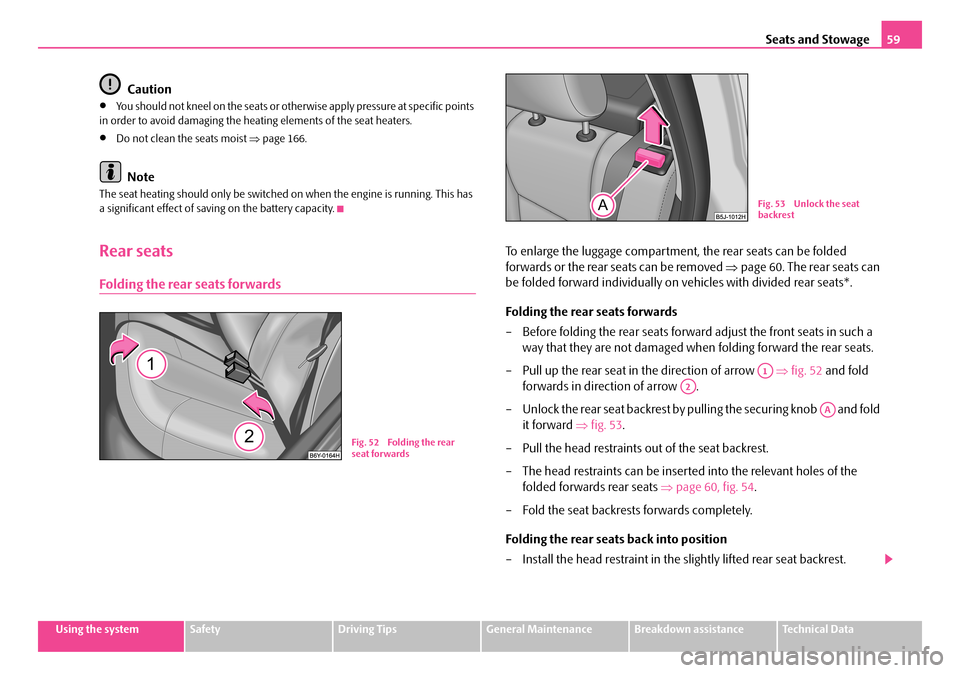
To enlarge the luggage compartment, the rear seats can be folded
forwards or the rear seats can be removed ⇒page 60. The rear seats can
be folded forward individually on vehicles with divided rear seats*.
Folding the rear seats forwards
– Before folding the rear seats forward adjust the front seats in such a
way that they are not damaged when folding forward the rear seats.
– Pull up the rear seat in the direction of arrow ⇒fig. 52 and fold
forwards in direction of arrow .
– Unlock the rear seat backrest by pulling the securing knob and fold
it forward ⇒fig. 53.
– Pull the head restraints out of the seat backrest.
– The head restraints can be inserted into the relevant holes of the
folded forwards rear seats ⇒page 60, fig. 54.
– Fold the seat backrests forwards completely.
Folding the rear seats back into position
– Install the head restraint in the slightly lifted rear seat backrest.
Fig. 52 Folding the rear seat forwards
Fig. 53 Unlock the seat backrest
A1
A2
AA
NKO A05F 20 MR08.book Page 59 Thursday, April 19, 2007 11:34 AM
Page 62 of 242

Seats and Stowage61
Using the systemSafetyDriving TipsGeneral MaintenanceBreakdown assistanceTechnical Data
Pedals
You should use only footmats which do not obstruct the movement of the pedals and have an anti-slip protection.
We recommend only to use footmats from Škoda genuine accessories offered by your Škoda dealer.
Operation of the pedals must not be hindered!
WARNING
•Greater pedal distances may be needed when there is a fault in the brake system.
•Do not place any footmats or other additional floor coverings in the area of the pedals in order to ensure that all the pedals can be fully depressed and are able to return unobstructed to their initial position - risk of accident!
•There must be no objects on the floor which could roll under the pedals. You would then no longer be able to apply the brakes, operate the clutch or accelerator - risk of accident!
luggage compartment
Loading the luggage compartment
Please observe the following in the inte rest of having good handling char-
acteristics of your vehicle:
– Distribute the items of luggage as evenly as possible.
– Place heavy objects as far forward as possible.
– Attach the items of luggage to the lashing eyes or the safety net*
⇒ page 62.
In the event of an accident, there is such a high kinetic energy which is produced by small and light objects that they can caus e severe injuries. The magnitude of the
kinetic energy depends on the speed at wh ich the vehicle is travelling and on the weight of the object. The speed at which the vehicle is travelling is in this case the more significant factor.
Example: In the event of a frontal collision at a speed of 50 km/h, an unsecured object with a weight of 4.5 kg produces an energy, which corresponds to 20 times its own weight. This means that it results in a weight of approx. 90 kg. You can imagine the injuries that can occur, if this “bullet” is flying through the interior compartment and hits an occupant.
WARNING
•Store the objects in the luggage compartment and attach them to the lashing eyes.
•Loose objects in the passenger co mpartment can be thrown forward during a sudden manoeuvre or in case of an accident and can injure the occupants or other oncoming traffic. This risk is still increased, if the objects which are flying around are hit by a deployed airbag. In this case, the objects which are thrown back can injure the occupants - hazard.
•Please note that the handling properties of your vehicle may be affected when transporting heavy objects as a result of the displacement of the centre of gravity. The speed and style of driving must be adjusted accord- ingly.
•The items carried in the luggage compartment should be stored in such a way that no objects are able to slip forward if there are any sudden driving or braking manoeuvres under taken - risk of injury!
•When transporting fastened objects which are sharp and dangerous in the luggage compartment enlarged by folding the rear seats forward or removing the rear seats, ensure the safety of the passengers transported on the other rear seats ⇒page 116, “Correct seated position for the occupants on the rear seats”.
•If the rear seats next to the folded forward seat are occupied, ensure maximum safety, e.g. by placing the goods to be transported in such a way that a folding back of the seat is prevented in case of a rear collision.
•Never drive with the boot lid fully opened or slightly ajar otherwise exhaust gases may get into the interior of the vehicle - risk of poisoning!
NKO A05F 20 MR08.book Page 61 Thursday, April 19, 2007 11:34 AM
Page 64 of 242

Seats and Stowage63
Using the systemSafetyDriving TipsGeneral MaintenanceBreakdown assistanceTechnical Data
The luggage compartment cover
You can use the luggage compartment cover behind the head
restraints for storing light and soft items.
The luggage compartment cover can be removed as required if one must
transport bulky goods.
– Unhook the support stra ps on the boot lid ⇒page 63, fig. 58.
– Slightly raise the luggage compartment cover.
– Remove the luggage compartment cover from the holders by
pulling to the rear or with adequate blows to the bottom side of the
luggage compartment cover in the area between the holders.
– To re-install, place the luggage compartment cover on the contact
surfaces of the side trim panels and press the luggage compartment
cover into the holders by pushing forward and then hang the
support straps on the tailgate.
The luggage compartment cover in the uppe r position is foreseen for storage of small objects of up to 2.5 kg. in weight.
Caution
Please ensure that the heating elements of the rear window heater are not damaged as a result of obje cts placed in this area.
Note
When opening the boot lid, lift the luggage compartment cover - risk that objects placed in this area can slip forward!
Further positions of the luggage compartment cover
You can use the luggage compar tment cover behind the head
restraints for storing light and soft items.Fig. 58 Removing the luggage compartment cover
A1
A2
A2
A1
Fig. 59 Luggage compartment cover in the lower position
Fig. 60 Luggage compartment cover stowed behind the rear seats.
NKO A05F 20 MR08.book Page 63 Thursday, April 19, 2007 11:34 AM
Page 66 of 242

Seats and Stowage65
Using the systemSafetyDriving TipsGeneral MaintenanceBreakdown assistanceTechnical Data
Fitting
– Insert the attachment points of th e roof rack into the mounts of the
body so that the pins of the attachment points grasp into the holes of
the body.
Note
•Pay attention to the information regarding assembly and disassembly in the attached instructions.
•If you have any questions, plea se contact a specialist garage.
Roof load
Distribute weight evenly over the roof luggage rack system. The maximum permis- sible roof load (including roof rack system) of 75 kg and the maximum permissible total weight of the vehicle should not be exceeded.
You cannot make full use of the permissible roof load if you use a roof luggage rack system with a lower load carrying capacity. The load transported on the roof luggage rack system must not exceed the we ight limit which is stated in the fitting instructions.
WARNING
•The items which you transport on the roof bar system must be reliably attached - risk of accident!
•You must on no account exceed the permissible roof load, the permis- sible axle loads and the permissible gros s weight of your vehicle - risk of accident!
•Please note that the handling prop erties of your vehicle change when you transport heavy or bulky items on the roof bar system as a result of the displacement of the centre of gravity and the increased wind attack area - risk of accident! You must absolutely adapt your style of driving and the speed of the vehicle to the specific circumstances.
Front cup holder
You can place two cups or beve rage cans into the recesses ⇒fig. 62.
WARNING
•Do not place any hot beverages into the cup holder. If the vehicle moves, the hot beverages may spill - risk of scalding!
•Do not use any cups or beakers which are made of brittle material (e.g. glass, porcelain). You might be injured by them in the event of an accident.
Caution
Do not open the beverages in the cup holder while driving. There is a risk of spilling e.g. when braking and therefore the electrical components or the seat upholstery can be damaged.
Fig. 62 Front centre console: Cup holder
NKO A05F 20 MR08.book Page 65 Thursday, April 19, 2007 11:34 AM
Page 68 of 242
Seats and Stowage67
Using the systemSafetyDriving TipsGeneral MaintenanceBreakdown assistanceTechnical Data
Ashtray*
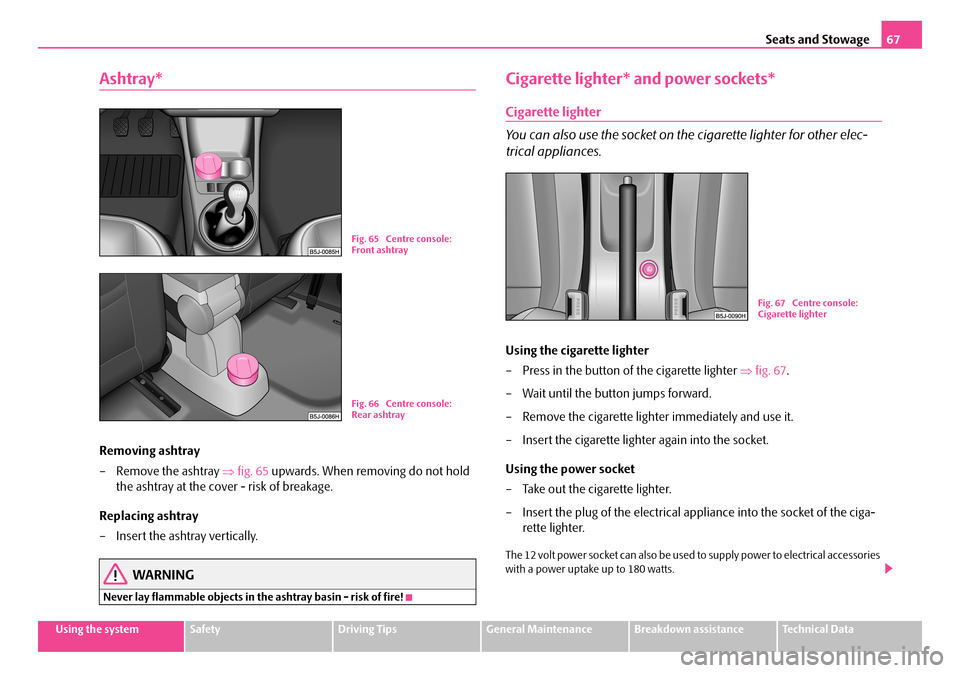
Removing ashtray
– Remove the ashtray ⇒fig. 65 upwards. When removing do not hold
the ashtray at the cover - risk of breakage.
Replacing ashtray
– Insert the ashtray vertically.
WARNING
Never lay flammable objects in the ashtray basin - risk of fire!
Cigarette lighter* and power sockets*
Cigarette lighter
You can also use the socket on the cigarette lighter for other elec-
trical appliances.
Using the cigarette lighter
– Press in the button of the cigarette lighter ⇒fig. 67.
– Wait until the button jumps forward.
– Remove the cigarette lighter immediately and use it.
– Insert the cigarette lighter again into the socket.
Using the power socket
– Take out the cigarette lighter.
– Insert the plug of the electrical a ppliance into the socket of the ciga-
rette lighter.
The 12 volt power socket can also be used to supply power to electrical accessories with a power uptake up to 180 watts.
Fig. 65 Centre console: Front ashtray
Fig. 66 Centre console: Rear ashtray
Fig. 67 Centre console: Cigarette lighter
NKO A05F 20 MR08.book Page 67 Thursday, April 19, 2007 11:34 AM
Page 70 of 242

Seats and Stowage69
Using the systemSafetyDriving TipsGeneral MaintenanceBreakdown assistanceTechnical Data
Opening and closing the storage compartments on the front
passenger side
– Pull or press the handle of the lid in the direction of arrow ⇒page 68,
fig. 68 and fold open the lid.
– Raise the lid until it is heard to engage.
A pin holder is located inside the lid.
WARNING
The storage compartment must always be closed when driving for safety reasons.
Cooling of storage compartment on front passenger side*
The storage compartment can be fitted for vehicles with an air-
conditioning system with a closable inlet for cooled air.
– You can switch the cooling system on or off using the control dial
⇒ fig. 69.
Opening the air inlet when the air conditioning system is on causes fresh or interior air to flow into the storage compartment.
The storage compartment is only cooled in the cooling mode. We recommend that you switch off the cooling (opening concealed) if it is operating in the heating mode or if you are not using the cooling system for the storage compartment.
Storage compartment on the driver's side
Unlockable compartment below the steering wheel on the left.
Stowage compartment for spectacles*
Fig. 69 Storage compartment: Using cooling system
Fig. 70 Dash panel: Storage compartment on the driver's side
Fig. 71 Detail of the headliner: Stowage compartment for specta-cles
NKO A05F 20 MR08.book Page 69 Thursday, April 19, 2007 11:34 AM