2007 SKODA FABIA warning
[x] Cancel search: warningPage 119 of 242
Seat belts118
Seat belts
Why seat belts?
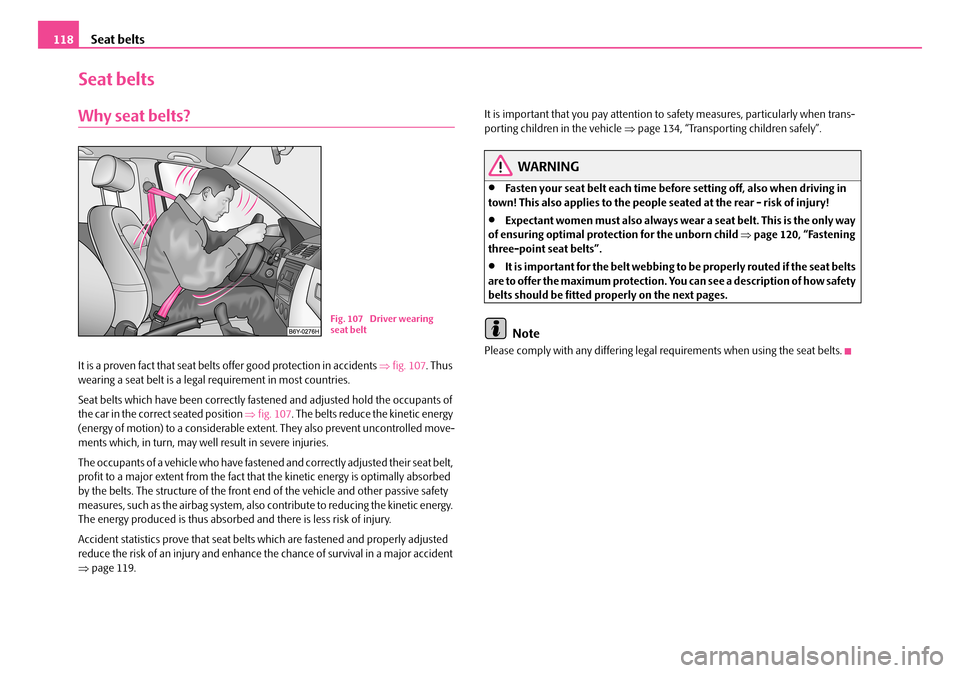
It is a proven fact that seat belts offer good protection in accidents ⇒fig. 107. Thus wearing a seat belt is a legal requirement in most countries.
Seat belts which have been correctly fastened and adjusted hold the occupants of the car in the correc t seated position ⇒fig. 107. The belts reduce the kinetic energy (energy of motion) to a considerable extent. They also prevent uncontrolled move- ments which, in turn, may well result in severe injuries.
The occupants of a vehicle who have fastened and correctly adjusted their seat belt, profit to a major extent from the fact that the kinetic energy is optimally absorbed by the belts. The structure of the front end of the vehicle and other passive safety measures, such as the airbag system, also contribute to reducing the kinetic energy. The energy produced is thus absorbed and there is less risk of injury.
Accident statistics prove that seat belts which are fastened and properly adjusted reduce the risk of an injury and enhance the chance of survival in a major accident ⇒ page 119.
It is important that you pay attention to safety measures, particularly when trans- porting children in the vehicle ⇒page 134, “Transporting children safely”.
WARNING
•Fasten your seat belt each time before setting off, also when driving in town! This also applies to the people seated at the rear - risk of injury!
•Expectant women must also always wear a seat belt. This is the only way of ensuring optimal protection for the unborn child ⇒page 120, “Fastening three-point seat belts”.
•It is important for the belt webbing to be properly routed if the seat belts are to offer the maximum protection. You can see a description of how safety belts should be fitted pr operly on the next pages.
Note
Please comply with any differing legal requirements when using the seat belts.
Fig. 107 Driver wearing seat belt
NKO A05F 20 MR08.book Page 118 Thursday, April 19, 2007 11:34 AM
Page 120 of 242

Seat belts119
Using the systemSafetyDriving TipsGeneral MaintenanceBreakdown assistanceTechnical Data
The physical principle of a frontal collision
The physical principle of a frontal accident can be explained quite simply:
Motion energy, so-called kinetic energy, is produced as soon as the vehicle is moving, both for the vehicle and its occupants. The magnitude of this kinetic energy depends essentially on the speed at which the vehicle is travelling and on the weight of the vehicle and the occupants. The greater the speed and weight increase,
the greater the amount of energy which has to be absorbed in the event of an acci- dent.
The speed of the vehicle is, nevertheless, the most important factor. Doubling the speed of the vehicle from 25 km/h up to 50 km/hour increases the kinetic energy four times.
The common opinion that it is possible to support your body in a minor accident with your hands, is incorrect. Even in a collision at only a low speed, the forces acting on the body are such that it is no longer possible to support your body.
Even if you only drive at a speed within the range from 30 km/hour to 50 km/hour, the forces which are produced on your body in the event of an accident can easily exceed 10.000 N (Newton). This equals a weight of one tonne (1 000 kg).
In the event of a frontal collision, occupants of the car not wearing a seat belt, are thrown forward and strike in an uncontrolle d way parts of the interior of the car, such as steering wheel, dash panel, windscreen, ⇒fig. 108. The occupants of a vehicle who have not fastened their seat belts may even be thrown out of the vehicle. This can resu lt in fatal injuries.
It is also important that rear seat occupants fasten their seat belts as they will other- wise be thrown through the vehicle in an uncontrolled manner in the event of an accident A rear seat passenger who has not fastened the seat belt is a danger not only to himself but also fo r those seated at the front ⇒fig. 109.
Important safety information regarding the use of
seat belts
The correct use of the seat belts considerably reduces the risk of
injury!
WARNING
•The belt webbing must not be jammed in-between at any point or twisted, or chafe against any sharp edges.
•It is important that the belt webbing is properly routed if the seat belts are to offer their maximum protection ⇒page 120, “How are seat belts correctly fa stened?”.
Fig. 108 The driver is thrown forward if not wearing a belt
Fig. 109 The rear seat occupant is thrown forward if not wearing a belt
NKO A05F 20 MR08.book Page 119 Thursday, April 19, 2007 11:34 AM
Page 121 of 242

Seat belts120
•No two persons (also not children) should ever use a single seat belt together.
•The maximum protection which seat belts can offer is only achieved if you are correctly seated ⇒page 115, “Correct seated position”.
•The belt webbing must not run across solid or fragile objects (e.g. spec- tacles, ball-point pens, keys etc.) as this may be a cause of injuries.
•Bulky, loose clothing (e.g. a winter coat over a jacket) does not allow you to be correctly seated and impairs proper operation of the seat belts.
•It is prohibited to use clamps or other objects to adjust seat belts (e.g. for shortening the belts for smaller persons).
•The lock tongue should only be insert ed into the lock which is the correct one for your seat. Wrong use of the safety belt will reduce its capacity to protect and the risk of injury increases.
•The backrests must not be tilted too far to the rear otherwise the seat- belts can lose their effectiveness.
•The belt webbing must always be ke pt clean. Soiled belt webbing may impair proper operation of the inertia reel ⇒page 167, “Seat belts”.
•The slot of the belt tongue must not be blocked by paper or similar objects otherwise the belt tongue will not lock in place properly.
•Inspect the seat belts regu larly to ensure they are in good condition. If you find seat belts which have damage to the seat belt webbing, seat belt connections, to the inertia reels or to the lock, the relevant safety belt must be replaced by a specialist garage.
•The seat belts must not be removed or changed in any way. Do not make an attempt to repair the seat belts yourself.
•Damaged seat belts which have been subjected to stress in an accident and were therefore stretched, must be replaced - this is best done by a specialist garage. The anchorage points of the belts must also be inspected. The anchorage points for the be lts should also be checked.
•In certain countries it is possible to use seat belts which differ in terms of their operation from the seat belts wh ich are described on the pages which follow.
How are seat belts correctly fastened?
Fastening three-point seat belts
Fasten your seat belt before starting!
– Correctly adjust the seat and the head restraint before fastening your
seat belt ⇒page 115, “Correct seated position”.
WARNING (continued)
Fig. 110 Routing of webbing over the shoul-ders and the lap belt
Fig. 111 Routing of belt webbing for an expectant mother
NKO A05F 20 MR08.book Page 120 Thursday, April 19, 2007 11:34 AM
Page 122 of 242

Seat belts121
Using the systemSafetyDriving TipsGeneral MaintenanceBreakdown assistanceTechnical Data
– Slowly pull the belt webbing at the tongue of the lock over your chest
and pelvis ⇒.
– Insert the tongue of the lock into th e seat belt buckle belonging to the
seat until it is heard to lock in place.
– Pull on the belt to check that it has also reliably engaged in the lock.
Each three-point seat belt is equipped with an inertia reel. This inertia reel offers you complete freedom of movement if the belt is unreeled slowly. If the brakes are applied suddenly, the inertia reel will block. It also blocks the belts when the car accelerates, when driving downhill and when cornering.
Expectant mothers must also wear the seat belt ⇒.
WARNING
•The shoulder part of the seat belt must never run across your neck but must run approximately over the middl e of the shoulder and fit snugly against the chest. The lap part of the belt must run across the hip and must never be routed across the stomach. It must always fit snugly ⇒page 120, fig. 110 . Adjust the belt webbing as required.
•The lap part of the belt should be positioned as low as possible at the pelvis of an expectant mother in order to avoid exerting any pressure on the lower abdomen.
•Always ensure that the webbing of the seat belts is properly routed. Seat belts which are not correctly adjusted ca n themselves cause injuries even in minor accidents.
•A seat belt which is hanging too loose can result in injuries as your body is moved forward by the kinetic energy produced in an accident and is then suddenly held firm by the belt.
•Only insert the lock tongue into the lo ck which is the correct one for your seat. This will affect the protection whic h the belt offers and increase the risk of an injury.
Seat belt height adjuster on the front seats
The seat belt height adjuster makes it possible for you to adapt the
routing of the front three-point seat belt in the area of the shoulder to
match your body size.
– To adjust the belt height press the height adjuster and move it up or
down ⇒fig. 112.
– Then pull firmly on the belt to ensure that the seat belt height adjuster
has correctly locked in place.
WARNING
Adjust the height of the belt in such a way that the shoulder part of the belt is positioned approximately across the middle of your shoulder - on no account across your neck.
Note
It is also possible to adapt the routing of the belt webbing on the front seats by adjusting the height of the seat*.
Fig. 112 Front seat: Seat belt height adjuster
NKO A05F 20 MR08.book Page 121 Thursday, April 19, 2007 11:34 AM
Page 123 of 242

Seat belts122
Taking seat belts off
– Press the red button in the belt lock ⇒fig. 113. The spring force causes
the tongue of the lock to jump out.
– Guide the belt back with your hand to enable the inertia reel to wind
up the belt webbing more easily.
A plastic knob in the belt webbing holds the belt tongue in a position which is easy to get hold of.
Three-point safety belt for the middle rear seat
It is used in the same way as the normal three-point seat belts on the left and right (at front and rear). The three-point seat belt for the rear middle seat must be put on first to allow the pelvic part of the belt to run between the belt lock for the right three-point seat belt and the backrest, whil e avoiding crossing the belt webbing of the right and middle seat belts.
WARNING
•The three-point safety belt for the rear middle seat can only fulfil its func- tion reliably when the backrests are correctly locked into position ⇒ page 59.
Note
The vehicles of the group N1 are not equipped with the third seat belt on the rear seats. The vehicle is only approved for four persons.
Belt tensioner
Safety for the driver and front passenger wearing their seat belts is enhanced by the belt tensioners fitted to the inertia reels of the front three-point seat belts.
The fastened three-point seat belts are au tomatically tensioned in the event of a frontal collision of a certain severity. The belts tensioners are also deployed if the seat belts are not fastened.
Belt tensioners are not activated in the ev ent of minor frontal collisions, side and rear-end collisions, in the ca se of a rollover and also not in accidents in which no major forces are produced from the front.
WARNING
•Any work on the belt tightener syst em, including removal and installa- tion of system components because of other repair work, must only be carried out by a specialist garage.
•The protective function of the system is only adequate for a single acci-dent. If the belt tensioners have been deployed, it is then necessary to replace the entire system.
•The Owner's Manual must also be ha nded over to the new owner if the vehicle is sold.
Note
•Smoke is generated when the belt tensione rs are deployed. This is not an indi- cation of a fire in the vehicle.
•It is essential to pay attention to relevant safety regulations if the vehicle or indi- vidual parts of the system are scrapped. Škoda Service Partners are familiar with
Fig. 113 Releasing lock tongue from belt lock
NKO A05F 20 MR08.book Page 122 Thursday, April 19, 2007 11:34 AM
Page 125 of 242
Airbag system124
Airbag system
Description of the airbag system
General information on the airbag system
The front airbag system is complementary to the three-point seat belts and offers additional protection in the head and chest area of the driver and passenger in the event of a frontal collision.
In the event of a side collision, the side airbags reduce the risk of injury to the occu- pants to the part of their body facing the side of the accident.
The airbag system is only functional after the ignition has been switched on.
The operational readiness of the airbag system is monitored electronically. The airbag warning light comes on for a few seconds each time the ignition is switched on.
The airbag system (according to vehicl e equipment) essentially consists of:
•an electronic control unit,
•the front airbags for the driver and front passenger ⇒page 126,
•the side airbags ⇒page 128,
•head airbags ⇒page 130,
•an airbag warning light in the instrument cluster ⇒page 28,
•a front passenger airbag switch* ⇒page 132,
•an indicator light for a switched off front seat passenger airbag* in the middle of the dash panel ⇒page 132.
A fault in the airbag system exists if:
•the airbag indicator light does not light up when the ignition is switched on,
•the airbag indicator light does not go out after about 3 seconds after the ignition is switched on,
•the airbag indicator light goes out and comes on again after the ignition is switched on,
•the airbag indicator light comes on or flickers when driving,
•an airbag indicator light showing a swit ched-off front passenger airbag* in the middle of the dash panel flashes.
WARNING
•To enable the occupants of a car to be protected with the greatest possible effect when the airbag is deployed, the front seats must be ⇒ page 115, “Correct seated position” correctly adjusted to match the body size of the occupant.
•If you do not fasten the seat belts when driving, lean too far forward or adopt an incorrect seated position, you are exposing yourself to increased risk of injury in the event of an accident.
•Have the airbag system checked imme diately by a specialist garage if a fault exists. Otherwise, there is a risk of the airbag not being activated in the event of an accident.
•No modifications of any kind may be made to parts of the airbag system.
•It is prohibited to manipulate individual parts of the airbag system as this might result in the airbag being deployed.
•The protective function of the airbag system is sufficient for only one accident. The airbag system must then be replaced if the airbag has been deployed.
•The airbag system needs no maintenance during its working life.
•If you sell your car, please hand over the complete vehicle documenta-tion to the new owener. Please note that the documents relating to the possibility of deactivating the front passenger airbag are also part of the vehicle documents!
•If the vehicle or individual parts of the airbag system are scrapped, it is essential to observe the relevant safety precautions. Škoda Service Partners are familiar with these regulations.
•When disposing of vehicle or parts of the airbag system, it is important to comply with the national legal requirements.
NKO A05F 20 MR08.book Page 124 Thursday, April 19, 2007 11:34 AM
Page 126 of 242

Airbag system125
Using the systemSafetyDriving TipsGeneral MaintenanceBreakdown assistanceTechnical Data
When are the airbags deployed?
The airbag system is designed in such a way that the driver and the front passenger airbag* are deployed in the event of a frontal collision of major severity.
In the case of a violent side crash, the side airbag* in the front seat and the head airbag* on the side of the car at which the collision occurs are deployed.
It is also possible under cert ain special accident situations that the front as well as the side airbags and head airbags* are deployed.
The airbags are not deployed in the case of minor frontal and side collisions, in the case of rear-end collisi ons and vehicle rollover.
Deployment factors
It is not possible to state globally which deployment conditions apply to the airbag system in every situation as the circumstances which exist in the case of accidents vary greatly. An important role in this case , for example, is played by factors such as the type of object against which the vehicle impacts (hard, soft), the angle of impact, the vehicle speed etc.
A decisive factor for the deployment of the airbags is the deceleration which occurs during a collision. The control unit analyses the nature of the collision and activates the relevant restraint system. If the vehi cle deceleration which occurs and is meas- ured during the collision remains below the prescribed reference values specified in the control unit, the airbags are not deployed although the vehicle may well suffer severe damage to the bodywork as a consequence of the accident.
The airbags are not deployed if:
•ignition off,
•a minor frontal collision,
•a minor side collision,
•a rear-end collision,
•rollover.
Caution
The dash panel must be replaced afte r the front passenger airbag has been deployed.
Note
•A grey white or red, non harmful gas is released when airbag is inflated. This is perfectly normal and is not an indi cation of a fire in the vehicle.
•In the event of an accident in which the airbags are deployed:
− The interior lighting comes on (if the switch for the interior light is in the door contact position),
− The hazard warning light is switched on,
− All the doors are unlocked.
NKO A05F 20 MR08.book Page 125 Thursday, April 19, 2007 11:34 AM
Page 128 of 242

Airbag system127
Using the systemSafetyDriving TipsGeneral MaintenanceBreakdown assistanceTechnical Data
In certain accident situations both the front airbags as well as the head and side airbags may be deployed together.
If the airbags are deployed, the airbags are filled with a propellant gas and inflated in front of the driver and front passenger ⇒page 126, fig. 116. The airbags inflate in fractions of a second and at a high speed in order to be able to offer that addi- tional protection in the event of an acci dent. The forward movement of the driver and of the front passenger is cushioned when they make contact with the fully inflated airbag and the risk of injury to head and chest is thus reduced.
The specially developed airbag allows the gas to flow out of the inflated airbag in a controlled manner (depending on the load of the particular car occupant) in order to cushion head and chest areas. The airbag then deflates subsequently to such an extent, after an accident, to again provide a clear view forward.
A grey white, non harmful gas is released when airbag is inflated. This is perfectly normal and is not an indication of a fire in the vehicle.
The airbag develops enormous forces when triggered, which can lead to injuries if the sitting position or seated position is not correct ⇒ in “Important safety information regarding the front airbag system” on page 127.
Important safety information regarding the front airbag system
Correct use of the airbag system considerably reduces the risk of
injury!
WARNING
•Never transport children on the front seat of a vehicle without using a proper restraint system. If airbags are deployed in the event of an accident, the child might suffer severe or even fatal injuries!
•For the driver and front passenger it is important to maintain a distance of at least 25 cm from the steering wheel or dash panel ⇒fig. 117. Not main- taining this minimum distance will mean that the airbag system will not be able to properly protect you - hazard! The front seats and the head restraints must always also be correctly adjusted to match the body size of the occu- pant.
•It is essential to always switch off ⇒page 131, “Deactivating an airbag” the front passenger airbag when attaching a child safety seat on the front passenger seat where the child is seated with its back facing in direction of travel (in some countries al so when the child is facing the direction of travel). If this is not done, there is a risk of the child suffering severe or even fatal injuries if the front passenger airbag is deployed. In certain countries national legal provisions also requir e that the side or head passenger airbags be deactivated. When transpor ting a child on the front passenger seat, please comply with the appropriate national regulations regarding the use of child safety seats.
•There must not by any further persons, animals or objects positioned between the front seated occupants and the deployment area of the airbag.
•The steering wheel and the surface of the airbag module in the dash panel on the passenger side must not be stuck onto, covered or modified in any other way. These parts should only be cleaned with a dry cloth or a cloth moistened with water. No objects such as cup holders, mobile phone mounts, etc. may be attached to the covers of the airbag modules or be located within the immediate area.
•No modifications of any kind may be made to parts of the airbag system. Any work on the airbag system includ ing installing and removing system components because of other repair work (e.g. removing the steering wheel) must only be carried out by a specialist garage.
•Never carry out changes on the front bumper or on the body.
•Never place any objects on the dash panel on the front passenger side.
Fig. 117 Safe distance to steering wheel
NKO A05F 20 MR08.book Page 127 Thursday, April 19, 2007 11:34 AM