2007 Seat Alhambra maintenance
[x] Cancel search: maintenancePage 131 of 291

Seats and stowage129
Safety First
Operating instructions
Tips and Maintenance
Te c h n i c a l D a t a
WARNING
If you do not hold the backrest firmly when you operate the lever for
adjusting the backrest angle, the backrest will be pushed forward by
springs. Risk of injury.•
Always hold the backrest firmly when you adjust the backrest angle.
•
Please observe safety recommendations concerning seats
⇒ page 131.
Removing and fitting individual seats
The seats can be fitted and removed more easily by two
people than by one person.
Removing an individual seat
– Push the head restraint down as far as it will go ⇒page 123.
– Fold down the backrests ⇒page 128.
– Fold the seat forwards ⇒page 128.
– When removing a seat in the third row
28)
, push the seat back as
far as it will go and forwards as far as it will go when removing a
seat in the second row.
– Push the two bars ⇒fig. 93 under the seat together in the direc-
tion of the arrow and lift the se at out of the floor anchorings.
Assembling seat
– Push the bars underneath the seat together in the direction of
the arrow and hold them in this position.
Fig. 93 Bar for removing
and installing the indi-
vidual seat
28)Optional equipment
Fig. 94 Installing the
seat: bar and retaining
bolts
alhambra ingles.book Seite 129 Donnerstag, 19. April 2007 4:04 16
Page 133 of 291
Seats and stowage131
Safety First
Operating instructions
Tips and Maintenance
Te c h n i c a l D a t a
Adjusting the armrest
– Turn the thumb wheel underneath the armrests to adjust the
angle of the armrests to your requirement.
Removable armrest
29)
– Take hold of the armrest at the rear and press the button ⇒page 130, fig. 95 in the direction of the arrow.
– With the button pressed, pull the armrest off to the side out of the
holder.
–When installing , please ensure that the armrest engages
securely in the holder.The removable armrests for the second row of seats can be found in a trans-
port bag ⇒page 130, fig. 96.
The bag hangs from a head restraint of a seat in the last row of seats or, in
vehicles with 4 integrated child seats
29), on the centre seat of the second row
of seats.
WARNING
•
The transport bag should always be secured properly when travelling in
the vehicle as it could otherwise be a safety risk in an accident or braking
manoeuvre. We recommend that you keep the bag at home.
•
The bag, if you do decide to keep it in the vehicle, may not be secured
to the head restraint of an integrated child seat. The backrest could be
forced forward in an accident or braking manoeuvre due to the weight of the
bag.
Safety instructions for seats
WARNING
•
Occupants may travel on the seats in the passenger compartment only
if the following conditions are fulfilled at the same time:
−The seats must always be fitted in the appropriate floor anchorings
and must be securely engaged.
− The backrest of all seats must be in the upright position and securely
engaged in this position.
− The seat occupants must have access to the seat belts. The seat
belts must be fitted correctly.
− All the occupants of the vehicle must be correctly seated while
driving.
•
A seat which has been removed can cause injury if it is transported in
the vehicle. Each seat must always be fitted in the floor anchorings and
must be securely engaged. The backrest must be in an upright position. If
a bench seat is not properly secured, it could become a life-threatening
hazard for all vehicle occupants.
•
Make sure that the seat feet of se ats are not soiled or damaged when
removed from the vehicle.
•
All adjustment to the seats, incl uding fitting and removal, may be
carried out only when the vehicle is stationary.
29)Optional equipment
alhambra ingles.book Seite 131 Donnerstag, 19. April 2007 4:04 16
Page 135 of 291

Seats and stowage133
Safety First
Operating instructions
Tips and Maintenance
Te c h n i c a l D a t a
Stowage compartmentsStowage compartment on the front passenger sideThe compartment can be opened by pulling the lever ⇒fig. 99 . It is locked
when the key slot* is horizontal.
Vehicle wallet compartment
The vehicle wallet should always be kept in the glove compartment.
Cooling the stowage compartmen t on the front passenger side
There is an air outlet on the right of the rear panel ⇒fig. 99 . If the air condi-
tioning is switched on, cooled air can be fed into the compartment. Turn the
air vent to open and close it.
WARNING
Always keep the stowage compartment cover closed while the vehicle is in
motion to reduce the risk of injury during a sudden braking manoeuvre or
in the event of an accident.Central stowage on instrument panelTo o p e n stowage compartment, press on the part closest to the air vents
(dotted area) in the direction of the arrow, this opens by spring action
⇒ fig. 100 .
To c l o s e , lower the cover by hand until it is completely closed.
Fig. 99 Passenger side:
Stowage compartment
Fig. 100 Central stowage
on instrument panel
alhambra ingles.book Seite 133 Donnerstag, 19. April 2007 4:04 16
Page 137 of 291
Seats and stowage135
Safety First
Operating instructions
Tips and Maintenance
Te c h n i c a l D a t a
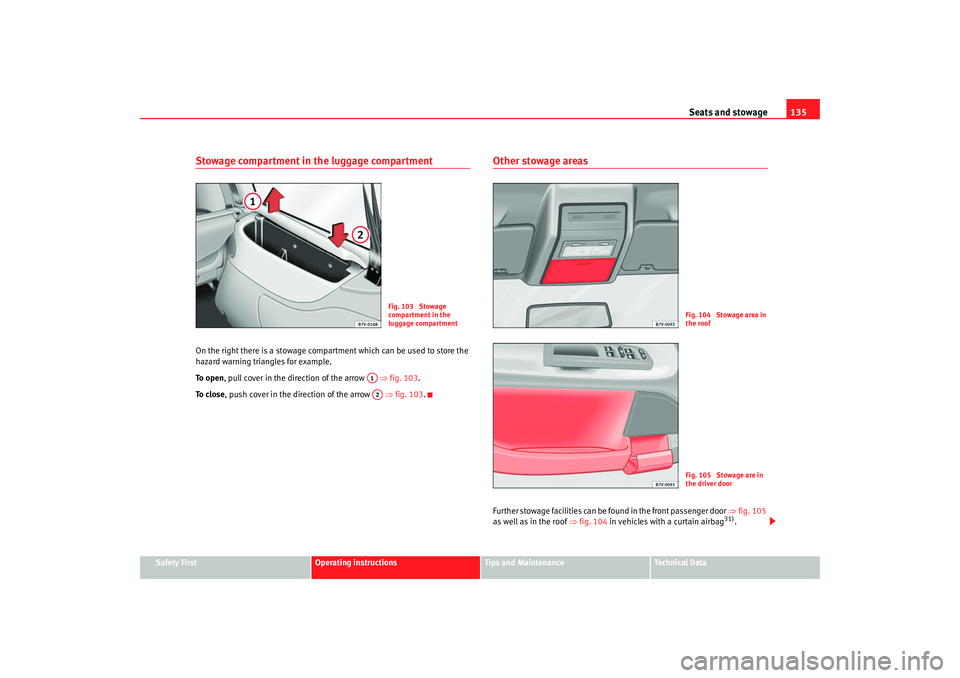
Stowage compartment in the luggage compartmentOn the right there is a stowage compartment which can be used to store the
hazard warning triangles for example.
To o p e n, pull cover in the direction of the arrow ⇒fig. 103 .
To c l o s e , push cover in the di rection of the arrow ⇒fig. 103 .
Other stowage areasFurther stowage facilities can be found in the front passenger door ⇒fig. 105
as well as in the roof ⇒fig. 104 in vehicles with a curtain airbag
31).
Fig. 103 Stowage
compartment in the
luggage compartment
A1A2
Fig. 104 Stowage area in
the roofFig. 105 Stowage are in
the driver door
alhambra ingles.book Seite 135 Donnerstag, 19. April 2007 4:04 16
Page 139 of 291

Seats and stowage137
Safety First
Operating instructions
Tips and Maintenance
Te c h n i c a l D a t a
•
Never place hot drinks in the drink holders. During normal or sudden
driving manoeuvres, sudden braking or an accident, the hot drink could be
spilled. Danger of scalding.
•
Ensure, when driving, that no can or other object is dropped in the
driver footwell, as it could get under the pedals and obstruct their working.
In the event of a sudden driving or braking manoeuvre, you will not be able
to operate the brake, clutch or accelerator pedal. Risk of accident!
•
Never leave closed drinks cans in direct sunlight for any length of time.
If the inside temperature is high they could explode.Caution
When driving, do not leave open cans in the cup holders. The drink might be
spilt on braking, for example, and could damage the vehicle.
Note
There is no left-hand cup holder on vehicles fitted with a hands-free tele-
phone system
32)
Folding table
Folding tables are fitted to the rear of the front seat backrests.Folding out the folding table
– Fold the table up in the direction of the arrow ⇒fig. 107 until it
engages.
Folding the table back
– Push the table down in the opposite direction of the arrow ⇒fig. 107 until it engages.
32)Optional equipmentWARNING (continued)
Fig. 107 Folding table on
right-hand front seat
alhambra ingles.book Seite 137 Donnerstag, 19. April 2007 4:04 16
Page 141 of 291

Seats and stowage139
Safety First
Operating instructions
Tips and Maintenance
Te c h n i c a l D a t a
The seats in the second row are fitted with a net bag ⇒
page 138, fig. 109 for
the stowage of small objects.
The bag will hold a newspaper, can or standard bottle of up to a maximum of
0.5 litres ⇒ .
WARNING
•
Ensure, when driving, that no can or other object is dropped in the
driver footwell, as it could get under the pedals and obstruct their working.
In the event of a sudden driving or braking manoeuvre, you will not be able
to operate the brake, clutch or accelerator pedal. Risk of accident!
Ashtrays, cigarette lighter and electrical
socketsFront ashtray
Opening and closing the ashtray
– To open move the ashtray cover ⇒fig. 110 forwards (arrow),
until it engages.
– To close, push the cover down as far as it will go.
Emptying the ashtray
– To remove the ashtray insert, pull it to the front until it engages.
– Take out the ashtray.No-smoking versions of the vehicle have a stowage compartment in place of
the ashtray.
WARNING
•
Never put paper in the ashtray. Hot ash could ignite the paper in the
ashtray.
Fig. 110 Front ashtray
alhambra ingles.book Seite 139 Donnerstag, 19. April 2007 4:04 16
Page 143 of 291

Seats and stowage141
Safety First
Operating instructions
Tips and Maintenance
Te c h n i c a l D a t a
•
Take care when using the cigarette lighter. Carelessness or negligence
when using the cigarette lighter can cause burns, risk of injury.
•
The cigarette lighter also works when the ignition is off and when the
ignition key is removed. To avoid the ri sk of fire, never leave children unsu-
pervised in the vehicle.
Sockets
Electrical equipment can be connected to any of the 12 volt
sockets.
Socket in the centre console
The 12 Volt socket in the stowage area or the 12 Volt socket of the cigarette
lighter
34) can be used for further electrical consumers with a power rating of
up to 120 Watt.
Socket, luggage compartment
34)
Electrical equipment can be connected to the 12-volt socket in the luggage
compartment ⇒fig. 113 The appliances connected to each socket must not
exceed a power rating of 120 Watt.
The socket is supplied with electricity from the additional battery on vehicles
equipped with an additional battery
34).
WARNING
The electrical sockets and any appliances connected to them are also func-
tional with the ignition switched off and the key removed. Improper use of
the sockets or electrical accessories can lead to serious injuries or cause a
fire. To avoid the risk of injury, never leave children unsupervised in the
vehicle.
Note
•
Using electrical appliances with the engine switched off will drain the
battery.
•
Before using any electrical accessories, see the instructions on
⇒ page 202.
WARNING (continued)
Fig. 113 Socket, luggage
compartment
34)Optional equipment
alhambra ingles.book Seite 141 Donnerstag, 19. April 2007 4:04 16
Page 145 of 291

Seats and stowage143
Safety First
Operating instructions
Tips and Maintenance
Te c h n i c a l D a t a
WARNING
Loose luggage and other objects in the luggage compartment can cause
serious injuries.•
Always stow objects in the luggage compartment and secure them on
the fastening rings.
•
Use suitable specialist straps to secure heavy objects.
•
During sudden manoeuvres or accidents, loose objects can be thrown
forward, injuring vehicle occupants or passers-by. This increased risk of
injury will be further increased if a loose object is struck by an inflating
airbag. If this happens, objects can be transformed into “missiles”. Risk of
fatal injury.
•
Remember that transporting heavy objects modifies the driving condi-
tions as the centre of gravity has been altered. There is a risk of accident.
Therefore, it is essential to adjust your speed and driving style accordingly,
to avoid accidents.
•
Never exceed the allowed axle loads or allowed maximum weight. If the
allowed axle load or the allowed total weight is exceeded, the driving char-
acteristics of the vehicle may change, leading to accidents, injuries and
damage to the vehicle.
•
Never leave the vehicle unattended, especially when the tailgate is
open. Children could climb into the luggage compartment closing the door
behind them; they will remain trapped without help and there is a mortal
risk.
•
Never allow children to play in or around the vehicle. Close and lock
both the tailgate and all the doors wh en you leave the vehicle. Before you
lock the vehicle, make sure that there are no adults or children in the
vehicle.
•
Never transport passengers in the luggage compartment. Every
passenger must be properly belted in.
Caution
•
Avoid overloading small areas by placing heavy objects on the vehicle
floor.
•
The wires of the heating element in the rear window and the window aerial
in the rear side windows could be damaged if objects on the luggage
compartment cover rub against them.
•
If you have removed the seats from the passenger compartment, you
should place a large, robust covering over the floor anchorings to prevent
damage.Note
•
Air circulation in the vehicle helps reduce fogging of the windows. Used
air escapes through ventilation slits in the side trim of the luggage compart-
ment. Ensure that the ventil ation slits are never covered.
•
Straps for securing the load to the fastening rings are commercially
available.
Fastening rings
There are fastening rings in the luggage compartment which
can be used to secure luggage and other objects.– Always use suitable undamaged belts for fastening the luggage
or any other object tot he anchorage rings ⇒ in “Loading the
luggage compartment” on page 142.The retainers for the detachable seat belts for the third row of seats and the
floor anchorings for the seats can be used as fastening rings for items of
luggage.
alhambra ingles.book Seite 143 Donnerstag, 19. April 2007 4:04 16