2007 Seat Alhambra seat adjustment
[x] Cancel search: seat adjustmentPage 31 of 291

Seat belts29
Safety First
Operating instructions
Tips and Maintenance
Te c h n i c a l D a t a
Belt retainer*
WARNING
•
When the belt for the outer seats in the centre row is removed insert the
webbing behind the guide of the side trim ⇒fig. 20, in order to lower the
backrest without damaging the webbing.
•
The seat belts must be removed fr om the holder before removing the
individual seats. This means that the belts will not be damaged.
Belt height adjustment
This device enables the positi on of the seat belts to be
adjusted for the height of the wearer at the shoulder area.The seat belt adjustment for the front seats and the outer seats in
the second row can be used to adjust the proper belt web position
at the shoulder.
– Press the upper part ⇒fig. 21 of the shoulder belt guide in the
direction of the arrow and hold it in this position.
– Move the retractor reel up or down to adjust the seat belt.
– Check that the retractor is secure by giving the belt a sharp tug.
Fig. 20 Belt retainer for
outer seats in centre row
Fig. 21 Location of the
belt height adjuster
alhambra ingles.book Seite 29 Donnerstag, 19. April 2007 4:04 16
Page 44 of 291

Airbag system
42Function of curtain airbags
Fully inflated airbags reduce the ri sk of head or chest injury in
a side collision.During some side collisions the curtain airbag is tri ggered on the impact side
of the vehicle ⇒fig. 27 .
In certain types of accident the front, side and curtain airbags may be trig-
gered together.
When the system is triggered, the airbag is filled with propellant gas. In the
process, the curtain bag covers the side windows and door pillars.
In order to provide the desired extra protection in an accident, the airbags
have to deploy extremely rapidly (withi n fractions of a second). A fine dust
may develop when the airbag deploys. This is normal and is no indication
that there was a fire in the vehicle.
The fully deployed airbags cushion the movement of the front occupants and
help to reduce the risk of injury to the upper body. The special design of the airbag allows the controlled escape of the propel-
lant gas when an occupant puts pressure on the bag. Thus, the head and
chest are surrounded and protected by the airbag.
Safety notes on the operation of the curtain airbag system
If you use airbags correctly, they can considerably reduce the
risk of injury in many kinds of accident.
WARNING
•
In order for the side airbags to provide their maximum protection, the
prescribed sitting position must alwa ys be maintained with seat belts
fastened while travelling.
•
For safety reasons, the head air bag must be disconnected in those
vehicles fitted with a passenger compartment separation screen. See an
Authorised Service Centre to make this adjustment.
•
There must be no other persons, animals or objects between the occu-
pants of the outer seats and the depl oyment space of the curtain airbags
so that the curtain airbag can deploy without restriction and provide the
greatest possible protection. Therefor e, sun blinds which have not been
expressly approved for use in your vehicle may not be attached to the side
windows.
•
The built-in coat hooks should be us ed only for lightweight clothing. Do
not leave any heavy or sharp-edged obje cts in the pockets. When using the
coat hooks, do not hang the clothes on coat hangers.
•
The airbags provide protection for one accident only, if they have been
deployed they must be replaced.
•
Any work on the curtain airbag system or removal and installation of
the airbag components for other repairs (such as removal of the roof lining)
should only be performed by a qualified workshop. Otherwise, a fault may
be introduced into the operation of the airbag system.
Fig. 27 Deployed curtain
airbags
alhambra ingles.book Seite 42 Donnerstag, 19. April 2007 4:04 16
Page 56 of 291

Child safety
54Fastening the harness belt for children in Group 1
A correctly adjusted seat belt helps to protect your child!
– Sit the child so that its bottom is as far back on the seat as
possible.
– Place the belt to the right and left over the childs' shoulders.
– Push the belt lock element ⇒fig. 37 with the tongue through
the other lock element .
– Insert both elements with the tongue at the front into the lock until they click into place. ( Pull to ensure they are securely
engaged! )
– Make sure that the protective cushion is always underneath the belt lock .
– Pull the upper part of the harness belt ⇒ fig. 38 down in the
direction of the arrow until the belt fits firmly against the body of
the child.
WARNING
The harness belt must always fit firmly against the body of the child (even
with thick or winter clothing) so that the child seat can provide the
maximum amount of protection possible.
Fig. 37 Section of inte-
grated child seat: Harness
belt lockFig. 38 Section of inte-
grated child seat: Harness
belt adjustment
AB
AC
AD
AE
AD
A1
alhambra ingles.book Seite 54 Donnerstag, 19. April 2007 4:04 16
Page 57 of 291
Child safety55
Safety First
Operating instructions
Tips and Maintenance
Te c h n i c a l D a t a
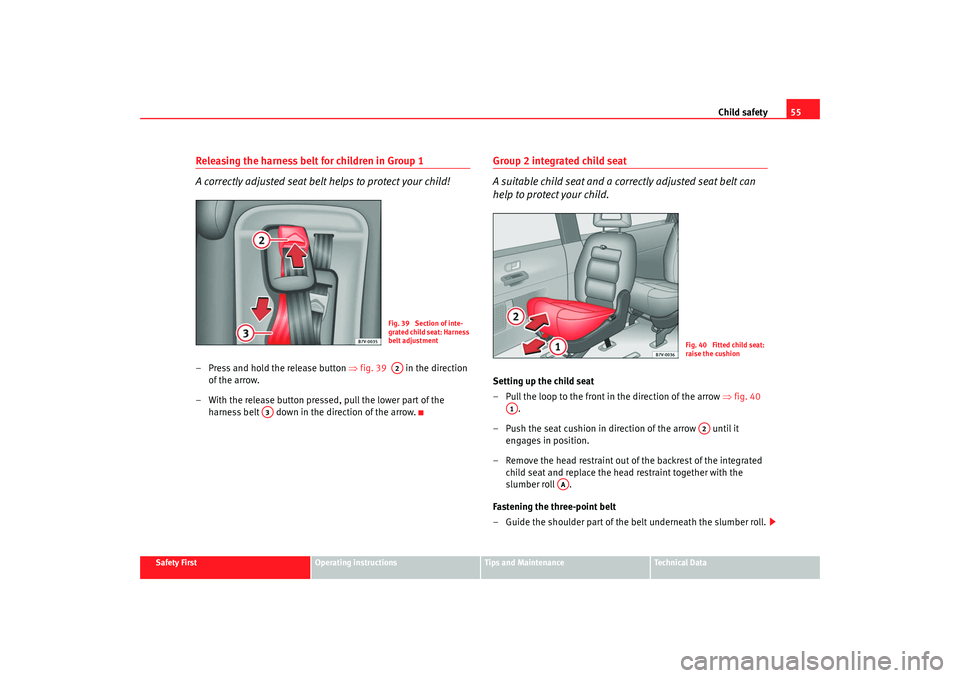
Releasing the harness belt for children in Group 1
A correctly adjusted seat belt helps to protect your child!– Press and hold the release button ⇒ fig. 39 in the direction
of the arrow.
– With the release button pressed, pull the lower part of the harness belt down in the direction of the arrow.
Group 2 integrated child seat
A suitable child seat and a corr ectly adjusted seat belt can
help to protect your child.Setting up the child seat
– Pull the loop to the front in the direction of the arrow ⇒fig. 40
.
– Push the seat cushion in direction of the arrow until it engages in position.
– Remove the head restraint out of the backrest of the integrated child seat and replace the head restraint together with the
slumber roll .
Fastening the three-point belt
– Guide the shoulder part of the belt underneath the slumber roll.
Fig. 39 Section of inte-
grated child seat: Harness
belt adjustmentA2
A3
Fig. 40 Fitted child seat:
raise the cushion
A1
A2
AA
alhambra ingles.book Seite 55 Donnerstag, 19. April 2007 4:04 16
Page 58 of 291

Child safety
56
– To fasten the three-point belt, take hold of the tongue and pull it slowly across the chest and lap.
– Push the tongue of the belt into the lock for that seat so that it engages audibly ( pull to check!).
– Adjust the three-point be lt to suit body size ⇒.
Restoring the normal seat
– Pull the loop in the direction of the arrow and push the seat
cushion down until it engages.
Removing the slumber roll
– Remove the head restraint.
– Pull the slumber roll off the head restraint.
– Reinsert the head restraint and push down until it can be heard to engage.Use the following measures to guarantee the proper routing of the shoulder
belt:•
Seatbelt height setting
•
Adjustment of the seat forwards and backwards
•
Backrest angle adjustment
WARNING
•
For safety reasons, the seat for children in Group 2 may only be fitted in
the direction of travel and in one of the outer positions (not on the centre
seat).
•
The risk of injury is increased if the belt is not correctly routed.
•
The shoulder part of the belt should be positioned roughly over the
centre of the shoulder, never across the neck, and fit closely against the
upper part of the body.
•
The lap belt part must lie across the pelvis, not across the stomach, and
always fit closely. Tighten the lap belt as necessary.
Group 3 integrated child seat
A suitable child seat and a corr ectly adjusted seat belt can
help to protect your child.Setting up the child seat
– Pull the loop to the front in the direction of the arrow ⇒fig. 41
.
A1
WARNING (continued)
Fig. 41 Using the inte-
grated child seat
A1
alhambra ingles.book Seite 56 Donnerstag, 19. April 2007 4:04 16
Page 59 of 291

Child safety57
Safety First
Operating instructions
Tips and Maintenance
Te c h n i c a l D a t a
– Push the seat cushion in direction of the arrow until it
engages in position.
Fastening the three-point belt
– To fasten the three-point belt, take hold of the tongue and pull it slowly across the chest and lap.
– Push the tongue of the belt into the lock for that seat so that it engages audibly ( pull to check!)
– Adjust the three-point belt to suit body size ⇒.
Restoring the normal seat
– Pull the loop in the direction of the arrow and push the seat
cushion down until it engages.Use the following measures to guarantee the proper routing of the shoulder
belt:•
Seatbelt height setting
•
Adjustment of the seat forwards and backwards
•
Backrest angle adjustment
WARNING
•
For safety reasons, the seat for children in Group 3 may only be fitted in
the direction of travel and in one of the outer positions (not on the centre
seat).
•
The risk of injury is increased if the belt is not correctly routed.
•
The shoulder part of the belt shou ld be positioned roughly over the
centre of the shoulder, never across the neck, and fit closely against the
upper part of the body.
•
The lap belt part must lie across th e pelvis, not across the stomach, and
always fit closely. Tighten the lap belt as necessary.
Cleaning the child seat– Open the zip ⇒fig. 42 fully and undo it at the end.
– Pull the cover from the Velcro fastening in area .
– Guide the belt lock and the harness belts through the cover and remove the child seat cover.The child seat cover can be washed in a washing machine at a maximum
temperature of 30°C.
A2
A1
WARNING (continued)
Fig. 42 Section of inte-
grated child seat
AA
AB
alhambra ingles.book Seite 57 Donnerstag, 19. April 2007 4:04 16
Page 63 of 291
Cockpit61
Safety First
Operating instructions
Tips and Maintenance
Te c h n i c a l D a t a
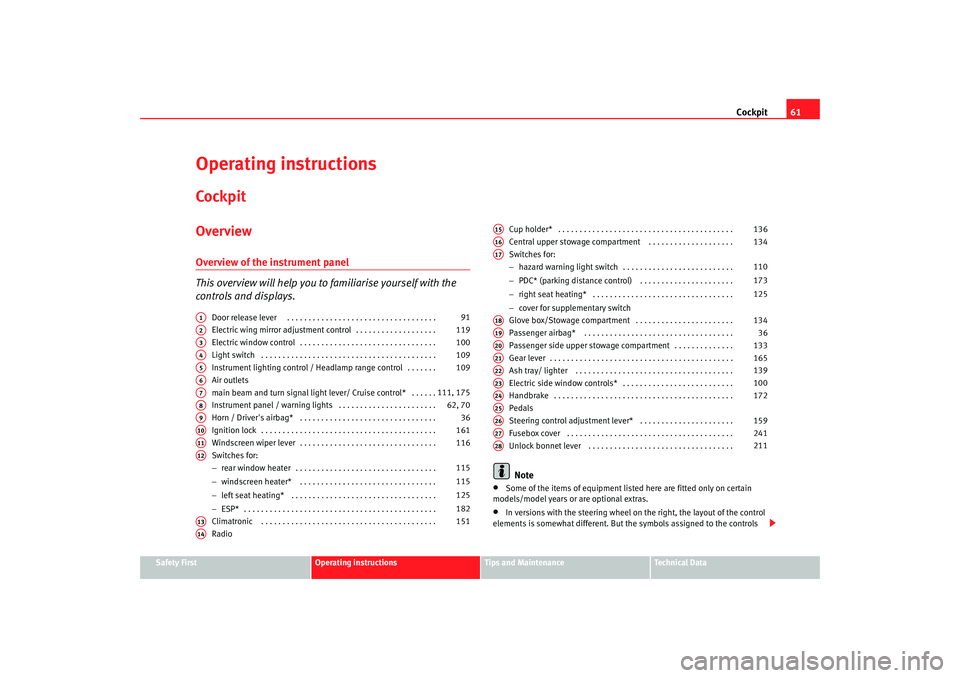
Operating instructionsCockpitOverviewOverview of the instrument panel
This overview will help you to familiarise yourself with the
controls and displays.
Door release lever . . . . . . . . . . . . . . . . . . . . . . . . . . . . . . . . . . .
Electric wing mirror adjustment control . . . . . . . . . . . . . . . . . . .
Electric window control . . . . . . . . . . . . . . . . . . . . . . . . . . . . . . . .
Light switch . . . . . . . . . . . . . . . . . . . . . . . . . . . . . . . . . . . . . . . . .
Instrument lighting control / Head lamp range control . . . . . . .
Air outlets
main beam and turn signal light lever/ Cruise control* . . . . . .
Instrument panel / warning lights . . . . . . . . . . . . . . . . . . . . . . .
Horn / Driver's airbag* . . . . . . . . . . . . . . . . . . . . . . . . . . . . . . . .
Ignition lock . . . . . . . . . . . . . . . . . . . . . . . . . . . . . . . . . . . . . . . . .
Windscreen wiper lever . . . . . . . . . . . . . . . . . . . . . . . . . . . . . . . .
Switches for:
− rear window heater . . . . . . . . . . . . . . . . . . . . . . . . . . . . . . . . .
− windscreen heater* . . . . . . . . . . . . . . . . . . . . . . . . . . . . . . . .
− left seat heating* . . . . . . . . . . . . . . . . . . . . . . . . . . . . . . . . . .
− ESP* . . . . . . . . . . . . . . . . . . . . . . . . . . . . . . . . . . . . . . . . . . . . .
Climatronic . . . . . . . . . . . . . . . . . . . . . . . . . . . . . . . . . . . . . . . . .
Radio Cup holder* . . . . . . . . . . . . . . . . . . . . . . . . . . . . . . . . . . . . . . . . .
Central upper stowage compartment . . . . . . . . . . . . . . . . . . . .
Switches for:
−
hazard warning light switch . . . . . . . . . . . . . . . . . . . . . . . . . .
− PDC* (parking distance control) . . . . . . . . . . . . . . . . . . . . . .
− right seat heating* . . . . . . . . . . . . . . . . . . . . . . . . . . . . . . . . .
− cover for supplementary switch
Glove box/Stowage compartment . . . . . . . . . . . . . . . . . . . . . . .
Passenger airbag* . . . . . . . . . . . . . . . . . . . . . . . . . . . . . . . . . . .
Passenger side upper stowage compartment . . . . . . . . . . . . . .
Gear lever . . . . . . . . . . . . . . . . . . . . . . . . . . . . . . . . . . . . . . . . . . .
Ash tray/ lighter . . . . . . . . . . . . . . . . . . . . . . . . . . . . . . . . . . . . .
Electric side window controls* . . . . . . . . . . . . . . . . . . . . . . . . . .
Handbrake . . . . . . . . . . . . . . . . . . . . . . . . . . . . . . . . . . . . . . . . . .
Pedals
Steering control adjustment lever* . . . . . . . . . . . . . . . . . . . . . .
Fusebox cover . . . . . . . . . . . . . . . . . . . . . . . . . . . . . . . . . . . . . . .
Unlock bonnet lever . . . . . . . . . . . . . . . . . . . . . . . . . . . . . . . . . .
Note
•
Some of the items of equipment listed here are fitted only on certain
models/model years or are optional extras.
•
In versions with the steering wheel on the right, the layout of the control
elements is somewhat different. But the symbols assigned to the controls
A1
91
A2
119
A3
100
A4
109
A5
109
A6A7
111, 175
A8
62, 70
A9
36
A10
161
A11
116
A12
115
115
125
182
A13
151
A14
A15
136
A16
134
A17
110
173
125
A18
134
A19
36
A20
133
A21
165
A22
139
A23
100
A24
172
A25A26
159
A27
241
A28
211
alhambra ingles.book Seite 61 Donnerstag, 19. April 2007 4:04 16
Page 123 of 291

Seats and stowage121
Safety First
Operating instructions
Tips and Maintenance
Te c h n i c a l D a t a
Seats and stowageThe importance of correct seat adjustmentProper seat adjustment optimi ses the level of protection
offered by seat belts and airbags.The driver seat, front passenger seat, and seats in the passenger compart-
ment, can be adjusted in many ways to suit the physical requirements of the
vehicle occupants. The correct seat position is very important for:•
fast and easy operation of all controls on the instrument panel,
•
relaxed posture that does not cause drowsiness,
•
safe driving,
•
optimum protection from the seat belts and airbag system ⇒page 7.
Vehicle seats
Your vehicle has a total of five or seven
24) seats.
•
First row of seats: two seats
•
Second row of seats: three seats
•
Third row of seats
24): two seats
Each seat is equipped with a three-point seat belt.
WARNING
If the driver and passengers assume improper sitting positions, they may
sustain critical injuries.•
Never transport more people than there are seats available in the
vehicle.
•
Every occupant in the vehicle must properly fasten and wear the seat
belt belonging to his or her seat. Chil dren must be protected with an appro-
priate child restraint system. Section “Child Safety”
•
The seats and all head restraints must always be adjusted to body size
and the seat belt must always be prop erly adjusted to provide you and your
passengers with optimum protection.
•
Always keep your feet in the footwell when the vehicle is moving; never
rest them on the dash panel, out of the window or on the seat. This also
applies to passengers. An incorrect sitting position exposes you to an
increased risk of injury in the event of a braking manoeuvre or an accident.
If the airbag is triggered, you could sustain fatal injuries due to an improper
sitting position.
•
It is important for the driver and front passenger to maintain a distance
of at least 25 cm from the steering wheel or dash panel. Failure to respect
the minimum distance means that the airbag will not protect you. Risk of
fatal injury. The distance between the driver and the steering wheel or
between the front passenger and the dash panel should always be as great
as possible.
•
Adjust the driver or front passenger seat only when the vehicle is
stationary. Otherwise your seat coul d move unexpectedly while the vehicle
is moving. This could increase the risk of an accident and therefore injury.
In addition, while adjusting your seat, you will assume an incorrect sitting
position. Risk of fatal accidents.
•
Special guidelines apply to installing a child seat on the front
passenger seat. When installing a child seat, observe the warning note in
“Child safety”.
•
The seats in the third row of seats may, for safety reasons, only be used
if the luggage compartment cover has been removed.
24)Optional equipment
WARNING (continued)
alhambra ingles.book Seite 121 Donnerstag, 19. April 2007 4:04 16