2007 Seat Alhambra airbag off
[x] Cancel search: airbag offPage 45 of 291

Airbag system43
Safety First
Operating instructions
Tips and Maintenance
Te c h n i c a l D a t a
•
Do not attempt to modify components of the airbag system in any way.
•
The side and head airbags are managed through sensors located in the
interior of the front doors. To ensure the correct functioning of the side and
head airbags neither the doors nor the door panels should be modified in
any way (e.g. fitting loudspeakers). If the front door is damaged in any way,
this may affect the correct working of the system. All work carried out on
the front door must be made in a qualified workshop.
Deactivating airbags*Disabling front passenger front and side airbags
The passenger airbags must be disconnected when a rear
facing child seat is fitted in the front passenger seat.
The key switch can be used to disconnect the front and side airbag
for the passenger seat. All the other airbags in the vehicle remain
functional.
Disabling front and side airbags for front passenger
– Switch off ignition.
– Open centre compartment on instrument panel.
– Using the ignition key, turn the switch to OFF ⇒ fig. 28 .
– Check if, when the ignition is switched on, that the warning lamp “PASS AIRBAG OFF” on the instrument panel ⇒fig. 29 remains lit
⇒ .
– Close centre compartment on instrument panel:
Enabling front and side airbags for front passenger
– Switch off ignition.
WARNING (continued)
Fig. 28 Interior of centre
compartment on instru-
ment panel: Key switch for
switching off the front
passenger airbags
Fig. 29 Warning lamp for
disabling airbag in dash
panel
alhambra ingles.book Seite 43 Donnerstag, 19. April 2007 4:04 16
Page 46 of 291

Airbag system
44
– Open centre compartment on instrument panel.
– Using the ignition key, turn the switch to ON ⇒page 43, fig. 28 .
– Check if, when the ignition is switched on, that the warning lamp “PASS AIRBAG OFF” on the instrument panel ⇒page 43, fig. 29
does not light up ⇒.
– Close centre compartment on instrument panel:
WARNING
•
The driver is responsible for the proper position of the key-operated
switch.
•
You should only disable the front and side passenger airbags if, in
exceptional cases, you have to use a rear-facing child seat on the front
passenger seat ⇒ page 45.
•
Never fit a child seat in the passenger seat, where the child faces back-
wards to the direction of travel and th e frontal airbag has not been deacti-
vated. This is highly dangerous for the child. However, if it is necessary in
exceptional circumstances to transport a child in a rear-facing child seat on
the front passenger seat, you must always disable the front passenger
airbag.
•
As soon as the child seat will no longer be used on the front passenger
seat, enable the front and side passenger airbag again.
•
Only deactivate the front and side passenger airbag when the ignition
is off, otherwise a fault may occur in the airbag system, this will create the
risk of the front, curtain or side airbag not deploying properly or not at all
in the event of an accident.
•
If, while the front and side passenger airbag are turned off, the indi-
cator PASS. AIRBAG OFF does not remain lit, this could indicate a fault in
the airbag system: −
Have the airbag system inspected immediately by a qualified work-
shop.
− Do not use a child seat on the front passenger seat! The front and
side passenger airbag may deploy during an accident in spite of the
fault.
− It is impossible to determine whethe r the front or side airbags will be
triggered in case of accident. Inform your passengers of this.
WARNING (continued)
alhambra ingles.book Seite 44 Donnerstag, 19. April 2007 4:04 16
Page 48 of 291

Child safety
46tional circumstances, to transport a child on the front passenger seat,
always disable the front passenger airbag ⇒page 43.•
All passengers, especially children, must assume the proper sitting
position and be properly belted in while travelling.
•
Never hold children or babies on your lap, this can result in potentially
fatal injuries to the child!
•
Never allow a child to be transported in a vehicle without being properly
secured, or to stand up or kneel on a seat while travelling. In an accident,
the child could be flung through the vehicle, causing possibly fatal injuries
to themselves and other occupants.
•
If children assume an improper sitting position when the car is moving,
they expose themselves to greater risk of injury during a sudden braking
manoeuvre or in an accident. This is particularly the case if the child is trav-
elling on the front passenger seat and the airbag system is triggered in an
accident; this could have consequences including serious injury or death.
•
A suitable child seat can protect your child!
•
Make sure that no hard or sharp objects, for example toys, are on the
child seats. Risk of injury.
•
Never leave a child unsupervised in a child seat or alone in the vehicle.
•
Depending on the time of year, the interior of a parked vehicle can reach
extreme temperatures which may enganger the life of people and animals.
•
Children who are less than 1.5 metres tall must not wear a normal seat
belt without a child restraint system, as this could cause injuries to the
abdominal and neck areas during a sudden braking manoeuvre or in an
accident.
•
Do not allow the belt webbing to become twisted or jammed, or to rub
on any sharp edges.
•
Incorrectly worn seat belts can cause injuries even in a minor collision
or sudden braking manoeuvres.
•
The seat belt cannot offer its full prot ection if the belt web is not posi-
tioned correctly.
•
Only one child may occupy a child seat.
WARNING (continued)
WARNING (continued)
alhambra ingles.book Seite 46 Donnerstag, 19. April 2007 4:04 16
Page 51 of 291

Child safety49
Safety First
Operating instructions
Tips and Maintenance
Te c h n i c a l D a t a
WARNING
•
The shoulder part of the seat belt mu st lie approximately on the centre
of the shoulder, never across the neck or the arm. The seat belt must lie
close to the torso. The lap belt part must lie across the pelvis, not across
the stomach, and always fit closely. Pull the belt tight if necessary to take
up any slack ⇒page 22, “Seat belts”.
•
Read and always observe information and warnings concerning the use
of child seats ⇒page 45.
Installation of child seats in vehicle seatsGeneral notesThe correct fitting of child seats in the different seats is described below.
Child restraint systems that have been checked according to ECE-R 44 are
suitable for installation on the front passenger seat or on the rear seats.
Note
The passenger seat and the rear seats comply with directive 77/541 EEC for
the installation of child restraint systems.
Front passenger seat
Only the use of an officially approved child seat corre-
sponding to the weight and height of the child is permitted.Universal seats for children in groups 0, 0+, 1, 2, or 3 (⇒ page 52) ⇒ can
be fitted in the passenger seat.
To fit a child seat, position the seat in the upright position and move the
passenger seat as far back as possible. The seat must be in the highest posi-
tion
3) on vehicles with a height-adjustable ⇒ front passenger seat.WARNING
•
Never fit a child seat in the passenger seat, where the child faces back-
wards to the direction of travel and the frontal airbag has not been deacti-
vated. This is highly dangerous for the child. If it is necessary in excep-
tional cases to transport a child on the front passenger seat, you must
always disable the front and side passenger airbags ⇒page 43.
•
Children must travel in a child seat appropriate to their weight and
height.
•
The vehicle seat must always be fitt ed in the direction of travel when
securing child restraint systems in weight class 0 or 0+.
•
Read and always observe information and warnings concerning the use
of child seats ⇒ in “Safety notes on using child seats” on page 45.
•
Please always read and follow the information and warnings provided
by the child seat manufacturer.
3)Optional equipment
alhambra ingles.book Seite 49 Donnerstag, 19. April 2007 4:04 16
Page 70 of 291

Cockpit
68Information symbols (priority 2) STOP OIL PRESSURE ENGINE OFF SERVICE MANUAL
Stop the car, turn the engine off and check the brake fluid level
⇒page 214.
ALTERNATOR WORKSHOP!
Take the vehicle to a qualified workshop as soon as possible and have the
alternator checked.
FASTEN SEATBELT
Fasten your seat belt correctly; and make sure your passengers are also
properly belted in ⇒page 17.
Fault message Symbol Action
CHECK OIL LEVEL
Check the oil level and top up with the right engine oil ⇒page 214.
OIL SENSOR WORKSHOP
Take the vehicle to an Authorised Service Centre as soon as possible and
have the engine checked.
STOP BRAKE FAULT SERVICE MANUAL
Take the vehicle to a qualified workshop as soon as possible and have the
ABS checked.
PLEASE REFUEL!
Refuel as soon as possible.
TOP UP WASHER FLUID
Fill up with water and washer fluid.
CHECK BRAKE PADS
Take the vehicle to a qualified workshop immediately and have the brake
pads checked.
EXHAUST WORKSHOP
Take the vehicle to an Authorised Service Centre as soon as possible and
have the engine checked.
ENGINE FAULT CONSULT WORKSHOP
or
Take the vehicle to an Authorised Service Centre as soon as possible and
have the engine checked.
AIRBAG FAULT
Take the vehicle to a qualified workshop immediately and have the airbag
system checked.
Fault message
Symbol Action
alhambra ingles.book Seite 68 Donnerstag, 19. April 2007 4:04 16
Page 90 of 291

Unlocking and locking
88•
the key with remote control
9) ⇒ page 93,
•
with the central locking button ⇒page 90.
Individual opening of doors
9)
An Authorised SEAT Service Centre ca n programme the individual opening of
doors.
When the key is turned once in the driver's door lock, in the direction of
opening, or when button ⇒page 93, fig. 61 on the remote control key is
pressed, only the driver 's door will unlock.
When the key is turned a second time or the button is pressed a second
time, all the doors and the tailgate are unlocked.
WARNING
•
Do not leave anyone in the car if it has been locked from the outside. It
is not possible to open the doors from the inside. Locked doors could delay
assistance in an emergency. People could become trapped inside in an
emergency.
•
Never close the doors without observing and ensuring it is clear, to do
otherwise could cause serious injury to you and others. Make sure that no
one is in the path of the door.Note
The entire vehicle is unlocked if the airbags are triggered during an accident.
The vehicle cannot be locked from the inside unless the ignition is first
switched off and back on. Following an accident, the vehicle cannot be locked
from the outside. Contact an Authorised Service Centre.
Opening and closing the doors with the keyOpening the doors
– Insert the key in the lock on the driver door.
– Turn the key to the open position. The doors and the tailgate are unlocked.
Closing the doors
– Insert the key in the lock on the driver door.
– First turn the key once to the locking position ⇒. The doors
and the tailgate are locked.Notes on unlocking
The following applies if you wish to unlock your vehicle manually using the
key:•
The deadlock mechanism, the interior monitoring system
10) and the anti-
theft alarm
10) will be deactivated immediately. The deactivation is confirmed
by the turn signals flashing briefly twice.
•
The interior lights in the courtesy position will be switched on for approx-
imately 20 seconds when the vehicle is unlocked.
•
If the key is held in the unlocking position, all windows (apart from the
electric vent wing at the rear) will be opened on vehicles equipped with elec-
tric windows.
Notes on locking
The following applies if you wish to lock your vehicle manually using the key:
9)Optional equipment
A1
10)Optional equipment
alhambra ingles.book Seite 88 Donnerstag, 19. April 2007 4:04 16
Page 123 of 291

Seats and stowage121
Safety First
Operating instructions
Tips and Maintenance
Te c h n i c a l D a t a
Seats and stowageThe importance of correct seat adjustmentProper seat adjustment optimi ses the level of protection
offered by seat belts and airbags.The driver seat, front passenger seat, and seats in the passenger compart-
ment, can be adjusted in many ways to suit the physical requirements of the
vehicle occupants. The correct seat position is very important for:•
fast and easy operation of all controls on the instrument panel,
•
relaxed posture that does not cause drowsiness,
•
safe driving,
•
optimum protection from the seat belts and airbag system ⇒page 7.
Vehicle seats
Your vehicle has a total of five or seven
24) seats.
•
First row of seats: two seats
•
Second row of seats: three seats
•
Third row of seats
24): two seats
Each seat is equipped with a three-point seat belt.
WARNING
If the driver and passengers assume improper sitting positions, they may
sustain critical injuries.•
Never transport more people than there are seats available in the
vehicle.
•
Every occupant in the vehicle must properly fasten and wear the seat
belt belonging to his or her seat. Chil dren must be protected with an appro-
priate child restraint system. Section “Child Safety”
•
The seats and all head restraints must always be adjusted to body size
and the seat belt must always be prop erly adjusted to provide you and your
passengers with optimum protection.
•
Always keep your feet in the footwell when the vehicle is moving; never
rest them on the dash panel, out of the window or on the seat. This also
applies to passengers. An incorrect sitting position exposes you to an
increased risk of injury in the event of a braking manoeuvre or an accident.
If the airbag is triggered, you could sustain fatal injuries due to an improper
sitting position.
•
It is important for the driver and front passenger to maintain a distance
of at least 25 cm from the steering wheel or dash panel. Failure to respect
the minimum distance means that the airbag will not protect you. Risk of
fatal injury. The distance between the driver and the steering wheel or
between the front passenger and the dash panel should always be as great
as possible.
•
Adjust the driver or front passenger seat only when the vehicle is
stationary. Otherwise your seat coul d move unexpectedly while the vehicle
is moving. This could increase the risk of an accident and therefore injury.
In addition, while adjusting your seat, you will assume an incorrect sitting
position. Risk of fatal accidents.
•
Special guidelines apply to installing a child seat on the front
passenger seat. When installing a child seat, observe the warning note in
“Child safety”.
•
The seats in the third row of seats may, for safety reasons, only be used
if the luggage compartment cover has been removed.
24)Optional equipment
WARNING (continued)
alhambra ingles.book Seite 121 Donnerstag, 19. April 2007 4:04 16
Page 137 of 291
Seats and stowage135
Safety First
Operating instructions
Tips and Maintenance
Te c h n i c a l D a t a
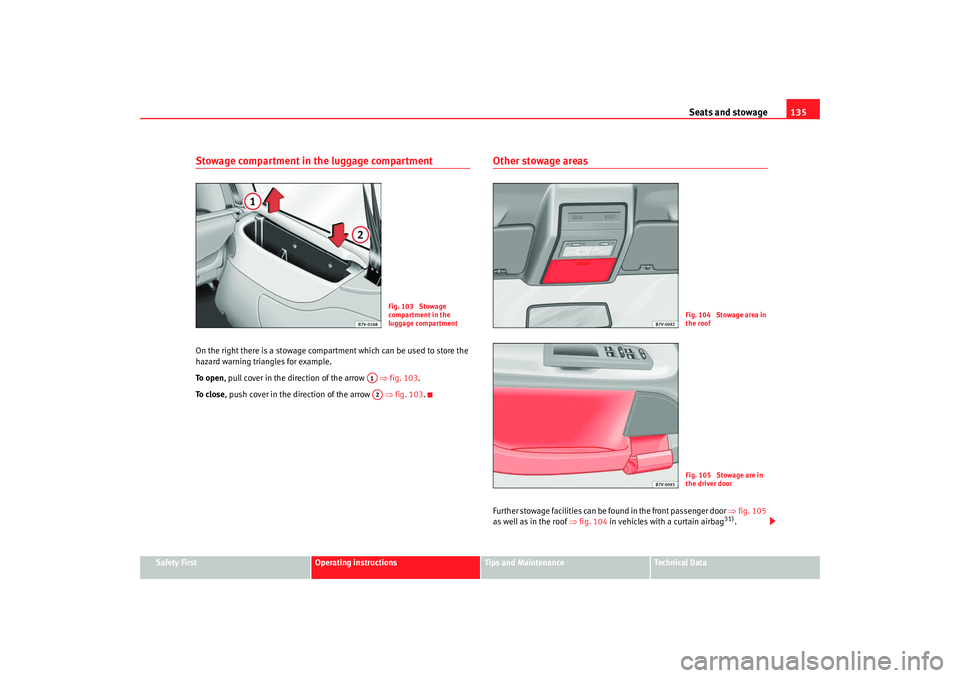
Stowage compartment in the luggage compartmentOn the right there is a stowage compartment which can be used to store the
hazard warning triangles for example.
To o p e n, pull cover in the direction of the arrow ⇒fig. 103 .
To c l o s e , push cover in the di rection of the arrow ⇒fig. 103 .
Other stowage areasFurther stowage facilities can be found in the front passenger door ⇒fig. 105
as well as in the roof ⇒fig. 104 in vehicles with a curtain airbag
31).
Fig. 103 Stowage
compartment in the
luggage compartment
A1A2
Fig. 104 Stowage area in
the roofFig. 105 Stowage are in
the driver door
alhambra ingles.book Seite 135 Donnerstag, 19. April 2007 4:04 16